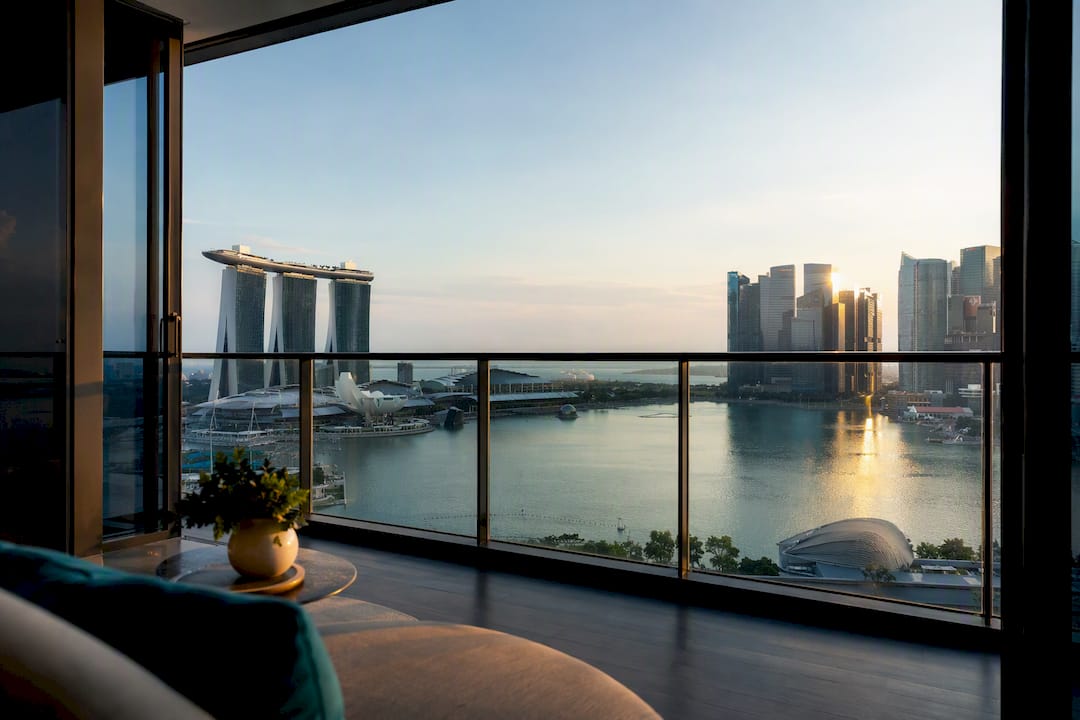
The actual premium amount varies significantly depending on floor, stack, and how much the developer already baked the view into launch pricing at a project like One Marina Gardens.
TL;DR:
- The typical bay view premium in District 01 ranges from 10% to 20%, with an average added value of around S$232,687, or about 15% of the property's price.
- Premiums are heavily influenced by floor level, view unobstructedness, scarcity of front-facing stacks, and potential future land development that could block views.
- Buyers should carefully compare recent transacted prices, confirm sightlines in person, and consider rental yield impacts before paying a premium for a bay view unit.
- The premium for bay views tends to be more durable than for park or skyline views, which are more easily obstructed or duplicated in other developments.
- In high-demand districts like District 01, the bay view premium has increased over time due to scarcity and rising land costs, but can compress during market downturns.
Table of Contents
- How Big Is the Bay View Premium in District 01?
- What Drives the Size of a Bay View Premium?
- How Do You Estimate the Bay View Premium for a Specific Unit?
- Does the Bay View Premium Pay Off for Investors?
- One Marina Gardens: A District 01 Case Study in Bay View Value
- How Does the Bay View Premium Compare to Park or Skyline Views?
- Have Bay View Premiums Changed Over Time?
- Who Actually Pays for Bay View Premiums?
- Velisa's Buying Checklist for a Bay View Premium
- Where to View Bay-Facing Units at One Marina Gardens
- Sources
- FAQ
How Big Is the Bay View Premium in District 01?
The clearest data point comes from a hedonic regression study of a Singapore residential sample, which found a totally unobstructed seaview added about S$232,687 to property value, close to 15% of the sample's average price. That figure has become the reference point most valuers and agents cite when they talk about view premiums in prime districts.
District 01 pricing gives that percentage real weight. The district's average PSF sat near S$2,650 in April 2026, with One Marina Gardens transactions reported in the same market digest. Separate project-level summaries put One Marina Gardens' median PSF near S$2,974, reflecting a mix of stacks, some with direct bay frontage and some without.
| Metric | Figure |
|---|---|
| District 01 average PSF (April 2026) | S$2,650 psf |
| One Marina Gardens median PSF | ~S$2,974 psf |
| Hedonic unobstructed seaview premium | approximately 15%, based on a study sample value around S$232,687 [15% premium study] |
| Typical market-quoted range for bay/sea view | Generally between 10% and 20%, varying by project and floor. |
It's a sample average from one study area. Use it as a sanity check against project-specific comparables, not as your final calculation.*
What Drives the Size of a Bay View Premium?
The percentage moves based on a handful of concrete variables, and most buyers only think about one or two of them.
- Floor and stack: Developers often price bay-facing stacks higher from day one, which means some of the premium is locked in at launch rather than something a resale buyer captures fresh.
- View quality gradation: A full, unobstructed bay sweep commands more than a partial or angled view sliced by another tower, and obstructed "peekaboo" views barely move the needle at all.
- Noise and privacy trade-offs: Higher floors often catch more wind noise and traffic hum from the expressway below, while a lower "buffer" floor with a clean sightline can actually deliver better livability. This is one reason lower-floor units sometimes outperform noisier high-floor stacks in resale demand.
- Scarcity of bay-facing stacks: Only a portion of any District 01 project actually faces Marina Bay directly. Limited supply within a project pushes those specific units' premiums higher than the project average.
- Planning and zoning risk: Agent reporting and market analysis consistently flag view, floor, and orientation as major value drivers, but future development on adjacent land parcels can erode a view premium that looked secure at purchase.
The honest picture is that premiums are project-specific and stack-specific, not a district-wide formula.
How Do You Estimate the Bay View Premium for a Specific Unit?
You can turn this from a vague percentage into a real dollar figure using a five-step process.
- Pick baseline comparables. Find recent transactions in the same project, or a nearby comparable project, for units without a bay view but otherwise similar in floor level and size.
- Choose a view-adjustment percentage. Use 8% to 12% for a partial or angled bay view, 10% to 20% for a clear unobstructed view, and reserve anything higher for exceptional, scarce stacks.
- Convert the percentage to Singapore dollars. Apply the PSF difference to the unit's actual square footage, then layer on any separate floor or stack premium the agent or developer price list quotes.
- Test the impact on rental yield. A higher purchase price on the same rental income compresses yield, so run the numbers both ways before assuming the premium pays for itself.
- Run a sanity check. Ask the sales team for level-specific comparables within the same stack, and cross-reference recent transacted prices through URA caveats rather than relying only on asking prices.
A few practical notes make this process more reliable:
- URA caveats remain the most authoritative record of what units actually transacted for, not what they were listed at.
- Per-floor premiums are notoriously inconsistent across projects, so a rule that works at one development may not transfer to another.
- Always confirm the exact sightline in person. Floor plans and brochures can make a partial view look more generous than it is on site.
Does the Bay View Premium Pay Off for Investors?
Run the math on a straightforward example. If the non-view comparable rents for S$5,500 a month and the bay-view unit only commands S$5,800, the yield on the premium-priced unit actually comes out lower, even though the headline rent is higher.
Where the premium tends to hold up: District 01 has a persistent shortage of genuinely unobstructed bay-facing rentals, and corporate tenants and relocating executives often pay for the prestige and the view without haggling hard. Local market commentary also frames District 01 as income-resilient, though capital appreciation tends to be steadier and less dramatic than in mass-market districts chasing speculative upside.
Where it falls flat: if the developer already front-loaded the view into launch pricing, there's limited room left for that premium to grow. A saturated rental pipeline in the surrounding precinct can also cap what tenants will actually pay over a non-view unit.
- Favor mid-floor units with a confirmed clear sightline over top-floor stacks with noise trade-offs.
- Negotiate a price buffer rather than paying the full quoted view premium at launch.
- Check for planning applications on adjacent plots that could compromise the view within your holding period.
One Marina Gardens: A District 01 Case Study in Bay View Value
One Marina Gardens is a 937-unit development in District 01 offering 1 to 4-bedroom layouts, positioned 160 meters from Marina South MRT with direct access into the CBD and Orchard Road corridor. The project's amenity mix, including multiple sky terraces and a 50-meter lap pool, extends the appeal of a bay-facing unit beyond the view itself into daily lifestyle use.
A childcare center on site can be a practical draw for owner-occupier families. That combination of connectivity and lifestyle infrastructure is part of why amenity-rich projects near MRT stations tend to hold rental interest even when the broader market softens.
- Project-level PSF has been reported near S$2,974 in recent district digests, against a District 01 average closer to S$2,650.
- Not every stack faces the bay directly. Buyers should confirm the specific unit's sightline rather than assume all units carry the same premium.
- Floor level still matters within the project. A mid-floor unit with a clean sightline can outperform a higher floor with a partial or angled view.
How Does the Bay View Premium Compare to Park or Skyline Views?
Bay views generally command the strongest premium of any view category in Singapore because Marina Bay is a fixed, protected body of water. It can't be built over the way a park boundary sometimes can, and the skyline backdrop adds a second layer of visual value on top of the water itself.
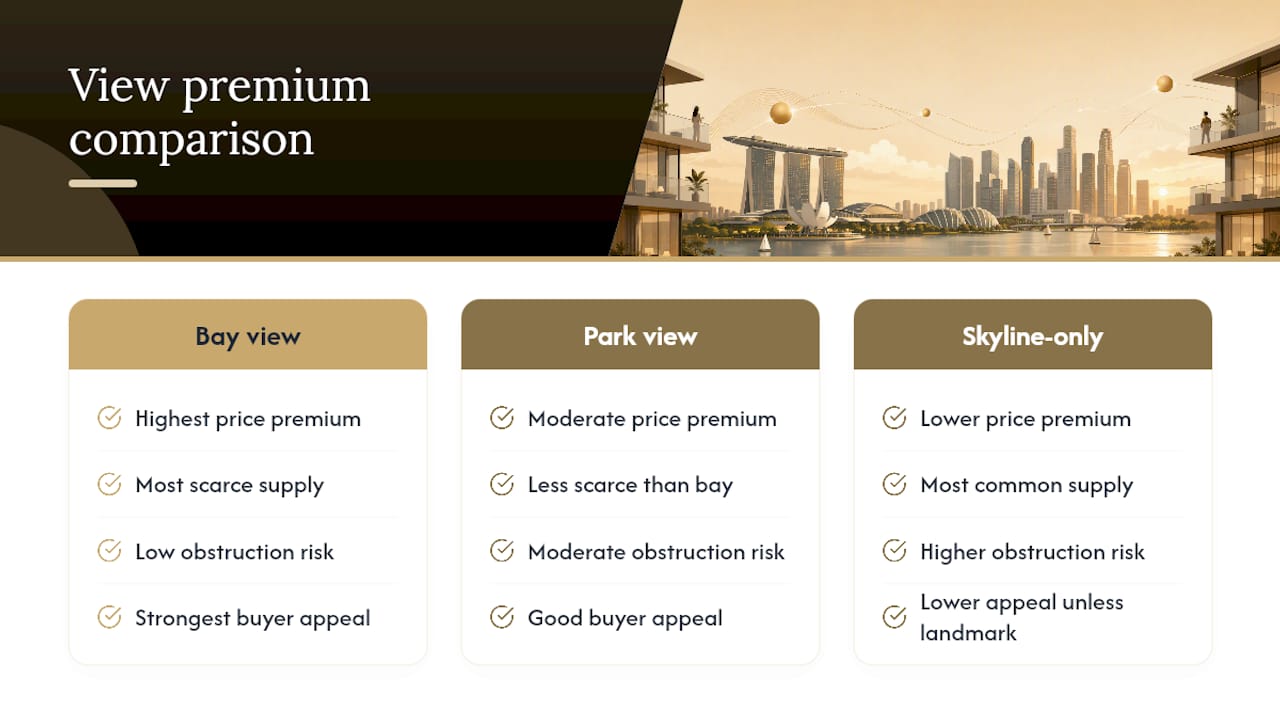
Park views typically trail behind waterfront views in percentage terms, mostly because more Singapore developments border a park than border Marina Bay, so the supply of park-facing stacks is less scarce. A pure city skyline view, without water in the frame, tends to sit even lower on the premium scale unless the skyline includes a recognizable landmark cluster.
The exception worth noting is when a unit captures both a bay view and a skyline view in the same sightline, which is common in several District 01 towers. That combination view often exceeds what either element would command alone, because it reads as more dramatic and more photogenic to prospective tenants and buyers alike. Developers price these dual-aspect stacks accordingly, and resale buyers should expect to pay close to launch-day premiums for them rather than finding a bargain.
The practical takeaway for comparison shopping: if you're weighing a bay-facing unit against a park-facing or skyline-only alternative in a similar price bracket, the bay unit is the one more likely to hold its premium through a market downturn, simply because there are fewer of them and the outlook can't be blocked by future construction the way a park or city view sometimes can.
Have Bay View Premiums Changed Over Time?
Marina Bay's transformation from a working harbor into Singapore's financial and lifestyle core has steadily pushed view premiums upward over the past two decades, as District 01 shifted from a primarily commercial precinct into a mixed residential and business address. Each wave of new launches in the area has tended to price bay-facing stacks more aggressively than the wave before it, reflecting both scarcity and rising baseline land costs.
Market cycles still matter. During downturns, view premiums tend to compress faster than base unit prices, since buyers under financial pressure are quicker to cut a discretionary lifestyle add-on than to abandon a purchase entirely. During upswings, the premium often expands again as buyer competition intensifies for the limited number of genuinely unobstructed stacks.
What has stayed consistent is the underlying scarcity argument. District 01's waterfront frontage is finite, and no amount of demand can create more of it. That structural constraint is a big part of why the hedonic-study benchmark of roughly 15% still holds up as a reasonable long-run reference point, even as absolute PSF figures across District 01 have moved considerably since that research was conducted. Buyers evaluating a current listing should treat the percentage as more durable than the dollar figure, since the dollar amount scales with whatever the district's baseline PSF happens to be at the time.
Who Actually Pays for Bay View Premiums?
Owner-occupiers with a long holding horizon tend to value the view for its own sake, and they're often the buyers willing to stretch furthest on price for a specific stack. Executives and professionals relocating for work in the CBD frequently fall into this group, since proximity to the financial district and a premium address both matter to their lifestyle and, in some cases, to entertaining clients.
Investors split into two distinct camps. One group treats the view as a rental differentiator, betting that corporate tenants and expatriate renters will pay more for a bay-facing unit near Marina South MRT. The other group is more skeptical, viewing the premium primarily as a resale story rather than a yield driver, and they tend to favor mid-floor units where the premium is smaller but the entry price is more forgiving.
There's also a behavioral pattern worth knowing about: once someone owns a bay-facing unit, they tend to value it more highly than the market does, a tendency behavioral economists call the endowment effect. It's worth keeping in mind if you're the seller trying to price realistically, or the buyer trying to negotiate against an owner who's emotionally attached to their view.
Families with young children represent a smaller but distinct segment in District 01 specifically, drawn less by the view alone and more by projects that pair bay frontage with practical amenities like on-site childcare, since that combination is unusual in a purely commercial precinct.
Velisa's Buying Checklist for a Bay View Premium
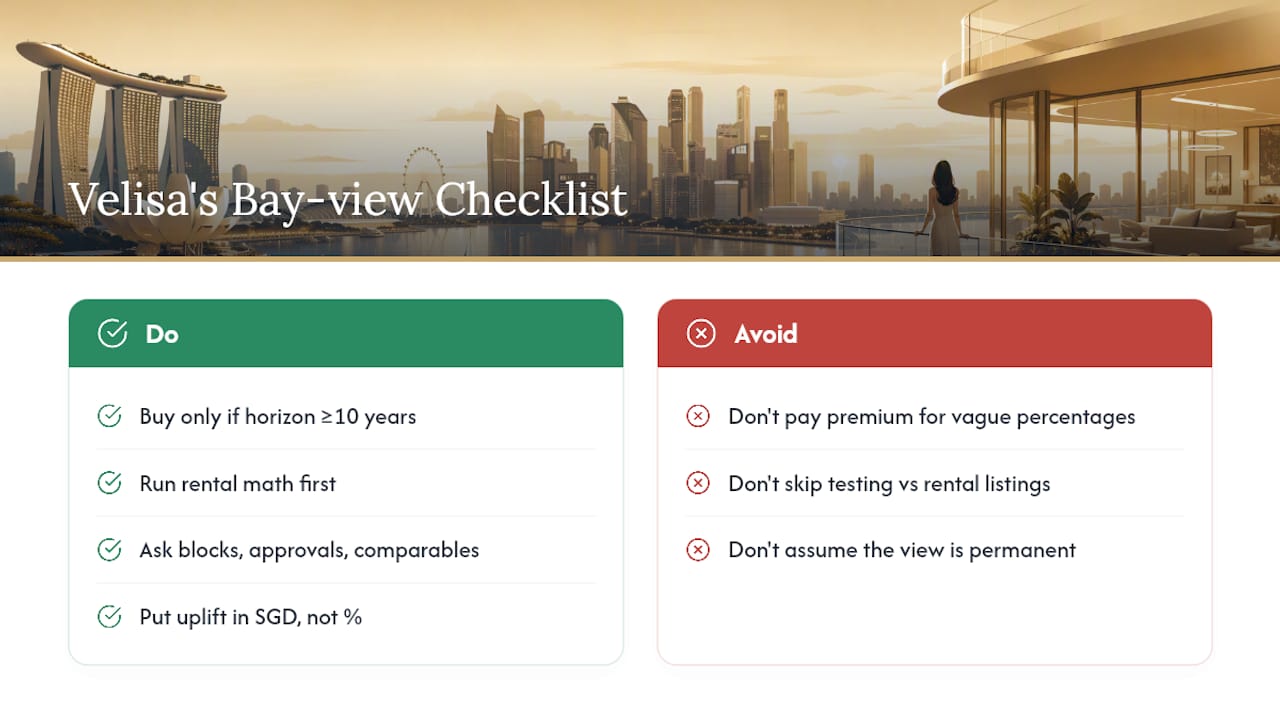
If you're buying to live in the unit for a decade or more, a view premium is easier to justify than if you're chasing yield on a five-year horizon. Investors should run the rental math before falling for the sightline.
At any showing, ask three things: what exactly blocks the view from this specific floor, what's approved or proposed on any land directly in the sightline, and what comparable non-view units in the same stack have transacted for recently. Then put a real number on the uplift in Singapore dollars, not a vague percentage, and test it against actual rental listings before you commit.
— Velisa
Where to View Bay-Facing Units at One Marina Gardens
Reading about premiums only gets you so far. The real test happens standing in the unit, looking at the actual sightline instead of a brochure render.
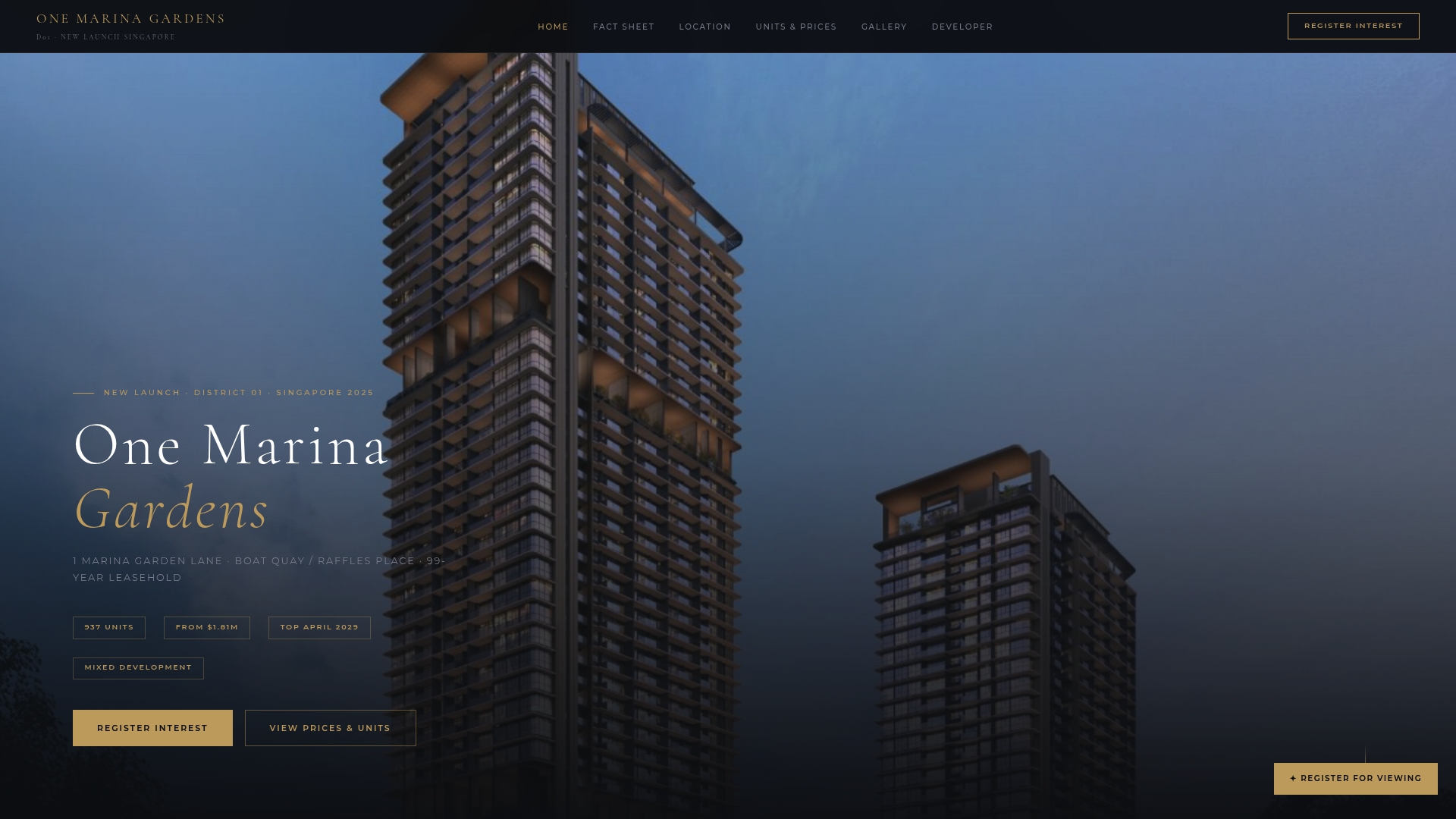
One Marina Gardens gives prospective buyers a straightforward way to see this firsthand. Its gallery of artist impressions and development photos shows the range of bay-facing layouts across the 937-unit development, from 1-bedroom homes to larger 4-bedroom units. At a showflat viewing, ask specifically about the sample PSF for the stack you're considering, confirm which floor levels get the cleanest unobstructed sightline, and compare that against nearby non-view stacks so you can see the premium in real numbers rather than marketing language. Full pricing details and the current unit price list are available for anyone ready to move from research to a booked viewing. Visit the main One Marina Gardens site to check current availability and arrange a showflat appointment.
Sources
Figures here draw on a peer-reviewed hedonic valuation study, District 01 market digests tracking PSF trends, CheckHowMuch's District 01 project data, and EdgeProp and StackedHomes reporting on floor and view pricing factors. Each source supplies a different piece: methodology, current PSF benchmarks, or project-specific transaction context.
This article is general information, not a substitute for advice from a qualified financial advisor. Consult a qualified financial professional about your own circumstances before acting on anything here.
- Modeling the Value of View in Real Estate Valuation: A 3-D GIS Approach
- Your property agent says: Eight factors that determine a property’s value - Singapore Property News
- How Much More Should You Really Pay for a Higher Floor or Sea View Condo? - StackedHomes
FAQ
Does a Higher Floor Always Mean a Bigger Premium?
Not always. Higher floors can bring more noise and less privacy, so a mid-floor unit with a clean, unobstructed sightline sometimes outperforms a noisier top-floor stack in resale demand.
Is the Bay View Premium a Good Investment for Rental Yield?
It depends on the market. The premium supports rental resilience where bay-facing units are scarce and tenants pay for prestige, but it can compress yield if the purchase price already reflects steep developer pricing at launch.
Does One Marina Gardens Have Units With Direct Bay Views?
One Marina Gardens is a District 01 development positioned near Marina South MRT with a mix of 1 to 4-bedroom units, and buyers should confirm specific sightlines and stack-level PSF directly through a showflat viewing.