
What are the best rental yield condos in Singapore right now?
WOODGROVE ESTATE leads Singapore's 2026 rental yield rankings with a gross yield of 6.22%, followed closely by The Hillford at approximately 6.1%. Both sit well above the market average of 3.36% for non-landed condominiums. The pattern behind these numbers is consistent: low entry prices, small unit sizes, and strong suburban tenant demand drive the headline figures up. Whether those figures hold after costs is a different question, and one this article answers directly.
A gross rental yield of 3%–4% is considered healthy in Singapore's 2026 market. Suburban OCR condos near MRT stations can reach 4.5%, while prime CCR properties in Districts 9–11 typically yield 2.5%–3.5%, with capital preservation rather than income as the primary draw.
| Condo | District | Gross Yield | Tenure | Year Built | Best For |
|---|---|---|---|---|---|
| One Marina Gardens | D01 | Competitive | 99-yr | New launch | Yield + capital appreciation |
| The Jovell | D17 | ~4.0%+ | 99-yr | — | Yield-focused suburban investors |
| Midtown Bay | — | ~3.5% | 99-yr | — | Tenant pool depth |
| 10 Shelford | D11 | — | Freehold | — | Balanced yield + growth |
| Springvale | D19 | ~4.2% | 99-yr | — | Affordable high yield |
| Faber Hills | D10 | — | Freehold | 2000 | Freehold exclusivity |
| Sky Vue | — | ~3.5% | 99-yr | — | Stable mature returns |
| Forte Suites | D12 | ~4.3% | Freehold | — | Entry-level yield seekers |
| Piccadilly Grand | — | — | 99-yr | 2026 | Growth + yield balance |
| Avenue South Residence | — | — | 99-yr | — | Long-term prestige |
| G Residences | D19 | ~4.0% | 99-yr | — | Growth district yield |
| People's Park Complex | D01 | ~4.5% | 99-yr | 1972 | High gross yield, older stock |
| The Hillford | — | ~6.1% | 60-yr | — | Maximum gross yield |
| Central Imperial | — | ~3.5% | Freehold | — | Location over max yield |
| Melville Park | D18 | ~4.5% | 99-yr | — | Affordable suburban yield |
| Parc Imperial | — | ~4.9% | Freehold | — | Freehold yield reliability |
| The Promenade@Pelikat | D19 | ~4.0% | 99-yr | — | Heartland suburban yield |
| Skysuites@Anson | — | ~4.9% | 99-yr | — | City-center income |
| Northoaks | D25 | ~4.2% | 99-yr | — | Stability + family appeal |
| Prestige Heights | D12 | ~4.8% | Freehold | — | Asset permanence + yield |
| The Clift | D01 | ~4.5% | 99-yr | — | City-fringe exclusivity |
| Emerald Park | D19 | — | 99-yr | — | Affordable entry yield |
| WOODGROVE ESTATE | D25 | 6.22% | 99-yr | — | Highest gross yield |

How do these top condos compare as rental investments?
The yield numbers above tell part of the story. The investment case for each condo depends on what drives that yield and whether it holds under real operating conditions.

WOODGROVE ESTATE and The Hillford sit at the top of the gross yield table for the same structural reason: low purchase prices relative to achievable rents. The Hillford's units run as small as 398 sq ft, and a 420 sq ft unit transacted at S$615,000 in October 2024. That low capital outlay pushes the yield calculation upward. The trade-off is a 60-year leasehold tenure from 2013, meaning the clock is running. Investors comfortable with that constraint get a yield profile few other condos can match.
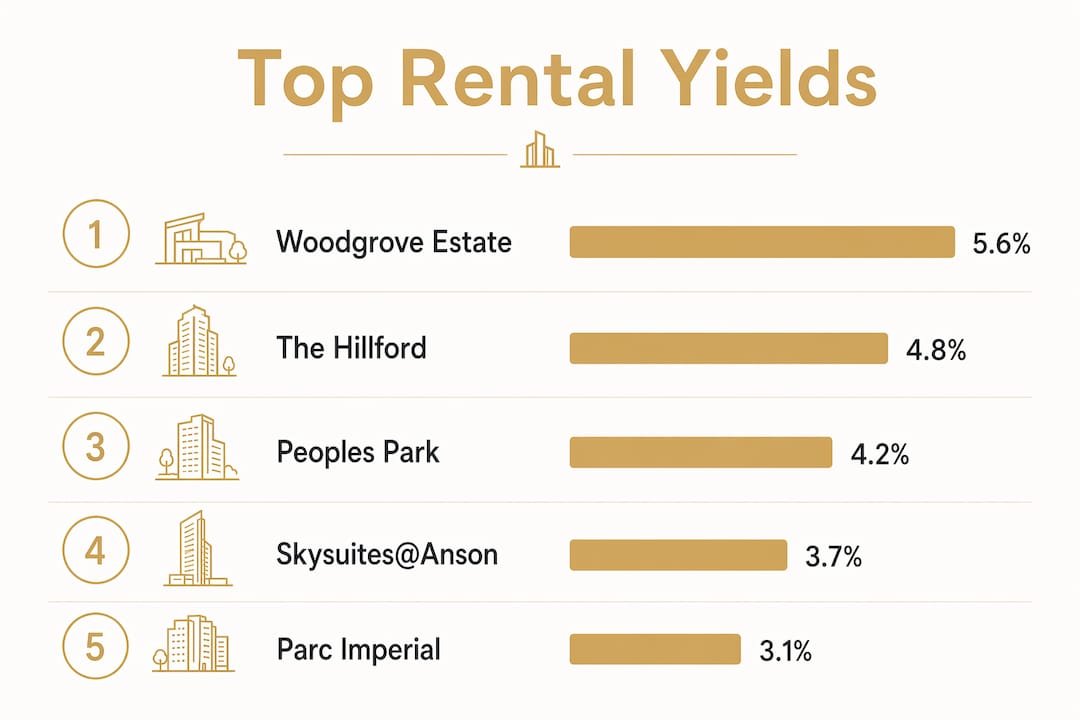
People's Park Complex is a different kind of outlier. At roughly 4.5% gross yield, it outperforms most CCR condos by a wide margin, and monthly maintenance fees are reportedly among the lowest in Singapore. The building dates to 1972, which introduces its own set of risks around capital expenditure and eventual en bloc uncertainty.
Skysuites@Anson and Parc Imperial both hit approximately 4.9% gross yield, placing them in the top tier without the extreme tenure or age constraints of the top two. Skysuites@Anson benefits from its District 2 location close to the CBD and MRT access. Parc Imperial in District 5 is freehold, which matters for investors who want tenure security alongside a strong yield.
Prestige Heights at 4.8% and Melville Park at 4.5% represent the suburban freehold and leasehold cases respectively. Prestige Heights in District 12 offers freehold tenure with a mature tenant base. Melville Park in District 18 is older stock but delivers consistent suburban demand.
For investors who want yield without the operational complexity of aging buildings, the mid-tier options are worth attention:
- Forte Suites (D12, freehold, ~4.3%) offers entry-level pricing with solid rental demand in a mature estate
- Springvale (D19, ~4.2%) and The Promenade@Pelikat (D19, ~4.0%) both benefit from Punggol and Sengkang's growing residential population
- The Jovell (D17, ~4.0%+) has recent transaction data supporting its yield and sits in a growing residential corridor
Piccadilly Grand and Avenue South Residence are newer launches where the investment case leans more toward capital appreciation alongside yield. Avenue South Residence in District 3 targets long-term investors who prioritize tenant quality and prestige over maximum gross yield.
One Marina Gardens in District 01 occupies a distinct position. As a new launch 160 meters from Marina South MRT, it combines CBD proximity with the growth story of the Marina South precinct. The yield profile is competitive for a CCR-adjacent location, and the capital appreciation case is supported by the area's ongoing development. For investors who want both income and long-term upside in a prime address, it sits in a category of its own among new launches.
Pro Tip: Unit size drives yield more than location alone. A 1-bedroom unit in a mid-tier district will often outperform a 3-bedroom unit in a prime district on gross yield, simply because the purchase price scales faster than achievable rent as unit size grows.
Smaller units like studios and 1-bedrooms typically achieve gross yields of 4.0%–4.5%, while 3-bedroom units in the same development often yield 3.0%–3.5%. The gap is widest in high-price districts where purchase prices rise faster than rents.
How do you evaluate a rental yield condo in Singapore?
Gross yield is the starting point, not the finish line. The calculation is straightforward: annual rental income divided by purchase price, multiplied by 100. A S$1.2 million unit renting for S$4,000 per month produces a gross yield of 4.0%. What you actually take home is lower.
Net yield runs 1.5%–2% below gross after accounting for property tax, maintenance fees, agent commissions, income tax on rental income, and vacancy periods. That same 4.0% gross yield often translates to 2.0%–2.5% net. Modeling net yield before committing to a purchase is the single most important step most first-time investors skip.
The factors that actually determine whether a condo rents well:
- MRT proximity. Units within a 10-minute walk of an MRT station consistently command higher rents and shorter vacancy periods. 1-bedroom condos near MRT stations in Tanjong Pagar, Queenstown, and Geylang achieve net yields above 3%, outperforming larger units in the same areas.
- Employment hub access. Condos near business parks, the CBD, or established commercial clusters attract corporate tenants on longer leases, which reduces turnover costs.
- Unit size and configuration. Smaller units rent faster and yield more on a percentage basis. A 500 sq ft 1-bedroom in Jurong East can achieve a meaningfully higher gross yield than a 1,100 sq ft 3-bedroom in the same block.
- Tenure type. Freehold condos carry a premium purchase price that compresses yield. A 99-year leasehold unit in the same location often yields more, though the asset depreciates over time.
- Development age and condition. Older buildings with deferred maintenance can surprise investors with large special levy assessments. Factor in a realistic capital expenditure reserve.
Pro Tip: Before buying for yield, check the URA rental transaction history for the specific development. Consistent transaction volume means the unit type rents reliably. A development with sparse rental records is a vacancy risk, regardless of what the gross yield calculation shows.
Which districts deliver the strongest rental yields in Singapore?
Geography shapes yield more than any single property feature. The OCR districts consistently outperform the CCR on gross yield because entry prices are lower while suburban rents remain firm.
| District / Region | Gross Yield Range | Key Characteristics |
|---|---|---|
| Woodlands (D25) | 4.2%–4.8% | Low entry prices, WOODGROVE ESTATE tops chart |
| Sembawang / Yishun | 4.1%–4.7% | Family demand, affordable stock |
| Jurong East | 4.0%–4.6% | Second CBD transformation, Jurong Region Line |
| Tampines (D18) | 3.9%–4.5% | Regional center, Melville Park located here |
| Punggol / Sengkang (D19) | 3.8%–4.3% | Young families, Springvale and The Jovell |
| Queenstown / Alexandra (D3) | 3.2%–3.8% | City-fringe, strong expat and PMET demand |
| Toa Payoh / Bishan (D12 / —) | 3.3%–3.9% | Mature estate, Forte Suites and Prestige Heights |
| Marine Parade / East Coast (D15) | 2.9%–3.5% | TEL connectivity, lifestyle appeal |
| Districts 9–11 (Prime CCR) | 2.0%–2.8% | Capital preservation, compressed yields |
Woodlands and the broader District 25 area produce the highest gross yields in Singapore, driven almost entirely by low acquisition costs. WOODGROVE ESTATE's 6.22% yield is the clearest expression of this dynamic. The tenant pool skews toward families and workers commuting to the Woodlands Regional Centre and the Johor Bahru corridor, which keeps occupancy rates steady.
Jurong East is the most watched OCR market right now. The Jurong Lake District transformation and the Jurong Region Line are pulling both tenant demand and capital values upward simultaneously. Studio condos in Jurong East currently show a gross yield of 5.0% and a net yield of 4.0%, making it one of the strongest income markets in the country.
The CCR story is different. Districts 9–11 yield 2.0%–2.8% gross because purchase prices are elevated by freehold tenure, land scarcity, and aspirational demand. Rents do not scale at the same rate as prices. Investors in Orchard, Tanglin, and River Valley are buying capital preservation, not income.
District 01, where One Marina Gardens sits, occupies a middle ground. The Marina Bay and Marina South precinct commands strong tenant demand from CBD professionals and expatriates, with the added tailwind of ongoing precinct development. The location near Marina South MRT supports both rentability and long-term value.
What taxes and fees reduce your rental income in Singapore?
Every investor should model net yield before signing anything. The gap between gross and net is wider than most people expect.
Recurring costs that reduce rental income:
- Property tax. Singapore levies property tax on residential property at rates that vary by annual value and whether the property is owner-occupied or rented out. Non-owner-occupied residential properties face higher progressive rates.
- Maintenance fees. These typically run S$300–S$500 per month for most condominiums, though some older developments charge less. On a S$1.2 million unit renting at S$4,000 per month, S$400 in monthly maintenance alone reduces your gross yield by roughly 1%.
- Agent commissions. Leasing a unit typically costs one month's rent per tenancy, paid to the agent. On a two-year lease, that is roughly 4% of total rental income per cycle.
- Income tax on rental income. Rental income is taxable in Singapore. Resident individuals pay progressive income tax rates on net rental income after allowable deductions. Non-residents pay a flat rate. The deductible expenses include mortgage interest, maintenance fees, and property tax, which partially offsets the liability.
- Vacancy. A two-month vacancy period can erode over 15% of annual net rental returns. This is the cost most investors underestimate at the planning stage.
- Repairs and capital expenditure. Older buildings require more frequent and more expensive maintenance. Budget a realistic annual reserve, especially for developments built before 2000.
After all these deductions, net yield typically runs 1.5%–2% below gross. A development showing 4.5% gross yield may deliver 2.5%–3.0% net. That is still a reasonable return in Singapore's low-risk property environment, but the planning needs to reflect reality.
Why rentability matters more than headline yield
The condos at the top of the gross yield table are there for a reason that experienced investors treat as a warning sign as much as an opportunity. High yields in Singapore almost always reflect one of three things: a very low purchase price, a very small unit, or an aging building with deferred maintenance risk. Often all three at once.
Experienced investors prioritize rentability over headline yield percentages. An older development with a 6% gross yield may sit vacant for three months between tenancies, require a S$30,000 renovation every few years, and face a special levy for building repairs. The net return after those costs can fall below what a newer, well-located development at 3.5% gross delivers consistently.
Key risks that erode high-yield positions:
- Vacancy concentration. Developments with many investor-owned units compete for the same tenant pool. When multiple units come available simultaneously, vacancy periods lengthen and rents soften.
- Aging infrastructure. Buildings from the 1990s and earlier face rising maintenance costs. The management corporation strata title (MCST) can levy special assessments for major repairs, which are not predictable in advance.
- Short leasehold tenure. The Hillford's 60-year lease from 2013 means roughly 47 years remain. Banks apply haircuts to financing for short-tenure properties, which limits your buyer pool at resale and can affect rental demand as the lease shortens.
- Tenant profile risk. Some high-yield micro-markets attract a narrower tenant profile. A development that rents well to one specific demographic faces concentrated demand risk if that demographic's circumstances change.
The practical benchmark: a gross yield above 3.5% is above the Singapore market average in 2026. Above 4.0% is strong. Above 4.5% is exceptional, and at that level, the question is always what the yield is compensating for.
How long does a rental investment take to mature?
The honest answer is five to seven years for most Singapore condos, and longer for new launches. A resale condo can generate rental income from the month of completion of purchase. A new launch requires a three-to-four year construction period before any rental income begins, which means the holding cost during that window is pure outlay.
Once a condo is tenanted, the investment matures in two phases. The first phase, roughly years one through three, is about establishing a rental track record: finding reliable tenants, understanding the actual vacancy rate for that development, and calibrating your net yield against the initial model. The second phase, from year four onward, is where compounding works in your favor. Rents tend to rise with inflation and demand, while your purchase price is fixed. A unit bought at S$1.2 million that rents for S$4,000 today may rent for S$4,500 in five years, pushing your effective yield on cost upward without any additional investment.
Capital appreciation adds a separate layer. Singapore's private residential market has historically rewarded patient investors, particularly in well-located developments near MRT stations and employment hubs. The URA's property price data shows long-term appreciation across most districts, though the pace varies significantly by location and market cycle.
For investors with a ten-year horizon, the combination of rental income and capital appreciation typically produces a stronger total return than either metric alone suggests at the point of purchase.
Rental yield versus capital appreciation: which should you prioritize?
These two objectives pull in opposite directions more often than not. The condos with the highest gross yields, WOODGROVE ESTATE, The Hillford, People's Park Complex, tend to have limited capital appreciation potential. Their yields are high precisely because their prices are low, and their prices are low because the market assigns them a discount for age, tenure, or location. You collect income, but the asset may not grow in value.
The condos with the strongest capital appreciation potential, prime CCR developments in Districts 9–11, new launches in growth precincts like Marina South, yield 2.5%–3.5% gross. The income is modest relative to the capital deployed, but the asset tends to hold and grow its value over time.
The middle ground, RCR and OCR developments near MRT stations with 3.5%–4.5% gross yields, is where most investors find the best risk-adjusted total return. Developments like Forte Suites, Springvale, and The Jovell sit in this range. They generate meaningful income while retaining reasonable appreciation potential.
One Marina Gardens occupies a specific niche in this spectrum. Its District 01 address and Marina South MRT proximity position it for capital appreciation alongside a competitive yield for a prime location. The investment case rests on both pillars: income from day one of tenancy and long-term value growth as the Marina South precinct develops. For investors who want a single asset that works on both dimensions, that combination is harder to find than the yield table alone suggests.
The practical rule: if your primary goal is maximum current income, buy in the OCR with a small unit and accept limited appreciation. If your goal is wealth building over a decade or more, weight location and development quality over headline yield.
How to manage tenants and keep rental income stable
Tenant management is where theoretical yield meets reality. The investors who consistently achieve their modeled returns share a few practices that less experienced landlords skip.
Screen tenants carefully before signing. Employment stability, rental history, and references matter more than the willingness to pay a slightly higher rent. A tenant who pays on time for two years is worth more than one who offers a premium but creates disputes. Singapore's Small Claims Tribunal handles tenancy disputes, but the process takes time and the outcome is uncertain.
Use a standard tenancy agreement and specify the terms clearly. The Tenancy Agreement should cover the security deposit (typically two months' rent for a two-year lease), the inventory list, the handover condition, and the responsibilities for minor versus major repairs. Ambiguity in the agreement is the most common source of disputes at the end of a tenancy.
Price the rent at market, not above it. Overpricing by even 5%–10% can extend vacancy by one to two months, which costs more than the premium you were trying to capture. Check URA rental transaction data for the specific development and unit type before setting your asking rent.
Maintain the unit proactively. A well-maintained unit attracts better tenants, commands market rent, and retains value. Deferred maintenance compounds. A S$500 repair today avoids a S$5,000 problem in two years.
Build a vacancy buffer into your cash flow model. Even the best-located condos experience occasional vacancy between tenancies. A two-month vacancy buffer in your annual budget protects your net yield calculation from the single biggest variable in rental income.
One Marina Gardens: a prime District 01 investment worth considering
If you're weighing a new launch against the resale options in this article, One Marina Gardens offers something most of the high-yield suburban condos cannot: a CBD-adjacent address with genuine long-term upside, 160 meters from Marina South MRT, in a precinct that Singapore's Urban Redevelopment Authority has designated for sustained development.
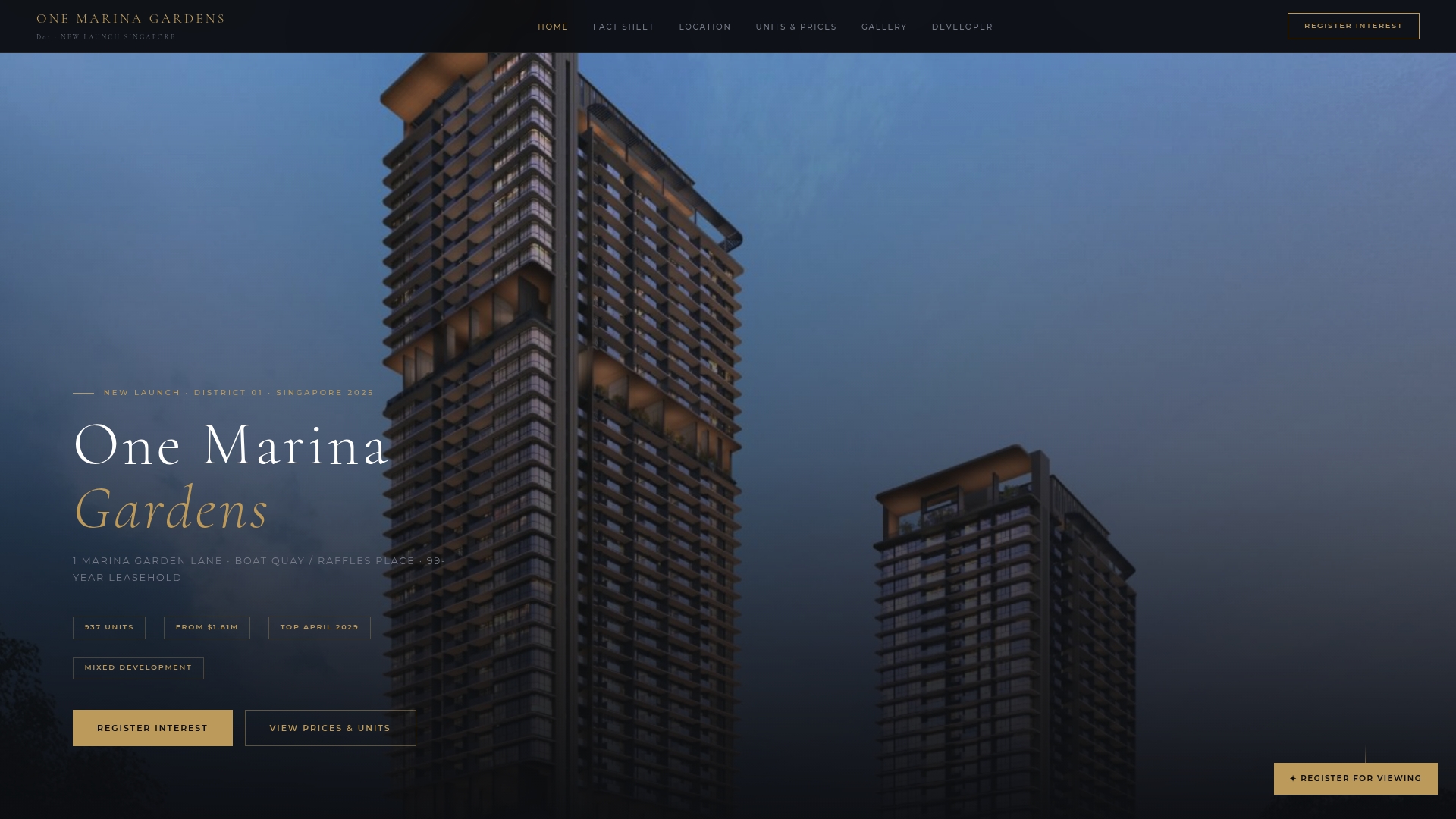
The development's 937 units span 1-bedroom to 4-bedroom configurations, giving investors the flexibility to target the unit size that best fits their yield strategy. The 1-bedroom and compact 2-bedroom units are particularly well-positioned for the corporate and expatriate tenant pool that the Marina Bay area consistently attracts. Amenities including multiple sky terraces, a 50-metre lap pool, and an on-site childcare center add genuine tenant appeal beyond the address alone.
Key investment highlights:
- District 01 location, 160 meters from Marina South MRT
- 937 units across 1-bedroom to 4-bedroom configurations
- Mixed-use development with retail and restaurant on-site
- Developed by Kingsford Marina Development
- Competitive yield for a prime CCR-adjacent location, with capital appreciation potential as Marina South develops
Review the full project fact sheet for unit specifications, floor plans, and facility details. To see current pricing and available units, the 2026 price list is publicly listed. For investors ready to visit, showflat appointments are available through the contact page.
Key Takeaways
The strongest rental yield condos in Singapore balance gross yield, net return after costs, and rentability — and the best choice depends on whether you prioritize income, appreciation, or both.
| Point | Details |
|---|---|
| Top gross yields | WOODGROVE ESTATE leads at 6.22%, followed by The Hillford at ~6.1%, but both carry tenure or age trade-offs. |
| Market yield benchmark | A gross yield of 3%–4% is healthy in 2026; above 4.5% is exceptional and usually reflects elevated risk. |
| Net yield gap | Net yield typically runs 1.5%–2% below gross after property tax, maintenance, agent fees, and vacancy costs. |
| Unit size advantage | Studios and 1-bedroom units consistently outperform larger units on gross yield, especially in OCR and RCR locations. |
| Onemarinagardens | One Marina Gardens in District 01 combines competitive yield with capital appreciation potential near Marina South MRT. |
Recommended
- Is One Marina Gardens a Good Investment? Marina South Growth Story (2026)
- One Marina Gardens Price List 2026 | Units & Available Prices from $1.81M
- One Marina Gardens | New Launch Condo D01 Singapore 2025 | Prices from $1.81M
- One Marina Gardens vs Marina One Residences — Which D01 Condo to Buy in 2026?