
Buying property young in the US comes down to three things: legal eligibility, financial readiness, and a clear medium-term plan. You can legally sign a real estate contract at 18, but lenders care far more about your credit score, income stability, and debt load than your age. Here's what you need to know before you start:
- Legal age: 18 in all US states to sign a binding contract
- Credit score: 620+ for conventional loans; higher scores unlock better rates
- Debt-to-income ratio: below 36% preferred by most lenders
- Timeline: generally several months from search to close, including mortgage pre-approval
- Ownership horizon: planning for a 5–7 year ownership suits most young buyers' career and lifestyle dynamics
- Luxury condo specifics: HOA financials, reserve funds, and amenity value all affect resale
Table of Contents
- Are you legally and financially ready to buy property young?
- What does the home-buying timeline actually look like?
- Strategic moves that separate smart young luxury buyers
- Why One Marina Gardens stands out for young luxury buyers
- Financing options for young high-net-worth buyers
- How to choose the right real estate agent for luxury buying
- Key Takeaways
- The case for buying early, but buying right
- One Marina Gardens: a premier choice for young luxury buyers
Are you legally and financially ready to buy property young?
US law sets 18 as the minimum age to purchase real estate, since that's when you can sign a legally binding contract. But clearing that bar is the easy part. What actually determines whether you get a mortgage is your financial profile.
Lenders typically want to see:
- Two years of consistent employment in the same field, or documented explanation of any gaps
- Credit score of 620 or higher for conventional loans; FHA loans accept scores as low as 580
- DTI ratio under 36% of gross monthly income, per HUD affordability guidelines
- Down payment savings can vary widely depending on loan type and insurance requirements
Credit improvement takes time. Chase mortgage advisors note it usually takes at least six months to see meaningful score gains, so start early: pay down balances, clear any collections, and avoid new credit applications before closing.
Down payment assistance programs exist at the federal and state level through HUD, and many young buyers may qualify. Government-backed loans through the FHA, VA, or USDA can lower both the credit threshold and the upfront cash requirement.
Beyond the down payment, budget for closing costs of 2%–6% of the purchase price, homeowners insurance (averaging about $2,424 per year in 2026), and HOA fees if you're buying a condominium.
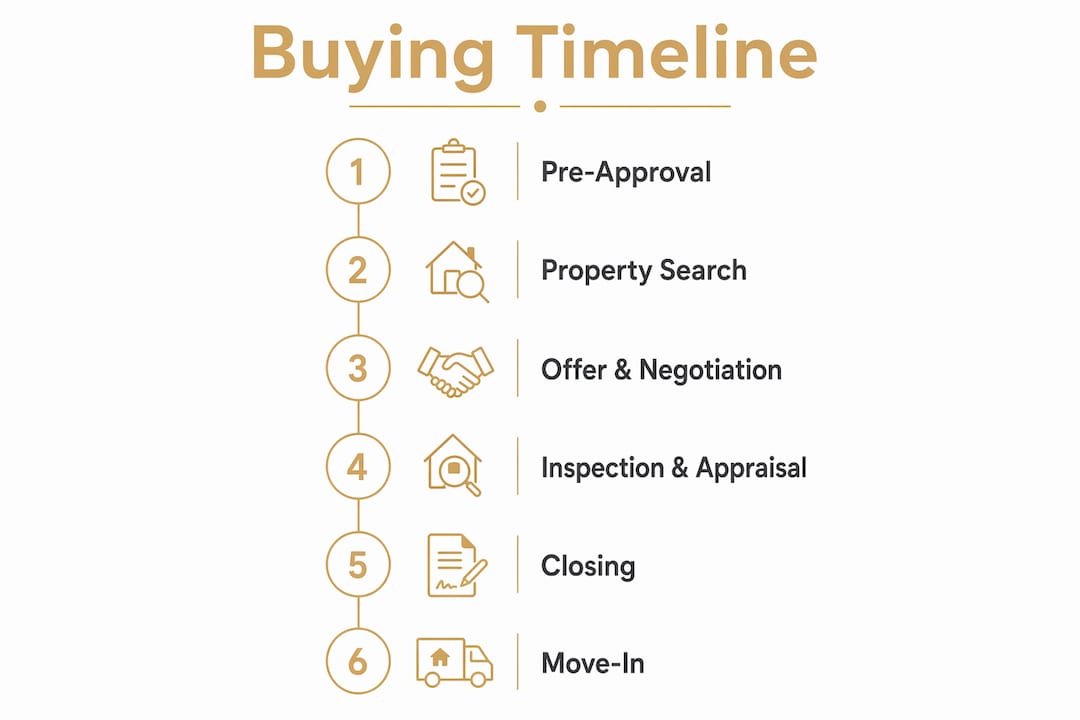
What does the home-buying timeline actually look like?
The full process runs 3–6 months from the start of a serious search to closing day. Most of that variation is in how long it takes to find the right property, not in the closing mechanics themselves.
| Stage | Typical Duration |
|---|---|
| Mortgage pre-approval (initial decision) | 1–3 business days |
| Active home search | 1–4 months |
| Offer to accepted contract | Days to weeks |
| Inspection, appraisal, underwriting | 2–4 weeks |
| Closing | 30 days from acceptance |
A few things worth knowing before you start:
- Pre-approval is not pre-qualification. Pre-approval involves a full credit pull and document review; pre-qualification is a soft estimate. Sellers and agents treat them very differently.
- Earnest money deposits typically run 1%–3% of the purchase price and are held in escrow.
- Closing costs of 2%–6% must be in cash at closing, on top of your down payment.
- Seller timelines matter. If a seller has a downstream purchase contingency, matching their preferred closing date can strengthen your offer at zero cost.
Get pre-approved before you tour a single property. It tells you exactly what you can borrow and signals seriousness to every listing agent you meet.
Strategic moves that separate smart young luxury buyers
Danielle Hale, chief economist at Realtor.com, puts it plainly: buying early is ahead of the game because it builds equity that compounds over decades. But buying smart matters more than buying fast.
Pro Tip: Plan for a 5–7 year ownership horizon. Young buyers' careers and lifestyles shift quickly, and that window gives you enough time to build equity and recoup closing costs without locking yourself into a property that no longer fits.
For luxury condominiums specifically:
- HOA due diligence is non-negotiable. Review the HOA's budget and reserve study before making an offer. Underfunded reserves mean special assessments, which can run into tens of thousands of dollars with little warning.
- Tighten contingency windows, don't waive them. A 7-day inspection window instead of 14 days signals seriousness while keeping your protection intact.
- Collaborate with listing agents. Aligning your offer terms with the seller's timeline often wins deals that pure price competition loses.
- Evaluate amenities for resale, not just lifestyle. A 50-metre lap pool or sky terrace adds genuine value to future buyers; a niche amenity with high maintenance costs can work against you.
The Urban Institute found that homeowners who bought their first properties before age 35 had the most housing wealth by age 60. Starting young, with a clear plan, is the advantage.
Why One Marina Gardens stands out for young luxury buyers
For young buyers and investors looking at premium condominium opportunities, Onemarinagardens represents exactly the kind of asset worth serious consideration. The 937-unit development by Kingsford Marina Development in Singapore's District 01 offers 1- to 4-bedroom apartments designed for both owner-occupiers and investors.
Pro Tip: Onemarinagardens sits just 160 meters from Marina South MRT, putting the CBD and Orchard Road within easy reach. For young professionals, that connectivity directly supports the medium-term ownership strategy that makes early property purchases work.
Key advantages for young buyers:
- Multiple sky terraces and a 50-metre lap pool add lifestyle value and long-term resale appeal
- An on-site childcare center and retail and dining options create a self-contained living environment
- Competitive rental yields support the investment case if career plans shift
- Transparent pricing, unit options, and showflat bookings are available through official channels
- The developer's track record and the investment potential of Marina South are well-documented for due diligence
For buyers navigating foreign ownership considerations, the ABSD guide for foreigners covers the key financial thresholds in detail.
Financing options for young high-net-worth buyers
Young high-net-worth buyers have more options than the standard 30-year fixed mortgage, and knowing which structure fits your situation can save significant money over time.
Conventional loans work well if you have a credit score above 620 and cash for a meaningful down payment. Putting down 20% eliminates private mortgage insurance, which typically adds 0.3%–2% of the loan amount annually. Jumbo loans apply to purchases above conforming loan limits and are common in luxury markets; they usually require stronger credit profiles and larger reserves. FHA loans lower the barrier for buyers with thinner credit histories, accepting scores as low as 580 with 3.5% down. VA loans offer no-down-payment options for eligible veterans and service members.
For high-net-worth buyers with complex income structures (equity compensation, business ownership, investment income), asset-depletion mortgages and portfolio loans from private banks are worth exploring. A real estate consultant can help you identify which lender type fits your income profile before you apply.
How to choose the right real estate agent for luxury buying
Not every agent understands the luxury condominium market, and the difference between a generalist and a specialist shows up fast in competitive situations.

Look for an agent with demonstrated transaction history in your target price range and property type. Ask directly: how many luxury condo purchases have you closed in the past 12 months? A good agent will have a clear answer. Beyond credentials, the right agent listens to your timeline and financial constraints rather than pushing you toward the fastest close.
Agents experienced with young buyers understand that career flexibility matters. They'll help you evaluate a property's resale dynamics, not just its current appeal. Tools like NestNoted can help you track listings, compare properties, and organize your search so you walk into every agent conversation prepared.
Finally, confirm your agent has relationships with listing agents in your target buildings. In luxury markets, those relationships directly affect whether your offer gets a fair hearing.
Key Takeaways
Buying property young rewards preparation over speed. The buyers who build the most long-term wealth start with strong financial foundations, clear ownership timelines, and properties chosen for resale value, not just lifestyle appeal.
| Point | Details |
|---|---|
| Legal age is just the start | You can buy at 18, but lenders focus on credit score, DTI, and two years of employment history. |
| Pre-approval takes several months | Start the mortgage process early; pre-approval is required before most agents will show luxury properties. |
| Plan for 5–7 years | Medium-term ownership (5 to 7 years) suits young buyers' career dynamics and gives time to build real equity. |
| HOA due diligence protects you | Review reserve studies before any condo offer; underfunded HOAs create costly special assessments. |
| Onemarinagardens fits the strategy | 937 units in District 01 with strong rental yields, MRT access, and premium amenities support a medium-term investment case. |
The case for buying early, but buying right
The conventional wisdom says wait until you're "settled." That advice costs young buyers years of equity growth for no good reason. What actually matters is not your age but whether your financial profile is solid and your ownership timeline is realistic.
Where I'd push back on most first-property guides: they treat luxury purchases as inherently riskier for young buyers. The opposite is often true. A well-located luxury condominium in a supply-constrained market tends to hold value better through economic cycles than a mid-market property in a less desirable area. The risk isn't the price point; it's buying without understanding HOA health, resale dynamics, and your own five-year plan.
Young buyers who rush because of social pressure, or who wait indefinitely because the market feels uncertain, both lose. The buyers who win are the ones who get financially ready, pick a property with genuine long-term value, and commit to a realistic ownership horizon. That's a strategy, not a gamble.
One Marina Gardens: a premier choice for young luxury buyers
Young luxury buyers who want a property that works as both a home and an investment should look closely at Onemarinagardens. The development offers 1- to 4-bedroom units in Singapore's District 01, with facilities that genuinely support both lifestyle quality and long-term resale value: sky terraces, a 50-metre lap pool, a childcare center, and direct retail and dining access.

The location, 160 meters from Marina South MRT with direct access to the CBD, is the kind of connectivity that holds value across market cycles. Kingsford Marina Development's transparent sales process means you can review pricing, unit availability, and project specifications before committing to a visit. Prices start from $1.81M, with full details available on the One Marina Gardens price list. To take the next step, book a showflat appointment and see the development in person.