
Condos with childcare facilities deliver real lifestyle value and a measurable edge in family-buyer demand, but the investment case depends entirely on which model is operating, whether it's properly licensed, and what the HOA documents actually say. ChildCare.gov distinguishes two fundamentally different setups: a licensed center-based operator leasing dedicated commercial space, and a family child care home run from an individual unit. California's Health & Safety Code Section 1597.40 adds a concrete example of how notice and insurance requirements work in practice. One Marina Gardens in Singapore's District 01 shows how a developer packages a dedicated childcare centre as a premium amenity alongside amenities like a lap pool and sky terraces.
Three things to verify before you buy:
- Which model applies: center-based lease, in-unit family child care, co-op, or operator partnership
- Whether the operator holds a current state license and valid liability insurance
- What the HOA rules say about childcare operations and who carries the insurance obligation
Your first call: Contact the HOA or developer's sales team, then your state's childcare licensing agency, and finally your property insurer to confirm coverage scope.
Table of Contents
- What do "condos with childcare facilities" actually mean?
- Why on-site childcare changes what you're actually buying
- US legal and regulatory checklist before you buy
- Exactly what to ask the developer, HOA, and operator
- How childcare amenities affect rental yield and resale value
- One Marina Gardens: how developer-integrated childcare works in practice
- Practical next steps for U.S. investors buying condos with childcare amenities
- Key Takeaways
- Why the due-diligence gap matters more than the amenity itself
- One Marina Gardens: a premium development built around family living
- Useful sources and regulatory resources
What do "condos with childcare facilities" actually mean?
The phrase covers four distinct operating models, and confusing them is the most common due-diligence mistake buyers make.
Center-based commercial operator. A developer leases dedicated ground-floor or amenity-floor space to a licensed childcare business. The operator runs the facility independently, sets its own hours and fees, and carries its own commercial liability insurance. A Harlem development that planned to lease community space to a daycare operator illustrates this model clearly: the condo building hosts the center, but the operator is a separate legal entity.
Family child care home in a unit. A licensed provider operates from their own condo unit, caring for a small group of children. ChildCare.gov notes these providers are regulated by states with licensing, background checks, CPR/First Aid training, and capacity limits. Hours tend to be flexible, group sizes are small, and caregiver continuity is higher than in a center setting.
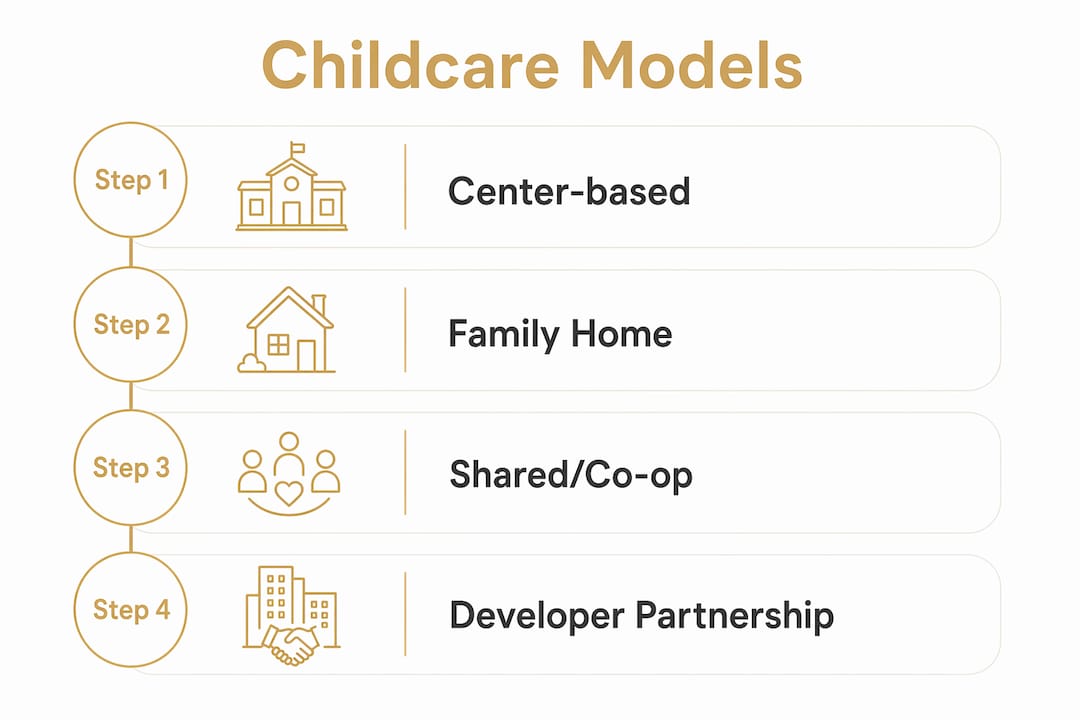
Shared or co-op model. Residents collectively fund and manage a childcare space, often converting a common room. Governance sits with the HOA or a resident committee, which creates both flexibility and accountability gaps.
Developer/operator partnership. The developer funds the space and contracts a third-party operator to manage it as a resident amenity. Encore Tower 2 at Fraser Mills announced onsite daycare spaces as part of its family-focused program, showing how developers use this model to differentiate a project at launch.
Pro Tip: Ask the sales agent which model applies before your first site visit. The answer changes every document you'll need to request.
Why on-site childcare changes what you're actually buying
Childcare amenities shift the buyer pool toward dual-income families and long-term residents, which tends to stabilize occupancy. Harvard Design Magazine has noted that developers add childcare specifically to capture this segment and improve resident retention. That's the upside.

The tradeoffs are real. Morning drop-off creates parking pressure. A center-based facility generates foot traffic from non-residents. HOA insurance premiums can rise when a licensed childcare operation is on-site. Noise from a kids' room adjacent to residential units is a legitimate concern, not a hypothetical one.
Who benefits most:
- Owner-occupiers with young children: The convenience premium is immediate and tangible. No commute to a separate daycare, no scramble for spots.
- Yield-focused investors: Benefit depends on whether the childcare amenity commands a rental premium in that specific submarket. In dense urban markets, it often does.
- Long-hold investors: Resident loyalty tends to be higher in buildings where families have childcare embedded in their daily routine.
Pro Tip: When modeling rental yield, treat the childcare amenity as a demand driver, not a guaranteed rent premium. Verify actual comparable rents in buildings with and without the facility before adjusting your numbers.
US legal and regulatory checklist before you buy
Licensing and insurance are the two non-negotiables. Everything else on this list matters, but an unlicensed or underinsured operator creates liability exposure for the HOA and, by extension, every unit owner.
- Confirm the operator's current state license. Center-based and family child care homes are licensed separately, with different capacity limits, inspection schedules, and staffing requirements.
- Request the most recent inspection report. Licensing agencies conduct periodic inspections; a gap in inspection history is a red flag.
- Verify background checks. States require criminal background checks for all staff and household members in a family child care home.
- Confirm CPR/First Aid certification for all caregiving staff.
- Check capacity limits. California's guidance, for example, allows small family daycares to supervise up to six children (up to eight with written landlord approval).
- Review HOA insurance certificates. Confirm the operator's liability policy names the HOA as additionally insured.
- Verify notice compliance. California Health & Safety Code requires written notice to property owners for certain operations; other states have analogous requirements.
- Check zoning. California's fair housing guidance confirms that licensed family child care homes must be permitted in any residentially-zoned area, including condominiums. HOAs cannot broadly prohibit them.
- Confirm indoor space standards. California guidance recommends 35 square feet per child of indoor space as a baseline.
| Checklist Item | What to Request |
|---|---|
| Operator license | Current certificate from state licensing agency |
| Inspection history | Last two inspection reports |
| Insurance | Certificate of liability naming HOA as additional insured |
| Staff credentials | CPR/First Aid cards, background check confirmation |
| Capacity compliance | Licensed capacity vs. current enrollment |
Pro Tip: For in-unit family child care, landlord guidance recommends requesting insurance certificates or parent affidavits and documenting operator obligations in writing before closing. This protects your investment if a nuisance or damage claim arises later.
Exactly what to ask the developer, HOA, and operator
Documents to request:
- Operator's current state license and renewal date
- Certificate of liability insurance (with HOA named as additional insured)
- Lease or amenity agreement between operator and HOA/developer
- Last two state inspection reports
- Staff credentials and background check policy
- Operating manual or curriculum summary
Questions for the developer or HOA:
- Who funds renovations to the childcare space, and is that obligation documented in the lease?
- Has the HOA ever filed a claim related to the childcare operation?
- Are there restrictions on in-unit childcare businesses, and how are they enforced?
- What happens to the amenity if the operator exits the lease?
Questions for the operator:
- What is the licensed capacity, and what is current enrollment?
- What are the staff-to-child ratios by age group?
- How are visitor pick-up and drop-off managed to minimize building disruption?
- What is the emergency and evacuation plan specific to this building?
Sample email to an HOA or developer:
How childcare amenities affect rental yield and resale value
The honest answer: childcare amenities can raise demand and support a rental or sale premium, but the size of that premium depends on location, unit mix, and how well the facility is actually run.
Scenario A — Owner-occupier premium. Families paying a convenience premium for walkable childcare will accept a higher purchase price. The amenity is priced into their lifestyle calculus, not just their financial model.
Scenario B — Rental demand lift. In urban markets with childcare shortages, a building with developer-integrated childcare attracts dual-income tenant families who stay longer and churn less. Lower vacancy is often worth more than a higher headline rent.
Scenario C — Limited or negative effect. Where parking is constrained, noise complaints are documented, or the operator has a thin track record, the amenity can become a liability. Buyers in this scenario should discount, not premium-price.
| Scenario | Likely Impact | Key Variable |
|---|---|---|
| Owner-occupier with young children | Purchase price premium | Proximity of unit to childcare space |
| Long-term family tenant | Lower vacancy, stable yield | Operator quality and hours |
| Parking/noise-constrained building | Neutral to negative | HOA management of drop-off traffic |
When modeling yield, adjust for potential HOA fee increases tied to the childcare operation, any revenue-sharing arrangement with the operator, and capex costs if the space needs retrofit. Use sensitivity ranges rather than single-point estimates.
One Marina Gardens: how developer-integrated childcare works in practice
This section is a labeled client example. One Marina Gardens is published by Onemarinagardens.
One Marina Gardens in Singapore's District 01 illustrates how a developer packages childcare as a core amenity rather than an afterthought. The 937-unit project by Kingsford Marina Development includes a dedicated childcare centre alongside multiple sky terraces, a 50-metre lap pool, retail shops, and a restaurant, positioned 160 meters from Marina South MRT.
- Dedicated childcare centre integrated into the amenity program, not leased to a third party as an afterthought
- Mixed-use environment with retail and F&B on-site, reducing the daily errand load for families
- Direct MRT access to the CBD and Orchard Road, which matters for dual-income households
- 937 units across 1- to 4-bedroom configurations, giving the project a unit mix that supports a genuine family buyer segment
Important note for U.S. buyers: Singapore operates under a different regulatory framework. The U.S. due-diligence checklist in this article applies to domestic purchases. For any overseas acquisition, engage local legal counsel and verify the operator's credentials under the jurisdiction's own licensing regime. The One Marina Gardens example illustrates developer packaging; it is not a model for U.S. regulatory compliance.
Practical next steps for U.S. investors buying condos with childcare amenities
The same due-diligence process applies whether you're buying domestically or overseas. The documents change; the logic doesn't.
- Hire local legal counsel before signing anything. For overseas purchases, this means counsel licensed in the target jurisdiction, not just a U.S. attorney.
- Request HOA meeting minutes from the last 12 months. Childcare-related disputes, insurance claims, or operator complaints will surface here.
- Secure conditional financing clauses that allow you to exit if due diligence reveals licensing or insurance gaps.
- Verify insurance endorsements confirm the operator's policy names the HOA and, where possible, individual unit owners as additionally insured.
- Confirm the operator's track record. Years in operation, licensing history, and any regulatory actions are public record in most U.S. states.
- For foreign investments: Confirm currency transfer controls, cross-border tax withholding obligations, and local operator reliability through independent references.
- Schedule an in-person inspection or showflat visit as the final verification step. No document review substitutes for seeing the space, the drop-off logistics, and the building's actual noise profile.
For co-living or shared-living models that incorporate neighborhood childcare as part of a broader community service, CoHaus offers a useful perspective on how shared residential services are structured and governed.
Key Takeaways
Licensing and insurance are the two variables that determine whether a childcare amenity adds value or creates liability for every unit owner in the building.
| Point | Details |
|---|---|
| Verify licensing type first | Center-based and family child care homes carry different rules, capacity limits, and inspection requirements. |
| Insurance is non-negotiable | The operator's liability policy must name the HOA as additionally insured before you close. |
| Childcare lifts family demand | Buildings with well-run childcare attract long-term family tenants and reduce vacancy in urban markets. |
| HOAs cannot broadly ban licensed providers | Fair housing and state law in California and other states limits HOA authority to prohibit licensed family child care homes. |
| Onemarinagardens as a reference point | One Marina Gardens integrates a dedicated childcare centre into its amenity program, illustrating how developer-packaged childcare is positioned as a premium lifestyle feature for family buyers. |
Why the due-diligence gap matters more than the amenity itself
Most buyers focus on whether a childcare facility exists. The sharper question is whether it's structured to last. An operator on a short-term lease with no HOA insurance endorsement is a liability dressed as an amenity. A licensed, well-staffed center with a documented operating agreement is a genuine asset-management variable that affects occupancy, tenant quality, and resale positioning.
The conventional wisdom treats childcare as a lifestyle add-on. The more useful frame is to treat it as a small commercial operation embedded in a residential building, one that requires the same scrutiny you'd apply to any commercial tenant. Request the lease. Read the insurance certificate. Ask about the last inspection. Those three steps separate buyers who benefit from the amenity from those who inherit its problems.
One Marina Gardens: a premium development built around family living
Promotional content — One Marina Gardens is the publisher of this article.

For buyers who want childcare built into the development from day one rather than negotiated after the fact, Onemarinagardens offers exactly that. The One Marina Gardens project in Singapore's District 01 includes a dedicated childcare centre as part of a fully integrated amenity program, not a leased afterthought.
- Dedicated childcare centre within the development
- 50-metre lap pool, multiple sky terraces, and a mixed-use ground floor with retail and dining
- 160 meters from Marina South MRT, with direct access to the CBD
- 1- to 4-bedroom units from SGD $1.81M, across 937 residences
Review the full project specs and unit distribution or check current unit availability and pricing. To book a showflat appointment or register your interest, contact the sales team directly.
Useful sources and regulatory resources
| Resource | What It Covers | How to Use It |
|---|---|---|
| ChildCare.gov — Family Child Care Homes | Federal overview of family child care home licensing, background checks, and capacity rules | Start here to understand the regulatory baseline before contacting your state agency |
| California CDSS Family Child Care Manual | California-specific licensing, notice, and insurance requirements | Use for California purchases; check your state's equivalent licensing agency for other markets |
| California Civil Rights Department — Child Care Provider Rights | HOA limitations on restricting licensed family child care homes | Cite when an HOA claims it can prohibit or restrict a licensed in-unit provider |
| AOA — California Landlord Daycare Rules | Landlord and HOA obligations when a tenant operates a family daycare | Use to draft owner/HOA queries and understand insurance endorsement requirements |
| IILA Los Angeles — How to Become a Licensed Family Child Care Home | Space requirements, inspection steps, and licensing scale for California | Verify indoor square footage and outdoor space compliance for in-unit operators |
For state-specific licensing databases outside California, search your state's health or social services department website for "child care licensing" and request the operator's license number directly from the agency to confirm current status.
This article is general information for buyers and investors, not legal or financial advice. Confirm current rules with a licensed attorney and your state's childcare licensing agency before making any purchase decision.