Finding spacious homes in Singapore means targeting the right neighborhoods and property types before you ever open a listing portal. The most productive starting point: focus on prime districts like Nassim Road, Greenbank Park, Leedon Heights, and Mount Elizabeth, where large plots and generous floor areas are the norm rather than the exception. Good Class Bungalows and corner terrace houses sit at the top of the space hierarchy for landed property, while upscale condominiums with open floor plans offer a practical alternative for foreigners who face ownership restrictions on landed homes.
Here is a quick-reference checklist to orient your search:
- Identify your target neighborhoods — Nassim Road, Greenbank Park, Leedon Heights, and Mount Elizabeth for landed luxury; Marina Bay and Orchard fringe for spacious condominiums.
- Know your property type — GCBs require a minimum land area of 1,400 sqm and are restricted to Singapore citizens only.
- Understand eligibility — foreigners can freely buy private condominiums but need Singapore Land Authority approval for landed homes.
- Define "spacious" concretely — floor area matters, but internal circulation and layout usability matter just as much.
- Use technology early — set precise filters on property portals for minimum floor area, not just bedroom count.
- Engage a specialist agent — someone who knows GCB areas and luxury condominium inventory, not a generalist.
- Run every shortlisted property through a structured framework before committing.
1. Top upscale neighborhoods where you can find spacious homes
Singapore's prime residential districts cluster around Districts 10, 11, and 21, where lot sizes are largest and greenery is densest. Each neighborhood below has a distinct character, and knowing those differences saves you weeks of misdirected searching.
Nassim Road
Nassim Road sits in District 10 and is widely regarded as Singapore's most prestigious residential address. The street runs through the Nassim GCB area, one of the 39 gazetted Good Class Bungalow zones, meaning every home here sits on at least 1,400 sqm of land. Transactions on Nassim Road regularly exceed S$30 million, with some landmark sales pushing well above S$100 million for the largest plots. The road's canopy of mature rain trees, proximity to the Botanic Gardens, and short drive to Orchard Road make it the benchmark against which every other luxury address in Singapore is measured.
- Gazetted GCB area with minimum 1,400 sqm plots
- Walking distance to Singapore Botanic Gardens (UNESCO World Heritage Site)
- Consistently among the highest per-square-foot land prices in Singapore
Greenbank Park
Greenbank Park occupies a quieter pocket of District 10, off Bukit Timah Road. The enclave is popular with families who want large garden plots without the visibility of Nassim Road. Properties here tend to be slightly more accessible in price than Nassim while still sitting firmly in GCB territory. The surrounding Bukit Timah nature corridor adds genuine greenery, and several top international schools are within a short drive.
- GCB-gazetted area with generous setbacks and garden space
- Close to Hwa Chong Institution and Nanyang Primary School
- Lower profile than Nassim Road, which appeals to buyers who prioritize privacy
Leedon Heights
Leedon Heights, also in District 10, borders the Leedon Park GCB area and offers a mix of bungalows, semi-detached homes, and upscale condominiums. The neighborhood has attracted significant redevelopment interest, and several large luxury condominium projects have been built here, giving buyers who cannot purchase landed property a genuine alternative with spacious units and lush surroundings.
- Mix of landed GCB homes and large-format luxury condominiums
- Quiet, low-density streetscape with mature trees
- Strong school proximity: Henry Park Primary within the 1km registration zone
Mount Elizabeth
Mount Elizabeth, in District 9, is better known for its private hospital, but the surrounding residential streets are among the most sought-after in Singapore. The area offers a mix of freehold apartments, boutique condominiums, and a handful of bungalows, all within walking distance of Orchard Road. Units here tend to be larger than typical city-fringe condominiums, and the freehold tenure of many buildings adds long-term value.
- Freehold tenure common, which supports long-term capital preservation
- Walking distance to Orchard Road retail and dining
- Strong rental demand from medical professionals and expatriate executives
2. Understanding spacious residential property types in Singapore
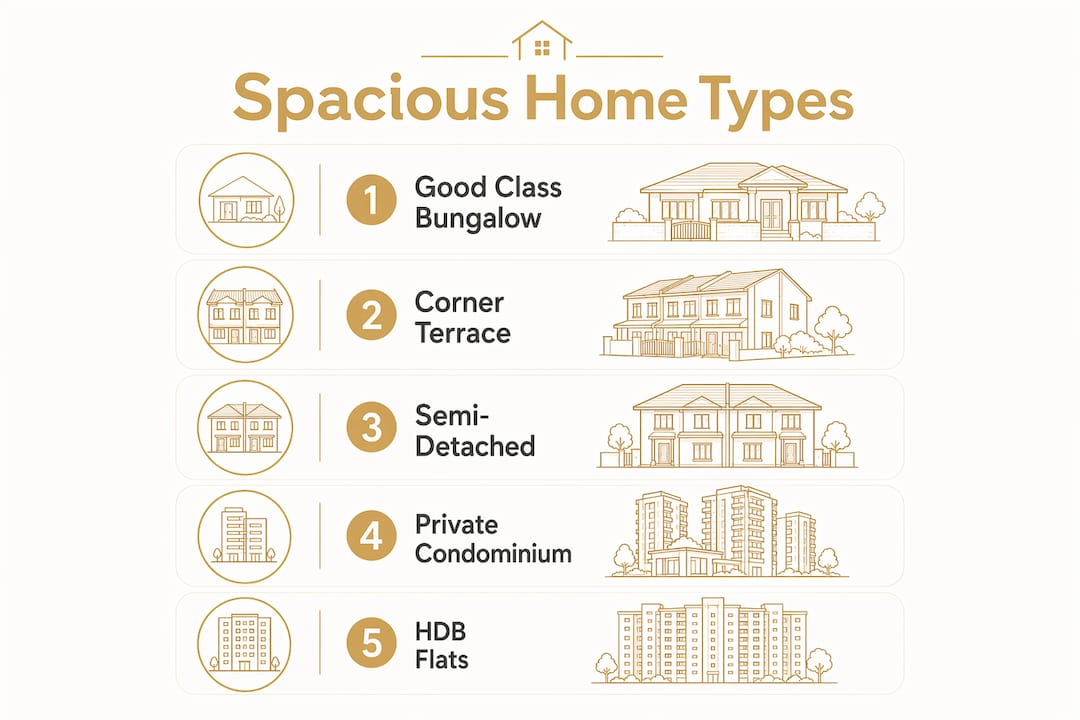
Singapore's property market sorts itself into a clear hierarchy when it comes to space. Landed homes occupy the top tier; condominiums and HDB flats sit below, with size varying widely within each category.
Good Class Bungalows
Good Class Bungalows are the pinnacle of residential space in Singapore. There are only around 2,700 of them across 39 gazetted areas, and each must sit on a minimum land area of 1,400 sqm. Typical built-up areas can be very large, with space for swimming pools, multiple car bays, and landscaped gardens. Strict Urban Redevelopment Authority (URA) regulations cap site coverage at 40% and limit height to two storeys plus an attic, which preserves the low-density character of GCB neighborhoods. Ownership is restricted to Singapore citizens only.
Corner terrace houses
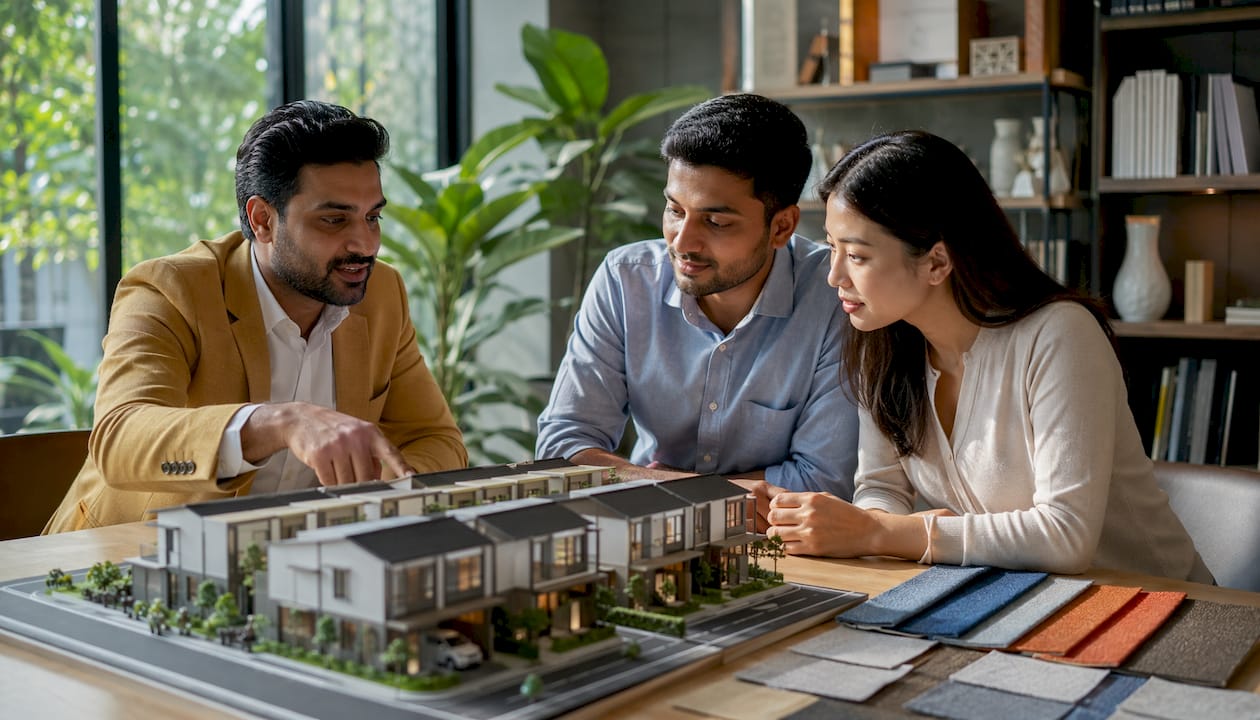
Corner terrace houses require a minimum plot size of 200 sqm and share only one wall with a neighbor, unlike standard inter-terrace units that are flanked on both sides. The extra exposed facade means more windows, better cross-ventilation, and significantly more natural light. For buyers who want landed living without the GCB price tag, corner terraces offer a practical middle ground.
Semi-detached homes and linked bungalows
Semi-detached homes also carry a minimum plot size of 200 sqm and offer one fully open side, which allows for extensions, landscaping, and outdoor living spaces. Linked bungalows step up further, with a minimum plot of 400 sqm and a near-detached feel despite a small shared connection at the porch or kitchen. Both types give families meaningful outdoor space without the full commitment of a GCB.
HDB flats and the public housing spectrum
The Housing Development Board designs flat types to suit different household sizes, ranging from compact 3-room units to 3Gen flats for multigenerational families. A 5-room flat typically measures 110–112 sqm, while a 3Gen flat reaches 115 sqm and an Executive flat tops out at around 130 sqm. Jumbo HDB flats, formed by combining two units, can stretch from 134 sqm to 170 sqm. These are the most space-efficient options at the lower end of the market, though foreigners cannot purchase HDB flats directly.
What "spacious" actually means in layout terms
Raw floor area is only part of the picture. A 1,200 sqm GCB with poor internal circulation can feel more cramped than a well-planned 150 sqm condominium. Experienced buyers focus on internal circulation, recommending at least 900mm of clearance between major furniture pieces for comfortable daily movement. Open floor plans that connect living, dining, and kitchen areas without unnecessary walls create a sense of volume that square footage alone cannot capture. When evaluating any unit, walk the circulation paths first, then measure the rooms.
Key figure: Singapore has approximately 2,700 Good Class Bungalows across 39 gazetted areas, each requiring a minimum land area of 1,400 sqm, making them among the rarest residential assets in Southeast Asia.
3. Legal considerations and eligibility for foreigners buying spacious homes
Ownership rules in Singapore differ sharply depending on property type, and getting this wrong early wastes time and creates costly surprises.
Private condominiums are the clearest path for foreign buyers. Foreigners can freely purchase and rent private condominiums with no additional approval required beyond standard stamp duty obligations. The main financial consideration is the Additional Buyer's Stamp Duty (ABSD), which applies at a higher rate for non-citizens. For detailed ABSD calculations specific to foreign buyers, the ABSD guide for foreigners covers current rates and scenarios in full.
Landed property is a different matter entirely. Singapore citizens can purchase landed homes freely. Permanent residents require approval from the Singapore Land Authority, and approval is not guaranteed. Foreigners who are neither citizens nor permanent residents are generally not permitted to purchase landed residential property in Singapore, with a narrow exception for properties on Sentosa Cove.
Good Class Bungalows carry the strictest restriction of all: ownership is limited to Singapore citizens only, with no pathway for permanent residents or foreigners regardless of approval.
Key legal points for foreign buyers:
- Foreigners may purchase private condominiums and apartments without restriction.
- Permanent residents require Singapore Land Authority approval for landed homes; approval is discretionary.
- GCBs are restricted to Singapore citizens only.
- ABSD applies to all residential purchases by non-citizens and varies by residency status and number of properties owned.
- Renting HDB flats as a foreigner requires a qualifying pass type (Employment Pass, S Pass, Work Permit, EntrePass, Student Pass, Dependant's Pass, or Long-Term Visit Pass) and prior HDB approval.
- Private condominium rentals are open to all foreigners with a valid pass, with a minimum rental period of three consecutive months as mandated by URA.
For expatriates and investors, the practical takeaway is straightforward: private condominiums offer the widest access and the fewest restrictions. Landed property requires either citizenship or a strong permanent residency case.
4. Effective strategies to find and acquire spacious homes in Singapore
The buyers who move fastest in Singapore's upscale market share one habit: they define their criteria precisely before they start searching, not after.

Start with location and lifestyle, not price. Decide which district genuinely fits your daily life. American expat families, for example, often gravitate toward the north and west of Singapore, particularly Woodlands and Woodgrove, because of the Singapore American School and the estate-style homes with garden access in those areas, even though the commute to the CBD is longer. Families prioritizing school proximity in Districts 10 and 11 face a different trade-off: shorter commutes and top schools, but significantly higher prices per square foot.
Set precise search filters on property portals. Most portals let you filter by floor area in square feet or square meters. Use that filter aggressively. A search for "4-bedroom condominiums" will return units ranging from 1,200 square feet to over 3,000 square feet. Filtering by minimum floor area immediately cuts the noise. Also filter by tenure (freehold vs. leasehold) and by district, not just by MRT station.
Evaluate internal circulation, not just square footage. When you visit a unit, walk every circulation path. Can two people pass comfortably in the corridor? Does the kitchen flow into the dining area without obstruction? Is there at least 900mm of clearance between the sofa and the coffee table? A unit that passes this test at 1,400 square feet will feel more liveable than one that fails it at 1,800 square feet.
Consult an agent who specializes in the segment you are targeting. A generalist agent who handles HDB resales and luxury bungalows interchangeably is not the right partner for a GCB search. Ask specifically about their transaction history in GCB areas or in large-format condominiums. The best agents in this segment know about off-market listings and can tell you which sellers are genuinely motivated.
Financing for upscale homes requires early preparation. Singapore's Total Debt Servicing Ratio (TDSR) caps total monthly debt obligations at 55% of gross monthly income. For high-value properties, this ceiling can constrain borrowing significantly, particularly for buyers with existing loans. Get an in-principle approval from a bank before you start serious negotiations, and factor in ABSD, legal fees, and stamp duty in your cash flow planning.
- Define location and lifestyle priorities before opening any portal.
- Filter by minimum floor area, not bedroom count alone.
- Walk circulation paths during every viewing.
- Engage a specialist agent with a verifiable track record in your target segment.
- Secure financing pre-approval and account for ABSD and stamp duties upfront.
Pro Tip: Run every shortlisted property through a four-layer framework: Property (is the asset fundamentally sound?), Numbers (can you carry it comfortably within TDSR?), Life (does the layout and location fit how you actually live over the next five to seven years?), and Exit (can you sell it on your timeline?). A property that scores well on price and size but fails the Life or Exit layer is the wrong property.
5. One Marina Gardens: a spacious condominium option in District 01
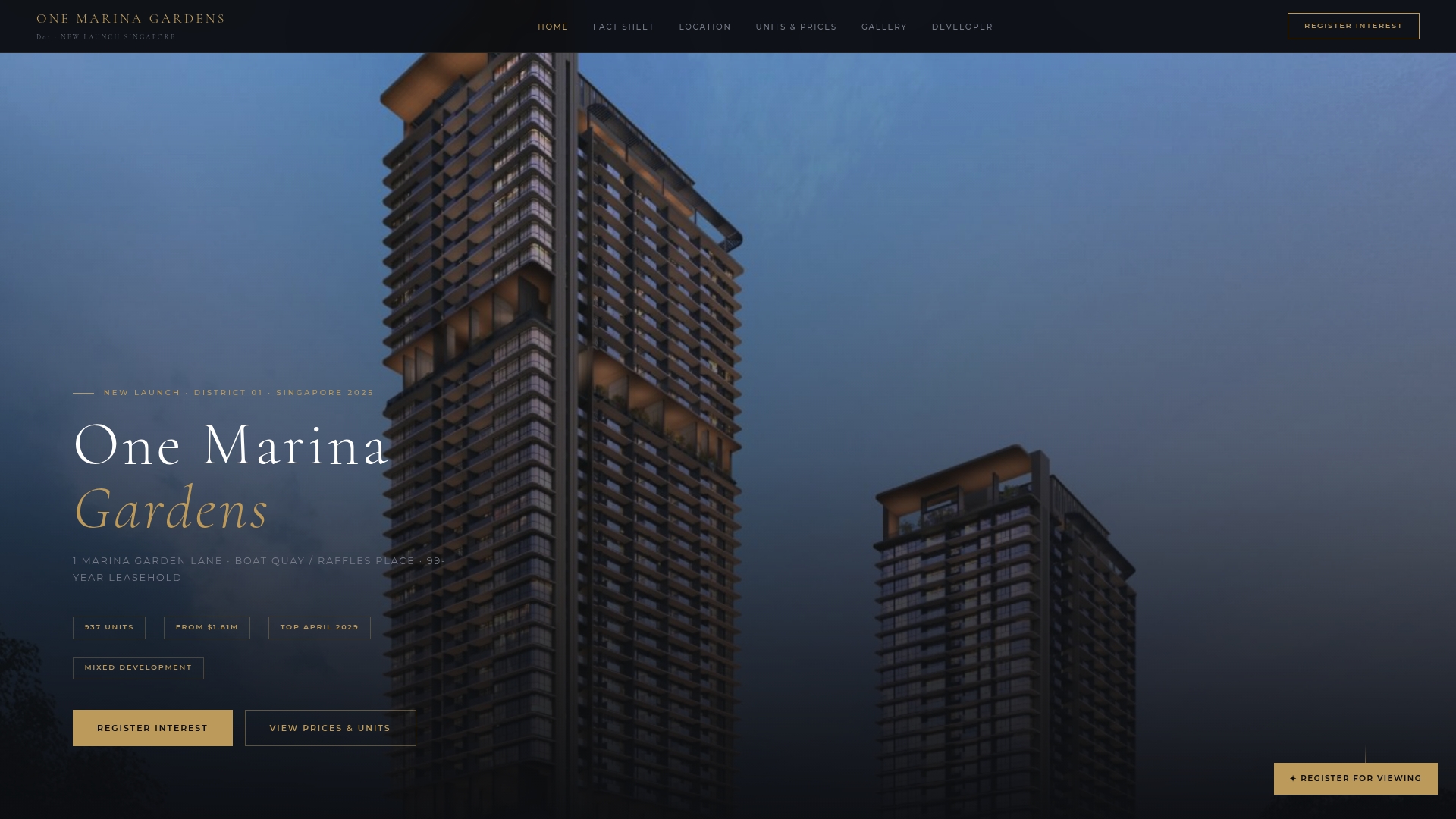
For buyers who want genuine scale and premium amenities without the complexity of landed property ownership, Onemarinagardens presents a compelling case in District 01.
Developed by Kingsford Marina Development, the project comprises 937 units across a range of 1- to 4-bedroom configurations. The 4-bedroom units are designed for buyers who want condominium convenience without sacrificing the floor area that a growing family or home-office setup demands. Multiple sky terraces, a 50-metre lap pool, a dedicated childcare centre, retail shops, and a restaurant sit within the development, which means residents rarely need to leave the building for daily essentials.
The location is a genuine differentiator. Onemarinagardens sits 160 meters from Marina South MRT, giving direct access to the CBD and Orchard Road. The Marina Bay waterfront is immediately adjacent, and the views from upper floors across the bay and city skyline are among the most dramatic available in any new Singapore condominium launch.
| Unit Type | Typical Size | Starting Price |
|---|---|---|
| 1-Bedroom | Compact configurations | — |
| 2-Bedroom | Mid-range layouts | Available on request |
| 3-Bedroom | Generous open floor plans | Available on request |
| 4-Bedroom | Largest residential units | Available on request |
Key highlights at a glance:
- 937 total units across 1- to 4-bedroom types
- Multiple sky terraces with panoramic Marina Bay views
- 50-metre lap pool and full suite of recreational facilities
- Dedicated childcare centre within the development
- 160 meters from Marina South MRT
- Mixed-use environment with retail and dining on-site
Pro Tip: Book a showflat appointment early. The 4-bedroom units at Onemarinagardens are the most limited in supply and the first to attract serious interest from families and investors seeking larger floor plates in District 01. Register your interest directly to get priority access to unit availability and pricing updates.
Onemarinagardens' unit pricing and floor plans are publicly listed, making it straightforward to compare floor area per dollar against other District 01 options.
6. How renovation and extension can increase space in existing properties
Buying a property that is slightly smaller than ideal is not necessarily a dead end. Singapore's regulatory framework allows meaningful space creation through renovation and structural extension, provided you work within the rules.
For landed homes, the most impactful option is a rear or side extension. URA regulations govern setbacks, site coverage, and height, so the scope depends on your property type. Terrace houses and semi-detached homes are generally capped at 2.5 storeys, and setback distances from boundaries must be maintained. Within those constraints, adding a rear extension of one or two rooms, or converting an underused attic into a usable bedroom or study, can add meaningful floor area without a full rebuild.
Skylights and double-volume voids are another tool, particularly in landed homes. They do not add floor area on paper, but they transform how a space feels. A double-volume living room with a skylight reads as dramatically larger than the same footprint with a standard ceiling height.
For condominium owners, internal reconfiguration is the primary lever. HDB regulations govern what can be modified in public housing, including wall hacking and wet area changes, all of which require approval. Private condominiums offer more flexibility for internal layout changes, though structural walls and wet area relocations still require approval from the building management and relevant authorities. Open-plan layouts that remove non-structural partitions between the living room and a secondary bedroom are among the most common and cost-effective ways to create a sense of space in a compact unit.
Storage is often the hidden space problem. Built-in wardrobes, under-stair storage, and platform beds with integrated drawers reclaim floor area that freestanding furniture wastes. In smaller Singapore homes, rooms frequently serve multiple functions, and zoning those functions clearly through furniture placement, area rugs, and lighting creates distinct areas without physical walls.
Before committing to any renovation, get a structural engineer's assessment for landed homes and review the relevant HDB or condominium management corporation rules for apartments. Renovation costs in Singapore vary widely by scope and property type, and a realistic budget conversation with your contractor before signing a purchase agreement saves significant stress later.
7. Common pitfalls when searching for spacious homes in Singapore
The search for large homes in Singapore has a few recurring traps. Knowing them in advance puts you ahead of most buyers.
Confusing gross floor area with usable space. Developers quote gross floor area, which includes walls, bay windows, planter boxes, and air-conditioning ledges. The actual liveable area is often noticeably smaller. Always ask for the net internal area or walk the unit with a tape measure. A 1,500 square foot unit with a large bay window and two planter boxes may deliver less usable floor space than a 1,350 square foot unit with a clean rectangular layout.
Overlooking the impact of layout on daily life. A long, narrow floor plate with bedrooms strung along a single corridor feels cramped regardless of total area. Open floor plans that connect the living, dining, and kitchen zones in a natural flow create a sense of volume that a segmented layout cannot replicate, even at the same square footage. Always evaluate the layout against how your household actually moves through a home on a typical day.
Underestimating the total cost of ownership. For upscale homes, property tax, maintenance fees, and ABSD can add substantially to the headline purchase price. GCB owners face high property tax assessments and significant ongoing maintenance costs for large gardens and pools. Condominium buyers pay monthly maintenance fees that scale with unit size and facility quality. Factor all of these into your affordability calculation, not just the mortgage repayment.
Skipping the neighborhood due diligence. A spacious home in the wrong neighborhood creates daily friction. Check the real commute door-to-desk on a Monday morning, not just the map distance to the nearest MRT. Verify school proximity if that matters to your household. Walk the neighborhood at different times of day to assess noise, traffic, and general character.
Moving too slowly on genuinely good properties. The best large-format homes in prime Singapore districts attract multiple serious buyers quickly. If a property passes your four-layer framework, move to an offer promptly. Waiting for a lower price on a property that is correctly priced for the market usually means losing it to a faster buyer.
Relying on online listings alone. A meaningful share of the best GCB and luxury condominium transactions in Singapore happen off-market, through agent networks before a property is ever publicly listed. This is another reason to build a relationship with a specialist agent early in your search rather than after you have already spent months browsing portals.
Key Takeaways
Finding spacious homes in Singapore requires targeting the right neighborhoods, understanding property type restrictions, and evaluating layout quality alongside raw floor area.
| Point | Details |
|---|---|
| Target prime districts first | Nassim Road, Greenbank Park, Leedon Heights, and Mount Elizabeth offer the largest plots and most exclusive addresses. |
| GCBs require 1,400 sqm minimum | Only around 2,700 Good Class Bungalows exist in Singapore, and ownership is restricted to citizens only. |
| Foreigners buy condos freely | Private condominiums are open to all foreign buyers; landed property requires Land Authority approval for permanent residents. |
| Layout beats raw square footage | Minimum 900mm circulation clearance and open floor plans determine how spacious a home actually feels day to day. |
| Use the four-layer framework | Evaluate every property on Property, Numbers, Life, and Exit before committing, not on price and size alone. |