
The impact of apartments on property values is defined by a consistent finding: well-designed multifamily developments do not reduce and often increase nearby home prices. Research from the Kem C. Gardner Policy Institute and the Harvard Joint Center for Housing Studies confirms this conclusion across multiple markets. The key variables are design quality and neighborhood integration, not the presence of apartments itself. Buyers and investors who understand this distinction make better decisions than those who rely on gut-level opposition.
What does research say about apartments' effect on nearby home prices?
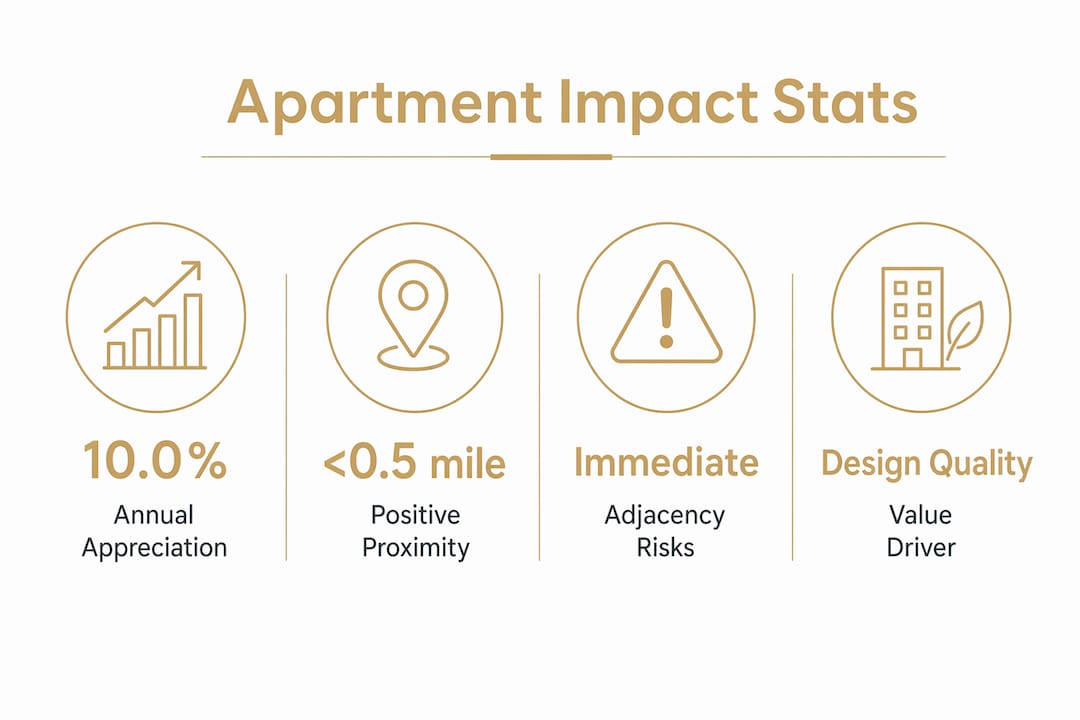
The data on this question is clearer than most people expect. Single-family homes within half a mile of new apartment buildings appreciated 10.0% annually versus 8.6% for homes farther away. That 1.4 percentage point gap, measured across suburban Salt Lake County from 2010 to 2019, is not a rounding error. It represents a meaningful compounding advantage for homeowners near new apartment construction.
Sydney tells a similar story at a larger scale. Neighborhoods that saw over 1,000 new apartments built between 2012 and 2017 recorded 91% detached house price growth over that period. Low-density suburbs without that construction activity saw only 69% growth. High apartment density and rising single-family prices coexisted, which directly contradicts the assumption that more apartments suppress surrounding home values.
The picture is not uniformly positive at every distance and every project type. Homes immediately adjacent to high-traffic mixed-use projects may trade at a 5–12% discount due to noise, traffic, and visual impact. That discount is strongest within the first few hundred feet of the development. Beyond that buffer, the neighborhood-level benefits tend to dominate.
The table below summarizes appreciation outcomes by proximity and project type.
| Scenario | Observed outcome |
|---|---|
| Within half a mile of new apartments (Salt Lake County) | 10.0% annual appreciation vs. 8.6% farther away |
| High-density apartment neighborhoods (Sydney, 2012–2017) | 91% price growth vs. 69% in low-density suburbs |
| Adjacent to quality retail-anchored development | 2–5% price premium |
| Adjacent to poorly screened apartment blocks | 3–10% price discount |
| Adjacent to high-traffic mixed-use projects | 5–12% discount within first few hundred feet |
The pattern across these studies is consistent. Distance matters. Design matters. The broad fear that apartments automatically drag down surrounding home values does not hold up against the evidence.
Why do well-designed apartments tend to maintain or raise values?
Well-integrated multifamily developments improve neighborhood attractiveness rather than degrade it. Landscaped exteriors, activated street frontages, and ground-floor retail create environments that feel more complete and livable. Those qualities attract buyers and tenants, which sustains demand and supports prices across the surrounding area.
The contrast with poorly designed projects is sharp. A building that turns a blank concrete wall toward the street, generates constant delivery traffic, and offers no pedestrian amenity creates genuine nuisances. Those nuisances show up in transaction prices for the nearest homes. The problem is not the apartment use. The problem is the execution.
Buyers evaluating a neighborhood near new multifamily construction should look at several specific factors:
- Street activation: Does the building engage the sidewalk with windows, entries, or retail, or does it present a wall?
- Parking design: Is parking hidden behind or below the building, or does it dominate the street frontage?
- Landscaping: Does the project include mature plantings and maintained green space?
- Traffic management: Does the site plan route service vehicles away from residential streets?
- Management quality: Is the building professionally managed with visible maintenance standards?
Pro Tip: Before purchasing near a new apartment development, request the project's design review documents from the local planning department. These documents show exactly what design standards the developer committed to and whether the city enforced them.
A well-designed project near your home is an asset. It signals that the neighborhood is attracting investment, which is one of the strongest predictors of future price appreciation.
How does segmented housing demand explain rising values near apartments?
Apartments and detached homes serve fundamentally different buyer groups. Apartments primarily meet the needs of young professionals, downsizers, and renters who prioritize location and low maintenance over yard space and square footage. Detached homes satisfy the preferences of families who want outdoor space, school districts, and privacy. These two groups are not competing for the same product.
This segmentation explains why apartment construction does not suppress single-family prices. When a new apartment tower opens, it draws residents who were not in the market for a detached home. The two markets run in parallel rather than in opposition.
New apartment supply also triggers what researchers call "chains of mobility." Here is how that process works:
- A new apartment building opens and attracts residents from across the city.
- Those residents vacate their previous homes, which may be older apartments, condos, or smaller houses.
- The vacated units become available to the next tier of buyers or renters.
- That ripple continues through several rounds of moves, increasing overall market liquidity.
A study of a 512-unit condo in Honolulu found that the building generated over 500 vacancies across the broader market within three years of opening. Those vacated homes were roughly 40% less expensive per square foot than the new condo units. The new luxury building indirectly created affordable options elsewhere in the market.
This dynamic matters for investors evaluating the effect of multifamily housing on a neighborhood. New apartments do not just affect the homes immediately next door. They reshape the supply and demand balance across an entire submarket, often in ways that benefit existing property owners.
What are practical considerations when evaluating apartment impact on investment?
Distance is the most important variable. The strongest effects, both positive and negative, occur within the first few hundred feet of a new development. Beyond half a mile, the hyper-local nuisance effects fade and the neighborhood-level benefits dominate. Buyers purchasing more than a quarter mile from a new apartment project are unlikely to experience any negative price impact.
For investors and homebuyers assessing a specific market, the following factors determine whether a nearby apartment development is a net positive or negative:
- Project scale and phasing: A 50-unit infill building integrates differently than a 500-unit tower. Larger projects require more careful traffic and design assessment.
- Retail and amenity mix: Homes near quality retail-anchored development earn a 2–5% price premium. Look for projects that include grocery, café, or service retail at street level.
- Owner-occupant ratio: Neighborhoods with high concentrations of rental units sometimes see softer demand from owner-occupant buyers who prefer more stable, owner-occupied blocks.
- Planning pipeline: Check the local planning authority's development register for additional projects in the pipeline. One well-designed building is an asset. A dozen poorly coordinated projects arriving simultaneously can strain infrastructure and parking.
- Local realtor data: Ask a local agent for transaction data on homes within 500 feet of comparable completed apartment projects in the same market. Actual sale prices tell you more than general studies.
Pro Tip: Use your local government's GIS mapping tool to identify all approved and pending apartment projects within a half-mile radius of any property you are evaluating. This takes 20 minutes and gives you a complete picture of the development pipeline before you make an offer.
The role of urban apartments in valuation is not passive. A well-located, well-designed apartment building actively improves the neighborhood's amenity profile, which supports prices for every property nearby.
Key Takeaways
Well-designed apartment developments consistently maintain or increase nearby property values, with the strongest positive effects appearing beyond the first few hundred feet of the project.
| Point | Details |
|---|---|
| Proximity drives appreciation | Homes within half a mile of new apartments appreciated 1.4 percentage points faster annually in Salt Lake County. |
| Design determines outcome | Landscaped, street-activated buildings support nearby prices; blank-wall, high-traffic projects create localized discounts. |
| Segmented demand protects values | Apartments serve renters and downsizers, not detached-home buyers, so new supply does not suppress single-family prices. |
| Vacancy chains expand opportunity | A single new condo building in Honolulu generated over 500 vacancies in more affordable segments within three years. |
| Distance is the key variable | Negative nuisance effects are strongest within the first few hundred feet and fade significantly beyond a quarter mile. |
The fear is real, but the evidence is not on its side
I have watched the same conversation play out in neighborhood after neighborhood. A developer proposes a new apartment building, and within weeks a coalition of homeowners is at the planning meeting warning that their property values will collapse. The fear is genuine. The evidence, however, does not support it.
What I find most telling is the investment mindset that drives most of this opposition. Homeowners treat their homes as financial assets, which is rational. But that same mindset leads them to oppose the very construction that, according to the data, tends to support their values. The opposition raises costs, delays projects, and worsens housing shortages, which creates the price volatility that homeowners claim to fear.
The more productive question is not "will this apartment building hurt my home's value?" It is "is this a well-designed project that will improve the neighborhood?" That distinction requires looking at the actual plans, the developer's track record, and the city's design standards. It requires engaging with the planning process rather than opposing it reflexively.
Diverse housing types in a neighborhood signal economic resilience. They attract a wider range of residents, support local retail, and reduce the fragility that comes from a single-use, single-income-level community. The neighborhoods I have seen hold their value through market cycles are almost always the ones with a mix of housing types, not the ones that fought every new development.
— Velisa
Onemarinagardens: a well-designed apartment investment in Singapore's prime district
The research is clear that design quality and location determine whether an apartment development supports or strains surrounding values. Onemarinagardens, developed by Kingsford Marina Development in District 01 of Singapore, is built to exactly the standard the evidence supports.

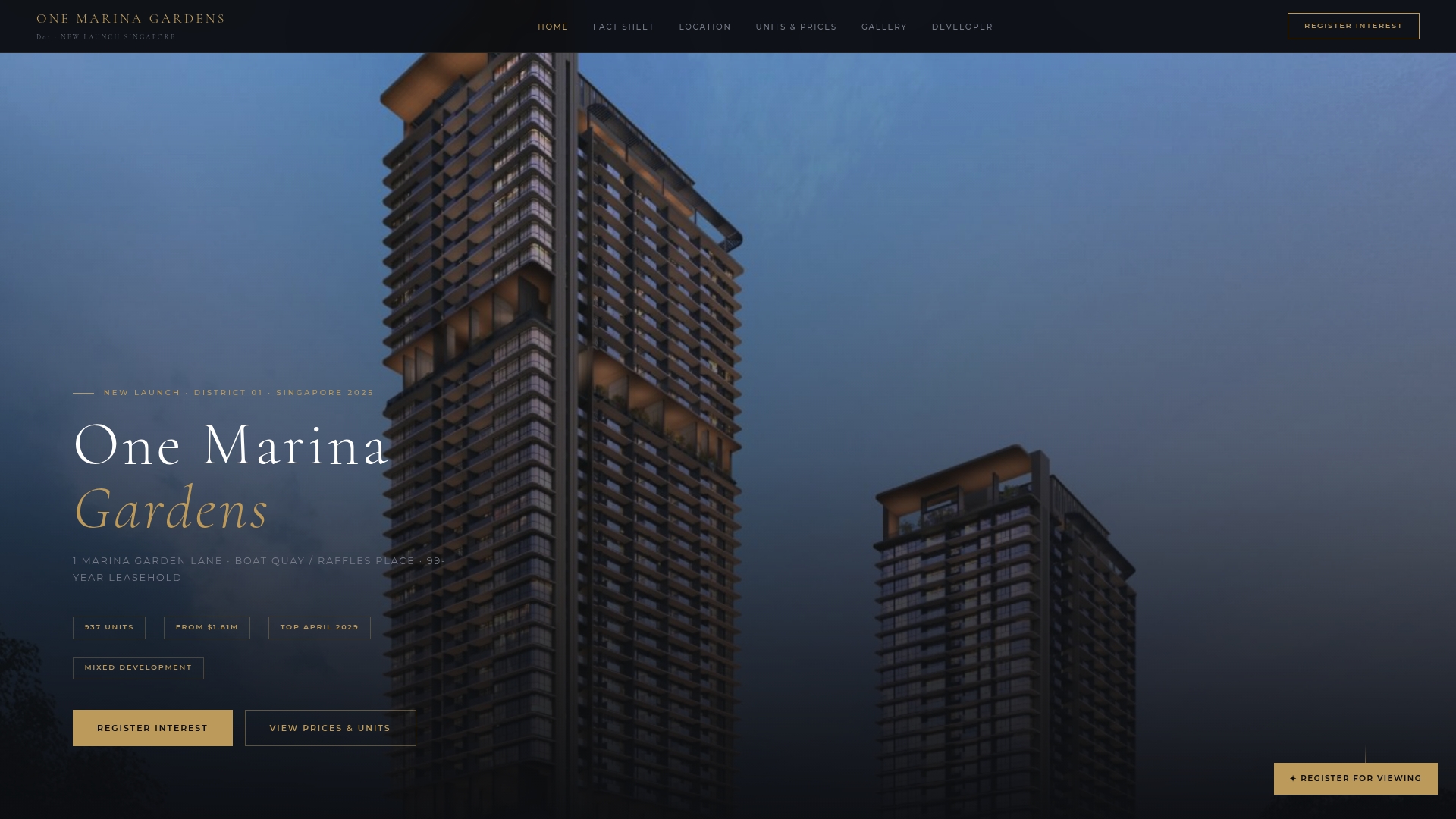
The 937-unit development sits 160 meters from Marina South MRT, offering direct connectivity to the CBD and Orchard Road. Multiple sky terraces, a 50-meter lap pool, and a dedicated childcare center create the amenity profile that research links to neighborhood price premiums. Units range from 1-bedroom to 4-bedroom configurations, serving both owner-occupiers and investors. Review the available units and pricing or register your interest to learn more about what Onemarinagardens offers.
FAQ
Do apartments lower nearby home values?
Well-designed apartments do not lower nearby home values and often increase them. Research from suburban Salt Lake County shows homes within half a mile of new apartments appreciated 1.4 percentage points faster annually than homes farther away.
How close to an apartment building does the negative effect occur?
Negative effects from nuisances like noise and traffic are strongest within the first few hundred feet of a project. Beyond a quarter mile, neighborhood-level benefits typically outweigh any localized discount.
Why do single-family home prices rise even when apartments are being built nearby?
Apartments serve renters, young professionals, and downsizers who are not competing for detached homes. This market segmentation means new apartment supply does not reduce demand for single-family properties, allowing both to appreciate simultaneously.
What is a vacancy chain and why does it matter for buyers?
A vacancy chain occurs when new apartment residents vacate older, more affordable homes, making those units available to the next tier of buyers. A single 512-unit Honolulu condo generated over 500 such vacancies within three years, expanding options across multiple price points.
How can investors assess the impact of a nearby apartment project?
Investors should evaluate project design, distance from the subject property, the retail and amenity mix, and the local development pipeline. Requesting design review documents from the planning department and pulling comparable sales data within 500 feet of similar completed projects gives the clearest picture.