
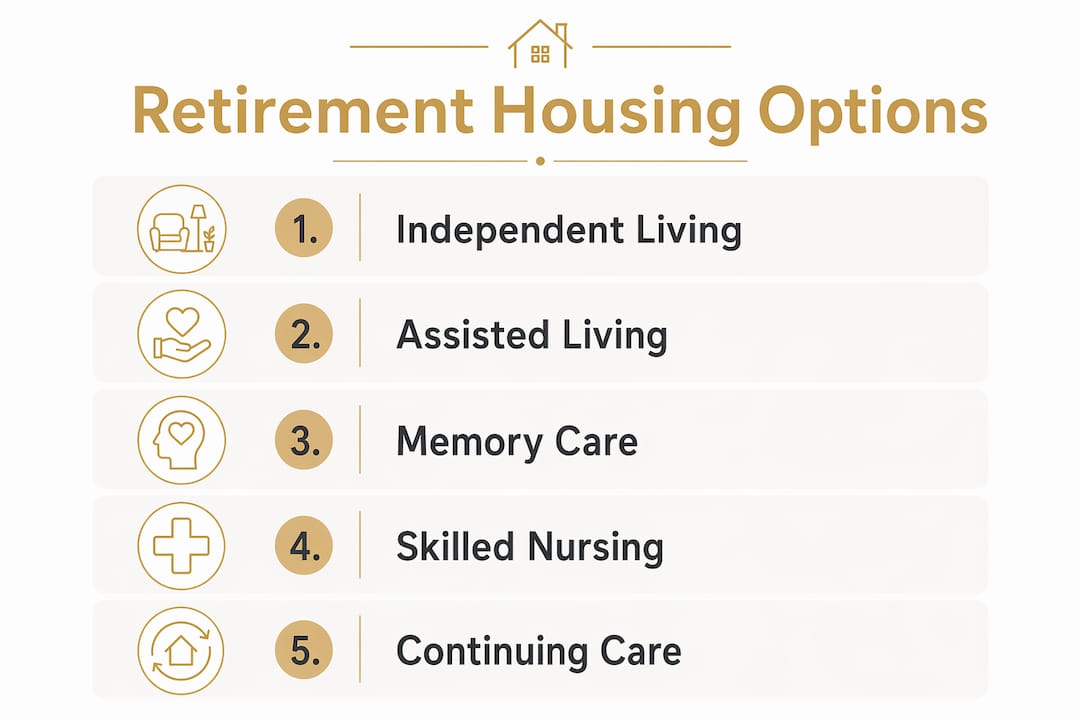
Seniors and their families exploring retirement housing beyond traditional condominiums have more options than most realize. The best retirement condo alternatives to Orchard Residences span a wide spectrum, from Continuing Care Retirement Communities (CCRCs) that bundle every care level under one roof, to maintenance-free rental apartments, active adult communities, assisted living, and memory care. Each type targets a different combination of health needs, lifestyle preferences, and financial goals. Here is a quick map of the landscape:
- CCRCs (Continuing Care Retirement Communities): All care levels on one campus, from independent living through skilled nursing
- Independent living condos: Ownership with shared amenities, no daily care services
- Purpose-built rental apartments: Maintenance-free renting with flexibility and no property tax exposure
- Active adult communities (55+): Age-restricted, resort-style lifestyle without medical support
- Assisted living communities: Personal care assistance with around-the-clock staff
- Memory care communities: Secure, specialized environments for cognitive impairment
The right fit depends on where you are today and where you expect to be in five or ten years.
1. Continuing care retirement communities offer all-in-one senior housing
A CCRC, sometimes called a life plan community, is the most comprehensive retirement housing alternative available in the United States. Tiered care on one campus means a resident can move from an independent apartment to assisted living or memory care without leaving the community, the neighbors, or the routines they have built. For anyone managing a progressive condition, or simply planning decades ahead, that continuity is hard to replicate elsewhere.
The care tiers typically include independent living, assisted living, memory care, and skilled nursing, all managed by a single organization. Amenities in most CCRCs rival those of upscale condominiums: dining programs, fitness centers, pools, arts studios, and organized social calendars. The difference is that the medical infrastructure is already in place when you need it, rather than something you have to arrange from scratch.
Fee structures vary. Some CCRCs require an upfront entrance fee, often comparable to local home prices in the area, plus a monthly fee. Others bill only a monthly fee that adjusts based on the care level the resident uses. According to Acts Retirement-Life Communities, many CCRCs offer fixed-rate contracts so costs stay predictable even when care needs change, which is a meaningful advantage over paying escalating care fees on the open market.
Key benefits of CCRCs at a glance:
- No need to relocate if health declines
- Predictable monthly costs under fixed-rate contracts
- Built-in social community and organized activities
- On-site healthcare access and emergency response
- Couples with different care needs can live in the same community
Pro Tip: Before signing any CCRC contract, ask specifically whether the entrance fee is refundable. Equity-based contracts may return a portion of the fee to your heirs; rental and non-refundable models do not. That distinction has real estate-planning consequences, so get the contract type in writing before you commit.
2. Independent living options: condos, rentals, and active adult communities
Independent living covers three distinct formats, and the financial and lifestyle differences between them are significant enough to deserve a careful look.

Condominiums give you ownership, equity potential, and the freedom to customize your space. The trade-off is ongoing financial exposure: property taxes, homeowners association fees, and the possibility of condo special assessments, which are large, unscheduled charges levied by the association for major repairs. These assessments can run into the thousands and are notoriously hard to predict when budgeting for retirement.
Purpose-built rental apartments for seniors are growing in popularity precisely because they sidestep those risks. Retirees increasingly favor rentals to avoid maintenance, property taxes, and special assessments, freeing home equity for other uses. The freed capital can fund travel, generate investment income, or simply sit in a more liquid form. The downside is real: renters build no equity, and they are subject to lease terms and potential rent increases.
Active adult communities (age-restricted to residents 55 and older) occupy a middle ground. These communities offer resort-style amenities, walking trails, fitness facilities, and community clubs designed for active seniors, without any medical or personal care services. They suit retirees who are healthy, socially motivated, and not yet thinking about care transitions.
| Feature | Condo ownership | Rental apartment | Active adult community |
|---|---|---|---|
| Ownership and equity | Yes | No | Varies (rent or own) |
| Property tax exposure | Yes | No | Varies |
| Special assessment risk | Yes | No | Low to none |
| Maintenance responsibility | Shared with HOA | None | Minimal |
| On-site amenities | Varies | Often included | Resort-style |
| Medical or care services | None | None | None |
| Financial flexibility | Lower (capital tied up) | Higher | Moderate |
| Social environment | Varies | Varies | Strong, age-matched |
- Condo ownership suits seniors who want equity and long-term asset control
- Rentals work best for those prioritizing flexibility and capital access
- Active adult communities fit healthy, social retirees who want a lifestyle upgrade without care obligations
3. Assisted living and memory care serve higher care needs
Assisted living fills the gap between independent living and a nursing home. It is designed for seniors who can manage most daily activities but need help with some, such as bathing, dressing, medication management, or housekeeping. Residents live in private or semi-private apartments and have access to staff around the clock for emergency assistance and daily task support. The model preserves as much independence as possible while ensuring help is always available.
Memory care communities go a step further. They provide a secure, structured environment specifically for residents with Alzheimer's disease or other forms of dementia. Staff receive specialized training, the physical layout minimizes wandering risks, and daily programming is designed to support cognitive function and emotional well-being. These are not simply locked assisted living units; the entire environment, from lighting to activity schedules, is built around the needs of people with cognitive impairment.
Both options sit toward the higher-cost end of the senior housing spectrum, reflecting the level of staffing and support involved. Key features of each:
- Assisted living: 24/7 staff availability, help with activities of daily living (ADLs), medication management, social programming, and on-site dining
- Memory care: Secured perimeter, dementia-trained staff, structured daily routines, sensory programming, and family support resources
- Both: Maintenance-free living, on-site emergency response, and a built-in social community
For families whose loved one can no longer safely live alone but does not yet need skilled nursing, assisted living is often the most appropriate and cost-effective step. Memory care becomes the right call when safety and cognitive support outweigh lifestyle considerations.
4. How to choose the right retirement housing alternative
The decision comes down to three factors: health status today, realistic expectations for the future, and financial readiness. According to AssistedLiving.org, senior housing forms a continuum that reflects the diverse aging trajectories people follow, from active independence to specialized memory care. No single option fits everyone, and the right answer at 68 may be the wrong one at 78.
Start with an honest assessment of your current ability to perform activities of daily living (ADLs): eating, dressing, bathing, toileting, and mobility. If you handle all of these independently and expect to for the foreseeable future, independent living or an active adult community is a reasonable starting point. If one or more ADLs already require help, assisted living deserves serious consideration now rather than after a crisis forces the move.
Pro Tip: Plan one level ahead. If you are choosing independent living today, ask whether the community has an assisted living option on-site or a formal transfer agreement with a nearby facility. Choosing a setting with no care pathway can mean an emergency relocation later, which is far more disruptive than a planned transition.
Key questions to ask when evaluating any community:
- What care levels are available on-site, and what triggers a transfer out?
- How are monthly fees structured, and what happens to costs if care needs increase?
- What is the staff-to-resident ratio, and how is staffing handled overnight?
- Are transportation services included, and what medical providers are nearby?
- What social, recreational, and wellness programs run regularly?
- Is the community financially stable, and can you review audited financials?
Acts Retirement-Life Communities notes that retirement housing choices should balance health status, social preferences, and financial goals equally, because care levels and costs vary significantly across options. Treating any one of those three factors as secondary tends to produce regret.
5. Cost considerations and what the financial trade-offs actually look like
Cost is where many retirement housing decisions get made, and where the most common mistakes happen. Independent living is typically the least expensive option; assisted living and memory care carry higher costs because of the staffing and medical infrastructure they require. CCRCs sit in a category of their own: the upfront entrance fee can be substantial, but the predictable monthly cost structure often delivers better long-term value than paying escalating care fees on the open market as needs change.
Financial advisors caution that tying up large home equity in a condo carries real opportunity costs. Capital locked in a property cannot generate investment income, fund travel, or cover unexpected medical expenses. For retirees who have already built equity over decades, renting and deploying that capital elsewhere is sometimes the stronger financial move, depending on the market and personal goals.
Condo ownership in retirement also carries risks that are easy to underestimate. Special assessments are unexpected large fees charged by condo associations for major repairs beyond what regular monthly fees cover. They can arrive with little warning and run into the thousands of dollars, a serious budget disruption for anyone on a fixed income.
Cost elements to account for across housing types:
- CCRCs: Entrance fee (potentially refundable depending on contract type), monthly fee covering housing, amenities, and future care
- Owned condos: Purchase price, HOA fees, property taxes, maintenance, and special assessment exposure
- Rental apartments: Monthly rent, renter's insurance, no property tax or maintenance costs
- Active adult communities: Rent or purchase price, HOA or community fees, no care costs
- Assisted living: Monthly fee covering room, board, and personal care services
- Memory care: Higher monthly fee reflecting specialized staffing and programming
Cost reality check: Independent living is the most affordable entry point, but it offers no care safety net. CCRCs cost more upfront yet often deliver the most predictable long-term value. Assisted living and memory care costs reflect the level of staffing they require, and those costs are largely unavoidable once care needs reach that level.
The smartest financial approach is to map your current assets against the realistic cost trajectory of your likely care path, not just the cost of where you want to live today. A financial advisor who specializes in elder care planning can model these scenarios and factor in home equity, Social Security income, and long-term care insurance before you commit to any option.
Key Takeaways
The best retirement housing alternative depends on matching care level, lifestyle preferences, and financial structure to your specific situation, not on finding the most prestigious address.
| Point | Details |
|---|---|
| CCRCs offer the most continuity | All care levels on one campus reduce relocation risk as health needs change over time. |
| Rentals free capital that condos lock up | Financial advisors note that home equity tied to a condo cannot generate income or fund other retirement needs. |
| Special assessments are a real ownership risk | Condo associations can levy large, unscheduled repair fees that disrupt fixed-income budgets. |
| Match housing to your ADL status | Your ability to perform daily activities independently is the clearest guide to which care level fits now. |
| Plan one level ahead | Choosing a community with no care pathway can force an emergency move later, which is harder on everyone. |
Recommended
- One Marina Gardens vs Marina One Residences — Which D01 Condo to Buy in 2026?
- One Marina Gardens | New Launch Condo D01 Singapore 2025 | Prices from $1.81M
- Is One Marina Gardens a Good Investment? Marina South Growth Story (2026)
- One Marina Gardens Location | Marina Garden Lane D01, Near Marina South MRT