Retirement living in Singapore condos is the most practical housing choice for retirees who want financial flexibility, low maintenance, and a connected urban lifestyle. Downsizing from a landed home to a condo can unlock between S$2 million and S$6 million in capital, freeing up funds that would otherwise sit locked in bricks and mortar. The Management Corporation Strata Title (MCST) model shifts daily upkeep to a professional management body, removing the physical and administrative burden that weighs on retirees managing large properties. For retirees weighing their next move, the condo option delivers on three fronts: money, mobility, and community.
What financial advantages do retirees gain by moving to condos in Singapore?
The financial case for condo living starts with the gap between what you own and what you need. Landed homes in prime districts are typically valued between S$4 million and S$8 million, while comparable condos sit around S$2 million. That difference is not just a number on paper. It becomes investable capital that can generate retirement income through fixed deposits, bonds, or dividend portfolios.
Monthly costs drop sharply after the move. Property tax on a smaller condo unit is lower than on a landed home. You no longer pay for gardeners, external painters, or roof repairs. The MCST covers pool maintenance, security, and common area upkeep through a monthly management fee, which is predictable and shared across all residents.
Tenure choice also shapes your budget. Freehold condos carry a 10–20% price premium over comparable leasehold units. That premium buys peace of mind on lease decay, but it also means a smaller unit for the same dollar. Retirees on a fixed budget need to weigh whether that premium delivers real daily value or simply looks better on paper.
Pro Tip: If you plan to hold the condo for 15–20 years and then pass it to family, freehold tenure matters. If your horizon is shorter, a leasehold unit in a well-located suburban district often gives you more space and better cash flow.
| Feature | Freehold prime district | Leasehold suburban district |
|---|---|---|
| Typical price (S$1.5M budget) | Smaller unit, higher per sq ft | Larger unit, lower per sq ft |
| Lease decay risk | None | Present after 30+ years |
| Resale flexibility | Strong | Good within 20 years |
| Monthly cost | Higher management fees | Generally lower |
Which condo features and locations best support retirees' lifestyle and independence?
Location is the single most important variable in a retirement condo decision. A unit near a polyclinic, a major hospital, and an MRT station covers three of the most critical daily needs for aging residents. Condos near MRT stations for retirees remove the dependence on driving, which becomes a practical concern as mobility changes with age.
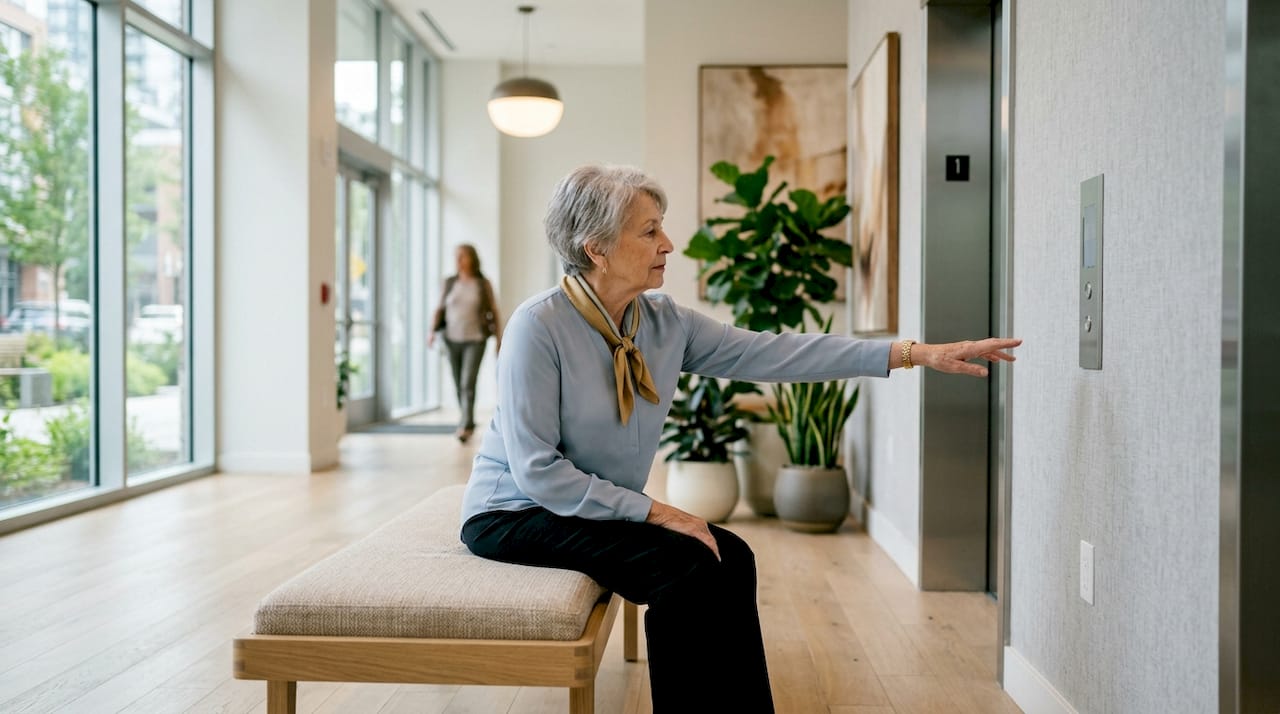
Accessibility inside the building matters just as much as the neighborhood. Adding a lift to a landed home costs upwards of S$80,000, while condos provide lift access to every floor as a standard feature. Barrier-free common areas, wide corridors, and step-free entrances are built into modern condo design. These features support aging in place without costly retrofits.
The right unit characteristics reduce daily friction. A single-level layout eliminates internal stairs. A mid-floor unit on a quiet facing reduces noise and heat. A two-bedroom unit gives couples enough space to live comfortably and accommodate a caregiver if needed later. These are not luxury preferences. They are practical decisions that affect quality of life for years.
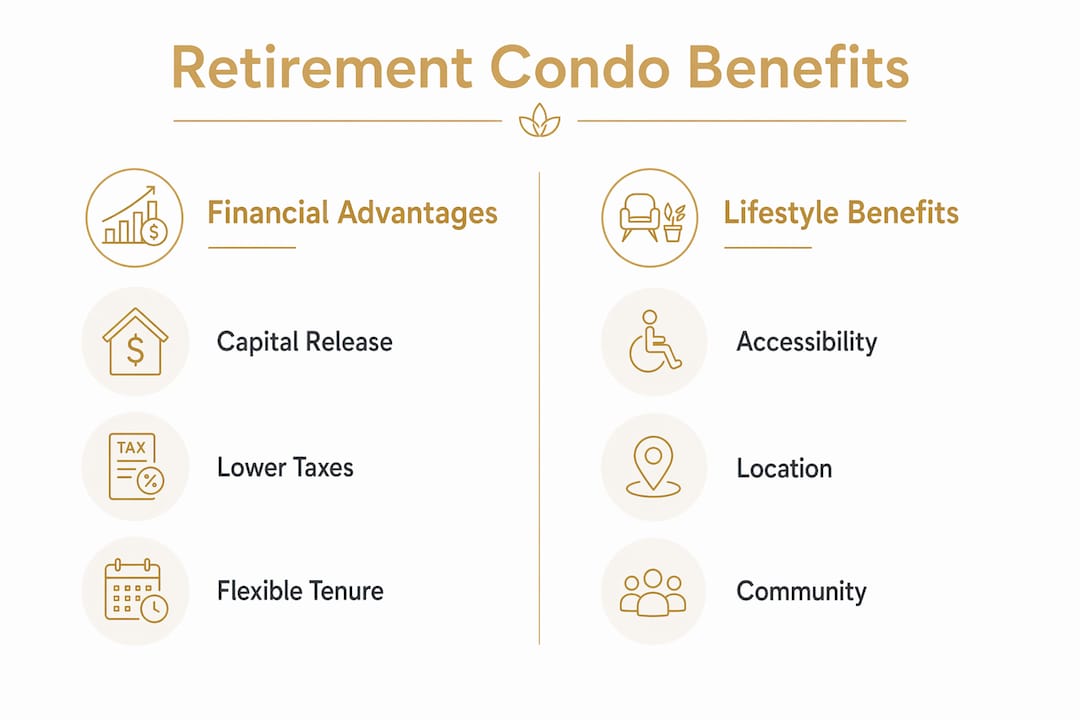
Social connection is a real benefit of condo living that retirees often underestimate before they move. Shared amenities and resident events create natural opportunities to meet neighbors, join interest groups, and stay active. Isolation is a documented health risk for older adults, and the built-in community of a condo directly counters it.
Key features to prioritize when selecting a senior-friendly condo:
- MRT proximity: Walking distance to a station removes driving dependency entirely.
- Healthcare access: Within 1–2 km of a polyclinic or private hospital.
- Single-level unit layout: No internal stairs between living areas.
- 24-hour security: Manned guardhouse and CCTV coverage.
- Lift access on every floor: Non-negotiable for long-term mobility.
- Active facilities: Pool, gym, and function rooms that encourage daily movement.
Pro Tip: Visit any shortlisted condo on a weekday morning. That is when you see the actual resident demographic, how busy the facilities are, and whether the management keeps common areas clean and well-maintained.
How do different condo choices affect living space and lifestyle trade-offs?
Budget shapes every retirement condo decision, and the S$1.5 million mark is where the trade-offs become most visible. At that price point, a freehold one-bedroom unit in a prime district runs about 660 sq ft, while a leasehold two-bedroom unit in a suburban district can reach approximately 829 sq ft. That 169 sq ft difference is a full bedroom and a larger living area.
For a single retiree, a 660 sq ft unit is workable. For a couple, it becomes tight quickly, especially if one partner needs a dedicated workspace or the unit needs to accommodate overnight family visits. Space is not a vanity metric in retirement. It directly affects daily comfort and the ability to age in place without feeling confined.
Freehold tenure offers better asset preservation, but retirees increasingly prioritize livability, size, and practical exit strategies over tenure when downsizing. A larger leasehold unit in a well-connected suburban district often delivers a better daily experience than a smaller freehold unit in a prime location. The key question is: how long do you plan to hold the property, and what matters more, the view or the room to breathe?
District familiarity also plays a role that financial models do not capture. Retirees who have lived in the east for decades often find that moving to a prime district condo feels disorienting, even if the numbers favor it. Staying close to existing social networks, familiar hawker centers, and long-standing medical providers has real quality-of-life value.
What government housing schemes help retirees downsize?
The Singapore government actively supports seniors who want to rightsize their housing. The 2-room Flexi flat and Community Care Apartment schemes offer smaller, purpose-designed homes with flexible financial terms tailored to older buyers. These options are not direct substitutes for private condos, but they form part of a broader retirement housing toolkit.
Key government-supported options and features include:
- 2-room Flexi flats: Shorter lease options (15–45 years) allow seniors to pay less upfront while retaining CPF savings for living expenses.
- Community Care Apartments: Integrated care services within the building, designed for seniors who want support without moving to a nursing facility.
- CPF Housing Grant support: Eligible seniors can access grants that reduce the purchase price of smaller HDB units.
- Silver Housing Bonus: Seniors who downsize from larger HDB flats to smaller ones receive a cash bonus deposited into their CPF Retirement Account.
These schemes work best as part of a broader plan. Retirees who combine a government-supported smaller home with proceeds from selling a larger property can build a more stable retirement income base. The CPF resources on senior housing provide detailed eligibility criteria and financial calculators that make the planning process concrete rather than theoretical.
Key Takeaways
Retirement living in Singapore condos delivers the strongest combination of financial flexibility, accessibility, and community support when retirees match their unit choice to their actual lifestyle needs and budget.
| Point | Details |
|---|---|
| Capital release potential | Downsizing from landed homes can free S$2M–S$6M for retirement income. |
| Accessibility by default | Condos provide lift access and barrier-free design without costly modifications. |
| Freehold vs leasehold trade-off | Freehold costs 10–20% more but offers smaller units; leasehold gives more space for the budget. |
| Location drives independence | Proximity to MRT stations and healthcare is the most critical factor for long-term livability. |
| Government schemes add options | CPF-linked schemes like 2-room Flexi flats and Community Care Apartments support flexible downsizing. |
Why I think most retirees wait too long to make this move
The retirees I have spoken with who moved to condos early, say in their late 50s or early 60s, consistently report that they wish they had done it sooner. The ones who waited until health forced the decision often had fewer options and less negotiating power in the market.
The financial logic is clear. Holding multiple properties in retirement creates execution risk: tenant management, vacancy gaps, and maintenance calls do not stop because you are older. Liquidating non-primary properties simplifies your finances and your daily life at the same time.
What I find most underappreciated is the emotional weight of managing a large landed home alone. The garden, the roof, the plumbing. These are not just costs. They are sources of ongoing stress that quietly erode quality of life. A well-run condo removes that entirely.
My honest advice: visit at least five condos before you decide, and spend time in the common areas at different hours. The right retirement condo should feel like it works for you, not like a compromise. Prioritize the right condo location over prestige, and choose a unit size that gives you room to live well, not just to own something impressive.
— Velisa
Onemarinagardens: a premier option for retirement in Singapore's CBD
Retirees who want urban connectivity without sacrificing comfort will find Onemarinagardens worth a close look. Located in District 01 along Marina Garden Lane, it sits 160 meters from Marina South MRT, putting the CBD, Orchard Road, and major healthcare hubs within easy reach by train.

The development by Kingsford Marina Development offers 937 units ranging from one-bedroom to four-bedroom configurations, with prices starting from S$1.81 million. Amenities include a 50-metre lap pool, multiple sky terraces, 24-hour security, and lift access throughout. These are not add-ons. They are the daily infrastructure that makes independent retirement living practical. Retirees can review the full unit options and pricing to assess fit against their budget and space requirements.
FAQ
What is the main financial benefit of condo living for retirees in Singapore?
Downsizing from a landed home to a condo can release between S$2 million and S$6 million in capital. That freed capital can fund retirement income through investments while monthly costs drop significantly.
Are condos near MRT stations better for retirees?
Yes. Condos near MRT stations remove the need to drive, which becomes critical as mobility changes with age. Proximity to transport also improves access to healthcare, shopping, and social activities.
What is the difference between freehold and leasehold condos for retirement?
Freehold condos carry a 10–20% price premium and have no lease decay, but typically offer smaller units for the same budget. Leasehold condos in suburban districts often provide more space and lower monthly costs.
What government schemes support seniors downsizing in Singapore?
The CPF Board supports seniors through 2-room Flexi flats with shorter lease options and Community Care Apartments with integrated care services. The Silver Housing Bonus also rewards eligible seniors who move to smaller HDB units.
How do I choose the right condo size for retirement?
A two-bedroom unit of at least 700–800 sq ft works well for couples and allows space for a caregiver if needed. Single retirees can manage comfortably in a one-bedroom unit, provided the layout is single-level and the building has full lift access.