
For a luxury new-build condo in Singapore's District 01, a net rental yield in the low single digits is a realistic and respectable target. That's well below the U.S. national average gross yield, which tends to be higher, and deliberately so. Prime city-center assets trade yield for durability of demand and long-term appreciation. One Marina Gardens sits squarely in that category.
Quick benchmarks by strategy:
- Cash-flow markets (Midwest, secondary U.S. cities): 7–9% gross, 5–8% net
- Balanced markets (Charlotte, Phoenix, Tampa): 5–7% gross, 4–6% net
- Premium coastal/central markets (Manhattan, Singapore D01): 2–4% gross, 2–3.5% net
- One Marina Gardens target range: 2.5–3.5% net yield, with appreciation as the primary return driver
Table of Contents
- What is a good rental yield for an investment property? Gross, net, and cap rate explained
- How to calculate rental yield step by step
- How do yield benchmarks differ across residential asset types?
- What costs actually reduce your gross yield to net?
- Why a lower yield can still be the better investment
- Cross-border considerations for U.S. investors buying in Singapore
- A checklist for screening any listing by rental yield
- One Marina Gardens: a worked yield example for a D01 unit
- How to use yield as a practical screening tool for listings
- Key Takeaways
- A perspective on yield and what it actually tells you
- One Marina Gardens suits both appreciation and balanced investors
- Useful sources and next steps
What is a good rental yield for an investment property? Gross, net, and cap rate explained
Three metrics dominate rental yield analysis. Using the wrong one at the wrong stage of a deal is how investors misread a listing.
Gross rental yield is annual rent divided by purchase price, expressed as a percentage. It's fast and useful for filtering a long list of properties, but it ignores every expense.
Net rental yield subtracts operating costs before dividing by purchase price. This is the number that actually tells you what you keep.
Cap rate uses net operating income (NOI) divided by property value, independent of financing. It's the standard for comparing properties across different capital structures.
| Metric | Formula | Best used for | Key limitation |
|---|---|---|---|
| Gross yield | Annual rent ÷ purchase price × 100 | Quick screening | Ignores all expenses |
| Net yield | (Annual rent − expenses) ÷ purchase price × 100 | Investment comparison | Requires accurate expense data |
| Cap rate | NOI ÷ property value × 100 | Cross-property underwriting | Excludes financing costs |
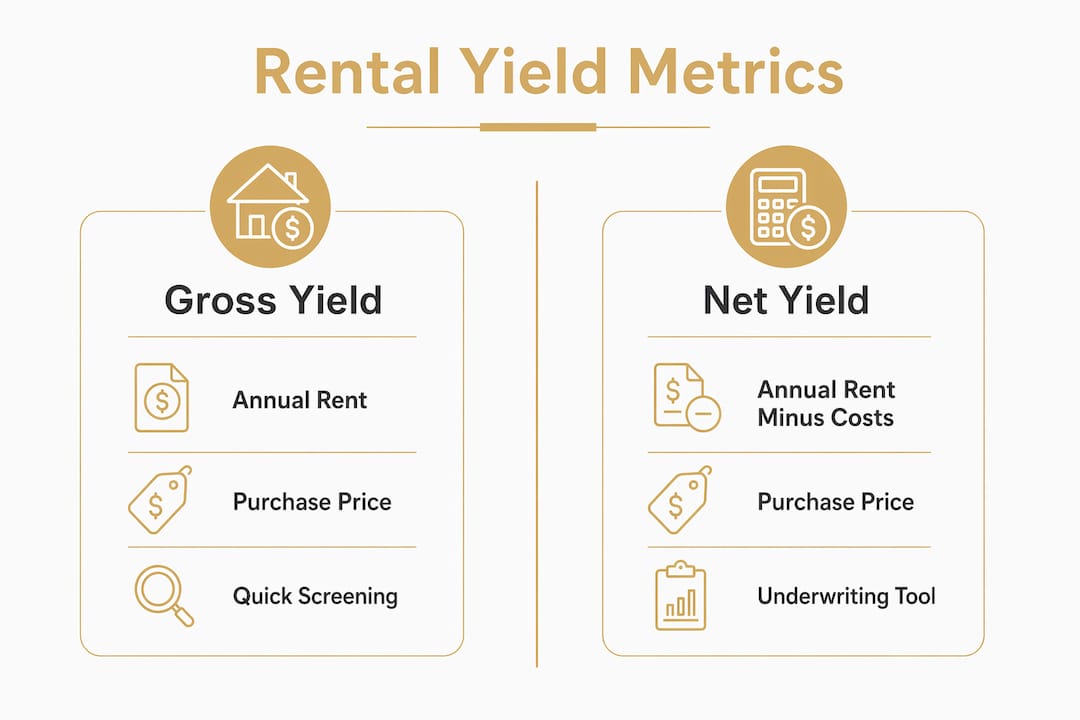
Analysts recommend using gross yield to screen and net yield (or cap rate) to underwrite. Never make a final acquisition decision on gross yield alone.
How to calculate rental yield step by step
Step 1 — Gather your inputs: annual rent, purchase price, HOA/service charge, property management fee, vacancy reserve, insurance, and property taxes.

Step 2 — Calculate gross yield: (Annual rent ÷ purchase price) × 100.
Step 3 — Total your annual expenses: add management fee (typically 8–10% of rent), maintenance/HOA, vacancy reserve (5–8% of annual rent), insurance, and property taxes.
Step 4 — Calculate net yield: ((Annual rent − total expenses) ÷ purchase price) × 100.
Step 5 — Run a sensitivity check: shift rent down 10% and expenses up 10%. If net yield drops below your minimum threshold, the deal needs a harder look.
Worked example (illustrative assumptions):
- Purchase price: $1,500,000
- Monthly rent: $4,500 → annual rent: $54,000
- Gross yield: 3.6%
- Annual expenses: management fee $4,320 + HOA/service charge $6,000 + vacancy reserve $2,700 + insurance $1,200 + property tax $3,000 = $17,220
- Net yield: ($54,000 − $17,220) ÷ $1,500,000 × 100 = 2.45%
A 10% rent drop to $4,050/month cuts net yield to roughly 1.9%. That's the scenario to stress-test before signing.
How do yield benchmarks differ across residential asset types?
Location and asset class set the ceiling on what yield is achievable. Gross yields in low-yield coastal U.S. markets run 2–4%, while high-yield Midwest markets reach 7–9%. Singapore's D01 sits firmly in the premium-coastal bucket.
| Asset type | Typical gross yield | Typical net yield | Primary return driver |
|---|---|---|---|
| High-yield cash-flow (Midwest U.S.) | 7–9% | 5–8% | Monthly income |
| Balanced secondary markets | 5–7% | 4–6% | Income + moderate appreciation |
| Premium coastal/central (U.S.) | 2–4% | 2–3.5% | Capital appreciation |
| Luxury new-build, D01 Singapore | 2.5–4% | 2–3.5% | Appreciation + rental durability |
Premium properties commonly show lower immediate yields in the 2–4% range, but that compression reflects demand durability and appreciation potential, not weakness. Chasing high headline yields without understanding the location can lead straight into value traps: high vacancy, deferred maintenance, or structurally weak tenant demand.
What costs actually reduce your gross yield to net?
Expenses typically consume a significant portion of gross rent in most markets. Use the 50% rule as a stress test: assume half your gross rent disappears to expenses. If the deal still works, you have a margin of safety.
Common expense categories:
- Property management: 8–10% of monthly rent
- HOA/service charge: varies widely; luxury condos often run $500–$1,000+/month
- Property taxes: 1–3% of property value annually (U.S. context; Singapore has its own ABSD and property tax structure)
- Insurance: $800–$2,000/year for a standard unit
- Vacancy reserve: 5–8% of annual rent
- Capex reserve: 1% of property value annually is a common rule of thumb
Pro Tip: Foreign buyers in Singapore face Additional Buyer's Stamp Duty (ABSD) that can reach 60% for U.S. citizens purchasing a first residential property. That acquisition cost materially changes your effective yield calculation from day one. Budget it into your total acquisition cost, not just the unit price.
For a D01 luxury condo, service charge escalations and short-term rental restrictions (Singapore limits most condos to minimum 3-month leases) are two costs many investors underestimate.
Why a lower yield can still be the better investment
Total return is what matters, not yield in isolation. The formula is straightforward: Total Return = Net Yield + Appreciation Rate.
Rent growth materially affects performance over a 3–5 year horizon. A property with 3% net yield and 6% annual appreciation delivers a 9% total return. That beats an 8% yield property in a flat market.
| Scenario | Net yield | Annual appreciation | 5-year total return (approx.) |
|---|---|---|---|
| High-yield, low-growth | 7% | 0–1% | 35–45% |
| Low-yield, high-growth (D01 luxury) | 3% | 5–7% | 50% |
The D01 scenario wins on total return over five years, but it demands patience and adequate cash reserves to cover negative cash flow in early years. Appreciation investors with a 7–10 year horizon are the natural fit. Cash-flow investors who need monthly income from day one should look at higher-yield markets first.
Cross-border considerations for U.S. investors buying in Singapore
Buying a Singapore condo as a U.S. citizen adds layers of complexity that directly affect net returns.
- ABSD: U.S. citizens pay 60% Additional Buyer's Stamp Duty on residential property purchases in Singapore. This is a major upfront cost that must be factored into your effective yield calculation.
- U.S. tax reporting: Foreign rental income is taxable in the U.S. You must report it on your federal return. Foreign tax credits may offset Singapore taxes paid, but the interaction is complex.
- FBAR and FATCA: If you hold a Singapore bank account to receive rent, balances above $10,000 trigger FBAR reporting. FATCA thresholds apply separately.
- Currency risk: SGD/USD movement directly affects your income in dollar terms. A 5% SGD depreciation against the dollar cuts your effective dollar yield by roughly the same amount.
- Financing: Most U.S. lenders won't finance foreign property. Singapore banks may lend to foreigners, but at lower loan-to-value ratios.
Consult a U.S. tax advisor with international real estate experience and a Singapore-licensed conveyancing lawyer before transacting.
A checklist for screening any listing by rental yield
- Run the 1% rule first. Monthly rent should be roughly 1% of purchase price for a healthy gross yield. This rule breaks down in premium markets like D01, but it's a fast eliminator for overpriced listings.
- Calculate gross yield. Use it only to screen, not to decide. Set a gross yield floor consistent with your strategy (e.g., 3%+ for appreciation plays, 6%+ for cash-flow plays).
- Build a net yield model. Apply realistic expense ratios: 35–45% of gross rent for efficient markets, 50% as a stress test.
- Test sensitivity. Shift rent down 10% and vacancy up to 10%. If net yield stays above your minimum, proceed.
- Check local rent-growth trends. BLS data shows national U.S. rent growth averaging 3–4% in recent 12-month periods, but Singapore's D01 rental market follows its own cycle.
- Model currency scenarios if buying cross-border. Run SGD/USD at flat, +5%, and −5%.
- Compare at least three comparable listings before approaching the developer's sales team.
- Set your personal net yield minimum based on strategy: 5%+ for cash flow, 2.5–4% for appreciation-led D01 luxury.
One Marina Gardens: a worked yield example for a D01 unit
One Marina Gardens units start from S$1.81M for a 1-bedroom. The following two scenarios use illustrative assumptions; verify current pricing and rental market rates with the sales team before modeling your own deal.
Conservative scenario (1-bedroom, ~S$1.9M):
- Monthly rent: S$4,200 → annual: S$50,400
- Gross yield: 2.65%
- Annual expenses: service charge S$7,200 + management fee S$4,032 + vacancy reserve S$2,520 + insurance S$1,500 = S$15,252
- Net yield: (S$50,400 − S$15,252) ÷ S$1,900,000 × 100 = 1.85%
Optimistic scenario (1-bedroom, ~S$1.9M, stronger rental market):
- Monthly rent: S$5,000 → annual: S$60,000
- Gross yield: 3.16%
- Annual expenses: S$15,600 (same cost base)
- Net yield: (S$60,000 − S$15,600) ÷ S$1,900,000 × 100 = 2.34%
The gap between conservative and optimistic net yield is roughly 0.5 percentage points. That's a meaningful difference over a 10-year hold. Rent assumptions are the single biggest variable; get current rental comps from local agents before locking in your model. Note: ABSD is excluded from these scenarios but would significantly increase total acquisition cost for U.S. buyers.
How to use yield as a practical screening tool for listings
Step 1: Apply a gross yield filter on listing sites. For D01 luxury, screen for 2.5%+ gross. For cash-flow markets, screen for 6%+.
Step 2: On anything that passes, build a full net yield model using the step-by-step method above. Require net yield to meet your personal minimum before spending more time on a listing.
Step 3: Pull rental comps from local agents or property portals. Verify that your rent assumption is achievable, not aspirational.
Step 4: Request the developer's expected service charge schedule. For One Marina Gardens, the project fact sheet covers facilities and unit distribution; use it alongside agent-sourced rental data.
Step 5: Run cash-on-cash return if you're using financing. A leveraged position changes the return profile significantly.
Step 6: Calculate IRR over your target hold period, incorporating rent growth and an exit price assumption. This is the number that lets you compare a D01 condo against any other asset class on equal footing.
Step 7: If the deal passes all six steps, book a showflat appointment and request updated pricing and rental assumptions directly from the sales team.
Key screening thresholds to apply:
- Gross yield floor: 2.5% for appreciation plays, 6% for cash-flow plays
- Net yield minimum: match to strategy (2–3.5% for D01 luxury, 5%+ for cash-flow)
- Vacancy stress test: model 10% vacancy before committing
Key Takeaways
For luxury new-build condos in Singapore's District 01, a net yield of 2–3.5% is realistic and acceptable when appreciation and rental durability are the primary return drivers.
| Point | Details |
|---|---|
| Net yield is the right metric | Gross yield screens listings; net yield (after all expenses) is what you actually earn. |
| D01 luxury yield range | Expect 2–3.5% net for a prime Singapore condo; well below U.S. averages, by design. |
| Total return beats yield alone | A 3% net yield plus 5–7% appreciation outperforms an 8% yield with flat capital growth. |
| U.S. buyers face ABSD | Singapore's 60% ABSD for U.S. citizens is a major acquisition cost; model it into every yield calculation. |
| One Marina Gardens | Units from S$1.81M; conservative net yield estimate 1.85–2.34% based on illustrative assumptions. |
A perspective on yield and what it actually tells you
Most investors come to a property like One Marina Gardens asking the wrong first question. They want to know if the yield is "good" before they've decided what good means for their situation.
Here's the honest framing: a 2–3.5% net yield on a D01 luxury condo is not a consolation prize. It's the price of admission to a market with structural tenant demand, limited new supply in the immediate precinct, and a location that doesn't go out of fashion. The investors who get burned are the ones who benchmark it against a Memphis duplex and walk away, then watch the condo appreciate 30% over five years while their duplex sits at the same price.
That said, yield compression in prime markets is real, and it demands discipline. Run the numbers conservatively. Model the ABSD. Get a cross-border tax advisor before you wire anything. And don't let appreciation projections paper over a deal that doesn't work at current rents. The investment case for District 01 is strong, but it's an appreciation and rental-durability story, not a cash-flow story. Know which story you're buying before you sign.
One Marina Gardens suits both appreciation and balanced investors
One Marina Gardens offers a product mix that covers 1- to 4-bedroom units from S$1.81M, with direct access to Marina South MRT and proximity to Singapore's CBD. For investors focused on long-term capital growth, the District 01 address and mixed-use environment support durable rental demand from corporate tenants and expatriate professionals.

For balanced investors who want both income and appreciation, the development's range of unit sizes lets you match your entry price to your yield target. Smaller units typically deliver higher gross yields relative to price; larger units attract longer-tenancy corporate renters.
View the current price list and available units or register interest and book a showflat appointment to get updated rental assumptions directly from the sales team. Before transacting, consult a U.S. cross-border tax advisor and a Singapore-licensed lawyer. This article is general information, not legal, tax, or financial advice.
Useful sources and next steps
- One Marina Gardens price list and unit availability — current pricing for yield calculations
- One Marina Gardens fact sheet — project specs, facilities, and unit distribution
- Gross rental yield by metro (DealCalcPro) — U.S. market benchmarks
- How to calculate rental yield (Wise) — formula reference
- Rental yield: gross, net, and what to subtract (HousingHandbook) — expense ratio guidance
- America's rental housing 2026 (Harvard JCHS) — market context
- HouseCanary rental yield explained — short-term rental considerations
For U.S. tax and reporting obligations on foreign rental income, consult a CPA with international real estate experience. For Singapore transaction law, ABSD calculations, and tenancy regulations, engage a Singapore-licensed conveyancing lawyer before signing any purchase agreement.