District 01's median transacted PSF sits around $3,600 as of Q2 2026, with Marina Bay's individual towers trading anywhere from roughly $2,100 to $3,800 per square foot depending on the project and unit mix, according to URA data and the Marina Bay neighbourhood guide. Short-term movement has skewed upward on thin volume, which means capital preservation and long-hold positioning currently make more sense than betting on a quick flip.
TL;DR:
- Most Marina Bay units trade below the district-wide median PSF of $3,600, with older projects like Marina Bay Residences averaging around $2,100 to $2,700.
- Transaction volume is thin, and recent PSF shifts are driven mainly by outlier trades and unit mix rather than broad market movements or new supply.
- Scarcity from limited new launches and ABSD policies keeps Marina Bay’s PSF resilient, especially with no large pipeline of new developments planned nearby.
- Current market signals favor patient investors with long-term capital, as low volume, high transaction variability, and macro factors contribute to PSF volatility.
- Buyers should verify PSF figures independently using URA and REALIS data and consider the district’s historical cycle pattern of volume-driven corrections rather than sharp price drops.
Table of Contents
- Current PSF Snapshot: Marina Bay Residences, The Sail, Marina One and the District 01 Benchmark
- What's Driving the Recent PSF Movement in Marina Bay
- Why Supply Scarcity and ABSD Keep Marina Bay PSF Resilient
- How Marina Bay's PSF Translates Into Rental Yield
- How to Verify Marina Bay PSF Yourself Using URA and REALIS
- Marina Bay's PSF Through Past Market Cycles
- How Marina Bay Stacks Up Against Other Prime Districts
- How New Infrastructure Could Shift Future PSF Trends
- Who's Buying in Marina Bay: Foreign vs. Local Demand
- What Moves PSF Volatility: Rates, Policy, and Macro Conditions
- Where the Data Points for Buyers Weighing Marina Bay Right Now
- See One Marina Gardens' Current Pricing, Gallery and Fact Sheet
- Sources
- FAQ
Current PSF Snapshot: Marina Bay Residences, The Sail, Marina One and the District 01 Benchmark
Marina Bay's four flagship names trade at noticeably different price points, and lumping them together into one "Marina Bay PSF" number hides more than it reveals. Marina Bay Residences, the oldest of the group, posts median PSF figures in the $2,100 to $2,700 range, according to PropKaki's transaction summary. The Sail @ Marina Bay tracks a similar band historically, with its own multi-year PSF series showing steady rental activity alongside price appreciation, per RealSmart's project data. Marina One Residences and One Marina Gardens, both newer to the skyline, generally command premiums closer to the top of the District 01 range given their construction age and amenity packages.
| Project | Recent median/average PSF | Data window | Notes |
|---|---|---|---|
| Marina Bay Residences | ~$2,100–$2,700 | Multi-year trailing | Older stock, smaller units lift median |
| The Sail @ Marina Bay | Comparable band, project-specific series | Annual series | Active rental turnover |
| District 01 benchmark | ~$3,600 median | Q2 2026 | Blended across new and resale stock |
The gap between individual project medians and the broader District 01 figure comes down to sample composition. A district-wide median blends new-launch pricing with older resale stock, so it typically runs higher than any single older project's own median. One Marina Gardens, as a newer launch, sits closer to the upper end of that District 01 spectrum rather than near the older resale towers.
What's Driving the Recent PSF Movement in Marina Bay
Recent PSF shifts in Marina Bay owe more to which units traded than to a broad repricing of the neighborhood. When a handful of large-format or penthouse units close in a given quarter, the average PSF can swing several percentage points even if the underlying market barely moved.
A few mechanics explain most of what you'll see in the data:
- Median vs. mean matters. A median resists distortion from one outlier trade; a mean does not, so a single $10 million penthouse sale can drag the average PSF upward even while typical unit prices hold flat.
- Unit mix skews the numbers. Compact one and two-bedroom units trade more often and at higher PSF than larger family units, which lifts the median when they dominate a quarter's volume.
- Low transaction counts amplify noise. District 01 sees far fewer trades per quarter than mass-market districts, so three or four unusual sales can move the headline figure noticeably.
EdgeProp and industry trackers regularly flag this pattern in Marina Bay specifically, where quarterly volume is thin enough that any single high-value closing becomes newsworthy on its own.
Why Supply Scarcity and ABSD Keep Marina Bay PSF Resilient
District 01 gets almost no new Government Land Sales releases, and that scarcity underpins price resilience even during broader market slowdowns, according to the Marina Bay neighbourhood guide. There's simply no pipeline of new competing stock to absorb demand the way you'd see in suburban districts.
Several structural factors compound that scarcity:
- Additional Buyer's Stamp Duty has cooled speculative foreign buying, tilting the buyer pool toward better-capitalized locals and long-term holders rather than short-term flippers, a shift covered in more detail in our ABSD guide for foreign buyers.
- Unit mix and floor level create real PSF spread within the same building. A high-floor unit with unobstructed bay views can command a meaningfully higher PSF than a low-floor unit facing another tower.
- Proximity to Marina South MRT and the broader CBD corridor supports liquidity, since transport access remains one of the few variables buyers can't recreate elsewhere in the district.
Pro Tip: *Don't judge a unit's PSF in isolation.
How Marina Bay's PSF Translates Into Rental Yield
High absolute rents in Marina Bay don't automatically mean high percentage yields, because purchase PSF has climbed faster than rents in most prime pockets of Singapore. Gross yields for Marina Bay condos typically land in a modest range rather than the double digits some buyers expect from a "prime address."
Here's how that plays out in practice:
- A compact one-bedroom bought at a lower absolute price point tends to generate a better percentage yield than a large three-bedroom unit, even when the larger unit fetches more rent in dollar terms.
- Compact and well-located units also tend to move faster on resale, since a broader pool of tenants and buyers can afford them, according to the comparative analysis from Jarnias Cyril's Singapore property review.
- Investors chasing yield rather than appreciation should generally favor smaller, well-configured units over sprawling family layouts.
One-bedroom units in prime CCR districts routinely rank among the better-yielding condo segments in Singapore, a pattern our rental yield rankings cover in more depth. If your goal is capital appreciation over yield, the calculus flips toward scarcity and waterfront positioning instead of rent-per-dollar efficiency.
How to Verify Marina Bay PSF Yourself Using URA and REALIS
You don't have to take any article's word for a PSF figure, including this one. URA publishes the underlying transaction data free of charge, and the steps to pull it yourself take about ten minutes.
- Go to the URA Residential Transaction Search and select "Search by Project."
- Type the exact project name (Marina Bay Residences, The Sail @ Marina Bay, Marina One Residences, or One Marina Gardens).
- Set your date range. Start with a 3-month window, then widen to 12 months if the caveat count looks thin.
- Export the results and calculate the median PSF yourself rather than relying on the mean if you see one or two unusually large unit sizes in the list.
- Cross-check against a subscription source like REALIS if you need historical depth beyond what the free portal shows.
Pro Tip: If a project shows fewer than 10 caveats in your 3-month window, widen to 12 months before drawing conclusions. Small samples exaggerate outlier trades, and Marina Bay's low quarterly volume makes this a frequent trap. Our own PSF verification walkthrough covers the calculation logic in more detail if you want a refresher on the formula itself.
Marina Bay's PSF Through Past Market Cycles
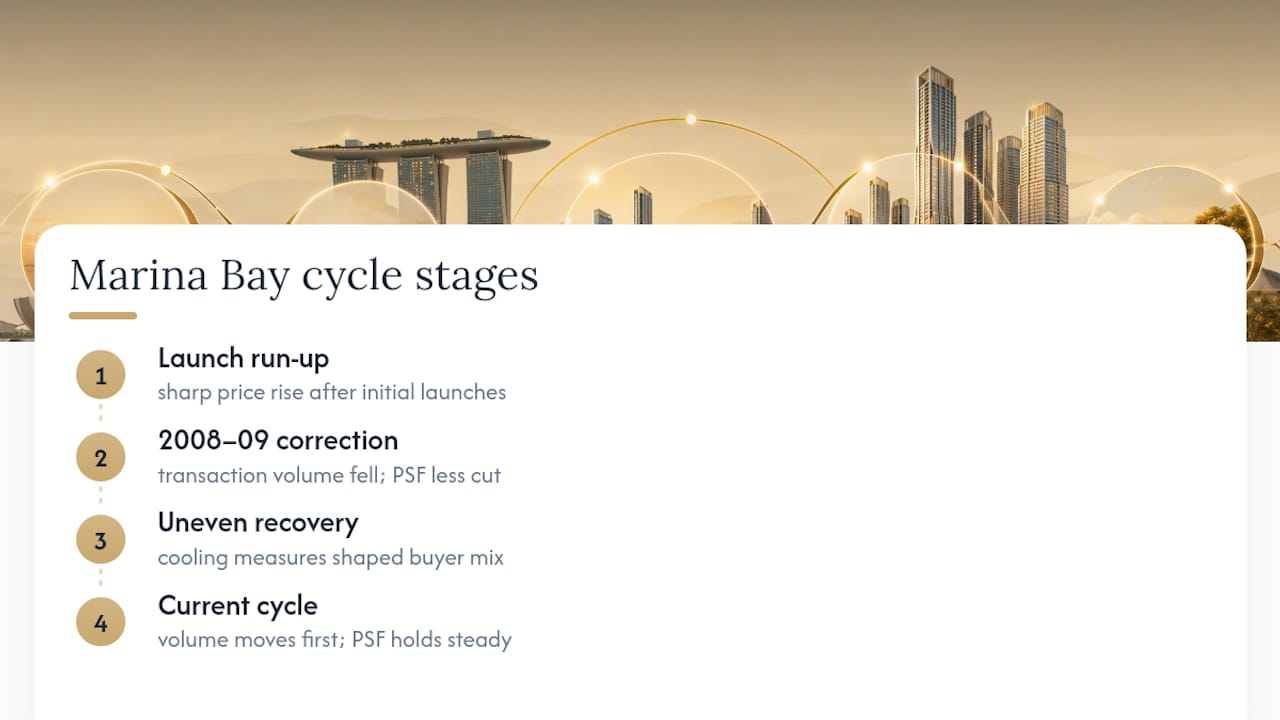
Marina Bay hasn't moved in a straight line since its towers first launched. The district went through a sharp run-up in the years following the original Marina Bay Residences and The Sail launches, cooled through the 2008 to 2009 global financial crisis alongside every other prime Singapore address, then recovered unevenly over the following decade as cooling measures reshaped who could buy what.
What makes Marina Bay's cycle distinct from a typical suburban condo cycle is the shallowness of its corrections. Because so little new supply enters District 01, downturns tend to show up as reduced transaction volume rather than steep price cuts. Sellers who don't need to sell simply wait out weak quarters, which keeps the PSF floor from dropping as far as it might in districts with more competing new launches.
The current cycle looks similar in shape. Volume has been the variable moving most, with PSF holding comparatively steady even through periods of broader market caution. That's consistent with what long-time observers of the CCR have noted for years: prime waterfront addresses correct on volume first and price second, if price corrects at all. For an investor evaluating entry timing, that pattern suggests watching transaction counts as an early signal, well before PSF figures themselves start to move.
How Marina Bay Stacks Up Against Other Prime Districts
Marina Bay's PSF profile looks different from Districts 9 and 10, Singapore's other two headline prime addresses, even though all three sit within the Core Central Region. District 9, covering Orchard and River Valley, tends to show a wider PSF spread because it mixes decades-old freehold stock with recent luxury launches. District 10, spanning Bukit Timah and the Good Class Bungalow belt, skews toward larger landed and low-rise formats that don't compare cleanly to Marina Bay's high-rise towers.
Marina Bay's differentiator is its narrower band of comparable stock. Nearly every unit in the district sits in a high-rise tower built within the last two decades, which makes PSF comparisons across projects more apples-to-apples than in Districts 9 or 10. According to the comparative Singapore property analysis, Marina Bay's PSF bands overlap with the higher end of District 9's range but rarely dip to District 9's lower resale tiers, since there's no equivalent older, smaller-format stock to pull the median down.
For an investor comparing across all three, the practical distinction is this: District 9 offers more entry points at varying price tiers, District 10 offers space and privacy at a premium, and Marina Bay offers density, skyline views, and walkable access to the CBD in a comparatively tight PSF range. None of the three is "cheaper" in any meaningful sense. They're pricing different lifestyles and different scarcity profiles.
How New Infrastructure Could Shift Future PSF Trends
Marina South MRT already anchors One Marina Gardens' immediate connectivity, but the wider Marina Bay precinct has more transport and civic infrastructure in the pipeline that could reshape demand over the coming years. Continued build-out of the Thomson-East Coast Line network and ongoing CBD rejuvenation initiatives tend to reinforce, rather than disrupt, the district's existing scarcity premium.

Infrastructure investment in an already land-constrained district rarely triggers a supply response. Unlike a suburban town where a new MRT line often precedes a wave of nearby launches, Marina Bay has essentially no vacant land left to develop around new transport nodes. The effect instead shows up as a demand-side tailwind. Better connectivity supports rental demand from professionals working in the CBD, which in turn supports the yield case for investors weighing Marina Bay against other CCR options.
The realistic read for buyers is that transport upgrades in this district tend to add a slow, cumulative lift to desirability rather than a sudden repricing event. If you're holding for the medium to long term, incremental connectivity improvements are one more argument for staying put rather than a reason to expect a near-term PSF jump.
Who's Buying in Marina Bay: Foreign vs. Local Demand
The buyer profile in Marina Bay has shifted meaningfully since Additional Buyer's Stamp Duty rates climbed for foreign purchasers. Local buyers and permanent residents, who face lower ABSD rates, now make up a larger share of transactions than the speculative foreign-investor wave that characterized Marina Bay's earlier launches. Our ABSD guide for foreign buyers breaks down exactly how those rate differences affect total acquisition cost.
This shift matters for PSF stability. Foreign, cash-rich buyers historically showed more willingness to pay outlier prices for trophy units, which occasionally pushed average PSF higher on individual large trades. A buyer pool weighted more toward local upgraders and long-term local investors tends to transact at prices closer to underlying rental economics, since these buyers are more sensitive to holding costs and financing constraints.
That doesn't mean foreign demand has disappeared. Marina Bay remains one of the districts where foreign interest concentrates most heavily within Singapore's CCR, simply because of its skyline recognition and CBD proximity. But the balance has tilted enough that PSF movements now reflect local purchasing power and local financing conditions more than they did a decade ago, which generally means less volatility tied to any single nationality's capital flows or currency swings.
What Moves PSF Volatility: Rates, Policy, and Macro Conditions
Interest rates remain the single biggest external lever on Marina Bay PSF, because financing costs directly affect how much buyers can bid without straining their monthly commitments. When mortgage rates rise, even cash-flush CCR buyers tend to negotiate harder, which shows up first in slower transaction volume and only later, if at all, in headline PSF.
Government cooling measures work through a different channel. ABSD adjustments, loan-to-value limits, and Total Debt Servicing Ratio rules don't change what a property is worth. They change who can afford to buy it and how much leverage they can use, which reshapes the buyer pool discussed above.
A few additional factors round out the volatility picture for District 01 specifically:
- Global capital flows. As one of Singapore's most internationally recognized addresses, Marina Bay is more exposed to swings in regional wealth (from mainland China, Hong Kong, and Southeast Asia) than districts with a purely domestic buyer base.
- Construction and completion timing. Newer projects like Marina One Residences and One Marina Gardens can see PSF cluster around launch pricing initially, then diverge as resale trades accumulate.
- Leasehold tenure. Most District 01 developments sit on 99-year leases, and remaining lease years increasingly factor into long-term valuation as projects age, a point worth weighing for anyone planning to hold more than 20 years.
Where the Data Points for Buyers Weighing Marina Bay Right Now
The current data favors patient, well-capitalized buyers over anyone hunting a fast flip. Scarcity in District 01 hasn't loosened, ABSD has thinned out the speculative crowd, and the low transaction volume we've walked through means PSF figures can look choppy quarter to quarter without reflecting a real shift in underlying value.
If you're liquidity-sensitive, that thin trading volume should give you pause. It can take longer to exit a Marina Bay unit at your target price than it would in a higher-volume district, simply because fewer comparable trades exist to anchor a quick sale. Cash-rich, long-hold buyers face the opposite calculus. They benefit from a district where new competing supply essentially doesn't exist and where every additional MRT link or CBD upgrade adds to an already scarce address.
For readers doing their own homework, our PSF verification guide and the One Marina Gardens fact sheet remain useful starting points before you commit to any figure you see quoted elsewhere. Numbers move fast in this district. Verify before you act, and weigh your own liquidity needs honestly before assuming a "prime address" is automatically the right fit.
— Velisa
See One Marina Gardens' Current Pricing, Gallery and Fact Sheet
One Marina Gardens is the newest entrant among Marina Bay's four flagship towers, and that positioning matters if you're weighing new-launch pricing against the older resale stock discussed throughout this guide. The development offers a range of layouts, various sky terraces, a lap pool, and amenities, situated close to Marina South MRT.
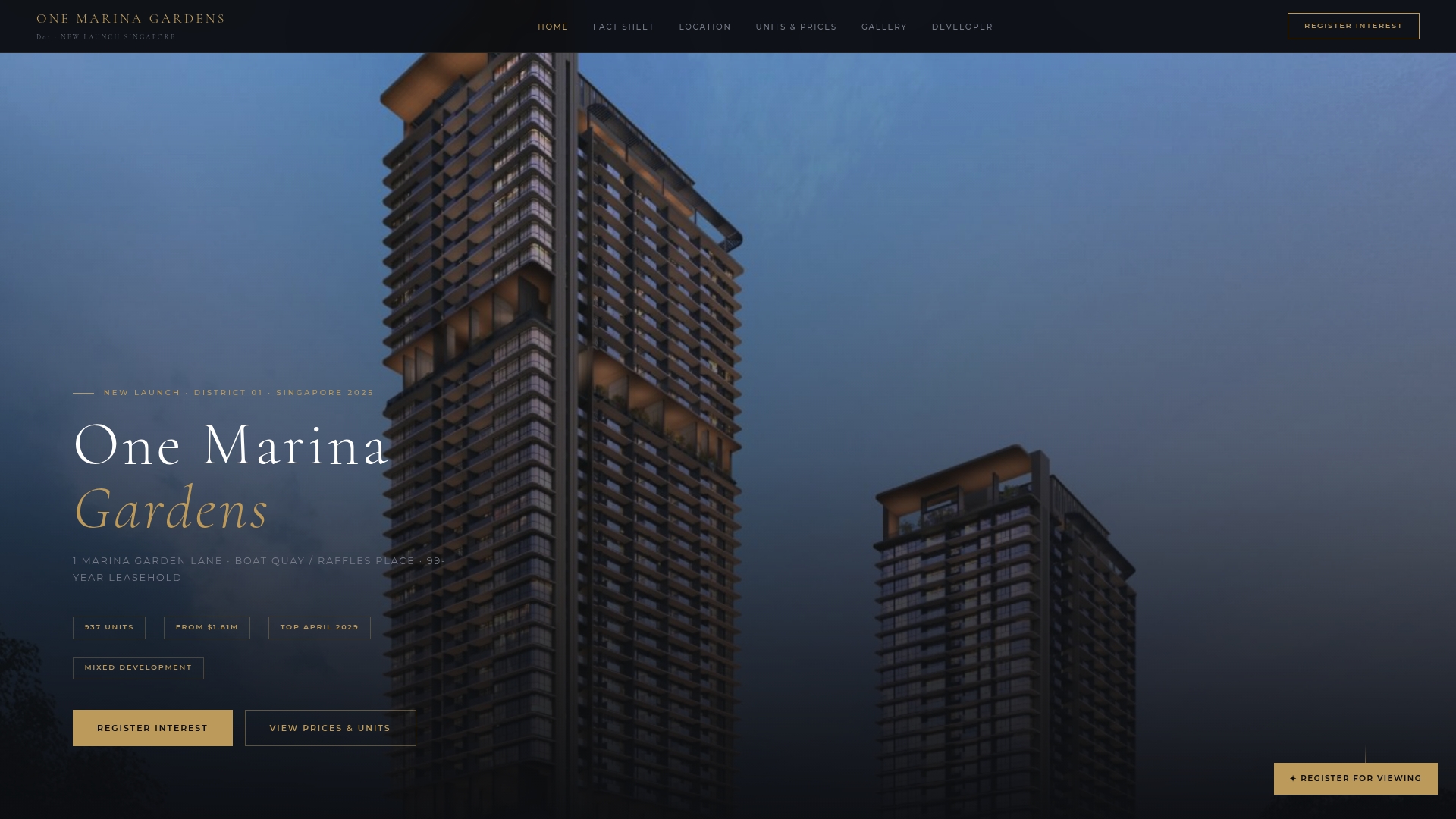
If you're ready to see how the numbers translate into actual floor plans and pricing, the current unit price list starts from $1.81 million, and the project gallery shows artist impressions of the sky terraces and facilities discussed above. For due diligence, the fact sheet lays out full specs and unit distribution. Whatever PSF figures you're comparing across District 01, cross-check them against URA's transaction search before you commit. Reach out through the main project page to book a showflat viewing and get current availability.
This article is general information, not a substitute for advice from a qualified financial advisor. Consult a qualified financial professional about your own circumstances before acting on anything here.
Sources
- Property data — URA
- URA eService — Residential transaction search
- Marina Bay neighbourhood guide (LovelyHomes) 2026
- Marina Bay Residences prices and transaction summary — PropKaki
FAQ
What Is the Current Median PSF in Marina Bay?
District 01's median transacted PSF sits around $3,600 as of Q2 2026, though individual projects like Marina Bay Residences trade lower, in the $2,100 to $2,700 range.
Why Do Marina Bay Median and Average PSF Differ So Much?
A single large penthouse or unusual bulk sale can pull the average PSF up sharply, while the median resists that distortion. Always check transaction counts before trusting either figure.
How Do I Check PSF Data Myself Instead of Relying on Articles?
Use the URA Residential Transaction Search, filter by project name and date range, and widen your window to 12 months if fewer than 10 caveats appear.
Is Marina Bay a Good Choice for Rental Yield or Capital Appreciation?
Marina Bay generally suits capital appreciation and scarcity-driven strategies better than pure yield plays, since compact units elsewhere in Singapore often post stronger percentage yields for the same capital outlay.
Does One Marina Gardens Fit Into Current Marina Bay PSF Trends?
As a new launch near Marina South MRT, One Marina Gardens prices toward the upper end of the District 01 range, and its fact sheet details the unit mix behind that positioning.