
For most buyers, a well-laid-out 3-bedroom beats a cramped 4-bedroom. Choose four only when you have a defined use for the extra room, not a vague "just in case." The single deciding factor is usable layout, not bedroom count, and the national price premium for that fourth room is steeper than most people budget for. One Marina Gardens offers both configurations, which makes it a useful reference point for comparing real floorplans side by side.
TL;DR:
- A well-designed 3-bedroom often offers more usable living space and lower ongoing costs than a poorly planned 4-bedroom, even if the latter has more total square footage.
- Moving from a 3- to a 4-bedroom home usually adds around $115,100 to the purchase price and approximately $764 per month in mortgage payments, with local variations.
- Choosing a 4-bedroom makes sense only if you have a specific, immediate need for the extra room, such as a home office or multigenerational living, and not for vague future planning.
- Judging a floorplan's livability requires measuring key areas, such as living, dining, and bedroom sizes, as well as assessing storage, bathroom layout, and circulation.
- Comparing actual floorplans and layouts is more accurate than relying solely on listing bedroom counts, particularly within developments like One Marina Gardens that offer both 3- and 4-bedroom options.
Table of Contents
- 3 bedroom vs 4 bedroom: what actually decides it
- The case for choosing a 3-bedroom home
- The case for choosing a 4-bedroom home
- What a fourth bedroom really costs you
- How to judge a floorplan for real living, not just headcount
- Your viewing checklist before you decide
- What a real new-launch project shows about this trade-off
- A simple rule for choosing between the two
- Finding the right fit at One Marina Gardens
- Sources
- FAQ
3 bedroom vs 4 bedroom: what actually decides it
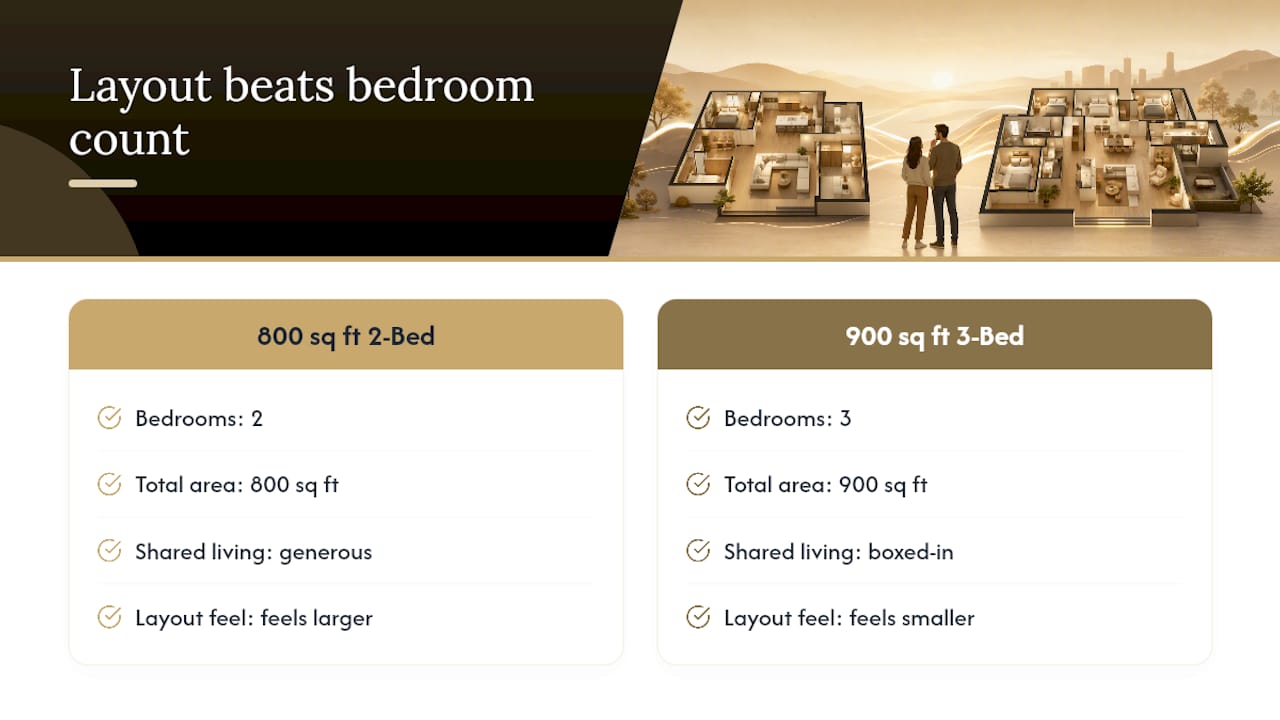
The bedroom count on a listing tells you almost nothing about how a home will feel to live in. A 900 square foot 3-bedroom with a boxed-in living room can feel smaller than a well-planned 800 square foot unit with two bedrooms and a generous shared space. That is the trap in comparing 3 bedroom vs 4 bedroom units purely by the number on the listing.
The industry term for what actually matters here is usable floor area, sometimes shortened to NSA (net saleable area) in property listings. Two condos can share the same bedroom count and differ enormously in how that space gets carved up. A local market review comparing compact newer 3-bed condos against older, larger 3-bedroom units found exactly this: newer units trade lower renovation friction for less raw space, while older stock delivers more square footage per dollar but often needs fresh mechanical and electrical work. Bedroom count was the least useful variable in that comparison.
The case for choosing a 3-bedroom home
A 3-bedroom tends to be the right call for first-time buyers, small families with one or two kids, and empty-nesters who no longer need a guest wing. It is also the more forgiving choice for anyone who wants to move in without a renovation punch list. Fewer rooms mean less to heat, cool, clean, and furnish, and that adds up faster than people expect.
Practical advantages of a well-designed 3-bedroom include:
- Lower monthly utility and strata maintenance costs, since less square footage means less to condition and light.
- Faster furnishing and setup, often one to two fewer rooms' worth of furniture, curtains, and lighting to buy.
- Quicker cleaning and lower day-to-day upkeep, which matters more than people admit once the novelty of a new home wears off.
- Less pressure to fill unused space, which is a real problem in oversized layouts that end up as storage rooms for boxes nobody unpacks.
A newer, compact 3-bedroom also tends to have fewer immediate repair needs than an older large one, which matters if you want to move in and not touch anything for a few years.
Pro Tip: When you tour a 3-bedroom, walk the living and dining area with a tape measure, not just your eyes. Check whether it can actually fit a dining table for six plus a sofa without turning it into a hallway. Also open every closet: storage volume, not room count, is what determines whether a 3-bedroom "lives big" or feels tight within a year.
The case for choosing a 4-bedroom home
A fourth bedroom earns its keep when it has a specific job, like a dedicated home office, a guest room, a room for a live-in caregiver, or a hobby studio. Vague future-proofing rarely justifies the premium on its own.
Where the math tends to favor four bedrooms:
- You have a concrete plan for family growth within the next few years, not just an open-ended "maybe someday."
- You expect remote or hybrid work to continue and need a room with a door, not a desk in the corner of the living room.
- You intend to hold the property long enough to amortize the higher purchase price against years of use rather than months.
- Multigenerational living is already part of the plan, not a hypothetical.
The trade-off is real. You pay more upfront, spend more on furnishing and utilities every month, and if the floorplan wasn't designed carefully, that fourth room can eat into the living and dining space that everyone actually uses daily. A poorly planned 4-bedroom layout can leave you with more bedrooms and less livable home.
What a fourth bedroom really costs you
The gap between three and four bedrooms is bigger than most buyers assume, and it shows up in three places: the purchase price, the mortgage payment, and everything you pay after move-in.
A national analysis of home prices found that moving from a three-bedroom to a four-bedroom home carries a typical premium of about $115,100, which works out to roughly $764 more per month on a mortgage. That is a national figure, and local markets vary widely, sometimes dramatically, so treat it as a benchmark to check against actual listings in your target area rather than a fixed rule.
By the numbers: A three to four bedroom upgrade adds an estimated $115,100 to the purchase price and about $764 a month to the mortgage in a typical U.S. market analysis. Local premiums can run well above or below that depending on demand and land constraints.
Beyond the mortgage, ongoing costs climb too. More square footage means more to heat and cool, an extra room's worth of furniture and bedding to buy, and more time spent cleaning and maintaining a larger footprint. Layout matters just as much at resale as it does at purchase:
- Buyers shopping for family homes weigh living-area size and bathroom count almost as heavily as bedroom count.
- A tight 4-bedroom with one bathroom often sells slower than a spacious 3-bedroom with two.
- Comparisons across housing types show that even bedroom-matched units can differ meaningfully in rent and resale value once total size and amenities are factored in, a gap documented in a 373-market rental study.
A bigger bedroom count can widen your buyer pool on paper, but a cramped layout may narrow it in practice.
How to judge a floorplan for real living, not just headcount
Walking through a listing, check these five things before you let bedroom count sway your decision:
- Living and dining dimensions. Measure them. A room that photographs well can still be too narrow for a proper dining table and a walkway.
- Actual bedroom size. A "bedroom" under roughly 70 square feet often can't comfortably fit a bed, a wardrobe, and a desk. That is a study wearing a bedroom label.
- Storage volume. Built-in wardrobes and utility closets matter more long-term than one extra room you might not furnish for a year.
- Bathroom placement and count. A fourth bedroom without a matching bathroom increases friction daily, especially with guests or growing kids.
- Circulation. Walk the path from entry to kitchen to bedrooms. Awkward hallways or rooms you have to cut through to reach another room quietly kill livability.
Families also repurpose rooms constantly. A spare room starts as a home office, becomes a nursery, and later turns into a study for a teenager. A flexible layout that can absorb that shift without a renovation is worth more than one extra fixed room that can't adapt.
Your viewing checklist before you decide
Bring a tape measure and a short list of questions to every showing. It takes ten extra minutes and saves you from buyer's remorse.
- Measure the living and dining area together, not just the bedrooms.
- Confirm each bedroom fits a queen bed, a wardrobe, and a walkway comfortably.
- Ask about strata or maintenance fees and get a typical monthly utility figure from the seller or agent.
- Check the renovation history: newer units generally mean fewer surprises in the first few years.
- Estimate the monthly cost delta yourself: take the price difference between a 3-bed and 4-bed listing, divide by your expected mortgage term, and add a furnishing estimate for one extra room.
Watch for red flags: bedrooms too small to fit standard furniture, a living room that feels like an afterthought, only one bathroom serving three or more bedrooms, or a floorplan with poor natural light and awkward hallways connecting rooms that should flow directly into each other.
Pro Tip: Ask the agent for the exact square footage of the living and dining area alone, separate from total unit size. If they can't provide it, measure it yourself. That single number tells you more about daily comfort than the bedroom count ever will.
What a real new-launch project shows about this trade-off
One Marina Gardens offers 1 to 4-bedroom units within a single development, family-oriented amenities including a childcare center, and direct access to Marina South MRT. That range makes it a useful real-world case for the 3 vs 4 bedroom decision, since both buyer profiles are shopping the same building.
Patterns worth noting from District 01 buyers generally:
- Families prioritizing a shorter commute and shared amenities tend to lean toward efficient 3-bedroom layouts.
- Buyers planning for a home office or a longer hold horizon more often opt for the 4-bedroom units.
- Layout efficiency, not raw square footage, is usually the deciding factor once buyers compare floorplans side by side.
Readers weighing similar options may also find it useful to compare spacious family-oriented condos or review compact 2-bedroom layout strategies that show how efficient shared space can make a smaller unit live larger than its bedroom count suggests.
A simple rule for choosing between the two
Prioritize usable living area over bedroom count, and pick four bedrooms only when you can name the exact use for the fourth room. If you can't name it in one sentence, you probably don't need it.
Holding horizon matters more than most buyers realize. If you plan to stay less than five years, minimizing friction and upfront cost usually wins, which favors a well-laid-out 3-bedroom. If you're settling in for a decade or more, a defined future need can justify paying for a fourth room now rather than moving again later.
— Velisa
Finding the right fit at One Marina Gardens
Onemarinagardens gives you both sides of this decision under one roof: thoughtfully designed 3-bedroom units for buyers who want lower running costs and easier upkeep, and flexible 4-bedroom layouts for families with a defined need for extra space. Every buyer's situation is different, and the fastest way to see which fits yours is to compare real floorplans rather than guess from a listing description.

The project's fact sheet breaks down unit distribution and specs for every layout size, and the gallery shows artist impressions of both 3- and 4-bedroom configurations. If you want to walk through the trade-offs on an actual floorplan, contact the sales team to arrange a showflat visit and get a direct comparison for your situation.
This article is general information, not a substitute for advice from a qualified financial advisor. Consult a qualified financial professional about your own circumstances before acting on anything here.
Sources
- That extra bedroom could cost more than $20,000 a month | Lower
- Compact 3-bed vs older large 3-bed — which is the better family buy? | SGInfoProperty
- 3 vs 4 Bedroom Home Designs and Why More Isn't Always Better | A Class Building
FAQ
Is a 3-bedroom home too small for a family?
Not if the layout is efficient. A well-designed 3-bedroom with adequate living and storage space fits most families comfortably; the deciding factor is usable floor area, not the bedroom count itself.
How much more does a 4-bedroom home typically cost than a 3-bedroom?
A national analysis found a typical premium of about $115,100, or roughly $764 more per month on a mortgage, though local markets vary significantly.
Does a fourth bedroom always increase resale value?
Not automatically. Buyers weigh living-area size and bathroom count heavily, and a cramped 4-bedroom can sell slower than a spacious, well-laid-out 3-bedroom.
What should I check to make sure a 3-bedroom will feel spacious enough?
Measure the living and dining area, confirm each bedroom fits a bed and wardrobe comfortably, and check storage volume rather than relying on the bedroom count alone.
Does One Marina Gardens offer both 3- and 4-bedroom units?
Yes, One Marina Gardens offers a range of layouts from 1 to 4 bedrooms, giving buyers the option to compare both configurations within the same development.