
Singapore's Additional Buyer's Stamp Duty rates for 2026 remain at the levels set on 27 April 2023: Singapore Citizens pay 0% on a first home, 20% on a second, and 30% on a third or more; Singapore Permanent Residents pay 5% on a first property and 30% on subsequent ones; foreigners pay a flat 60% regardless of property count; entities pay 65%; housing developers pay 35% (plus a non-remittable 5% component); and trustees acquiring residential property on behalf of a trust pay 65%. IRAS) confirms that ABSD is calculated on the higher of the purchase price or market value and is payable on top of Buyer's Stamp Duty (BSD). According to the Ministry of Finance, the 2023 rate increases affected approximately 10% of residential transactions, targeting investor demand while protecting owner-occupiers.
Key facts before you read further:
- ABSD applies to residential properties only (houses, apartments, condominiums, HDB flats).
- BSD is always due first; ABSD is an additional layer on top.
- Rates have not changed since April 27, 2023, so the 2026 schedule is the same as 2023–2025.
- Transitional provisions may apply if your Option to Purchase (OTP) was granted before a rate-change date.
- Certain foreigners qualify for ABSD remission under Free Trade Agreements (FTAs).
Table of Contents
- How ABSD liability is determined: buyer profile, property count, and ownership structures
- How ABSD is calculated, with worked examples
- Remissions, exemptions, and special reliefs for 2026
- How and when to pay ABSD: process, deadlines, and penalties
- Applying 2026 ABSD rules to a One Marina Gardens purchase
- Key Takeaways
- The part of ABSD most buyers underestimate
- One Marina Gardens: pricing, ABSD guidance, and next steps for buyers
- Official sources and further reading
How ABSD liability is determined: buyer profile, property count, and ownership structures
Your ABSD liability depends on two things decided at the point of acquisition: your buyer profile and how many residential properties you already own.
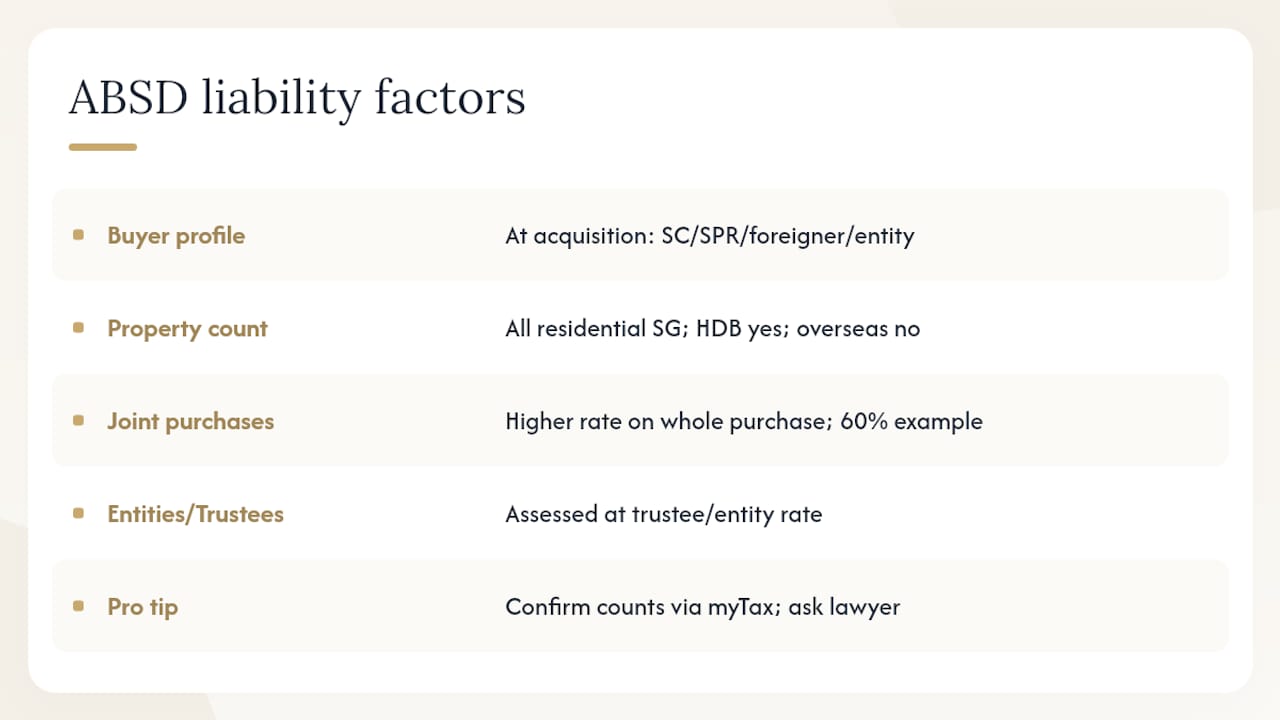
Buyer profile is assessed at the time of the transaction. A Singapore Citizen is classified as an SC, a holder of a valid Singapore Permanent Resident pass is classified as an SPR, and everyone else is a foreigner for ABSD purposes. Companies, limited liability partnerships, and other legal entities are treated as entities. Trustees acquiring property on behalf of a trust are assessed at the trustee/entity rate, not the individual beneficiary's rate.
Property count covers all residential properties you own wholly, partially, or jointly anywhere in Singapore. If you own a 10% share in a property jointly with a sibling, that property counts toward your total. HDB flats count. Overseas properties do not count for Singapore ABSD purposes, but you should confirm this with a conveyancing lawyer if your situation is complex.
Joint purchases are where many buyers get caught off guard. When two buyers with different profiles purchase together, IRAS applies the higher applicable rate to the entire transaction. A Singapore Citizen buying jointly with a foreigner spouse will face the 60% foreigner rate on the full purchase price unless an FTA remission or married-couple remission applies. The rate is not split or averaged.
Pro Tip: Check your property count and your co-buyer's profile before you sign an OTP. Pull your own records via the IRAS myTax portal and ask your conveyancing lawyer to confirm the count. A surprise second-property classification on a S$2M purchase adds S$400,000 in ABSD — not the kind of number you want to discover at stamping.
How ABSD is calculated, with worked examples
The formula is straightforward. ABSD is applied to the higher of the purchase price or market value, and BSD is calculated on the same base and added on top. Total stamp duty = BSD + ABSD.
BSD uses a progressive rate structure) on the first S$180,000, S$180,000, S$640,000, S$500,000, and the remainder above S$1.5M, at rates of 1%, 2%, 3%, 4%, and 5% respectively for residential property. ABSD is then a flat percentage on the full value.
IRAS retains the right to reassess market value. If the transacted price is below what IRAS determines to be market value, ABSD will be charged on the higher assessed figure. Budget for this possibility, especially in off-market or related-party transactions.
Example 1: Singapore Citizen buying a second property at S$2M
- BSD: 1% × S$180,000 + 2% × S$180,000 + 3% × S$640,000 + 4% × S$500,000 + 5% × S$500,000 = S$1,800 + S$3,600 + S$19,200 + S$20,000 + S$25,000 = S$69,600
- ABSD: 20% × S$2,000,000 = S$400,000
- Total stamp duty: S$469,600
Example 2: Foreigner buying a S$2M condominium (first or any property)
- BSD: S$69,600 (same calculation as above)
- ABSD: 60% × S$2,000,000 = S$1,200,000
- Total stamp duty: S$1,269,600
Example 3: SPR buying a second property at S$1.8M
- BSD: 1% × S$180,000 + 2% × S$180,000 + 3% × S$640,000 + 4% × S$500,000 + 5% × S$300,000 = S$1,800 + S$3,600 + S$19,200 + S$20,000 + S$15,000 = S$59,600
- ABSD: 35% × S$1,800,000 = S$630,000
- Total stamp duty: S$689,600
Example 4: Entity purchasing at S$2.5M
- BSD: 1% × S$180,000 + 2% × S$180,000 + 3% × S$640,000 + 4% × S$500,000 + 5% × S$1,000,000 = S$1,800 + S$3,600 + S$19,200 + S$20,000 + S$50,000 = S$94,600
- ABSD: 65% × S$2,500,000 = S$1,625,000
- Total stamp duty: S$1,719,600
These figures illustrate why ABSD dominates the total stamp duty bill at current rates. BSD is almost a rounding error by comparison once you factor in a 60% or 65% ABSD rate. When financing a purchase, note that MAS loan-to-value limits apply to the property price, not the total stamp duty cost, so ABSD must typically be funded from cash or CPF, not from the mortgage.
Remissions, exemptions, and special reliefs for 2026
Not every buyer pays the headline rate. Three remission routes are worth knowing in detail.
FTA remission for qualifying foreigners
Certain foreign nationals are treated like Singapore Citizens for ABSD purposes under Singapore's Free Trade Agreements. IRAS lists the qualifying nationalities) and the conditions that apply. Nationals of the United States, Switzerland, Iceland, Liechtenstein, and Norway are among those who may qualify, subject to meeting the specific conditions of the relevant FTA. The MOF's guidance on FTA tax concessions explains the policy framework behind these arrangements.
Key points on FTA remission:
- Qualifying nationals are treated as Singapore Citizens for ABSD purposes, meaning they pay 0% on a first property and 20% on a second.
- The remission is not automatic. You must apply to IRAS and provide documentation proving nationality and that the purchase meets the conditions.
- The Stamp Duties (Remission) Rules at Singapore Statutes Online set out the legislative basis for these remissions.
- If you are unsure whether your nationality qualifies, check the IRAS FTA remission page directly rather than relying on a third-party summary.
Married-couple remission
A married couple where one spouse is a Singapore Citizen and the other is a foreigner or SPR can apply for ABSD remission under specific conditions. The typical structure allows the couple to purchase one residential property jointly and claim a remission so that the SC rate applies, provided:
- At least one spouse is a Singapore Citizen.
- Neither spouse owns any other residential property at the time of purchase.
- The property is purchased jointly.
- The couple disposes of any previously owned residential property within a specified period if applicable.
The application is submitted to IRAS after purchase, and the remission is granted as a refund if ABSD was paid upfront. Timing matters: confirm the conditions and the application window with your conveyancing lawyer before the OTP is exercised.
Housing developer remission
Developers who purchase residential land or property for redevelopment can apply for remission of the remittable portion of their ABSD (the 35% component), provided they complete construction and sell all units within five years of the acquisition date. The non-remittable 5% component is payable regardless of whether the developer meets the sale conditions. Developers who miss the five-year window face the full 35% ABSD with no remission.
How and when to pay ABSD: process, deadlines, and penalties
ABSD is paid through the IRAS e-stamping system. The process is the same as for BSD, and both duties are typically paid together at the stamping stage.
Payment deadlines:
- 14 calendar days from the date of the OTP acceptance or Sale and Purchase Agreement (S&P) if the document is signed in Singapore.
- 30 calendar days from the date the document is received in Singapore if it was signed overseas.
Missing these deadlines triggers late-payment penalties and interest charges. IRAS can also impose penalties for understatement of value or incorrect buyer-profile declarations.
Step-by-step payment checklist:
- Confirm your buyer profile (SC, SPR, foreigner, entity) and your total residential property count before signing.
- Calculate BSD and ABSD on the higher of purchase price or market value using the IRAS rates.
- Gather required documents: NRIC/passport, proof of citizenship/PR status, corporate documents if purchasing as an entity, and the OTP or S&P agreement.
- Log in to IRAS myTax e-stamping and complete the stamping declaration.
- Pay the computed BSD + ABSD amount. Payment can be made via PayNow, GIRO, or other accepted methods on the portal.
- Download and retain the stamping certificate. Your conveyancing lawyer will need this for the completion of the sale.
Penalties for late or incorrect payment:
- Late stamping attracts a penalty of up to four times the unpaid duty, depending on how late the stamping occurs.
- Understatement of value or incorrect profile declarations can result in additional assessments plus interest.
- IRAS may conduct post-transaction audits, particularly for related-party transactions or where the transacted price appears below market value.
Pro Tip: Most conveyancing law firms in Singapore handle e-stamping on your behalf as part of their standard service. If you are buying without a lawyer (rare, but possible for experienced investors), walk through the myTax portal steps with IRAS's online guide before the deadline, not on the day itself.
Applying 2026 ABSD rules to a One Marina Gardens purchase
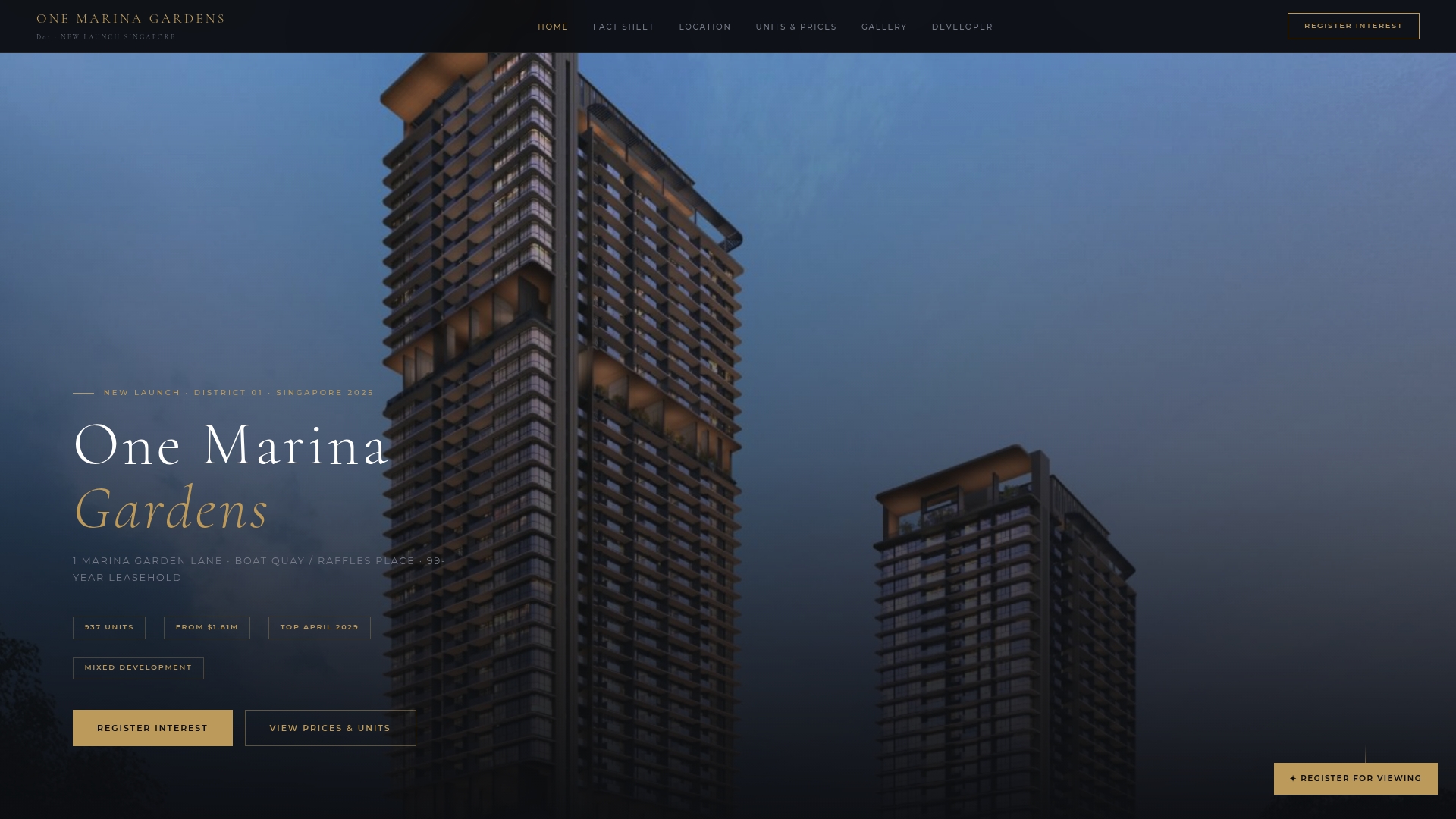
One Marina Gardens is a 937-unit new-launch condominium in District 01, developed by Kingsford Marina Development, with units priced from S$1.81M. The development sits 160 meters from Marina South MRT and offers 1- to 4-bedroom apartments. Here is how ABSD plays out across buyer profiles at a representative price of S$2M.
| Buyer Profile | ABSD Rate | ABSD on S$2M | BSD on S$2M | Total Stamp Duty |
|---|---|---|---|---|
| SC, 1st property | 0% | S$0 | S$69,600 | S$69,600 |
| SC, 2nd property | 20% | S$400,000 | S$69,600 | S$469,600 |
| SPR, 1st property | 5% | — | S$69,600 | — |
| SPR, 2nd property | 35% | S$700,000 | S$69,600 | S$769,600 |
| Foreigner (individual) | 60% | S$1,200,000 | S$69,600 | S$1,269,600 |
| Entity | 65% | — | S$69,600 | — |
BSD computed using the progressive residential BSD bands per IRAS. ABSD computed on S$2M (purchase price assumed equal to or higher than market value for illustration).
A few practical notes for One Marina Gardens buyers:
- New-launch purchases are stamped on the S&P agreement, typically within 14 days of exercise. The developer's sales team can confirm the exact timeline.
- IRAS may assess market value independently. If the assessed value exceeds S$2M, ABSD will be computed on the higher figure.
- Foreign buyers who qualify under an FTA remission should apply to IRAS promptly after purchase. See the ABSD guide for foreign buyers at One Marina Gardens for a step-by-step walkthrough of the FTA remission process specific to this project.
This example is for illustration only. Confirm final duty calculations with IRAS or a qualified conveyancing professional before committing to a purchase.
Key Takeaways
Singapore's 2026 ABSD rates remain at the April 2023 levels, with foreigners paying 60%, entities 65%, and Singapore Citizens 0% on a first home rising to 30% on a third property.
| Point | Details |
|---|---|
| Rates unchanged since April 2023 | The 2026 ABSD schedule is identical to the April 27, 2023 increases; no new changes have been announced. |
| Computed on higher of price or value | ABSD is applied to the higher of purchase price or IRAS-assessed market value, so budget for a potential valuation uplift. |
| FTA and married-couple remissions exist | Qualifying nationals (e.g., US, Swiss, Norwegian) and SC/foreigner married couples may access remissions; applications go to IRAS. |
| 14-day stamping deadline | BSD and ABSD must be paid via IRAS e-stamping within 14 days of signing in Singapore; late payment triggers penalties up to four times the unpaid duty. |
| Onemarinagardens case study | At S$2M, an SC second-property buyer pays S$469,600 in total stamp duty; a foreigner pays S$1,269,600 — figures that should be built into any One Marina Gardens budget from day one. |
The part of ABSD most buyers underestimate
The rate table is the easy part. What catches buyers off guard is the interaction between ABSD and the rest of the purchase budget, and the way the rules treat joint ownership.
The 60% foreigner rate is not a deterrent for every buyer. For a high-net-worth individual purchasing a S$2M unit in a prime District 01 development, S$1.2M in ABSD is a known cost of entry into one of the world's most stable property markets. What matters more is whether the buyer has structured the purchase correctly. Buying through an entity to "manage" ABSD exposure backfires immediately: the entity rate is 65%, higher than the individual foreigner rate. Buying jointly with a Singapore Citizen spouse without checking the married-couple remission conditions first can mean paying the full foreigner rate when a remission was available.
The married-couple remission is also narrower than most buyers assume. Both spouses must have no other residential property at the time of purchase. If the SC spouse already owns a flat, the remission does not apply. This is the scenario that generates the most post-purchase surprises, and it is entirely avoidable with a 30-minute conversation with a conveyancing lawyer before the OTP is signed.
One more point: the Singapore property market trends in 2026 show that ABSD has not eliminated foreign and investor demand in prime districts. It has repriced it. Buyers who understand the full cost structure, including ABSD, BSD, and MAS loan-to-value constraints, are the ones who make decisions with confidence rather than regret.
One Marina Gardens: pricing, ABSD guidance, and next steps for buyers
Buying a new-launch unit in District 01 is one of the clearest property decisions in Singapore right now, and the ABSD math is a central part of that calculation. At One Marina Gardens, units start from S$1.81M, and the development's location, facilities, and connectivity to Marina South MRT make it a strong candidate for both owner-occupiers and investors who have already factored in their stamp duty exposure.
The Onemarinagardens sales team can walk you through unit availability, pricing by floor and type, and help you understand how ABSD applies to your specific buyer profile. Whether you are an SC upgrader, an SPR buying your first private property, or a foreign buyer exploring FTA remission eligibility, getting the numbers right before you sign matters. View the One Marina Gardens fact sheet for unit mix, price ranges, and facilities, or register your interest at the main project page to arrange a showflat appointment.
This article is general information, not professional tax or legal advice. Confirm your ABSD liability and any remission eligibility with IRAS or a qualified conveyancing professional before committing to a purchase.
Official sources and further reading
These are the primary authoritative sources for ABSD rules, remissions, and payment in Singapore. If any detail in this article conflicts with what you find on these pages, the official source governs.
- IRAS | Additional Buyer's Stamp Duty (ABSD)))
- Measures For A Sustainable Property Market | Ministry of Finance (MOF)
- IRAS | Foreigners Eligible for ABSD Remission under Free Trade Agreements (FTAs)))
- Stamp Duties (Remission) Rules | SSO (AGC)
- mytax.iras.gov.sg | e-Stamping
- MOF | Tax concessions given to foreign nationals or entities through Free Trade Agreements
- MAS | Loan tenure and loan-to-value limits explainer