
A deferred payment scheme (DPS) lets a buyer pay a small upfront sum and delay the bulk of the purchase price until the project receives its Temporary Occupation Permit (TOP) or Certificate of Statutory Completion (CSC). That cashflow convenience is now off the table for new Executive Condominium (EC) launches: as of May 8, 2026, the Ministry of National Development (MND) abolished DPS for all new EC Government Land Sale (GLS) tenders with tender closing on or after that date. New EC buyers must now follow the Progressive Payment Scheme, which requires a significant upfront payment within eight weeks of booking.
Three actions every buyer should take right now:
- Check TOP/CSC status. DPS is only lawful on completed projects that have already obtained TOP or CSC. If the project is still under construction, any DPS offer is prohibited under the 2007 prohibition for uncompleted private residential properties.
- Confirm the payment schedule in your Sale & Purchase Agreement (S&P). Read the payment tranche clause line by line. What the developer's brochure calls a "flexible payment plan" may not match what the S&P actually commits to.
- Run a CPF/liquidity stress test. Under the Progressive Payment Scheme, a $1.2M EC requires approximately $240,000 within eight weeks. Know your CPF Ordinary Account balance and cash reserves before you sign.
Table of Contents
- What is a deferred payment scheme and how does it work?
- How does DPS compare with the Progressive Payment Scheme?
- What is the legal status of DPS in Singapore right now?
- What are the real pros and cons of using DPS?
- How do you confirm whether a project offers DPS and what to ask?
- One Marina Gardens: how a developer presents predictable progressive payments
- Key Takeaways
- Why the market is moving away from DPS
- One Marina Gardens: progressive payments, no guesswork
- Useful official sources and further reading
What is a deferred payment scheme and how does it work?
In its classic form, a DPS works in three stages. The buyer pays a booking or option fee (typically 5% of the purchase price), then defers the remaining balance until the project hits TOP or CSC. During the construction period, no mortgage installments run. The developer carries the financing risk, and the buyer sits on a relatively small cash commitment until the keys are ready.
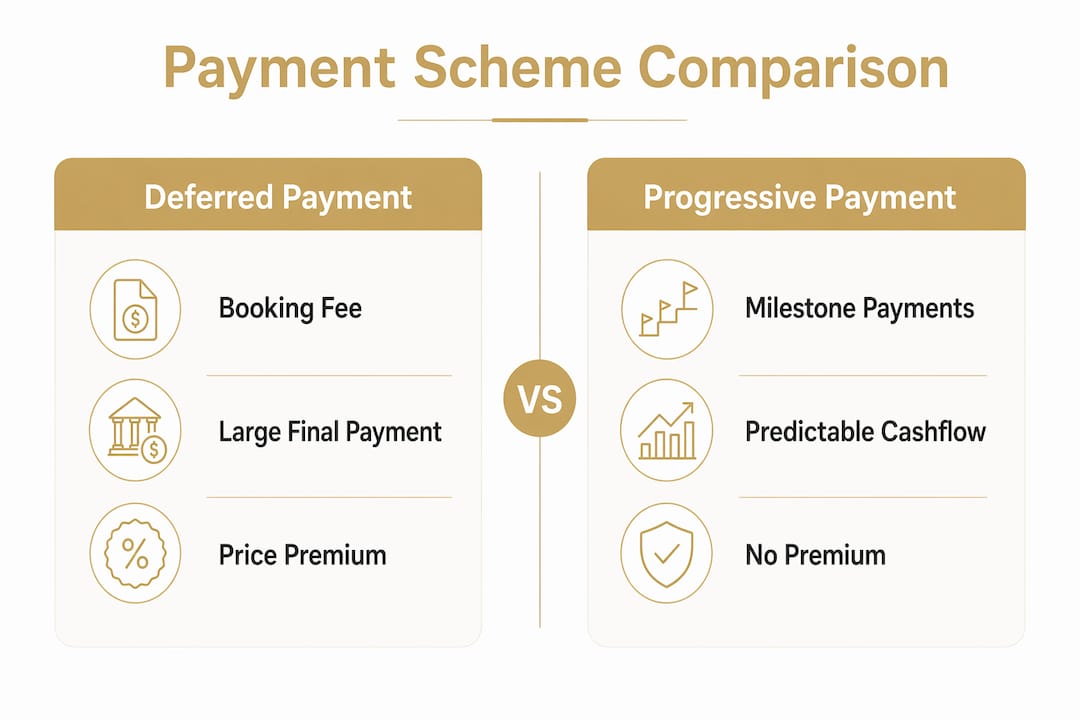
The 20% downpayment that is standard under the Progressive Payment Scheme gets restructured: under a historic DPS, the buyer might pay only the 5% booking fee upfront, with the remaining 15% and the full loan drawdown triggered at TOP. That gap is the cashflow relief buyers valued.
Variants and marketing names to recognize:
- Stay-then-pay or stay-and-pay: buyer takes possession and can occupy or rent the unit before the full purchase price is exercised
- Reservation schemes or preferential payment plans: marketing labels that describe a deferred completion structure without using the DPS name
- Absorption promotions: developer absorbs interest during the deferred period, effectively subsidizing the buyer's holding cost
These rebranded deferred structures appear on completed or de-licensed projects where DPS is still legally permissible. The key tell is a nomination or assignment clause that lets the buyer transfer the purchase before full exercise.
Historical projects associated with DPS-style promotions include The Interlace, D'Leedon, The Crest at Prince Charles Crescent, and The Peak at Cairnhill II. These are cited as historical examples of how DPS was applied on completed or near-completed stock — not as current recommendations.
Who typically benefits from DPS:
- HDB upgraders who need time to sell their flat before committing full mortgage payments
- Cash-constrained buyers who can service a small booking fee now but expect liquidity later
- Investors who want to collect rental income during the deferred period before full loan drawdown
Who should be cautious:
- Buyers with tight CPF balances who may struggle when the deferred lump sum falls due at TOP
- Investors who have not modeled the 2–3% price premium that DPS units typically carry
- Anyone buying on a new EC GLS tender — DPS is no longer available to them
Pro Tip: If a developer markets a "flexible payment schedule" on a new EC launch after May 8, 2026, ask immediately whether the project's GLS tender closed before or after that date. The answer determines whether any deferred structure is legally permissible.
How does DPS compare with the Progressive Payment Scheme?
The Progressive Payment Scheme (PPS) ties each payment tranche to a construction milestone: foundation, structural frame, partition walls, and so on, through to TOP. Mortgage installments begin once the loan is drawn down at the first tranche. DPS, by contrast, defers nearly all tranches to TOP, so the mortgage clock does not start until the unit is ready.

| Dimension | Deferred Payment Scheme | Progressive Payment Scheme |
|---|---|---|
| Upfront cash required | $60,000 booking fee only (for a $1.2M unit) | $240,000 within 8 weeks (5% + 15% S&P on $1.2M) |
| When mortgage installments start | At TOP/CSC | At first loan drawdown (early construction) |
| Developer risk / buyer protections | Developer carries financing risk; buyer has limited stage-gate protections | Stage payments tied to construction milestones; buyer has statutory protections at each stage |
| Typical price premium | 2–3% above comparable PPS unit | No premium |
| Suitability | Investors, HDB upgraders needing liquidity buffer | Owner-occupiers, buyers with strong CPF/cash |
| Timeline to TOP | Same project timeline; payment deferred, not construction | Same project timeline |
Worked cashflow example on a $1.2M unit:
- Under PPS: 5% booking fee at signing ($60,000), plus 15% S&P tranche within eight weeks ($180,000), for a total $240,000 upfront cash commitment.
- Under historic DPS: 5% booking fee only ($60,000) upfront; remaining balance deferred to TOP.
- PPS buyers must be prepared with $240,000 within eight weeks, versus only $60,000 under DPS.
The 2–3% price premium on a DPS unit is not trivial. On a $1.2M purchase, a 3% premium adds $36,000 to the purchase price. That is the cost of the cashflow convenience, and it compounds into your loan quantum.
For new EC buyers post-May 8, 2026: PPS is now mandatory. The practical difference is that buyers must arrive at the showflat with a clear picture of their CPF OA balance and available cash. The EC price discount versus private condos remains a genuine advantage, but the liquidity requirement at booking is now non-negotiable.
Pro Tip: Model your net cost by adding the DPS premium to the purchase price before comparing it against a PPS unit. A 3% premium on a $1.2M unit costs $36,000 more than a PPS purchase — often more than the interest saved during the deferred period.
What is the legal status of DPS in Singapore right now?
Two rules govern DPS in Singapore, and both matter.
The 2007 prohibition. Since October 2007, the government has disallowed deferred payment schemes for uncompleted private residential properties. A developer cannot legally offer DPS on a project that has not yet obtained TOP or CSC. Any such offer on an uncompleted project is prohibited, regardless of how it is marketed.
The May 8, 2026 EC policy change. MND's announcement abolished DPS specifically for new EC GLS tenders with tender closing on or after May 8, 2026. The policy package also doubles the Minimum Occupation Period (MOP) to 10 years and raises the first-timer buyer quota to 90%. The stated intent is to encourage financial prudence and align EC financing with private market standards.
What remains permissible:
- DPS on completed private projects that have obtained TOP or CSC, as a private commercial arrangement between buyer and developer
- Resale transactions where the seller and buyer negotiate deferred completion terms (subject to legal advice)
- Stay-then-pay or similar structures on completed stock where the developer holds CSC
What to check in your S&P and developer T&Cs:
- TOP/CSC clause: confirm the project has already obtained TOP or CSC before any DPS offer is valid
- Payment schedule: read every tranche date and trigger event; do not rely on the brochure
- Nomination/assignment clause: this determines whether you can exit before full exercise
- Possession clause: confirm when you can take keys and whether rental is permitted during the deferred period
For verification, the MND press release and MND written answer are the primary sources. Cross-check the project's TOP/CSC status through the developer's disclosure documents or the Urban Redevelopment Authority (URA) records.
What are the real pros and cons of using DPS?
The genuine benefits:
- Cashflow relief during construction: you are not servicing a mortgage on a unit you cannot yet occupy
- HDB upgrader alignment: you can sell your HDB flat and receive proceeds before the full EC or private condo payment falls due
- Rental income potential: on a completed project with a stay-then-pay structure, you can collect rent before the full mortgage begins, temporarily boosting return on equity
- Flexibility for investors managing multiple assets: deferred drawdown means capital stays deployed elsewhere longer
The real costs:
- Price premium of 2–3% above comparable PPS units, paid upfront in the purchase price
- Interest-rate risk shifts to the buyer once the mortgage commences at TOP; if rates have risen during construction, your installments are higher than modeled
- Limited unit selection: DPS is typically offered on remaining or less-desirable units that the developer needs to clear
- Seller's Stamp Duty (SSD) and assignment restrictions: if nomination clauses are narrow, your exit options before TOP are constrained
Worked premium example. A DPS premium typically adds a small percentage to the purchase price compared to PPS units. If the deferred period is two years and you would have paid roughly $24,000 in mortgage interest during that period on a PPS unit, the DPS costs you $12,000 more in net terms — before accounting for any rental income earned during the deferred period.
Investor risk checklist before committing to a DPS:
- What is your exit plan if the market softens before TOP?
- Does the DPS premium exceed the interest you would have paid under PPS?
- Can you service the full mortgage at current rates, not the rates at the time of booking?
- Are nomination/assignment rights broad enough to allow a sub-sale if needed?
- Have you confirmed TOP/CSC status so the DPS is legally valid?
Developers use DPS as a tactical inventory tool on completed stock. That is not a reason to avoid it, but it does mean the unit selection is usually what is left after the progressive-scheme buyers have chosen.
How do you confirm whether a project offers DPS and what to ask?
Step-by-step verification checklist:
- Confirm TOP/CSC status first. Ask the developer or agent for a copy of the TOP or CSC certificate. If the project does not have one, no DPS is legally permissible.
- Read the payment schedule in the S&P. The schedule is a numbered table of tranches, trigger events, and due dates. Every deferred term must appear here in writing, not just in a marketing brochure.
- Check the nomination/assignment clause. This clause determines whether you can transfer the purchase to another buyer before full exercise. A narrow clause limits your exit strategy significantly.
- Confirm possession and rental rights. Ask in writing whether you can take keys and rent the unit during the deferred period. Verbal assurances are not enforceable.
- Request written confirmation of any absorption or interest terms. If the developer claims to absorb interest during the deferred period, that commitment must appear in the S&P or a signed addendum.
Exact questions to ask the developer or agent:
- "Has this project obtained its TOP or CSC? Can you provide the certificate?"
- "When does the mortgage loan drawdown begin under this payment schedule?"
- "Is there a price premium on this unit compared to units sold under the standard progressive scheme?"
- "What are my nomination and assignment rights before full exercise?"
- "When is stamp duty payable, and does the deferred period affect the stamp duty calculation date?"
How to verify legitimacy: Request the CSC or TOP document directly. Cross-check the project's completion status on URA's website or through the developer's official disclosure. Any deferred payment arrangement on a completed project should be recorded as a specific clause in the S&P, not as a side letter or verbal agreement.
Pro Tip: When a DPS is on offer, ask your bank three specific questions: How long is my pre-approval valid? Will the bank count the deferred balance toward my LTV calculation from the date of booking or from TOP? And does the bank offer progressive drawdown on a completed project?

One Marina Gardens: how a developer presents predictable progressive payments
One Marina Gardens, developed by Kingsford Marina Development in District 01, is a 937-unit new-launch condominium at Marina South. It illustrates how a developer in the current post-DPS environment presents payment terms to buyers.
What buyers should check in One Marina Gardens' materials:
- Booking fee and the exact 8-week S&P tranche requirement
- The full progressive payment schedule tied to construction milestones
- Cash and CPF OA requirements at each stage, so there are no surprises at drawdown
- Facilities and unit mix (1- to 4-bedroom apartments, 50-metre lap pool, sky terraces, childcare centre) that affect resale and rental positioning
The development sits 160 meters from Marina South MRT, with direct access to the CBD and Orchard Road. For buyers comparing rental yield potential against the upfront cash requirement under PPS, the location and amenity profile are material inputs to that calculation.
| Data point | Detail |
|---|---|
| Developer | Kingsford Marina Development |
| District | District 01, Marina South |
| Total units | 937 |
| Unit types | 1- to 4-bedroom apartments |
| MRT proximity | 160 meters to Marina South MRT |
| Payment scheme | Progressive Payment Scheme (standard new launch) |
Pro Tip: Request the One Marina Gardens fact sheet before your showflat visit. It lists the exact payment tranche schedule, unit distribution, and facility details — the specifics you need to model your CPF and cash requirements accurately.
Developer disclosures at One Marina Gardens follow the standard progressive structure: each tranche is tied to a construction milestone and disclosed in the S&P. That transparency is what buyers should expect from any developer, and it is the baseline against which any deferred or alternative payment offer should be measured.
Key Takeaways
Since May 8, 2026, DPS is abolished for new EC GLS tenders, leaving the Progressive Payment Scheme as the only lawful option for new EC launches and making upfront liquidity planning the single most critical step for EC buyers.
| Point | Details |
|---|---|
| DPS definition | Deferred payment scheme delays most of the purchase price to TOP/CSC; only lawful on completed projects with TOP/CSC. |
| May 8, 2026 EC rule change | MND abolished DPS for all new EC GLS tenders closing on or after this date; PPS is now mandatory for new EC launches. |
| 2007 private project ban | DPS on uncompleted private residential projects has been prohibited since October 2007; completed projects with TOP/CSC may still offer it as a private arrangement. |
| Upfront cash under PPS | A typical EC under PPS requires $240,000 within eight weeks for a $1.2M unit (5% booking fee and 15% S&P payment). |
| Onemarinagardens | One Marina Gardens follows the standard progressive payment structure; request the fact sheet to model exact CPF and cash requirements before booking. |
Why the market is moving away from DPS
From a developer's standpoint, DPS was always a trade-off. Offering it meant carrying the financing cost of a sold unit for the entire construction period, pricing that risk into the unit at a 2–3% premium, and accepting that buyers who could not produce 20% upfront were your target market. That is a specific buyer profile, and it is not always the profile that produces the smoothest transaction.
The MND policy change for ECs formalizes what the private market had already largely concluded: DPS is a marketing lever for completed inventory, not a standard financing structure. When a developer has units sitting on a completed project, a stay-then-pay promotion moves stock. When a developer is launching a new project, the progressive scheme is cleaner, faster, and aligns buyer commitment with construction risk.
Progressive schemes also give developers a natural cash-flow rhythm. Each milestone payment funds the next construction stage. DPS breaks that rhythm and forces the developer to bridge-finance the gap. Removing it from new EC launches means developers and buyers are now working from the same financial timeline.
The practical implication for buyers is straightforward: the era of booking an EC with $60,000 and deferring the rest is over for new launches. The best investment condo alternatives now compete on location, yield, and progressive payment clarity rather than on deferred cashflow gimmicks.
One Marina Gardens: progressive payments, no guesswork
Buyers who want a clear, milestone-linked payment schedule without the premium or legal complexity of a deferred arrangement will find One Marina Gardens a straightforward choice. Every tranche is tied to a construction milestone, disclosed in the S&P, and backed by Kingsford Marina Development's track record in District 01. The 937-unit project at Marina South offers 1- to 4-bedroom apartments with direct MRT access, a 50-metre lap pool, sky terraces, and a dedicated childcare centre — the kind of amenity profile that supports both owner-occupier living and long-term rental demand.
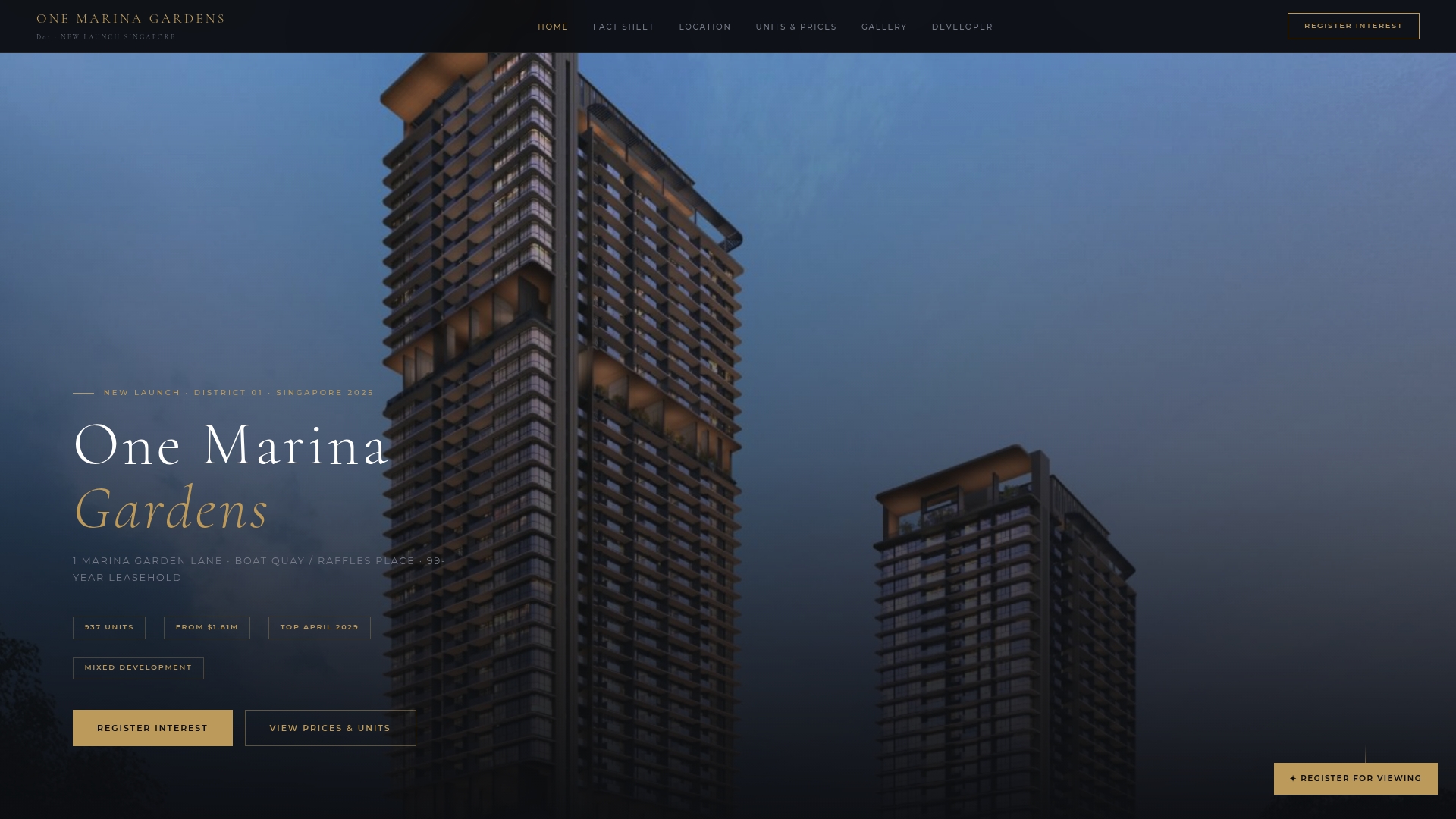
Download the One Marina Gardens gallery to review unit layouts and finishes, or visit onemarinagardens.info to book a showflat appointment and get the exact progressive payment schedule from the sales team.
This article is general information only and does not constitute financial, legal, or property investment advice. Verify current payment terms, TOP/CSC status, and regulatory requirements with the developer, your solicitor, or a licensed financial adviser before making any purchase decision.
Useful official sources and further reading
The sources below are the authoritative references for everything covered in this article. Use them to verify TOP/CSC status, confirm the current regulatory position, and cross-check any developer's payment terms.
- MND press release — May 8, 2026: The primary source for the abolition of DPS on new EC GLS tenders, the 10-year MOP change, and the first-timer quota update. Read this before any EC purchase decision.
- MND written answer on deferred payment schemes: Confirms the October 2007 prohibition on DPS for uncompleted private residential properties and explains when DPS remains permissible on completed projects with TOP/CSC.
- PropertyNet.SG — developer payment schemes explained: Practical breakdown of progressive, deferred, and stay-then-pay structures, including the 2–3% premium industry practice.
- Winfred Quek — EC DPS removed analysis: Worked cashflow examples showing the $240,000 upfront requirement under PPS on a $1.2M EC, with practical guidance for buyers adjusting to the post-May 2026 rules.
- Stuart Chng — DPS explainer for investors: Covers rebranded DPS variants (stay-then-pay, reservation schemes) and how to inspect CSC/TOP documentation to confirm legality.
To verify a specific project's TOP or CSC status, use the Urban Redevelopment Authority's online records or request the certificate directly from the developer. For the S&P review, a licensed conveyancing solicitor should confirm that every deferred payment term is recorded as a binding clause, not a side arrangement.