
Singapore's property market is normalizing in 2026: price momentum has slowed, a record supply pipeline is building, and lower mortgage costs are keeping buyers active enough to prevent any real correction. The result is a two-speed market where prime and landed segments hold firm while HDB resale and mass-market condos face genuine headwinds.
Key headline takeaways for H1 2026:
- The URA private residential price index rose modestly in Q2 2026, down from Q1, showing a deceleration from prior years.
- HDB resale prices slipped modestly in Q2 after a small drop in Q1, marking the first consecutive quarterly decline in several years.
- The GLS Confirmed List for 2026 shows a record high number of private units, substantially above the 10-year annual average — completions are expected mostly in 2028–2030.
- Savills revised its full-year 2026 investment sales forecast upward after a strong first half, signaling that institutional capital is still rotating into Singapore.
- MTI maintained its 2026 GDP growth forecast within a moderate range, but flagged increased downside risks from global trade conditions.
For investors, the message is nuanced. Caution is warranted in the mass-market and HDB resale segments where supply is rising fastest. Opportunistic buyers with a medium-to-long horizon will find the prime districts and landed stock more defensible, particularly as borrowing costs ease.
Table of Contents
- What do the H1 2026 Singapore property market numbers actually say?
- What's actually driving Singapore's 2026 real estate market?
- How are private condos and HDB resale likely to perform in H2 2026?
- What does the commercial and investment-sales market look like for the rest of 2026?
- What are the realistic H2 2026 scenarios, and what should you watch?
- How should investors and buyers approach H2 2026 tactically?
- Where does this analysis come from? Sources and methodology
- How are short-term rentals and co-living reshaping investment potential?
- How are foreign buyers and regulatory changes affecting Singapore's market?
- How does Singapore compare to other regional property markets in 2026?
- What demographic shifts are shaping Singapore's housing demand?
- How are technology and sustainability trends changing what Singapore property is worth?
- Key Takeaways
- Singapore's 2026 market is more interesting than the headlines suggest
- One Marina Gardens: prime District 01 in a normalizing market
- Useful sources and further reading
What do the H1 2026 Singapore property market numbers actually say?
The headline figures tell a story of controlled deceleration, not distress. Private prices are still positive; HDB resale is softening under supply pressure; and investment volumes are running well ahead of prior-year levels.

| Metric | H1 2026 Reading | Source |
|---|---|---|
| Private residential price index, Q1 2026 | +0.9% QoQ | URA |
| Private residential price index, Q2 2026 | +0.5% QoQ | URA |
| H1 2026 cumulative private price growth | 1.4% | URA |
| HDB Resale Price Index, Q1 2026 | modest drop | HDB / PropertyNet |
| HDB Resale Price Index, Q2 2026 | modest drop | HDB / PropertyNet |
| GLS Confirmed List, full-year 2026 | 9,320 units | URA / GLS |
| H1 2026 investment sales | ~S$31–35 billion | EdgeProp / Knight Frank |
The private price deceleration from 0.9% to 0.5% QoQ is the single most important signal in the table. It confirms that cooling measures and affordability constraints are doing their job without tipping the market into negative territory. The HDB resale back-to-back decline is more pointed: about 13,480 HDB flats reached their minimum occupation period (MOP) in 2026, nearly double the 2025 figure, flooding the resale pool with fresh supply at exactly the moment buyer urgency is fading.
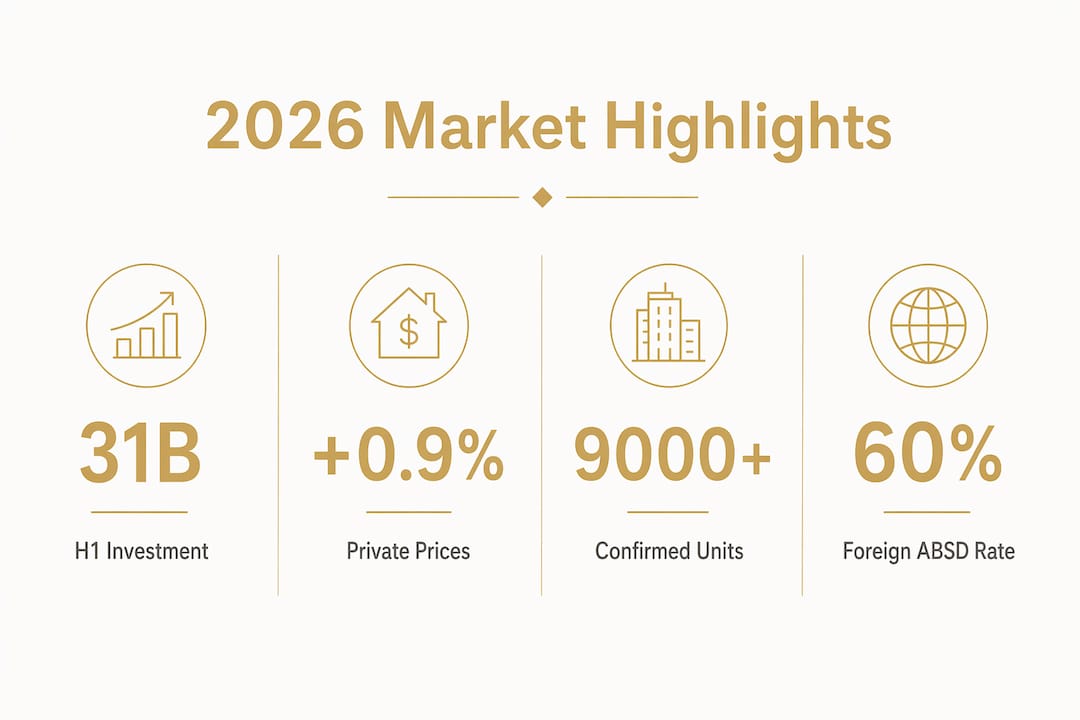
The GLS figure deserves its own emphasis. Nine thousand-plus confirmed units in a single year is unprecedented. Those completions won't hit the market until 2028–2030, so the near-term price impact is limited. But developers and land bidders already know what's coming, and that knowledge shapes how aggressively they price new launches today.
The investment-sales number, S$31–35 billion in H1 alone, is the counterweight. Commercial deals made up the majority of Q2 volumes, and Savills' upgraded full-year forecast of S$55–S$60 billion suggests the second half will sustain that pace.
What's actually driving Singapore's 2026 real estate market?
Four forces are shaping the data above, and they pull in different directions.
Supply timing. The GLS record matters most over a 3–5 year horizon. Near-term, the pipeline is still thin enough that well-located new launches face limited direct competition. From 2028 onward, the calculus changes as completions stack up. Developers are already forming consortium bids for GLS sites and recording high land prices, which signals continued confidence in medium-term absorption — but also locks in elevated break-even costs that support rather than suppress launch prices.
Financing conditions. SORA, Singapore's benchmark overnight rate, has tracked the global rate cycle closely. With the U.S. Federal Reserve signaling further cuts through late 2026, SORA is expected to drift lower, reducing floating-rate mortgage costs. The MAS Mortgage Servicing Ratio and Total Debt Servicing Ratio rules remain in place, capping how much of any rate relief translates into higher purchasing power. Still, even modest rate reductions improve affordability at the margin, particularly for upgraders stretching into the S$1.5–2.5 million range.
Policy framework. The government has shown no appetite to remove cooling measures. Additional Buyer's Stamp Duty rates for foreigners remain at 60%, and the LTV and TDSR frameworks continue to constrain leverage. This is deliberate: the government wants price growth to track income growth, not capital inflows. Buyers who factor in ABSD at the outset avoid the most common mistake in Singapore property investment.
External capital. Cushman & Wakefield identifies Singapore as a safe-haven destination for regional capital, with lower borrowing costs and tight quality office supply supporting investment demand. That safe-haven premium is real and structural: Singapore's rule of law, transparent title system, and liquid exit market attract capital that has no equivalent destination in Southeast Asia.
How are private condos and HDB resale likely to perform in H2 2026?
The two segments are moving in opposite directions, and the gap is widening.
Private condos: CCR, RCR, and OCR
The Core Central Region (CCR) — which includes District 01 and the prime Orchard belt — has held up best. Foreign-buyer restrictions have reduced speculative demand, but genuine owner-occupier and long-term investor interest remains. RCR (city fringe) has seen the most new-launch activity and is where the GLS pipeline will eventually land hardest. OCR (suburban) is the most price-sensitive segment; affordability constraints bite earliest here, and the HDB upgrader pipeline that typically supports OCR demand is itself under pressure from MOP supply.
For H2 2026, the base case is continued modest positive growth in CCR and RCR, with OCR flat to slightly positive. Rental yields by segment give a useful cross-check: CCR condos run around 2.5% gross, OCR around 3.5%, and HDB flats between 3.8–4.5% gross. Those yield differentials reflect the capital-appreciation premium baked into CCR pricing. Investors prioritizing income over appreciation should look at OCR or HDB; those prioritizing capital resilience should look at CCR and landed.
HDB resale: softening, not collapsing
The back-to-back quarterly declines are notable but not alarming. The MOP wave of roughly 13,480 units is a one-year supply surge; it will normalize in 2027. First-time buyers and downgraders still provide a floor of demand. The practical implication for upgraders is that the window to sell an HDB flat at peak pricing has likely passed for this cycle — but the window to buy a private condo at a reasonable entry point is opening.
Pro Tip: When evaluating older resale condos, check the remaining lease carefully. A 99-year leasehold property with fewer than 60 years remaining faces CPF usage restrictions and bank financing constraints that can materially reduce your pool of future buyers — and therefore your exit options.
What does the commercial and investment-sales market look like for the rest of 2026?
The commercial market is the strongest part of Singapore's 2026 property story, and the numbers back that up clearly.
Singapore's real estate investment sales crossed S$30 billion in H1 2026, with commercial deals accounting for more than half of Q2 volumes. Savills' revised forecast of S$55–S$60 billion for the full year implies a broadly similar H2 pace, which is achievable if one or two large portfolio transactions close as expected.
Sector-by-sector, the picture is uneven:
- Prime office: Tight quality supply and sustained demand from financial services and tech occupiers keep Grade A vacancy low. Cushman & Wakefield expects asset re-pricing to favor well-located office assets as borrowing costs fall.
- Industrial: Logistics and data-center demand remains solid, but conventional factory and warehouse space faces some softness as global trade uncertainty weighs on occupier expansion plans.
- Retail: High-street and prime mall retail is recovering, supported by tourism and domestic consumption. Secondary retail continues to struggle with structural vacancy.
- Hospitality: Hotel RevPAR has held up well through H1 2026, supported by MICE events and regional leisure travel. The segment is rate-sensitive and could soften if global travel demand weakens.
For capital allocators, the clearest income-plus-appreciation case sits in prime office and well-located industrial assets. Listed S-REITs offer exposure to these sectors without the ABSD and liquidity constraints of direct ownership — a meaningful consideration for investors who want Singapore real estate exposure without a seven-figure entry ticket.
What are the realistic H2 2026 scenarios, and what should you watch?
Three scenarios cover the plausible range for the second half of 2026.
| Scenario | Trigger conditions | Likely market outcome |
|---|---|---|
| Downside | Global recession shock; Singapore unemployment rises; SORA stays elevated | Private prices flat to -1%; HDB resale -1–2%; investment sales fall short of S$50bn |
| Base case | MTI GDP 2.0–4.0% realized; SORA drifts lower; GLS absorption steady | Private prices +0.5–1.5% H2; HDB resale stabilizes; investment sales reach S$55bn |
| Upside | Fed cuts accelerate; SORA drops faster than expected; foreign capital re-engages | Private prices +2–3% H2; CCR outperforms; investment sales exceed S$60bn |
The base case is the most probable, and it is essentially what the H1 data already describes: a market that is moving, but not racing. The downside scenario is the one to stress-test against, because Singapore's open economy is genuinely exposed to global trade shocks. MTI's maintained GDP forecast of 2.0–4.0% comes with an explicit note about increased downside risks — that language matters.
Indicators to watch:
- SORA trajectory: A 25–50 basis point drop in SORA by Q4 2026 would be a clear upside trigger for private residential demand.
- GLS absorption rate: If developers slow their bidding on new GLS sites, it signals reduced confidence in medium-term demand.
- HDB MOP flow: The 2026 MOP surge is a one-year event; watch whether 2027 MOP volumes normalize, which would ease resale supply pressure.
- Singapore unemployment rate: Any move above 3% would signal demand-side stress that cooling measures cannot offset.
- MTI GDP revisions: A downward revision below 2% would shift the base case toward the downside scenario.
How should investors and buyers approach H2 2026 tactically?
Translating the scenarios into concrete moves requires matching your horizon to the right segment and stress-testing your financing before you commit.
- Stress-test your affordability at higher rates. Even with SORA expected to fall, run your mortgage calculations at SORA plus 1.5–2%. If the monthly payment at that stress rate breaches your TDSR or MSR limit, the purchase is too leveraged for the current environment.
- Check LTV limits before you structure the deal. The MAS loan-to-value framework caps LTV at 75% for a first property and lower for subsequent purchases. Know your tier before you make an offer.
- For short-term horizons (6–18 months): The market is not a trading vehicle right now. Transaction costs (BSD, ABSD, agent fees, legal) make sub-two-year holds expensive. If you need liquidity within 18 months, listed S-REITs or property bonds are more appropriate.
- For medium-term horizons (3–5 years): RCR new launches with strong MRT connectivity and the CCR prime belt offer the best risk-adjusted case. The GLS pipeline will add supply, but well-differentiated projects in established locations tend to hold value through supply cycles.
- For long-term horizons (8+ years): Landed residential and prime CCR condos have historically delivered the strongest capital performance. Landed stock faces constitutional supply constraints that create a structural floor — subdivision and plot-size rules mean the supply of landed homes cannot expand freely, regardless of demand.
- Consider rental yield benchmarks before committing to a buy-to-let. Gross yields of 2.5% in CCR look thin until you factor in capital appreciation expectations. Headline yields also overstate cash-flow reality once ABSD amortization and operating costs are included — many investors in prime districts are effectively making a capital-gain bet, not an income play.
- If ABSD is a constraint, explore listed vehicles. S-REITs listed on SGX provide diversified Singapore real estate exposure without triggering ABSD, and they offer daily liquidity that direct property cannot match.
This article is general market information, not financial or investment advice. Consult a licensed property agent and a qualified financial advisor before committing capital to any property transaction.
Where does this analysis come from? Sources and methodology
The outlook draws on primary datasets and analyst commentary released through mid-2026.
Primary datasets used:
- URA Private Residential Property Price Index (flash and full quarterly releases, Q1 and Q2 2026)
- HDB Resale Price Index (Q1 and Q2 2026 releases)
- URA Government Land Sales Confirmed List (2026 full-year release)
- MAS SORA reference rates and housing loan policy documentation
- MTI GDP growth forecast statement (2026)
Analyst commentary:
- Savills Singapore (investment sales forecast revision, July 2026)
- Cushman & Wakefield Singapore (market outlook, H1 2026)
- Knight Frank / EdgeProp (H1 2026 investment sales data)
Method notes: QoQ figures for the URA private residential index are drawn from flash releases and may be revised in final publications. H1 cumulative growth is the arithmetic sum of Q1 and Q2 QoQ changes as reported. HDB RPI figures are from official HDB quarterly releases. GLS unit counts reflect the Confirmed List only, not the Reserve List. Investment-sales figures vary by provider (S$31–35 billion range for H1 2026) depending on whether strata and en-bloc transactions are included.
Data currency note: All figures in this article reflect data available through Q2 2026 releases. URA and HDB publish quarterly updates; readers should verify the most current index readings directly at ura.gov.sg and hdb.gov.sg before making any investment decision. Forecasts from Savills and Cushman & Wakefield represent analyst estimates, not guaranteed outcomes.
How are short-term rentals and co-living reshaping investment potential?
Singapore's regulatory stance on short-term rentals is among the strictest in Asia. Private residential properties must be rented for a minimum of three consecutive months, and enforcement has tightened. This effectively closes the Airbnb-style arbitrage that has inflated yields in markets like Bangkok or Bali.
Co-living operators have found a workable middle ground. Purpose-built co-living developments and serviced apartment operators with the right licensing can offer flexible tenancies, and demand from young professionals and short-stay expats is real. For individual condo investors, the practical implication is straightforward: underwrite your rental case on a conventional 12-month tenancy, not a short-term premium. Any yield uplift from co-living arrangements requires a licensed operator structure that most individual investors cannot replicate.
The segment to watch is purpose-built student and professional housing near the one-north and Jurong Lake District precincts, where institutional co-living operators are expanding. These assets trade at yields above conventional residential and attract a different buyer profile, typically institutional or family-office capital.
How are foreign buyers and regulatory changes affecting Singapore's market?
Foreign buyer activity is the most policy-sensitive variable in Singapore's market. The 60% ABSD rate for foreign nationals, introduced in April 2023, effectively priced out most individual foreign buyers from the private residential market. The ABSD framework remains unchanged in 2026, and there is no credible signal that the government intends to relax it.
What has changed is the composition of foreign capital. Individual foreign buyers have retreated, but institutional and family-office capital continues to flow into commercial assets, where ABSD does not apply in the same way. Singapore's status as a regional wealth management hub means that high-net-worth individuals are still acquiring property, often through corporate structures or by qualifying for exemptions under free trade agreements (notably the U.S.-Singapore FTA, which gives American citizens the same ABSD treatment as Singapore Permanent Residents for their first residential purchase).
The practical effect is a bifurcated foreign-capital story: institutional money is active in commercial and investment-grade assets; individual foreign buyers are largely absent from the residential market. This has reduced speculative froth in the CCR without eliminating genuine end-user demand from expats and long-term residents. For expat buyers in Singapore, the calculus depends heavily on residency status and whether the U.S.-Singapore FTA exemption applies.
How does Singapore compare to other regional property markets in 2026?
Singapore sits at the premium end of the Asia-Pacific residential spectrum, and the comparison with regional peers clarifies why its price trajectory looks modest by local standards but strong in a regional context.
Hong Kong's residential market has faced more severe headwinds from capital outflows and policy uncertainty, with prices declining meaningfully from their 2021 peaks. Tokyo remains attractive for yield-focused investors, but the yen's weakness has complicated USD-denominated returns for international buyers. Bangkok and Kuala Lumpur offer higher gross yields but carry significantly more political and currency risk, and their legal frameworks for foreign ownership are more restrictive in practice than Singapore's.
The key differentiator for Singapore is not yield — it rarely wins that comparison. It is capital preservation and exit liquidity. The combination of a transparent legal system, a deep pool of institutional buyers, and a government that actively manages supply through the GLS program means that well-located Singapore property has historically held value through global downturns better than most regional alternatives. That premium is priced in, which is why CCR gross yields of 2.5% look thin in isolation but make sense in a total-return framework.
What demographic shifts are shaping Singapore's housing demand?
Two demographic forces are reshaping demand in ways that won't reverse quickly.
Household formation and shrinking household size. Singapore's average household size has been declining for decades, driven by later marriages, lower birth rates, and more singles living independently. Smaller households mean more units demanded per capita even when population growth is flat. This structural dynamic supports demand for one- and two-bedroom units, which is exactly the segment that new launches and the GLS pipeline are targeting.
An aging population and retirement-oriented demand. Singapore's median age is rising, and a growing cohort of asset-rich retirees is making housing decisions that prioritize accessibility, proximity to healthcare, and low-maintenance living. This group is a natural buyer for well-located condos with strong amenity packages. The retirement living segment is not a niche — it is becoming a primary demand driver in the CCR and established suburban districts.
Urban migration within Singapore. The government's long-term planning push toward decentralized growth nodes (Jurong Lake District, Woodlands Regional Centre, Punggol Digital District) is gradually shifting where people want to live. But the CBD-adjacent premium has not eroded. Workers who can afford it still prefer short commutes, and the Marina Bay precinct in particular continues to attract both owner-occupiers and tenants who value proximity to the financial district.
How are technology and sustainability trends changing what Singapore property is worth?
Green building certification is no longer a marketing add-on in Singapore. The Building and Construction Authority's Green Mark scheme sets minimum standards for new developments, and the government's target of greening 80% of Singapore's building stock by 2030 is driving retrofits across the commercial sector. For investors, the practical implication is that non-certified older buildings face higher operating costs and potential obsolescence risk as tenants and buyers increasingly screen for sustainability credentials.
Smart home technology has moved from premium feature to baseline expectation in new launches. Integrated building management systems, EV charging infrastructure, and high-speed fiber connectivity are now standard in any development competing for the mid-to-upper price bracket. Developments that lack these features at launch will face a growing discount relative to newer stock.
The intersection of technology and sustainability is most visible in the industrial and data-center segment. Singapore's position as a regional data hub has driven significant demand for energy-efficient, high-specification facilities. The government's controlled approach to data-center capacity allocation means that approved projects command a scarcity premium. For residential investors, the takeaway is simpler: buy new or recently completed stock with Green Mark certification, and verify that the development's facilities management is equipped to maintain smart-building systems over the long term.
Key Takeaways
Singapore's 2026 property market is a two-speed story: private prices are growing modestly with prime and landed segments outperforming, while HDB resale softens under a record MOP supply wave and a 9,320-unit GLS pipeline signals medium-term supply pressure.
| Point | Details |
|---|---|
| Private prices decelerating | URA private residential price index grew 1.4% in H1 2026, slowing from 0.9% in Q1 to 0.5% in Q2. |
| HDB resale under supply pressure | HDB Resale Price Index fell modestly in Q2 after a small drop in Q1, driven by a significant number of flats reaching their minimum occupation period and entering the market. |
| Record GLS pipeline ahead | The GLS Confirmed List for 2026 is substantially above the 10-year average; completions are expected to arrive in 2028–2030. |
| Investment sales running strong | H1 2026 investment sales reached S$31–35 billion; Savills forecasts robust full-year investment sales of S$55–S$60 billion. |
| Onemarinagardens in prime District 01 | One Marina Gardens offers 937 units in District 01 with direct Marina South MRT access, positioning it in the CCR segment where capital resilience has been strongest. |
Singapore's 2026 market is more interesting than the headlines suggest
The dominant narrative around Singapore property in 2026 is "cooling" — and that framing misses what is actually happening. The market is not cooling in the sense of prices falling broadly. It is differentiating, which is a more useful concept for anyone making a real capital allocation decision.
The HDB resale softness is real and supply-driven, not a signal of systemic weakness. The private price deceleration is exactly what a well-functioning market with active policy management looks like. And the investment-sales figures — S$31–35 billion in a single half-year — tell you that sophisticated institutional capital has not lost confidence in Singapore as a destination.
What the data does not capture well is the qualitative shift in buyer behavior. The speculative urgency that characterized 2021–2022 is gone. Buyers in 2026 are doing more due diligence, running tighter affordability checks, and thinking more carefully about exit liquidity. That is healthy. It also means that well-differentiated projects in genuinely prime locations face less competition from speculative demand, which historically is when the best long-term entry points appear.
The risk that most commentary underweights is the GLS pipeline timing. Nine thousand-plus units confirmed for 2026 alone, with more on the Reserve List, means the 2028–2030 completion window will be the real test of whether Singapore's demand fundamentals can absorb supply at this scale. Investors with a 5–7 year horizon should be thinking about that window now, not after the completions land.
One Marina Gardens: prime District 01 in a normalizing market
District 01's Marina South precinct is one of the clearest beneficiaries of the current market dynamic. As speculative demand has faded, genuine long-term buyers and investors have moved in, attracted by the precinct's long-lease new stock, direct MRT connectivity, and proximity to the CBD financial core.
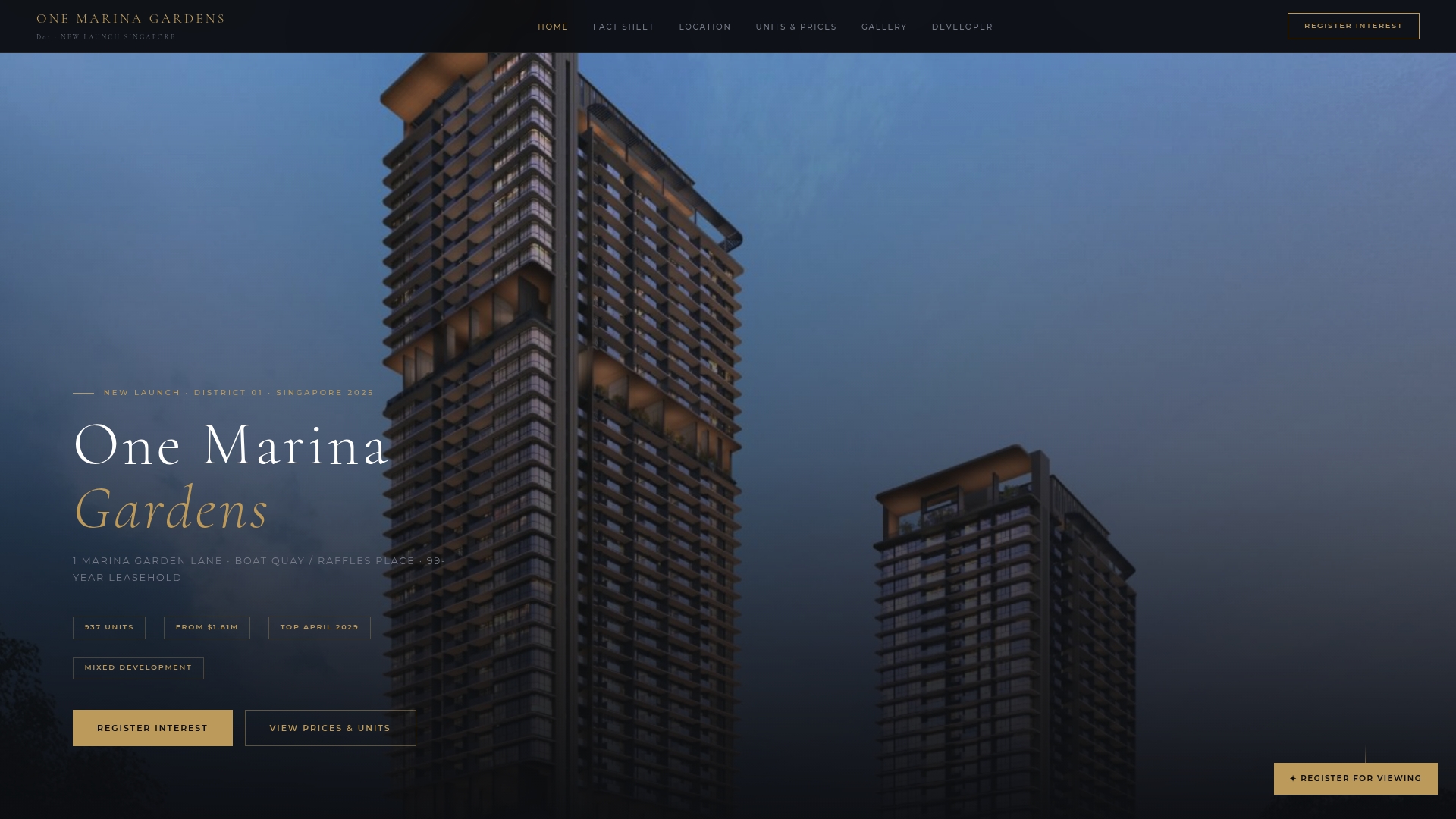
Onemarinagardens sits at the center of this story. The 937-unit development by Kingsford Marina Development offers 1- to 4-bedroom apartments with multiple sky terraces, a 50-metre lap pool, a dedicated childcare centre, and retail and restaurant space within the development. At 160 meters from Marina South MRT, the commute to Raffles Place takes minutes. For investors, the combination of a long-lease freehold-equivalent tenure, CCR location, and a mixed-use environment supports both rental demand and long-term capital resilience.
Pricing starts at a premium level reflecting the development's prime location. Review the full project fact sheet for unit sizes, floor plans, and facility details, or visit onemarinagardens.info to register for a showflat appointment and speak directly with the developer's sales team.
Useful sources and further reading
The figures and forecasts in this article draw on the following primary sources. Check each directly for the most current data releases.
- URA Real Estate Information System (REIS) — The primary source for private residential price indexes, transaction caveats, and rental data. Updated quarterly with flash and full releases.
- URA Media Release: Q2 2026 private residential data and GLS Confirmed List — The Q2 2026 flash release covering the private price index (+0.5% QoQ) and the 9,320-unit GLS Confirmed List figure.
- HDB — Selling a Flat: Eligibility and MOP — Official HDB guidance on MOP rules and resale eligibility, essential for understanding the 2026 MOP supply wave.
- MAS — MSR and TDSR Rules — The Monetary Authority of Singapore's explainer on mortgage servicing ratio and total debt servicing ratio constraints.
- MAS — Loan Tenure and LTV Limits — LTV framework for residential property loans; critical for stress-testing buyer affordability.
- IRAS — Additional Buyer's Stamp Duty (ABSD)) — Official ABSD rate table by buyer profile, including the 60% rate for foreign nationals.
- MTI — 2026 GDP Growth Forecast — MTI's maintained 2.0–4.0% forecast with commentary on downside risks.
- Savills Singapore — Investment Sales Forecast Revision (July 2026) — Savills' upgraded S$55–S$60 billion full-year forecast following strong H1 transaction momentum.
- Cushman & Wakefield — Singapore Market Outlook — Analyst commentary on safe-haven capital flows, office demand, and borrowing-cost effects.
- EdgeProp — Singapore Investment Sales Cross S$30 Billion in 1H2026 — Detailed breakdown of H1 2026 investment-sales volumes by sector and deal type.
- PropertyNet — Singapore Property Market Mid-2026 Review — Mid-year market summary covering HDB resale declines, private price trends, and MOP supply analysis.