
Buyer's Stamp Duty (BSD) is a statutory tax on documents used to buy or acquire property in Singapore, collected by the Inland Revenue Authority of Singapore (IRAS)) and computed on the higher of the purchase price or market value. Every buyer pays it — citizens, permanent residents, foreigners, and companies alike. Both rate schedules took effect on February 15, 2023. BSD is separate from Additional Buyer's Stamp Duty (ABSD), and payment is due within 14 days of signing a contract in Singapore.
Before you sign anything, do three things:
- Confirm whether IRAS will assess BSD on the contract price or on a higher market valuation.
- Set aside cash for BSD upfront — CPF reimbursement comes later, after stamping.
- Instruct your conveyancer on the day you sign so the stamping deadline is not missed.
Current BSD marginal rates at a glance (effective February 15, 2023):
| Portion of Value | Residential Rate | Non-Residential Rate |
|---|---|---|
| First S$180,000 | 1% | 1% |
| Next S$180,000 | 2% | 2% |
| Next S$640,000 | 3% | 3% |
| Next S$500,000 | 4% | 4% |
| Next S$1,500,000 | 5% | 5% |
| Remainder above S$3,000,000 | 6% | 5% |
Key Takeaways
| Point | Details |
|---|---|
| BSD applies to all buyers | Every buyer pays BSD regardless of nationality, residency status, or property count. |
| Compute on the higher value | IRAS uses the higher of purchase price or market value — a below-market deal does not reduce BSD. |
| Residential rates: 1%–6% | Six marginal bands apply post-February 15, 2023; non-residential property is capped at 5%. |
| Pay cash first | BSD must be paid in cash at stamping; CPF reimbursement is a separate step processed afterward. |
| Onemarinagardens | One Marina Gardens units from S$1.81M in District 01 — the sales team covers total BSD costs before signing. |
Table of Contents
- What BSD covers and who is liable to pay it
- How BSD rates work and how to calculate them
- Worked examples at common price points
- Special cases, remissions, and exemptions
- How to file, pay, and meet the deadlines
- Common pitfalls buyers overlook
- A note on why getting BSD right matters
- One Marina Gardens: a practical next step for buyers
- Sources
- FAQ
What BSD covers and who is liable to pay it
BSD is the duty levied on dutiable documents relating to immovable property in Singapore. The Ministry of Finance sets the policy framework; IRAS administers collection. The duty attaches to the document itself, not the transaction, which has a practical consequence: if you sign a legally binding document and the deal later falls through, stamp liability may already exist.
When liability arises depends on what you sign and where:
- Option to Purchase (OTP): BSD is due within 14 days of exercising the OTP in Singapore.
- Sale and Purchase Agreement (SPA): BSD is due within 14 days of signing if the document is executed in Singapore.
- Documents signed overseas: The deadline extends to 30 days from the date the document is received in Singapore.
- HDB resale: The OTP is typically exercised at the HDB branch; the 14-day clock starts from that exercise date.
BSD applies to every buyer without exception. Singaporean citizens buying their first HDB flat pay it. Foreign nationals buying a luxury condo pay it. A company acquiring a commercial shophouse pays it. Nationality, residency status, and property count do not affect BSD liability — though they do affect ABSD. If you are a foreign buyer, the ABSD guide for foreigners explains how the two duties stack.
How BSD rates work and how to calculate them
BSD is a marginal tax, meaning each band of value is taxed at its own rate — not the whole price at the highest rate. IRAS computes BSD on the higher of the purchase price or market value, rounded down to the nearest dollar, with a minimum duty of S$1.
The IRAS stamp duty rate table sets out the bands. The Data records every rate change back to 2003, useful if you need to confirm which rates applied to a contract signed before February 15, 2023.
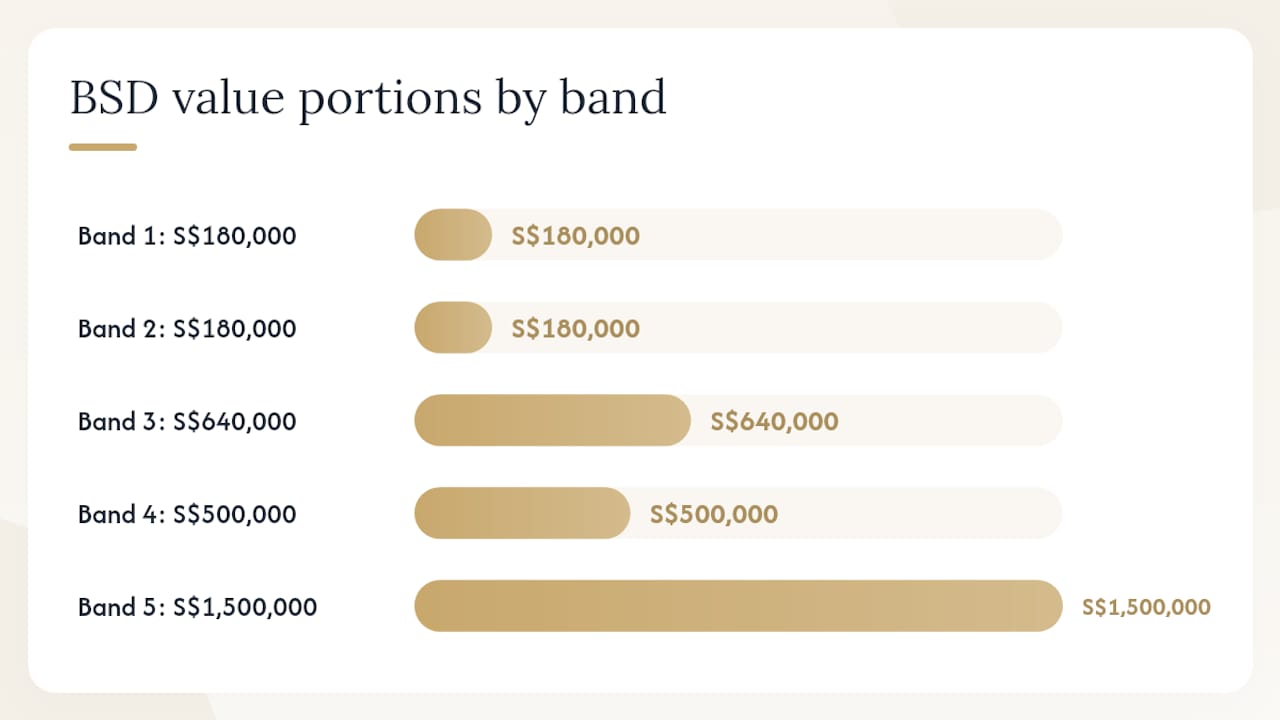
Residential BSD formula (post-February 15, 2023):
| Band | Value Portion | Rate | Max Duty in Band |
|---|---|---|---|
| 1 | First S$180,000 | 1% | S$1,800 |
| 2 | Next S$180,000 | 2% | S$3,600 |
| 3 | Next S$640,000 | 3% | S$19,200 |
| 4 | Next S$500,000 | 4% | S$20,000 |
| 5 | Next S$1,500,000 | 5% | S$75,000 |
| 6 | Remainder | 6% | Uncapped |
The algebraic shortcut for common residential price ranges:
- S$180,001 to S$360,000: BSD = (Price × 2%) − S$1,800
- S$360,001 to S$1,000,000: BSD = (Price × 3%) − S$5,400
- S$1,000,001 to S$1,500,000: BSD = (Price × 4%) − S$15,400
- S$1,500,001 to S$3,000,000: BSD = (Price × 5%) − S$30,400
- Above S$3,000,000: BSD = (Price × 6%) − S$60,400
These shortcuts give the same result as the full band-by-band calculation and are faster for quick estimates.
Worked examples at common price points
The examples below use the residential rate schedule. Each shows the band-by-band breakdown so you can replicate the math for any price.
Example 1: S$500,000 (typical HDB resale)
✓
Example 2: S$1,000,000 (mid-range condo)
Example 3: S$1,500,000 (entry-level prime condo)
Example 4: S$3,000,000 (luxury residential)
Example 5: S$5,000,000 (prime luxury)
Quick reference summary:
| Purchase Price | Total BSD |
|---|---|
| S$500,000 | S$9,600 |
| S$1,000,000 | S$24,600 |
| S$1,500,000 | S$44,600 |
| S$3,000,000 | S$119,600 |
| S$5,000,000 | S$239,600 |
IRAS may assess BSD based on the higher of the contract price or market value, particularly in related-party sales or below-market transactions. To avoid surprises, consider a formal valuation before signing.
For context on typical condo price bands in Singapore, the best condominiums buyer's guide covers how purchase prices vary across districts.
Special cases, remissions, and exemptions
BSD is not always a flat liability. Several situations change how it is assessed or whether a remission is available.
- Gifts and intra-family transfers: BSD is assessed on market value, not on the nominal consideration (which may be S$0 or a token sum). A parent transferring a property to a child at below-market price will still owe BSD on the full market value. Get a formal valuation before proceeding.
- Inheritance: Property passing under a will or intestacy is generally not subject to BSD because no dutiable document of acquisition is executed. Confirm the specific structure with a lawyer.
- En-bloc and block purchases: Where a single contract covers multiple properties, BSD is typically assessed on the total consideration. The allocation between units matters for the band calculation; your conveyancer should confirm how IRAS treats the contract structure.
- Aborted sales: If a sale is aborted after an OTP or SPA is executed, the document has already been stamped. Remission of BSD on an aborted transaction is possible in limited circumstances; IRAS sets out the conditions and required documentation on its remission pages.
- Acquisitions before February 15, 2023: The pre-2023 rate schedule applies. The data.gov.sg historical dataset confirms the exact bands for any earlier effective date.
- Remissions vs. exemptions: A remission reduces or cancels a duty that would otherwise be payable; an exemption means the duty never arose. Both require a formal application to IRAS with supporting documents. Do not assume either applies without checking the current IRAS guidance.
For any related-party transaction, IRAS can and will assess on market value where the sale price appears below arm's length. Commissioning an independent valuation before signing is the practical safeguard.
How to file, pay, and meet the deadlines
BSD is paid through the Mytax, which also provides a built-in BSD calculator. In practice, your conveyancing solicitor handles the stamping, but you remain legally liable.
Deadlines:
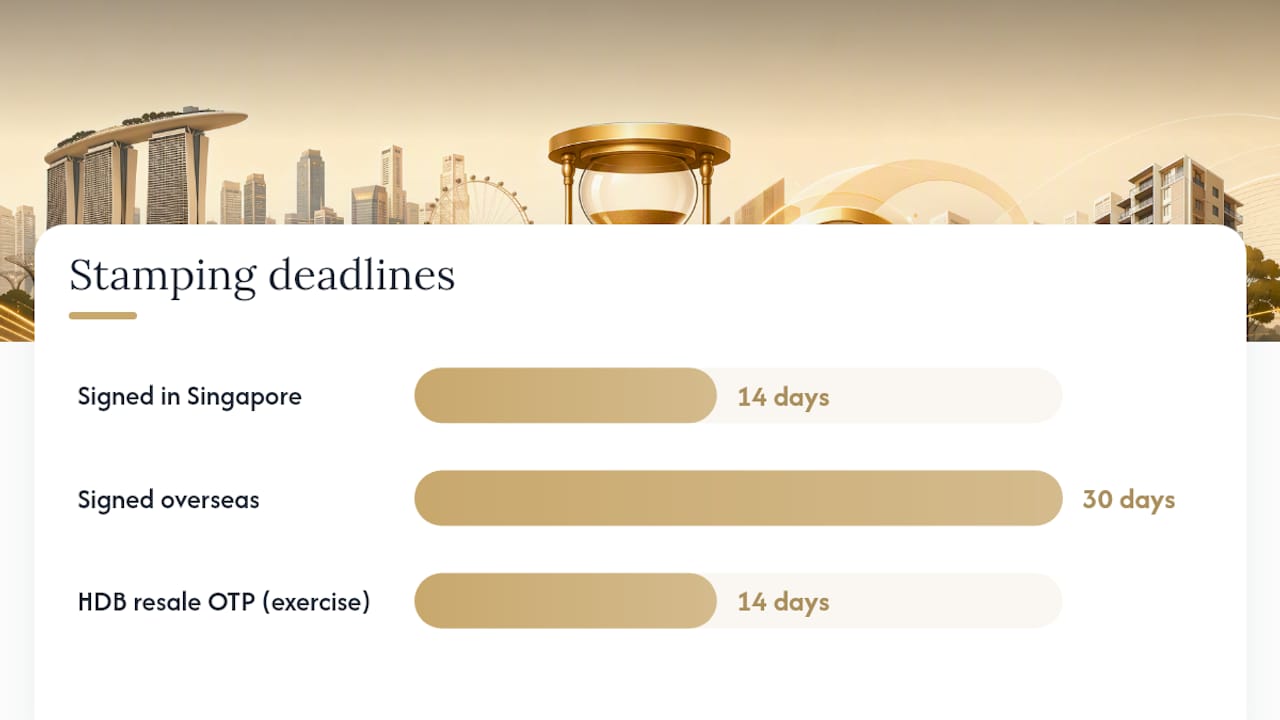
- Documents signed in Singapore: stamp within 14 days of execution.
- Documents signed overseas: stamp within 30 days of the document being received in Singapore.
- HDB resale OTPs: the 14-day window starts from the date the OTP is exercised, not the date it is issued.
How the e-stamping process works:
- Your conveyancer logs into the e-Stamping portal and inputs the property details, purchase price, and buyer profile.
- The portal calculates the BSD (and any ABSD) due.
- Payment is made electronically — accepted methods include PayNow, GIRO, and other channels listed on the portal at the time of payment.
- A stamp certificate is issued as proof of payment. Keep this; you will need it for CPF reimbursement and for completion of the conveyancing.
Documents your conveyancer typically needs:
- Signed OTP or SPA
- Property address and title details
- Purchase price and, if different, the market valuation
- Buyer identification details (NRIC/passport, entity registration if applicable)
Late stamping attracts penalties. IRAS issues a demand note and charges a late-stamping penalty, which can be a multiple of the original duty depending on how late the document is presented. There is no grace period — the 14-day rule is strict.
Common pitfalls buyers overlook
Pro Tip: BSD must be paid in cash first. CPF reimbursement is a separate step that happens only after stamping is complete — budget your cash position accordingly before you sign anything.
This catches buyers off guard more often than any other BSD issue. You may be eligible to use CPF for BSD, but the cash-first requirement means you need liquid funds at the point of stamping, not just CPF savings. Plan for this at the OTP stage, not after.
Other pitfalls worth knowing:
- Market value vs. contract price: IRAS assesses BSD on whichever is higher. In a related-party or below-market deal, the contract price is not the safe number to use. Get a formal valuation if there is any doubt.
- Missing the stamping deadline: Instructing your conveyancer on the day you sign is not optional. A missed deadline means penalties, and the buyer bears the liability even if the conveyancer caused the delay.
- Confusing BSD with ABSD: BSD applies to every buyer on every property. ABSD is an additional layer that depends on nationality, residency status, and the number of properties owned. The two are calculated separately and both are due at stamping.
- Signing before confirming tax consequences: An executed dutiable document creates stamp liability even if the deal collapses afterward. Never sign a legally binding document without first understanding the BSD (and ABSD) exposure.
- Verification: Always confirm current rates directly with IRAS before relying on any third-party guide, including this one. Rates can change; the IRAS BSD page is the authoritative source.
Singapore's broader tax environment — including the absence of capital gains tax — is worth understanding as context for why stamp duties carry more weight here than in many other markets. The Singapore capital gains tax explainer covers that policy background clearly.
A note on why getting BSD right matters
BSD is one of those costs that buyers often underestimate until they are staring at the stamping invoice. On a S$3,000,000 residential purchase, you owe S$119,600 before you get the keys. On a S$5,000,000 unit, that figure climbs to S$239,600. These are not rounding errors in a property budget.
What I find buyers consistently underestimate is the cash-flow timing. The CPF reimbursement process is real and available, but it is not instant. You pay cash at stamping, you complete the conveyancing, and then you apply for CPF reimbursement. That gap can run several weeks. For buyers stretching to a new launch at the upper end of their budget, that timing gap matters.
The other thing worth saying plainly: BSD rates have changed twice in recent years (2018 and 2023), and there is no structural reason they cannot change again. Buyers planning a purchase in 2026 should verify the current bands on the IRAS website rather than relying on any guide published before their signing date. The Singapore property market trends outlook provides useful context on how policy changes interact with pricing.
One Marina Gardens: a practical next step for buyers
Buying a new launch in District 01 means BSD is calculated on a known developer price list — no valuation surprises, no below-market ambiguity. One Marina Gardens is a 937-unit development by Kingsford Marina Development, 160 meters from Marina South MRT, with units from S$1.81M across 1- to 4-bedroom configurations. The sales team walks buyers through total acquisition costs, including BSD and ABSD, before any document is signed.
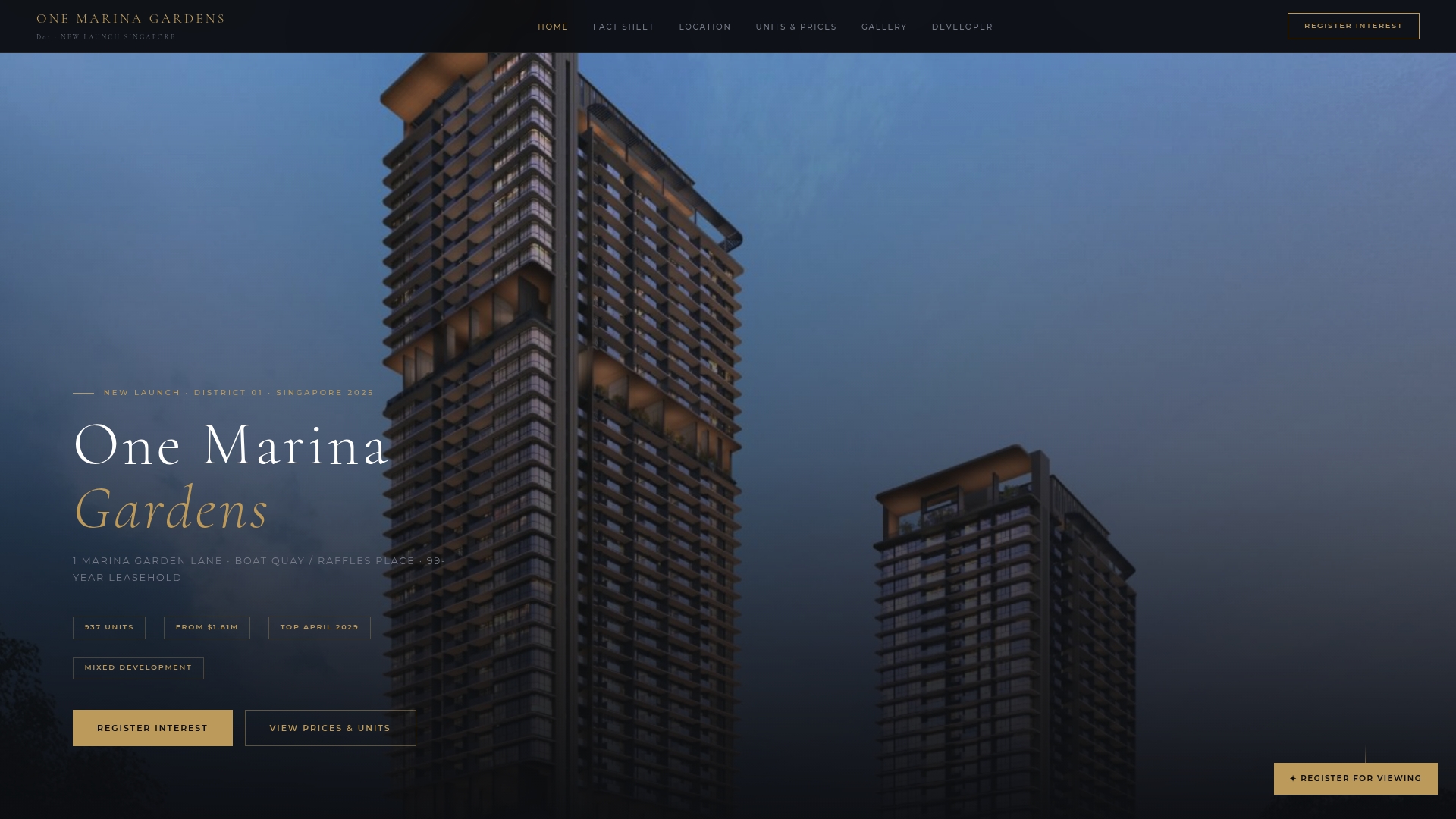
For buyers who want to see the numbers before committing, the One Marina Gardens price list shows available units and current pricing — useful for running your own BSD estimate against the worked examples in this guide. To take the next step, book a showflat appointment directly through the One Marina Gardens website and speak with the sales team about your specific buyer profile.
Sources
Verify all figures directly with official sources before signing any document. Rates and rules can change after publication.
Always confirm current rates with IRAS directly. No third-party guide, including this one, substitutes for the official source at the time you sign.
This article is general information, not a substitute for advice from a qualified financial advisor. Consult a qualified financial professional about your own circumstances before acting on anything here.
FAQ
How do you calculate buyer's stamp duty in Singapore?
Apply the marginal rate to each band of the purchase price (or market value, whichever is higher).
Is BSD based on the purchase price or the property's valuation?
BSD is computed on whichever is higher — the purchase price or IRAS's assessed market value. If you buy at below-market price, IRAS will assess BSD on the market value, not the lower contract figure.
Does an HDB buyer have to pay BSD?
Yes. BSD applies to every buyer of Singapore property, including HDB resale and new flat purchases. There is no BSD exemption for HDB buyers or first-time buyers; the same marginal rate schedule applies.
Why is BSD higher now than it was before 2026?
The impact of the 2023 change varies depending on the property price.
Can CPF be used to pay BSD?
BSD must be paid in cash at the point of stamping. If you are eligible, you can apply to your CPF account for reimbursement after stamping is complete, but the upfront cash payment cannot be skipped. Budget accordingly before you sign the OTP or SPA.