
Decoupling property in Singapore is a legal transfer of one co-owner's share to the other that resets ABSD exposure — and it works for private property when the transfer is a genuine, market-value transaction with all duties paid. HDB is a different story: HDB does not permit part-share transfers between spouses, except in narrow cases such as divorce, death, financial hardship, or renunciation of citizenship. If you own an HDB flat, stop here and consult a conveyancer about your specific situation before going further.
For private property owners, three checks come before anything else:
- Check your SSD holding period. Seller's Stamp Duty applies for properties sold within a set window from purchase. Transferring a share inside that window triggers SSD on the transferred portion, which can wipe out the ABSD savings entirely.
- Confirm the receiving spouse qualifies for the loan alone. The bank will reassess the mortgage under TDSR (55% of gross monthly income) and the MAS 4% stress-test rate. If the numbers don't work solo, the decoupling fails at the financing stage.
- Run a net-savings breakeven. Add up BSD on the transferred share, legal fees, valuation costs, and the CPF refund cashflow impact, then compare that total against the ABSD you'd avoid on the second purchase. If the margin is thin, the exercise may not be worth the effort or the audit risk.
One more thing before you proceed: contrived 99/1 structures and token-price transfers have been challenged by IRAS and the courts. Treat decoupling as a real sale at real market value, or don't do it at all.
Key Takeaways
Decoupling property in Singapore saves ABSD legally only when the transfer passes three independent tests: genuine market-value pricing, solo financing qualification for the receiving spouse, and a holding period outside the SSD window.
| Point | Details |
|---|---|
| HDB owners are largely excluded | Part-share transfers between spouses are blocked except for divorce, death, hardship, or citizenship renunciation. |
| BSD is the primary decoupling cost | BSD on the transferred share uses the standard 1%–6% tiered schedule applied to the market value of that share. |
| CPF refund affects cashflow, not net worth | The exiting owner refunds CPF principal plus accrued OA interest to their own CPF account, reducing cash proceeds. |
| Run the lender check first | Confirm the receiving spouse qualifies for the solo loan under TDSR before paying for valuation or legal retainers. |
| Contrived structures carry clawback risk | MOF has documented clawbacks on 99/1 arrangements; commercial substance and independent documentation are non-negotiable. |
Table of Contents
- What does decoupling property in Singapore actually mean?
- Why do Singapore co-owners choose to decouple?
- How do HDB rules differ from private property rules?
- What are the execution options for transferring a property share?
- What are the full costs of decoupling, and how do you calculate them?
- How do CPF refunds, mortgages, and lender consent work together?
- What does IRAS scrutiny actually look like, and where do courts draw the line?
- What is the step-by-step timeline for decoupling a private property?
- When does decoupling become a bad idea?
- Two worked examples that show the full math
- What should you prepare before instructing lawyers and bankers?
- Decoupling is worth doing — but only when all three gates pass
- Sources
What does decoupling property in Singapore actually mean?
Decoupling, in the Singapore property context, refers to a part-sale transfer where one co-owner sells their share of a jointly held property to the other, leaving a single owner on title. It is not a full resale to a third party. The goal is to free up the exiting owner's property count so they can buy again as a "first-time" purchaser under ABSD rules.
A few terms come up constantly in this process, and getting them right matters:
- Sale of share vs. gift. A part-sale involves real monetary consideration at market value. A gift transfers the share for no consideration. Both are legally possible, but they carry different stamp duty and IRAS implications.
- Change in manner of holding. This refers to converting a joint tenancy to a tenancy-in-common (or vice versa) without changing the ownership proportions. It does not by itself constitute decoupling.
- Joint tenancy vs. tenancy-in-common. Joint tenants hold the property as a single undivided interest with a right of survivorship — if one dies, the other automatically inherits. Tenants-in-common hold defined percentage shares that can be bequeathed separately.
- 99/1 structure. A common pre-decoupling arrangement where one co-owner holds 99% and the other holds 1%. IRAS has scrutinized these structures heavily when the 1% holder later buys a second property, treating the 1% share as a pre-arranged device to reduce ABSD.
| Ownership structure | Immediate legal effect on title | Probate/inheritance implication | IRAS scrutiny level |
|---|---|---|---|
| Joint tenancy | Undivided equal interest; right of survivorship | Surviving owner inherits automatically; no probate needed for that asset | Low for standard transfers |
| Tenancy-in-common | Defined percentage shares; no survivorship right | Each share passes under the will or intestacy rules | Low to moderate |
| Contrived 99/1 | Defined shares, but proportions designed to minimize ABSD exposure | Each share passes under will; 1% share may be challenged as sham | High; MOF clawback precedent exists |
The key legal distinction is between a genuine change in ownership and a paper arrangement designed purely to reduce tax. IRAS applies a commercial-substance test, and the courts have backed it.
Why do Singapore co-owners choose to decouple?
The dominant motive is ABSD avoidance. IRAS determines ABSD based on the buyer's existing property count and residency status at the moment of acquisition), which means a Singapore Citizen buying a second residential property pays 20% ABSD, a Permanent Resident buying a second property pays 30%, and a foreigner buying any property pays 60%. Those rates apply to the full purchase price, not just the equity.
Other motives do exist:
- LTV and TDSR profile. Removing one co-owner from the existing mortgage can improve the remaining owner's debt-service ratio for a new purchase, though the receiving spouse must still qualify for the existing loan alone.
- Estate and succession planning. Some owners decouple to hold properties in separate names for inheritance purposes, though this is a secondary driver and carries its own complexity.
- Relationship changes. Divorce or separation sometimes triggers a transfer, though HDB rules constrain this for flat owners.
- Investment strategy. One spouse takes sole ownership of the current property; the other buys a second property as a first-time purchaser, accessing a lower ABSD tier or none at all.
To see why the math drives most decisions: a Singapore Citizen couple jointly owning one property and planning to buy a second at S$1.5M would face 20% ABSD, which is S$300,000. If decoupling costs land in the S$25,000–S$90,000 range (as industry analysis shows), the net saving on a S$1.5M purchase can be substantial. On a S$2M second purchase, 20% ABSD is S$400,000 — the arithmetic becomes even more compelling. The question is always whether the costs, risks, and financing constraints eat into that saving enough to make the exercise marginal.
For readers weighing the ABSD implications of a new purchase, the ABSD guide for foreigners buying One Marina Gardens covers residency-based duty scenarios in detail.
How do HDB rules differ from private property rules?
HDB owners face a near-complete bar on decoupling. The HDB change-of-ownership rules do not allow part-share transfers between spouses except in four narrow circumstances: divorce, death of a co-owner, financial hardship, or renunciation of citizenship. A couple who simply wants to restructure ownership to free up an ABSD slot cannot do so with an HDB flat.
The contrast with private property is stark:
- Eligibility. Private property co-owners can transfer a share at any time (subject to SSD and lender consent). HDB co-owners cannot transfer a share between spouses outside the four exceptions.
- CPF refund process. For private property, the exiting owner refunds CPF principal plus accrued Ordinary Account interest to their CPF account on completion. For HDB, the CPF refund rules are similar in principle but the transfer itself is rarely permitted, so the question rarely arises.
- Timing constraints. HDB flats are subject to a Minimum Occupation Period (MOP) of five years before any sale or transfer is permitted. Private properties have no MOP, though SSD applies within the holding-period window.
Executive Condominiums (ECs) occupy a middle ground. During the first ten years, an EC is subject to HDB rules, including MOP restrictions. After the ten-year mark, it becomes fully privatized and can be treated like any other private property for transfer purposes. If you own an EC that has not yet crossed the ten-year threshold, consult a conveyancing lawyer before assuming private-property rules apply.
What are the execution options for transferring a property share?
Three main routes exist: a part-sale at market value, a gift, and a change in manner of holding. Each has different tax treatment and IRAS risk.
Part-sale at market value
This is the standard decoupling method. The exiting co-owner sells their share to the remaining co-owner at a price equal to the market value of that share. BSD is calculated on the market value of the transferred share using the standard tiered schedule, which runs from 1% on the first S$180,000 up to 6% on amounts above S$1.5M. The receiving spouse pays BSD. ABSD does not apply to the receiving spouse on this transfer if they are taking over a share of a property they already co-own, but specific circumstances should be confirmed with a conveyancer.
Gift (no consideration)
A gift transfer involves no monetary consideration. BSD is still payable on the market value of the share — IRAS does not allow a zero-value transfer to avoid stamp duty. The gift route does not reduce BSD exposure, and it raises additional IRAS scrutiny because the absence of real consideration makes the commercial-substance argument harder to sustain.
Change in manner of holding
Converting from joint tenancy to tenancy-in-common (or adjusting percentage shares) without a transfer of ownership does not constitute decoupling. It changes how the property is held but does not remove either party from the title. This step sometimes precedes a part-sale but is not a substitute for it.
The 99/1 structure
Some co-owners have used a 99/1 split — where one party holds 1% — as a staging device before the 1% holder buys a second property. The Ministry of Finance has documented cases where contrived 99/1 arrangements were treated as tax avoidance and amounts were clawed back. The 1% share is not treated as a genuine ownership interest when the structure was clearly designed to minimize ABSD rather than reflect a real economic arrangement.
Pro Tip: Get an independent market valuation from a licensed appraiser before executing any transfer. The valuation report is your primary documentary defense if IRAS questions whether the consideration was genuine. Pair it with a bank confirmation of funds movement and separate legal representation for each party.
What are the full costs of decoupling, and how do you calculate them?
Every cost line matters in a breakeven model. Missing one — especially the CPF refund cashflow impact — can turn a projected saving into a surprise loss.
Worked BSD calculation on a 50% share
Assume a private property valued at S$2M. The exiting co-owner holds 50%, so the transferred share is worth S$1M.
BSD on S$1M using the residential tiered schedule:
- 1% on first S$180,000 = S$1,800
- 2% on next S$180,000 = S$3,600
- 3% on next S$640,000 = S$19,200
- 4% on remaining S$0 (S$1M falls below the S$1.5M threshold for the 4% tier)
Total BSD: S$24,600
Add legal fees for both parties (approximately S$5,000–S$8,000), valuation (approximately S$700), and refinancing admin. Total decoupling cost: roughly S$30,000–S$35,000 in this scenario.
Compare that against ABSD avoided on a S$1.5M second purchase at the 20% Singapore Citizen rate: S$300,000. The net saving is approximately S$265,000–S$270,000 before accounting for the CPF refund cashflow effect.
CPF refund mechanics
When the exiting co-owner used CPF to service the mortgage, they must refund the principal withdrawn plus accrued Ordinary Account interest to their CPF account on completion. This is not a cash cost — the money goes back into their CPF OA — but it reduces the cash proceeds they receive from the transfer. If the property has appreciated significantly and the CPF usage was substantial, the exiting owner may receive very little cash despite the transfer proceeding at market value. Plan for this before committing.
Industry cost analysis shows total decoupling costs commonly land in the S$25,000–S$90,000 range, with the BSD on the transferred share being the largest single line item.
How do CPF refunds, mortgages, and lender consent work together?
The financing leg is where most decoupling attempts stall. Banks do not automatically transfer a joint mortgage into one name — they reassess the remaining borrower from scratch.
Checklist of steps with banks and CPF Board:
- Request a redemption statement from your bank. This shows the outstanding loan balance and any early redemption penalty. You need this figure to calculate the total funds the receiving spouse must arrange.
- Confirm solo serviceability under TDSR. The receiving spouse's gross monthly income must support the full loan repayment at a 55% TDSR ceiling, stress-tested at the MAS 4% floor rate. If their income alone does not clear this bar, the bank will decline to reissue the loan in their name.
- Request a formal bank assessment in writing. Do this before instructing lawyers or paying for a valuation. A written in-principle approval from the bank for the solo loan protects you from wasting legal retainer fees on a transaction that cannot complete.
- Notify CPF Board. The exiting co-owner's CPF usage must be refunded on completion. The CPF Board will provide a statement of the amount due (principal plus accrued OA interest). Factor this into the cash-flow model.
- Confirm no Mortgage Servicing Ratio (MSR) constraint. MSR applies to HDB loans and some EC purchases. For private property, TDSR is the binding constraint, but confirm with your lender.
Typical processing times: banks generally take two to four weeks to assess and approve a solo loan application once full documentation is submitted. CPF Board processing for refund confirmation typically runs one to two weeks. Practitioners advise allowing 8–14 weeks from decision to completion for a private property decoupling, accounting for all parallel workstreams.
The practical warning here is blunt: if the receiving spouse cannot qualify for the full loan alone, the decoupling cannot proceed. Any costs already incurred — valuation fees, legal retainers, stamp duty paid on any preliminary documents — may not be recoverable. Run the lender check first, before spending anything else.
What does IRAS scrutiny actually look like, and where do courts draw the line?
IRAS applies a commercial-substance test to property transfers. The question is not whether the paperwork is technically correct but whether the arrangement reflects a genuine economic transaction or was structured primarily to avoid tax.
The MOF has published records of cases where contrived 99/1 structures were found to constitute tax avoidance and amounts were clawed back. The enforcement pattern is consistent: IRAS looks at the sequence of events, the pricing of the transfer, the independence of the parties' advisers, and whether the transfer was coordinated with a subsequent purchase in a way that suggests pre-arrangement.
A fact pattern likely to fail IRAS scrutiny:
- Co-owners convert to a 99/1 tenancy-in-common shortly before one party plans to buy a second property
- The 1% holder transfers their share for a nominal or token sum well below market value
- Both parties use the same lawyer
- The second purchase is contracted within weeks of the transfer completing
- No independent valuation was obtained; no bank confirmation of funds movement exists
Advisory commentary confirms that decoupling remains legal when done as a genuine market-value transaction with all duties paid, but that IRAS, courts, and MOF have successfully challenged contrived structures. The SSD window timing is equally decisive: a transfer inside the SSD holding period triggers duty on the transferred share and signals to IRAS that the arrangement was rushed rather than commercially motivated.
Pro Tip: The documentary record that survives an IRAS audit has four components: an independent licensed valuation at market value, a bank confirmation showing actual funds transferred between accounts, separate lawyers for each party (not the same firm), and a written commercial rationale for the transfer that does not mention ABSD avoidance as the sole purpose.
For supplemental legal perspective on the conveyancing mechanics and compliance considerations, Yuen Law's analysis of decoupling private property ownership covers the legal limits in detail.
What is the step-by-step timeline for decoupling a private property?
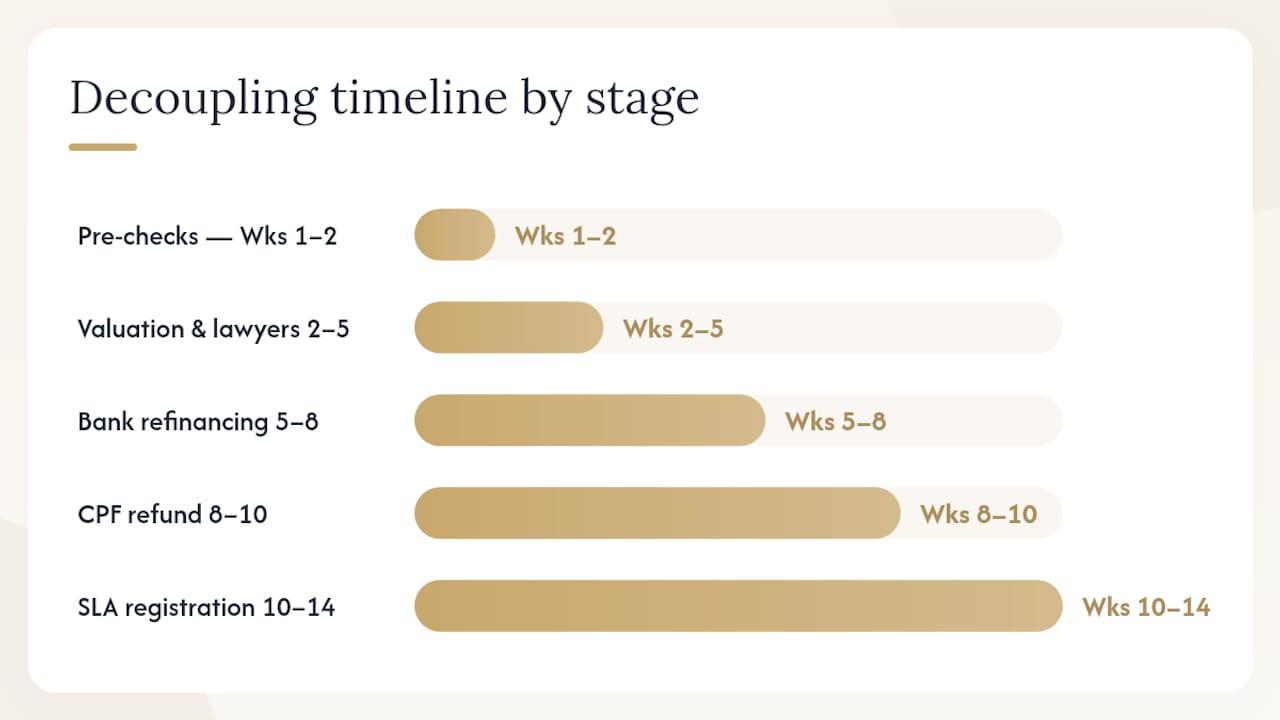
A realistic timeline runs 8–14 weeks from the decision to complete. The sequence matters because some steps must be completed before others can begin, and starting in the wrong order wastes money.
Weeks 1–2: Pre-checks and lender assessment
- Obtain a redemption statement from your bank
- Submit a solo loan application (or in-principle request) for the receiving spouse
- Pull CPF withdrawal statements for both parties
- Confirm SSD holding period status
Weeks 2–3: Valuation
- Instruct an independent licensed valuer to assess the property at market value
- Receive the formal valuation report (typically five to seven business days)
Weeks 3–5: Instruct lawyers
- Each party engages a separate law firm — this is not optional; both parties must have independent legal representation
- Lawyers prepare the transfer documents (Instrument of Transfer) and draft the sale and purchase agreement or deed of assignment
- Stamp duty (BSD) is assessed and paid
Weeks 5–8: Bank refinancing
- Bank processes the loan reissuance in the receiving spouse's name
- Existing joint mortgage is discharged; new mortgage is issued in sole name
- Bank issues a letter of offer; receiving spouse accepts
Weeks 8–10: CPF refund processing
- Exiting co-owner's CPF Board refund is processed on completion
- Funds flow: sale proceeds from receiving spouse to exiting owner; exiting owner refunds CPF principal plus accrued OA interest to their CPF account
Weeks 10–14: SLA registration
- Lawyers lodge the transfer with the Singapore Land Authority for title registration
- SLA updates the title register to reflect sole ownership
- Completion confirmed; title deed issued in the receiving spouse's name
Documents lawyers and banks will request: title deed or certificate of title, current mortgage loan statement, CPF withdrawal history for both parties, proof of funds for the transfer consideration, identity documents, marriage certificate, income documents for the solo loan assessment, and the independent valuation report.
Who handles each step: your conveyancing lawyer coordinates with SLA and the CPF Board; the bank's mortgage team handles loan discharge and reissuance; you manage the CPF Board notification directly or through your lawyer.
When does decoupling become a bad idea?
The arithmetic looks attractive in many scenarios, but several situations make decoupling inadvisable or outright dangerous.
Red flags that should pause or stop the process:
- Inside the SSD window. If the property was purchased within the SSD holding period, the transfer triggers SSD on the transferred share. For properties bought on or after July 4, 2025, advisory guidance notes a four-year SSD window — confirm the exact window for your purchase date with a conveyancer.
- Receiving spouse fails TDSR solo. If the bank will not reissue the loan in one name, the transaction cannot complete. No amount of legal preparation changes this.
- Marginal ABSD savings after costs. If the second property purchase price is low enough that the ABSD avoided is only modestly above the decoupling costs, the net saving may not justify the effort, the audit risk, or the CPF cashflow disruption.
- HDB property. As covered above, decoupling is not available for HDB flat owners outside the four narrow exceptions.
- Impending divorce or relationship instability. Transferring sole ownership to one party in a deteriorating relationship creates legal and financial exposure for the exiting owner. Get independent legal advice before proceeding.
- Contrived 99/1 history. If the current ownership structure was set up as a 99/1 split specifically to facilitate a future decoupling, IRAS may treat the entire arrangement as tax avoidance.
Consequences when things go wrong:
SSD clawback and IRAS reassessment can result in significant additional duty plus surcharges. A sham transaction finding can void the transfer and trigger penalties. The remaining owner may face mortgage stress if the solo loan is approved at a higher rate or shorter tenure than the original joint mortgage. CPF complications arise if the refund calculation was not properly accounted for in the cash-flow model.
A practical rule of thumb: if the net saving after all costs is below S$100,000, or if any single red flag above applies, pause and get independent legal and financial advice before proceeding. The cost of a consultation is trivial compared to the cost of a failed or challenged transaction.
Two worked examples that show the full math
Example A: Clear net saving on a S$1.5M second purchase
Setup: Singapore Citizen couple, joint owners of a private property currently valued at S$2M, purchased more than four years ago (outside SSD window). They plan to buy a second property at S$1.5M. The receiving spouse earns S$12,000 per month gross and can service the existing mortgage alone under TDSR.
Decoupling costs:
- BSD on 50% share (S$1M): S$24,600
- Legal fees (both parties): S$7,000
- Valuation: S$700
- Bank refinancing admin: S$500
- CPF refund: S$180,000 refunded to exiting owner's CPF OA (not a cash loss, but a liquidity impact)
Total out-of-pocket cost: approximately S$32,800
ABSD avoided on S$1.5M second purchase at 20% SC rate: S$300,000
Net saving: approximately S$267,200 (before accounting for the CPF OA refund, which is a liquidity shift rather than a permanent cost)
Documents to retain for IRAS: independent valuation report, bank confirmation of S$1M funds transfer, separate lawyer invoices for each party, bank letter confirming solo loan approval, CPF refund confirmation.
Example B: Marginal case where SSD makes decoupling a net loss
Setup: Same couple, but the property was purchased two years ago. SSD applies at 8% on the transferred share for properties sold in year two of ownership (confirm the exact rate for your purchase date with a conveyancer, as SSD rates have been adjusted over time).
Additional SSD cost on S$1M share at 8%: S$80,000
Revised total cost: approximately S$112,800
ABSD avoided on S$1.5M second purchase: S$300,000
Net saving: approximately S$187,200 — still positive, but the SSD has consumed more than a third of the benefit. If the second purchase were at S$1M instead (ABSD of S$200,000), the net saving drops to approximately S$87,200. At that level, the compliance risk, CPF cashflow disruption, and management effort may not justify the exercise.
The single failing step in Example B is timing. Waiting until the SSD window closes would restore the full saving. This is why practitioners consistently identify the SSD holding period as the first gate to check.
What should you prepare before instructing lawyers and bankers?
Getting organized before the first call saves time and prevents the most common source of wasted cost: starting the legal process before confirming the bank will cooperate.
Documents to assemble:
- Title deed or certificate of title (obtain from SLA if you don't have a copy)
- Current mortgage loan statement showing outstanding balance and monthly repayment
- CPF withdrawal history for both co-owners (downloadable from the CPF Board portal)
- Last three months' payslips and latest Notice of Assessment for the receiving spouse
- Identity documents (NRIC or passport) and marriage certificate
- Existing mortgage facility letter showing loan terms and any early redemption clauses
Questions to ask your lawyer:
- What is my SSD exposure based on my purchase date and the current transfer value?
- Who pays which stamp duties, and when are they due?
- Do we need separate law firms, or can one firm act for both parties with a conflict waiver? (The answer is almost always separate firms.)
- What is your estimated timeline from instruction to SLA registration?
- Are there any caveats or encumbrances on the title that need to be cleared first?
Questions to ask your bank:
- Will you reissue the mortgage in the receiving spouse's name, and what documentation do you need?
- What is the early redemption penalty, if any, on the existing joint loan?
- How long will the solo loan assessment take, and what is the in-principle approval process?
- Will the new loan be on the same terms, or will the rate and tenure be reassessed?
Order of operations: run the lender affordability check first. Only once the bank confirms in writing that the receiving spouse qualifies for the solo loan should you commission the valuation and instruct lawyers. Lock the second purchase only after the decoupling is confirmed to be financially and operationally viable. Step-by-step guidance from mortgage and conveyancing platforms consistently emphasizes this sequencing to avoid wasted retainer fees.
For readers who have cleared the decoupling process and are ready to evaluate second-property options, the Singapore property market trends outlook provides useful context on timing and investment strategy.
Decoupling is worth doing — but only when all three gates pass
Decoupling can be a genuinely responsible tax-planning move. The ABSD savings on a S$1.5M or S$2M second purchase are real, the legal mechanism is well-established, and Singapore's conveyancing system is efficient enough to execute the process cleanly in two to three months. None of that is in dispute.
What gets people into trouble is treating the ABSD saving as a foregone conclusion and working backward to justify the structure. The three gates that practitioners consistently identify are arithmetic (does the net saving justify the cost?), financing (can the receiving spouse service the full loan alone?), and timing (is the property outside the SSD window?). All three must pass. If even one fails, the transaction either cannot complete or produces a worse outcome than doing nothing.
The 99/1 arrangements that attracted MOF enforcement action were not complicated schemes. They were straightforward attempts to minimize stamp duty through a structure that lacked any commercial purpose beyond tax reduction. IRAS does not need a smoking gun to challenge these — a pre-arranged sequence of events, a token transfer price, and a rapid subsequent purchase are enough to trigger scrutiny.
My recommendation: always obtain an independent valuation and keep the bank confirmation of funds movement. Engage separate lawyers for each party, not as a formality but because independent representation creates a paper trail that demonstrates the transaction was arm's-length. And if the sole purpose of the structure is to avoid ABSD with no other commercial rationale, reconsider whether the saving is worth the exposure.
If you've worked through the decoupling math and you're ready to explore what a second property purchase could look like, One Marina Gardens in District 01 offers 1- to 4-bedroom units from S$1.81M, with direct access to Marina South MRT and views across Marina Bay. Developed by Kingsford Marina Development, the 937-unit project includes a 50-metre lap pool, multiple sky terraces, a childcare centre, and retail amenities within the development.

View the gallery and unit layouts to see what the freed ABSD slot could unlock.
Sources
The following official and practitioner sources are the primary references for Singapore property decoupling rules, stamp duty calculations, and registration requirements. Confirm current rates and rules with your conveyancer and IRAS directly, as thresholds and SSD windows are subject to legislative change.
- Mof
- Sla
- Decoupling Singapore 2026: When | Winfred Quek CEA R073319H
- Decoupling Property Singapore 2026: Cost, Process & Tax
- How to Decouple a Private Property in Singapore: The Step-by-Step Process | Cashew
This article provides general information about property decoupling in Singapore and is not a substitute for professional legal, tax, or financial advice. Confirm all stamp duty rates, SSD windows, and eligibility conditions with IRAS, HDB, or a qualified conveyancer before proceeding.