
The defect liability period (DLP) is the window of time after you receive your new home's keys during which the developer is contractually obligated to fix construction defects at no cost to you. For most Singapore new homes, that window is 12 months, starting from the date you receive the Notice of Vacant Possession (NVP). Your single most important move right now: inspect every room, photograph every flaw, and send a written notice to the developer before you start any renovation work.
Here is what you need to know at a glance:
- The DLP typically runs for 12 months from the NVP date, not from when you physically move in
- Delaying your move-in does not pause the clock — the 12-month countdown begins the moment the NVP is issued
- For HDB flats, the one-year DLP starts from key collection
- For private properties, the Sale and Purchase Agreement (FORM E) clause 17 governs the DLP and the developer's obligations
- Patent (visible) defects must be reported during the DLP; latent (hidden) defects can attract developer liability for up to 15 years in some cases
One critical caution: latent defects — problems hidden inside walls, under slabs, or in concealed pipework — may not surface until well after your DLP ends. Those defects follow different legal timelines and may require a separate legal claim. Do not assume that the end of your DLP is the end of your rights.
Key Takeaways
Singapore homeowners who inspect, document, and notify the developer in writing within the 12-month defect liability period preserve their full contractual remedies under clause 17 of the SPA — and their latent-defect rights can extend well beyond that window under Singapore's Limitation Act.
| Point | Details |
|---|---|
| DLP length and start | 12 months from NVP receipt (private) or key collection (HDB) — not from move-in date. |
| Inspect before renovating | Report all defects in writing before any renovation work begins to preserve clause 17 rights. |
| Clause 17 notice sequence | Written notice → vendor has 1 month → clause 17.2 gives 14 days → clause 17.3 allows hire-and-recover. |
| Latent defect window | Latent defects may be actionable up to 15 years from completion, with a 3-year window from discovery. |
| Documentation is your case | Dated photos, video walkthroughs, and a written defect log are the foundation of any successful claim. |
| Onemarinagardens | Prospective buyers can review SPA and DLP terms directly with the sales team at the One Marina Gardens showflat before signing. |
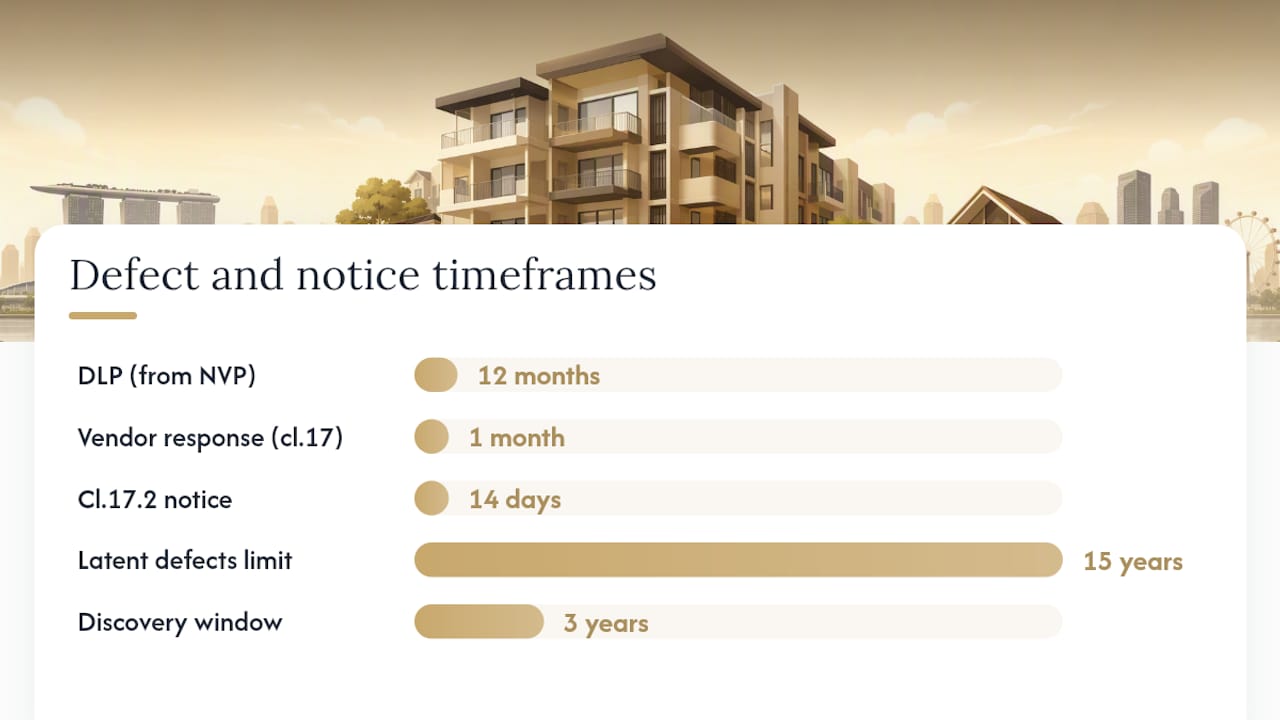
Table of Contents
- What the defect liability period means under your contract and Singapore law
- What actually counts as a defect under your SPA
- How to inspect, document, and report defects correctly
- Developer obligations and what to do when they miss the deadline
- What to do when the developer delays or refuses to fix defects
- After the DLP ends: latent defects and how long your rights last
- How HDB handles defect rectification for new flats
- What to do before you renovate: a pre-renovation checklist
- Why DLP rights are worth taking seriously from day one
- One Marina Gardens: new-build quality and what to ask before you buy
- Sources
- FAQ
What the defect liability period means under your contract and Singapore law
The DLP is not just a developer promise — it is a contractual and regulatory obligation backed by Singapore's standard Sale and Purchase Agreement, HDB's official procedures, and court-interpreted case law.
SPA clause 17 and the private property framework
Under FORM E clause 17, the standard SPA used for private residential developments in Singapore, the vendor must make good any defects in the unit that appear within the 12-month DLP, at the vendor's own cost. The 12-month period runs from the date the purchaser receives the NVP, not from the date of physical occupation. That distinction matters practically: if you receive your NVP in January but only move in during March, your DLP still expires in January of the following year.
Clause 17 sets out a structured timeline:
- Vendor obligation: Upon receiving written notice of a defect, the vendor must make it good within a month
- Purchaser's clause 17.2 option: If the vendor fails to act within that month, the purchaser may serve a further notice giving the vendor two weeks to begin rectification
- Clause 17.3 remedy: If the vendor still does not act, the purchaser may engage their own contractors, carry out the rectification, and recover the costs from the vendor or deduct them from any stakeholder sums held by the Singapore Academy of Law
HDB's one-year DLP for new flats
For HDB flat buyers, the framework is simpler in process but equally firm in obligation. HDB's official guidance confirms that newly completed flats are covered by a one-year DLP starting from the date of key collection. HDB coordinates rectification directly, and flat owners can submit defect reports through HDB's e-service portal.
The Building and Construction Authority (BCA) and the Ministry of National Development (MND) sit above the process as regulators. BCA sets construction quality standards and provides dispute resolution pathways through its IQUAS framework. MND has addressed in parliamentary Q&As how design and construction-flaw defects can be handled after the DLP ends, clarifying the respective roles of HDB, developers, and regulators.
Pro Tip: Pull out your SPA today and find the exact NVP date. That date, not your move-in date, is when your 12-month clock started. If you are unsure, call your conveyancing lawyer — guessing costs you time you may not have.
What actually counts as a defect under your SPA
Not every imperfection in your new home qualifies as a defect the developer must fix. Courts and contracts use a specific definition: a defect is a failure in workmanship, materials, or construction that causes the unit to fall short of the specifications in the SPA or the approved plans.
Patent defects: visible problems you can spot now
Patent defects are those you can see or detect through a reasonable inspection. Common examples include:
- Hollow or cracked floor and wall tiles
- Misaligned or sticking doors and windows
- Grout gaps, chipped paintwork, or uneven plaster
- Visible water stains or active leaks from pipes and fittings
- Faulty electrical sockets, switches, or light fittings
- Scratched or damaged sanitary ware, countertops, or cabinetry
- Gaps between skirting boards and floors
These must be reported during the DLP. If you spot a patent defect after the DLP expires and you never reported it, your contractual remedy under clause 17 is gone.
Latent defects: the hidden problems that can surface years later
Latent defects are not discoverable through a normal inspection at handover. They include:
- Structural cracks or settlement issues in beams, columns, or slabs
- Concealed water ingress through external walls or roof membranes
- Spalling concrete in hidden structural elements
- Defective waterproofing under wet-area screeds
- Corroding reinforcement steel inside structural members
- Faulty concealed plumbing causing slow leaks inside walls
Because latent defects are hidden, Singapore law gives homeowners a longer window to pursue claims. A Singaporelegaladvice notes that latent defects may attract developer liability for up to 15 years from project completion in certain circumstances.
The renovation trap: how you can accidentally void your rights
Renovating before defects are reported and acknowledged is the single most common way homeowners lose their DLP rights. Once you tile over a floor, hack a wall, or install built-in cabinetry, the developer can argue that the defect was caused or concealed by your renovation works. The practical rule: do not cover, alter, or demolish any surface until every defect in that area has been logged, acknowledged in writing by the developer, and scheduled for rectification.

How to inspect, document, and report defects correctly
A defect you cannot prove is a defect you cannot claim. The quality of your documentation determines whether you can enforce your rights under clause 17 or pursue any later legal remedy.
Room-by-room inspection checklist
Work through the unit systematically. For each area, check:
Structural and external:
- External walls for cracks, staining, or efflorescence
- Balcony surfaces, drainage outlets, and waterproofing
- Roof access areas (where applicable) and common corridor interfaces
Wet areas (bathrooms, kitchen, utility):
- Floor and wall tile adhesion (tap with a coin — hollow sounds indicate debonding)
- Waterproofing integrity (look for damp patches on ceilings of units below)
- All plumbing fixtures, taps, and drainage flow rates
- Grout lines and silicone sealant joints
Finishes and fittings:
- Every door and window for alignment, smooth operation, and locking
- All cabinetry, hinges, drawer runners, and laminate edges
- Paintwork on every wall and ceiling for drips, roller marks, or missed patches
- Electrical outlets, switches, and light fittings (test each one)
Mechanical and services:
- Air-conditioning units, drainage trays, and condensate pipes
- Intercom, doorbell, and smart-home systems if included
How to document defects so they hold up
- Photograph every defect with a timestamp visible in the image. Use your phone's native camera app — it embeds GPS and time metadata automatically.
- Shoot wide and close. One wide shot showing the room context, one close-up of the defect itself.
- Record a video walkthrough narrating each defect as you go. A continuous video is harder to dispute than individual photos.
- Name your files systematically:
Unit-XX-Bathroom1-TileHollow-2026-01-15.jpg— room, defect type, date. - Log everything in a spreadsheet: defect number, location, description, photo reference, date reported, developer response date.
How to serve notice on the developer
Your notice must be in writing. Email is acceptable and creates a time-stamped record, but send a copy by registered post as well. Your notice should include:
- Your name, unit number, and SPA reference
- A reference to clause 17 of the SPA
- A numbered list of defects with location and description for each
- Attached photographs (numbered to match the list)
- A request for the vendor to make good within the clause 17 timeframe
- A proposed date range for access to carry out inspection and rectification
Pro Tip: Do not renovate any area where a defect has been reported until you have written confirmation from the developer that rectification is scheduled. A verbal promise from a site supervisor is not enough.
Developer obligations and what to do when they miss the deadline
Clause 17 of the FORM E SPA creates a step-by-step process with defined windows. Understanding the sequence tells you exactly when you can act and what you can do.
The standard flow works like this: you serve written notice of a defect, the vendor has a month to make it good; if the vendor fails to act, you serve a clause 17.2 notice giving a further two weeks; if the vendor still does not act, clause 17.3 lets you hire your own contractors, carry out the rectification, and recover the cost from the vendor or from stakeholder funds held by the Singapore Academy of Law.
That recovery right is real, but it comes with procedural requirements. You must follow the notice sequence correctly, obtain written quotes before spending money, and keep receipts for every dollar spent on rectification.
What the Court of Appeal said about clause 17
The Singapore Court of Appeal's decision in Sandy Island Pte Ltd v Thio Keng Thay [2020] SGCA 86 is the leading case on clause 17 interpretation. The court confirmed that clause 17 imposes a genuine obligation on the vendor to make good defects appearing within the DLP. It also drew a clear boundary: clause 17 is not a comprehensive code covering every possible defect. Complex latent defects that fall outside the DLP may require separate common law claims rather than the clause 17 route.
The court's reasoning also confirms that the clause 17.2/17.3 process is an option for the purchaser, not a mandatory pre-condition to any legal claim. You can use it, or you can pursue common law damages directly — but timing and evidence quality will determine which route is more effective.
HDB vs. private property: key differences
| Dimension | HDB new flats | Private / SPA (FORM E) |
|---|---|---|
| DLP length | 1 year | 12 months (clause 17) |
| DLP start date | Date of key collection | Date of NVP receipt |
| Governing document | HDB rectification process | FORM E SPA clause 17 |
| Vendor response window | HDB-coordinated | 1 month after written notice |
| Purchaser remedy if vendor delays | HDB escalation / feedback | Clause 17.2 (14-day notice) → clause 17.3 (hire and recover) |
| Regulator involvement | HDB directly | BCA (IQUAS), MND (policy) |
| Latent defect route | MND / common law | Common law / limitation act |
What to do when the developer delays or refuses to fix defects
Most developers rectify defects without a fight. When they do not, you have a clear escalation path.
- Re-serve written notice referencing clause 17 and the original notice date. Confirm the one-month window has passed and state your intention to invoke clause 17.2.
- Serve a clause 17.2 notice giving the vendor 14 days to commence rectification. Send by email and registered post. Keep the delivery confirmation.
- Obtain independent inspection and written quotes. Before spending a dollar on your own contractors, get a professional inspection report and at least two written quotes from licensed contractors. This documentation is what makes your clause 17.3 cost recovery claim credible.
- Invoke clause 17.3 if the 14-day window passes without action. Engage your own contractors, keep all invoices, and write to the vendor demanding reimbursement or deduction from stakeholder funds.
- For HDB flats, escalate through HDB's official feedback and rectification channels before pursuing any external dispute route.
- Consider BCA's IQUAS pathway. BCA's IQUAS process provides an administrative route for resolving construction quality disputes with professional involvement — useful for technical defects where an independent assessment adds weight to your claim. Administrative routes like this typically require thorough documentation and do not replace your contractual claims, but they can move a stubborn developer.
- Mediation through the Singapore Mediation Centre or the Community Disputes Resolution Tribunal is appropriate for lower-value disputes where litigation costs would outweigh the claim.
- Litigation is the last resort for high-value or complex defect claims, particularly latent defects that fall outside the clause 17 framework.
Pro Tip: Get an independent professional inspection report and written contractor quotes before you spend any money on rectification. Courts and arbitrators look at whether you took reasonable steps to mitigate your loss — a documented, competitive quote process demonstrates exactly that.
For a broader understanding of how to review contract terms before you reach this stage, reviewing real estate contract terms carefully at the point of purchase can help you spot DLP clause variations before you sign.
After the DLP ends: latent defects and how long your rights last
The expiry of your one-year DLP does not end all developer liability. Singapore's Limitation Act creates separate windows for different types of claims, and latent defects in particular can remain actionable long after the DLP has closed.
According to Enari's construction contracts guidance, the practical timelines applied in Singapore are:
| Defect type | Limitation period | Discovery rule |
|---|---|---|
| Patent defects (contract claim) | 6 years from breach | N/A — defect was discoverable |
| Latent defects (contract claim) | Up to 15 years from completion | 3 years from date of discovery |
| Structural / concealed defects | Up to 15 years | 3 years from discovery |
The discovery rule is the key mechanism for latent defects. If a concealed waterproofing failure only becomes apparent when water starts seeping through your ceiling five years after handover, your three-year window to bring a claim runs from the date you discovered (or reasonably should have discovered) the problem — not from the date the building was completed.
What this means practically:
- Keep your SPA, NVP notice, and all DLP correspondence permanently — not just for 12 months
- If a new problem surfaces after the DLP, get a professional inspection immediately to establish the discovery date in writing
- Consult a property lawyer before the three-year discovery window closes — bring your inspection reports, purchase documents, and all correspondence with the developer
- The MND's parliamentary Q&A on post-DLP defects clarifies that design or construction-flaw defects discovered after the DLP can still be pursued, and that HDB and regulators have roles in mediating these situations for public housing
How HDB handles defect rectification for new flats
HDB's process is more direct than the private-property route because HDB itself coordinates rectification rather than leaving it entirely to the developer and purchaser to negotiate.
Step-by-step: submitting a rectification request to HDB
- Collect your keys and begin your inspection within the first few weeks. The one-year DLP clock starts from this date.
- Document all defects using the same photo-and-log method described above.
- Submit your rectification request through HDB's e-service portal. Include photos, a description of each defect, and your unit details.
- Track the response. HDB will acknowledge your submission and arrange for inspection and rectification works. Keep records of every communication.
- Follow up in writing if works are not scheduled within a reasonable period. Reference your submission date and request a confirmed timeline.
What HDB typically does after you submit:
- Arranges for an HDB inspector or appointed contractor to assess the defects
- Schedules rectification works and notifies you of the access date
- Coordinates with the developer or main contractor for structural or major defects
- Provides a feedback channel if you are dissatisfied with the outcome
For complex or disputed defects, HDB can also facilitate mediation between the flat owner and the developer. The HDB rectification page is the authoritative starting point for all HDB flat owners.
What to do before you renovate: a pre-renovation checklist
Renovation is the point where most homeowners accidentally compromise their DLP rights. Follow this checklist before any contractor sets foot in your unit.
- Complete a full defect inspection of every room, wet area, and external surface before signing any renovation contract
- Log every defect in writing and submit your notice to the developer or HDB
- Wait for written acknowledgment from the developer confirming they have received your defect list and will schedule rectification
- Do not cover walls, floors, or ceilings in any area where a defect has been reported until rectification is complete and signed off
- Photograph original finishes in every room before any work begins — this is your baseline record if a dispute arises later
- Get written confirmation of the rectification schedule before allowing contractors to start work in adjacent areas
- Send a short written note to the developer stating that your renovation works do not constitute a waiver of any DLP rights — a one-line email is sufficient
Red flags to watch for: contractors who tell you to renovate first and "sort out defects later," or showflat sales staff who suggest that minor defects will be fixed automatically without a formal notice. Neither is a substitute for the written notice process under clause 17.
Pro Tip: Create a dedicated digital folder labeled "DLP Records" and keep every photo, email, registered mail receipt, and contractor quote in it. Mirror it to cloud storage. If a dispute goes to mediation or court two years from now, this folder is your entire case.
Why DLP rights are worth taking seriously from day one
Most buyers treat the defect liability period as a formality — a box to tick before the real business of moving in and renovating begins. That is a mistake that costs some homeowners tens of thousands of dollars.
The clause 17 framework is genuinely powerful when used correctly. The right to hire your own contractors and recover costs from the vendor, backed by a Court of Appeal judgment confirming that obligation, is not a theoretical remedy. It is a practical tool. But it only works if you follow the notice sequence precisely, document everything, and act within the contractual windows.
What most guides understate is the latent defect risk. A one-year DLP gives you a false sense of closure. Structural and concealed defects can take years to manifest — and when they do, the three-year discovery window starts running immediately. Homeowners who discard their SPA and DLP correspondence after the first year have already weakened their position before the problem even appears.
The other underrated point: renovation timing. Legal advisers consistently recommend delaying renovation until defects are identified and rectified, because renovating first can conceal defects and complicate claims under clause 17. That advice is correct, and it is routinely ignored. The practical cost of waiting an extra four to six weeks before renovating is trivial compared to the cost of losing a valid defect claim because a contractor tiled over the evidence.
One Marina Gardens: new-build quality and what to ask before you buy
If you are considering a new-build condominium in Singapore, understanding your DLP rights before you sign is as important as understanding the floor plan. One Marina Gardens, developed by Kingsford Marina Development in District 01, is a 937-unit development with units ranging from 1-bedroom to 4-bedroom configurations, priced from S$1.81M. The development sits 160 meters from Marina South MRT and includes a 50-meter lap pool, multiple sky terraces, and a dedicated childcare center.

Prospective buyers who visit the showflat can ask the sales team directly about the DLP terms in the SPA, the developer's rectification process, and the defect inspection procedures at key collection. Knowing those answers before you sign puts you in a far stronger position than reading the SPA for the first time after you receive your NVP. Browse the One Marina Gardens gallery for development visuals, or book a showflat appointment to review the unit specifications and SPA terms in detail.
This article is for general informational purposes only and does not constitute legal advice. Consult your Sale and Purchase Agreement and a qualified Singapore property lawyer for advice specific to your situation.
Sources
The following official pages and legal references were used in this article. Keep a copy of each relevant to your property.
Keep your SPA, NVP notice, and all developer correspondence permanently — not just for the first year.
This article is general information, not a substitute for advice from a qualified lawyer. Consult a qualified legal professional about your own circumstances before acting on anything here.
FAQ
How long is the defect liability period in Singapore?
For private homes governed by the FORM E SPA, the DLP is 12 months from the date the purchaser receives the Notice of Vacant Possession. For HDB flats, it is one year from the date of key collection.
What is the difference between the defect liability period and a maintenance period?
The DLP is a contractual window during which the developer must fix defects at their own cost. A maintenance period (used in construction contracts) is a similar concept but typically applies to contractors rather than end-buyers, and the obligations and remedies differ.
What is the difference between the defect liability period and a warranty?
The DLP is a time-limited contractual obligation tied to your SPA, requiring the developer to rectify defects that appear within the period. A warranty is a broader guarantee — often covering specific components like waterproofing or structural elements — and may run longer than the DLP under separate terms.
Can I still claim for defects after the DLP expires?
Yes, for latent defects. Patent defects carry a six-year limitation period from the date of breach, while latent defects may be actionable for up to 15 years from project completion, with a three-year window running from the date of discovery.
Does renovating my unit affect my DLP rights?
Renovating before defects are reported and acknowledged can void your rights for affected areas. Developers can argue that renovation works caused or concealed the defect. Always report and get written acknowledgment of all defects before any renovation work begins in that area.