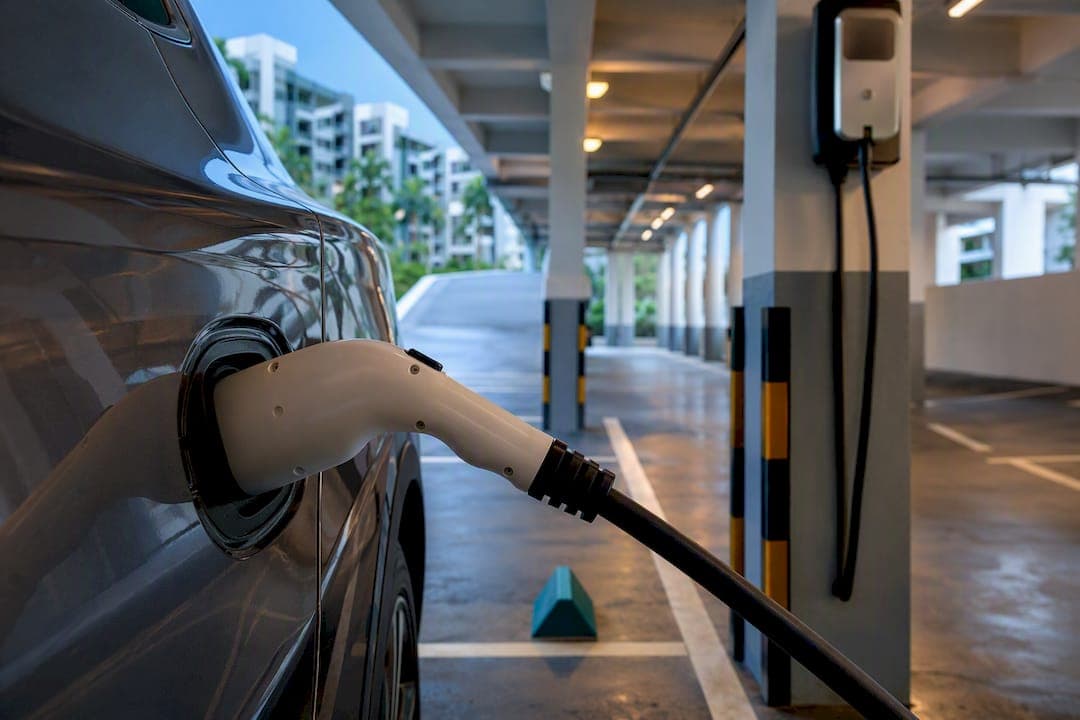
Yes, condo residents in Singapore can get EV charging, through one of three routes: an operator-funded shared charger installed via the Electric Vehicle Common Charger Grant (ECCG), an MCST-owned charger paid for from the sinking fund, or a private unit charger the resident installs and registers themself. The Land Transport Authority (LTA) sets the rules for all three paths, and every charger has to be registered before it can be switched on.
TL;DR:
- Operator-funded chargers are the easiest to approve because they involve no upfront costs for the MCST and recover expenses through usage fees.
- Most condo chargers are installed under shared or MCST-owned models, with grants covering up to half the project cost, but applications require detailed documentation for approval.
- Installing chargers at 7.4 kW or 11 kW is sufficient for overnight charging, as most EV onboard chargers cannot utilize higher power levels for faster charging.
- Approval depends on quorum and owner participation in meetings, with recent legal changes lowering voting thresholds for capex-free proposals.
- Future-proofing involves reserving capacity and using load management systems to scale up charging points as resident EV ownership increases.
Table of Contents
- Where to Charge: Shared Condo Chargers and Nearby Public Networks
- Can My Condo Install Chargers? Governance, Voting and the MCST Process
- Grants and Costs: ECCG Explained and Ownership Models
- Choosing Charger Type and Power for Condos (What Really Matters)
- Installation Steps and Technical Checklist
- Using Shared Chargers Fairly: Etiquette, Bookings and Enforcement
- Practical Checklist for Residents and MCSTs Before Voting or Applying
- Does an EV Charger Change What a Condo Unit Is Worth?
- What Happens When Residents Disagree About Chargers?
- Future-Proofing Your Condo's Charging Setup
- What Buyers Should Ask About EV Readiness
- See One Marina Gardens' Amenities for Yourself
- Sources
- FAQ
Where to Charge: Shared Condo Chargers and Nearby Public Networks
Most condos get chargers one of two ways. In an operator-funded model, a company installs and owns the hardware at no upfront cost to the MCST, then recovers its investment through per-use fees. In an MCST-owned model, the estate pays for the equipment outright (often with ECCG support) and controls pricing directly.
Several networks already operate in Singapore's private residential estates, and checking which one serves your building tells you a lot about how charging will work day to day:
- Charge+ — common in condos and commercial car parks, with an app showing live port status
- SP Mobility — backed by Singapore Power's grid infrastructure
- Greenlots — one of the earlier entrants into Singapore's EV network
- Shell Recharge — pairs condo chargers with its wider retail and public network
- BlueSG — primarily car sharing, but relevant if your estate hosts a bay
If your condo has no chargers yet, the operator apps double as a way to find the closest public plug while your MCST works through approvals.
Can My Condo Install Chargers? Governance, Voting and the MCST Process
Getting a charger approved comes down to which resolution your Management Corporation Strata Title (MCST) needs, and that depends entirely on who pays. A 2024 amendment to the Building Maintenance and Strata Management Act (BMSMA) lowered the voting threshold for EV charger motions, and capex-free operator deals typically clear that bar far more easily than proposals asking owners to fund equipment from the sinking fund.
A typical path through an Annual General Meeting (AGM) or Extraordinary General Meeting (EOGM) looks like this:
- The council or a resident committee drafts a proposal comparing operator-funded, capex, and hybrid models.
- If applying for the ECCG, the MCST secures a signed Letter of Offer (LOF) or at least a firm quote to present at the meeting.
- The motion goes to a vote at the AGM or EOGM, with the resolution type matched to the funding model chosen.
- Once passed, the council appoints the operator or contractor and sets a rollout timeline.
The most common obstacle isn't the vote itself. It's getting enough owners in the room, or proxies collected, to reach quorum in the first place. Strata developments with high absentee-owner rates often need two attempts at an EOGM before a motion even gets tabled.
Grants and Costs: ECCG Explained and Ownership Models
The ECCG co-funds shared charger installation at non-landed private residences, covering up to half of eligible costs with a cap per charger, and applications run through the Business Grants Portal. The grant shortens payback for MCSTs that go the capex route, but it doesn't remove the need for a properly documented application.
Three ownership structures dominate the market:
- Capex-free (operator-funded): the operator installs, owns, and maintains the charger, recovering costs through usage fees. Easiest to approve, lowest MCST risk.
- Capex (MCST-owned): the estate pays upfront, often using the ECCG to offset cost, and keeps control of pricing and access.
- Hybrid: the MCST co-invests with an operator, splitting risk and revenue.
The Straits Times has reported that ECCG-backed installations now number in the thousands across condominiums, with operator-funded deals doing much of that heavy lifting because they sidestep the sinking-fund debate entirely.
Choosing Charger Type and Power for Condos (What Really Matters)
A 22 kW charger sounds impressive until you realize most residents' cars can't use anywhere near that speed. Onboard chargers in the majority of EVs on Singapore roads cap out well below that figure, so paying for high-power hardware often buys nothing but a bigger electrical bill for the switchroom upgrade.
LTA guidance recommends starting with lower-powered AC chargers for overnight residential charging, and that advice holds up against how condo parking actually works:
- 7.4 kW or 11 kW chargers suit overnight charging for the vast majority of resident vehicles.
- Multiple lower-powered units usually beat one or two high-powered ones for total availability across a car park.
- Type-approved, TR25-compliant equipment is non-negotiable. Anything installed without it can't be legally registered.
Pro Tip: Before your MCST commits to a hardware spec, survey residents on their EV models. Knowing the actual onboard charger limits in your building avoids overspending on 22 kW units that offer zero real-world speed benefit to most of the fleet.
Installation Steps and Technical Checklist
Installing a compliant charger in a Singapore condo follows a fairly fixed sequence, and skipping a step usually means redoing paperwork later.
- A Licensed Electrical Worker (LEW) assesses feasibility, checking switchroom capacity, transformer load, and available lots.
- If applying for the ECCG, the MCST accepts the Letter of Offer before work begins.
- The contractor installs the charger to TR25 standards, then runs commissioning and safety tests.
- The charger is registered on the OneMotoring portal, listing brand, model, and LEW certification, before it goes live.
- Operators charging a fee to the public need an EVCO (Electric Vehicle Charging Operator) license from LTA.
Every one of these steps has to happen in order. A charger that's physically installed but not registered on OneMotoring is not legally operational, regardless of whether it powers on.
Using Shared Chargers Fairly: Etiquette, Bookings and Enforcement
Shared chargers fail socially long before they fail mechanically. A charging bay is not a reserved parking spot, and treating it as one is the single biggest source of resident complaints in strata developments with limited charger counts.
A few habits keep things running smoothly for everyone:
- Unplug and move your car once charging finishes, don't leave it parked there for convenience.
- Use the operator's app or booking window if your condo has one, rather than showing up and hoping.
- Report faulty ports through the proper channel instead of leaving a note or ignoring it.
- Respect posted time limits, especially during peak evening hours when demand spikes.
MCSTs can formalize these expectations into by-laws, including idle fees for cars left plugged in after charging completes. That single rule change often resolves more conflict than any amount of signage.
Practical Checklist for Residents and MCSTs Before Voting or Applying
Walking into an AGM or EOGM with paperwork in hand moves things faster than walking in with a good idea and nothing else. Before the vote, get these ready:
- Letter of Offer from LTA if pursuing the ECCG, or at least a firm operator quote
- LEW feasibility report covering switchroom capacity and lot allocation
- Operator lease or proposal spelling out the ownership model and fee structure
- Decisions locked in advance: how many chargers, where they go, and who enforces the rules
The Straits Times noted that the ECCG has already co-funded thousands of chargers across non-landed private residences, a scale that shows most of the friction in this process is administrative, not technical. Getting documents in order before the meeting is what actually determines whether a motion passes on the first try.
Does an EV Charger Change What a Condo Unit Is Worth?
There's no solid data showing that an EV charger in the car park adds a measurable premium to resale price in Singapore, and treating it as one would be overselling the point. What the presence of chargers does reliably affect is buyer shortlisting. An EV owner comparing two similarly priced units will usually weight the one with confirmed charging access higher, simply because retrofitting after purchase means going through the entire MCST approval process described above, on their own, with no guarantee of a quick yes.
That makes EV readiness closer to a convenience filter than a value driver, similar to how a condo with fiber internet already wired in isn't priced higher, but it removes friction for a buyer who'd otherwise have to sort it out themselves. For MCSTs weighing whether to push a charger motion through, this distinction matters: the case for installing chargers rests on resident demand and future proofing, not on a resale multiplier that the data doesn't support.
Buyers evaluating new launches should ask directly how many charging lots are planned and under which ownership model, since that answer says more about long-term convenience than any marketing material will. A development that's already wired for chargers, or has clear plans for them, saves a future EV-owning resident from becoming the person who has to propose the first motion.
What Happens When Residents Disagree About Chargers?
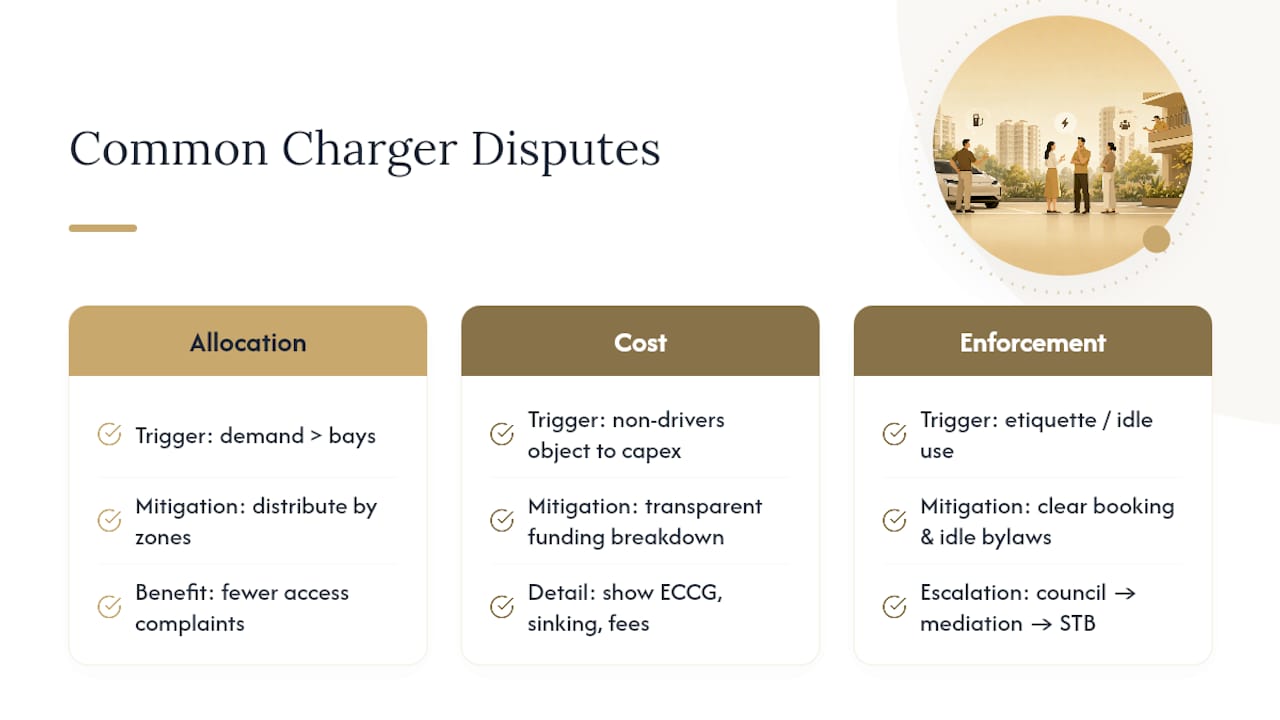
Disputes around condo EV chargers tend to cluster around three issues: allocation of limited bays, cost sharing, and enforcement of etiquette rules. None of them are unique to EV charging, but the electrical and safety stakes make them harder to wave off than a parking disagreement.
Allocation disputes usually surface when demand for charging bays outpaces supply, a real risk flagged in reporting on how Singapore's residential estates are keeping pace with EV adoption. MCSTs that distribute chargers across multiple zones, rather than clustering them in one corner of the car park, tend to see fewer complaints about unfair access.
Cost disputes arise mostly under capex or hybrid models, where owners who don't drive EVs question why sinking-fund money is going toward chargers they'll never use. The clearest way to defuse this is transparency at the proposal stage: showing exactly how much comes from the ECCG, how much from the sinking fund, and how usage fees offset ongoing costs.
Where formal resolution is needed, MCSTs fall back on the same channels used for any strata dispute. Escalation through the council, mediation, and, if necessary, the Strata Titles Boards. Most charger disputes resolve well before reaching that stage, provided the by-laws around booking and idle fees were clear from the start. A well-drafted by-law, agreed on before the chargers go live, prevents most of the disputes that would otherwise need formal mediation later.
Future-Proofing Your Condo's Charging Setup
EV adoption in Singapore is still climbing, and a charger setup sized for today's demand can look undersized within a few years. The smarter approach is planning capacity in stages rather than committing to a single build-out.
Start by reserving conduit and switchroom capacity for future chargers even if only a handful go in initially. Retrofitting wiring through a completed car park costs far more than running extra capacity during the first installation. Load management systems, which distribute available power across multiple chargers rather than allocating a fixed amount to each, let MCSTs add charging points later without a full transformer upgrade.
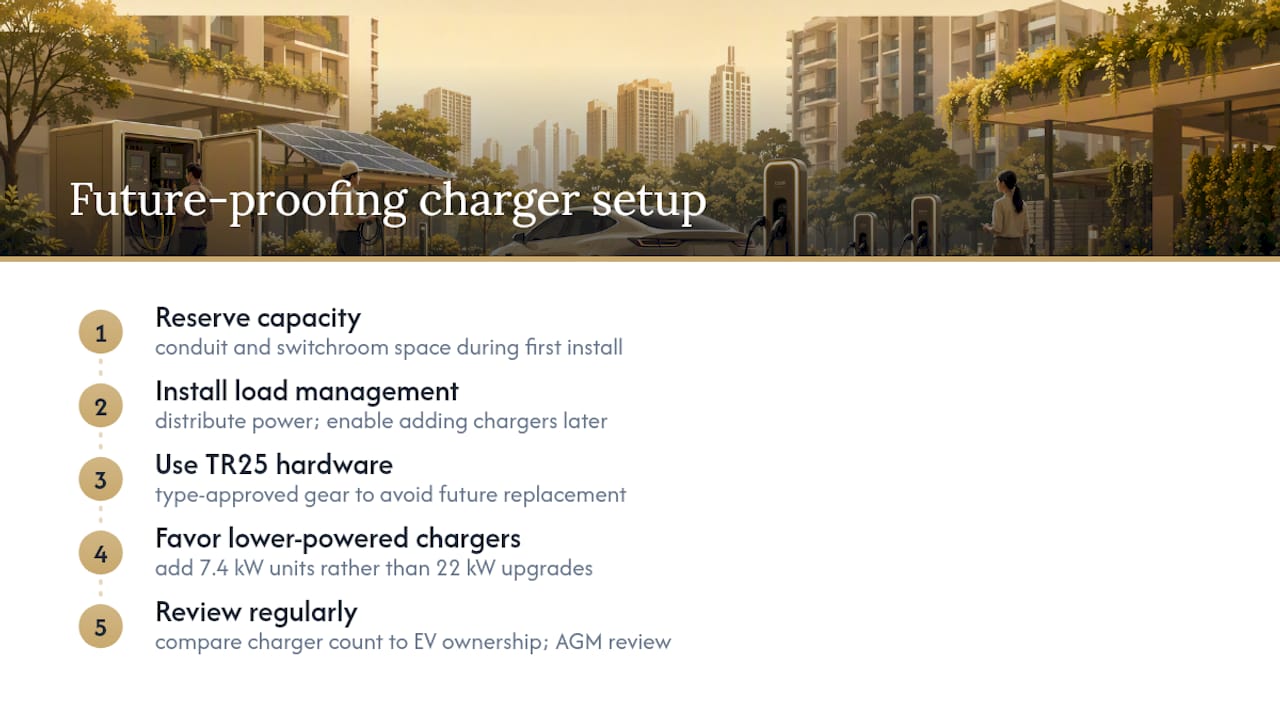
Sticking with type-approved, TR25-compliant hardware from the outset also matters for longevity, since equipment that meets the current standard is far less likely to need replacement when LTA guidance evolves. And favoring multiple lower-powered chargers over a few high-powered ones, as covered earlier, isn't just a cost decision. It's also the more scalable one, since adding a fifth 7.4 kW charger to a load-managed system is simpler than upgrading infrastructure built around two 22 kW units.
Finally, MCSTs should revisit their charger count against resident EV ownership every couple of years rather than treating the initial installation as a one-time decision. A development that installed two chargers for 200 units in 2024 may need six by 2028, and building that review into the annual AGM agenda avoids another drawn-out EOGM fight later.
What Buyers Should Ask About EV Readiness
Before buying into any development, ask how many chargers exist or are planned, who owns them, and how close the nearest public network is if demand outpaces supply. EV readiness is a genuine convenience amenity, not a proven price lever, so weigh it against your actual driving needs rather than resale hype. If you're reviewing a development like One Marina Gardens, raise these questions directly with the sales team during your enquiry.
— Velisa
See One Marina Gardens' Amenities for Yourself
If modern infrastructure planning matters to how you shortlist a new home, a well-connected condominium in District 01 with a range of unit types and several amenities may be worth considering.

Rather than guessing at what's included from a floor plan alone, browse the development gallery to see the amenities and layouts firsthand, then register your interest to book a showflat appointment and ask the sales team your specific questions about parking and charging provisions directly.
Sources
- Guidelines and Frequently Asked Questions for the EV Common Charger Grant
- EV charger installation process Singapore - Electgo
- 2000 EV chargers in condominiums co-funded under government grant - The Straits Times
FAQ
Can I Install an EV Charger at My Condominium?
Yes, but it has to go through your MCST's approval process and end with LTA registration via OneMotoring; a resident cannot legally install and use a charger without both steps.
Where Can I Charge My Electric Car in Singapore If My Condo Has No Chargers?
Public and shared networks including Charge+, SP Mobility, Greenlots, Shell Recharge, and BlueSG operate charging points across the island, and their apps show live port availability near your address.
Can I Charge My EV Directly From My Apartment Unit?
Generally no. Most condo units don't have dedicated EV-rated wiring to a parking lot, so charging almost always routes through a common-area charger rather than a cable run from your apartment.
How Do I Install an EV Charger in My Condo as an MCST?
Start with an LEW feasibility assessment, decide on an ownership model, pass the appropriate resolution at an AGM or EOGM, then install to TR25 standards and register the charger on OneMotoring before it goes live.
Does the ECCG Cover the Full Cost of a Charger?
No. The ECCG covers up to 50% of eligible installation costs with a cap per charger, so MCSTs or operators still fund the remainder.