
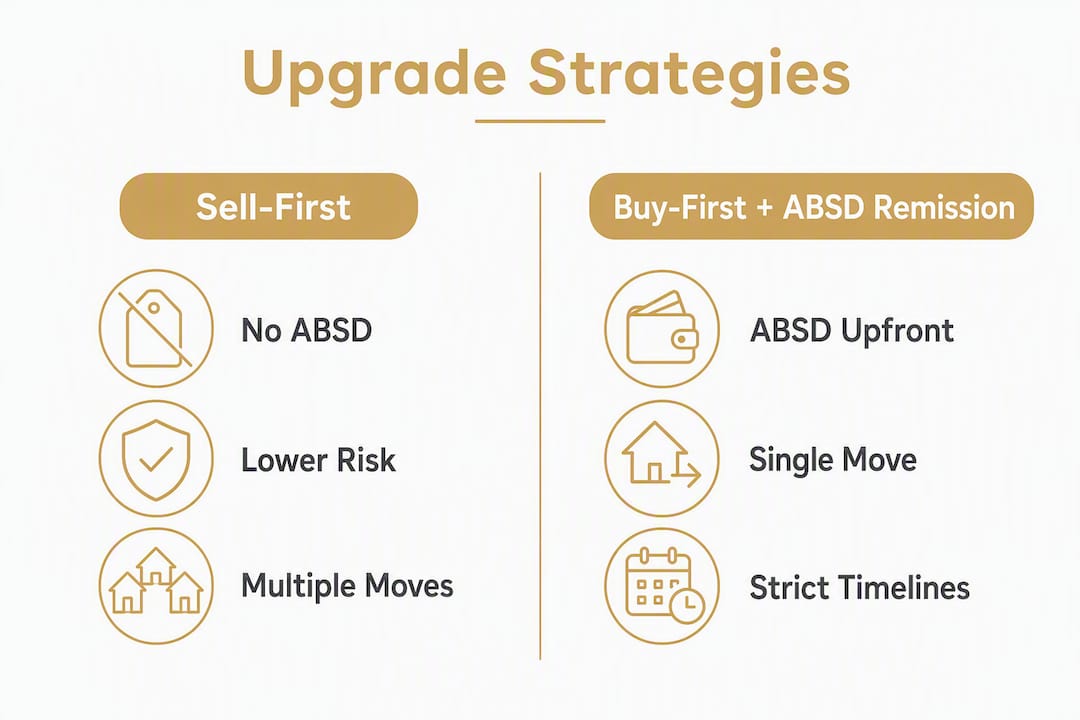
You can upgrade from an HDB flat to a private condominium by choosing one of three routes: sell-first (0% ABSD because you own no private property at purchase), buy-first with married-couple ABSD remission (pay 20% ABSD upfront in cash, then claim a refund if you sell your HDB within 6 months of completion or TOP), or a new-launch progressive-payment path that lets you stay in your HDB through construction and only starts the ABSD remission clock at TOP.
The right route depends almost entirely on your liquid cash position:
- Cash-constrained (less than S$150,000 in liquid savings): Sell-first is the safest default. You pay 0% ABSD and borrow at a higher LTV, but you need interim housing.
- Cash-rich and want a single move: Buy-first with ABSD remission works if you can fund the 20% ABSD entirely from cash savings, not CPF.
- Timeline-flexible and want to avoid interim rent: A new-launch under the Progressive Payment Scheme (PPS) lets you stay in your HDB for 3–4 years while the condo is built, then sell before or shortly after TOP.
Before you sign anything, run four checks: confirm your HDB Minimum Occupation Period (MOP) is complete, calculate net sale proceeds after CPF refund, verify your borrowing ceiling under TDSR and LTV rules, and confirm your ABSD funding plan in cash.
Table of Contents
- How ABSD and the HDB Minimum Occupation Period shape your options
- What are the three upgrade strategies and which one fits you?
- What does the full money checklist look like?
- What does the sell-first vs buy-first timeline actually look like?
- How do you sell your HDB without ending up homeless?
- How do you apply for ABSD remission and what documents does your lawyer need?
- A worked example: upgrading via new-launch PPS
- Which route is right for you?
- Key Takeaways
- The mistake most upgraders make is a cash-flow problem, not a property problem
- One Marina Gardens fits the new-launch upgrade path naturally
- Official and recommended sources to confirm rules and for deeper reading
How ABSD and the HDB Minimum Occupation Period shape your options
The Additional Buyer's Stamp Duty (ABSD)) is assessed at the point of purchase, specifically when you exercise the Option to Purchase (OTP) or sign the Sale and Purchase (S&P) agreement. For Singapore Citizens buying a second residential property, the current rate is 20%, applied to the purchase price or market value, whichever is higher.
The 20% ABSD rate for Singapore Citizens on a second residential property is the single biggest cash commitment in any HDB-to-condo upgrade. On a S$1.8 million condo, that is S$360,000 in cash, held by IRAS until remission is approved.
The married-couple ABSD remission is the mechanism most upgraders use to recover that sum. To qualify, both spouses must be Singapore Citizens, the condo must be purchased in both names (or at least one name where the other spouse has no other property interest), and the HDB flat must be disposed of within the applicable remission window after completion or TOP for new-launch properties. Miss that window and the ABSD is forfeited entirely, with no appeal mechanism.
MOP adds another layer. Most HDB flats carry a 5-year Minimum Occupation Period before you can sell on the open market. You cannot buy a private property and retain your HDB during MOP. If your MOP is not yet complete, your only legal option is to sell the HDB before or simultaneously with the condo purchase, and even then, timing must be tight.

The critical timing distinction between resale and new-launch is this: for a completed resale condo, the 6-month disposal clock starts at legal completion, which typically happens 8–12 weeks after OTP exercise. For a new-launch, the clock only starts at TOP, which may be 3–4 years away. That gap is the entire strategic advantage of the new-launch PPS route.
Pro Tip: Before you exercise any OTP, ask your conveyancing lawyer to pull your ABSD profile from IRAS and confirm the exact disposal deadline in writing. A verbal estimate from an agent is not sufficient.
What are the three upgrade strategies and which one fits you?
Each of the three main routes to upgrade from an HDB flat to a condo carries a distinct cash commitment, timeline, and risk profile. Here is how they compare.
Sell-first
Steps: List HDB → accept offer → exercise OTP on condo (after HDB completion or simultaneously) → complete condo purchase as first-property owner.
Because you own no private property at the point of purchase, selling first removes ABSD exposure entirely. Your downpayment LTV is also more favorable. The trade-off is interim housing: you need somewhere to live between HDB completion and condo key collection, typically 3–6 months of rental or an extension of stay negotiated with your buyer.
Buy-first with ABSD remission
Steps: Exercise condo OTP → pay 20% ABSD in cash at completion → list and sell HDB → complete HDB sale within 6 months of condo completion → apply for ABSD remission via conveyancing lawyer.
This route suits cash-rich couples who want a single physical move. The biggest hazard is missing the 6-month disposal deadline, which forfeits the full ABSD with no recourse. ABSD is refunded without interest once IRAS approves the remission, so the cash is effectively an interest-free loan to the government for up to 6 months.
New-launch Progressive Payment Scheme
Steps: Book new-launch unit → pay progressive instalments tied to construction milestones → remain in HDB throughout construction → sell HDB before or within 6 months of TOP → apply for ABSD remission at TOP stage.
PPS timelines typically span 3–4 years, and the ABSD remission clock only starts at TOP for uncompleted properties. This is the lowest-immediate-cash route for buyers who want to avoid interim rental and are comfortable with a multi-year construction window.
Side-by-side comparison
| Factor | Sell-first | Buy-first + remission | New-launch PPS |
|---|---|---|---|
| ABSD exposure | 0% | 20% upfront, refunded | 20% upfront, refunded at TOP |
| Interim housing needed | Yes (3–6 months) | No | No |
| Timeline length | 6–12 months total | 6–9 months | 3–5 years |
| Required cash buffer | Lower (no ABSD) | High (ABSD + downpayment) | Moderate (staged payments) |
| Main risk | Rental cost, deposit timing | Missing 6-month window | Construction delay, market shift |
What does the full money checklist look like?
Cash planning is where most upgraders get into trouble, and the CPF refund trap is the most common reason.
When you sell your HDB, CPF principal plus accrued interest is refunded to your CPF Ordinary Account, not to your bank account. That money cannot be used to pay ABSD, option fees, or the 5% cash component of the downpayment. Many upgraders look at their HDB sale proceeds, see a large number, and assume they have more liquid cash than they actually do. Run the math before you sign anything.
Numbered budget checklist for a typical condo purchase:
- Agent commission: — Typically 1% of HDB sale price, paid by seller.
Bridging loans can cover the gap between HDB completion and condo downpayment, but they count toward your Total Debt Servicing Ratio (TDSR). A bridging facility drawn for 6 months carries interest costs that add up quickly, and lenders will assess your TDSR including the bridging repayment. Confirm your TDSR headroom with a mortgage adviser before drawing any facility.
Pro Tip: Treat your CPF refund as retirement savings, not upgrade cash. Structure the entire purchase so your 5% cash OTP, ABSD (if applicable), and BSD are covered by liquid bank savings alone.
What does the sell-first vs buy-first timeline actually look like?
Concrete calendar blocks help you see where the pressure points are.
Sell-first timeline (resale condo target)
| Month | Action |
|---|---|
| Month 1 | List HDB; engage agent and conveyancing lawyer |
| Month 2–3 | Accept HDB offer; exercise HDB OTP; negotiate 3-month extension of stay |
| Month 4–5 | HDB resale approval from HDB; prepare for completion |
| Month 5–6 | HDB completion; CPF refund to OA; cash proceeds to bank |
| Month 6–7 | Exercise condo OTP (now as first-property buyer, 0% ABSD) |
| Month 8–9 | Condo S&P signed; mortgage approved; BSD paid |
| Month 10–12 | Condo completion; key collection; move in |
Buy-first timeline (resale condo, ABSD remission route)
| Month | Action |
|---|---|
| Month 1 | Exercise condo OTP; pay option fee and 5% cash |
| Month 2–3 | Condo S&P signed; ABSD paid in cash at completion |
| Month 3–4 | List HDB immediately; 6-month disposal clock running |
| Month 5–7 | HDB completion; apply for ABSD remission via lawyer |
| Month 8–9 | IRAS processes remission; refund issued (no interest) |
New-launch PPS timeline
| Year | Action |
|---|---|
| Year 1 | Book unit; pay booking fee and progressive instalments begin |
| Year 1–3 | Continue living in HDB; pay staged construction payments |
| Year 3–4 | TOP issued; 6-month ABSD remission clock starts |
| Within 6 months of TOP | Complete HDB sale; apply for ABSD remission |
Pro Tip: For the buy-first route, instruct your HDB resale agent on the same day you complete the condo purchase. Every week of delay eats into your 6-month window.
How do you sell your HDB without ending up homeless?
The extension of stay is the most underused tool in a sell-first upgrade, and it costs nothing to ask for.
Practitioners consistently advise negotiating a 3-month extension of stay with your HDB buyer at the point of accepting their offer. Most buyers will agree, especially in a market where they themselves may need time to arrange financing or renovation. The extension gives you a rent-free buffer to complete your condo purchase and move in without a gap.
When you raise the extension in negotiation, keep the ask simple: "We'd like to request a 3-month extension of stay post-completion at a nominal fee of S$1 per month, subject to both parties' agreement." Lock it into the OTP conditions, not as a verbal side agreement.
If an extension is not possible, here are your practical interim options:
- Short-term rental (HDB or private): — Flexible month-to-month leases exist but require a security deposit (typically one month's rent) that locks up cash you may need for the condo downpayment. Factor this into your liquidity plan.
Pro Tip: If you are selling first and your condo completion date is uncertain, negotiate a flexible end date on your extension of stay rather than a fixed one. A clause that ties the end date to your condo key collection date protects you from a double-move scenario.
How do you apply for ABSD remission and what documents does your lawyer need?
Remission is not automatic. You must apply, and the application requires clean sequential documentation.
To qualify for the married-couple ABSD remission, both spouses must be Singapore Citizens, the condo must be in both names (or in one name where the other holds no other residential property), and the HDB must be fully disposed of within the applicable 6-month window. Partial disposals, such as transferring a share to a family member rather than completing an open-market sale, do not satisfy the condition.
Document checklist for ABSD remission
| Document | Purpose |
|---|---|
| Condo S&P agreement | Proof of purchase and purchase date |
| Condo completion statement | Confirms legal completion date (starts 6-month clock for resale) |
| TOP certificate (new-launch) | Confirms TOP date (starts 6-month clock for uncompleted property) |
| HDB resale completion letter | Confirms HDB disposal date |
| Marriage certificate | Confirms married-couple status |
| NRIC copies (both spouses) | Identity verification |
| IRAS remission application form | Filed by conveyancing lawyer via myTax Portal |
The workflow runs in this order: pay ABSD at condo purchase → sell HDB within the window → instruct your conveyancing lawyer to file the remission application with IRAS → IRAS reviews and issues refund. Processing typically takes several weeks after submission.
Pro Tip: Use the same conveyancing law firm for both the condo purchase and the HDB sale if possible. A single firm holds all the documents and can sequence the remission filing without waiting for inter-firm transfers.
A worked example: upgrading via new-launch PPS
This example shows how the new-launch route plays out for a married Singapore Citizen couple with a paid-off HDB flat valued at S$600,000 and a new-launch condo purchase at S$1.8 million.
| Event | Timing | Cash outflow | Cash inflow | Notes |
|---|---|---|---|---|
| Booking fee (5%) | Month 1 | — | — | Cash only |
| Progressive payments (foundation to TOP) | Months 6–42 | — | — | Staged; can use CPF OA |
| ABSD paid at purchase | Month 1 | S$360,000 | — | 20% of S$1.8M; cash only |
| HDB sale completion | Month 42 (pre-TOP) | — | S$600,000 gross | CPF refund portion returns to OA |
| TOP issued | Month 42 | — | — | 6-month remission clock starts |
| ABSD remission refund | Month 42–48 | — | S$360,000 | Refunded without interest |
| Net cash position at TOP | Month 42 | S$360,000 held by IRAS | HDB proceeds in bank/OA | Liquid cash gap covered by HDB sale |
The key risk in this example is a construction delay pushing TOP past the expected month 42. If TOP slips by 6 months, the HDB sale timing may need to adjust accordingly. For uncompleted properties, the ABSD remission clock starts at TOP, so a delayed TOP actually extends your window to sell the HDB, which is a structural advantage of the new-launch route over resale buy-first.
The contingency plan here: if the HDB sale stalls, the couple has the option to accept a lower offer or, if MOP rules permit, explore a short-term rental of the HDB to cover carrying costs while waiting for a buyer.
Pro Tip: Before booking day, hold a cash buffer equal to at least 3 months of combined mortgage obligations plus living expenses. New-launch timelines shift, and you do not want a construction delay to force a distressed HDB sale.
Which route is right for you?
Run through this checklist before you decide.
- HDB saleability: — Is your flat in a popular estate with strong demand? Sell-first carries low risk of a stalled sale. Niche location or older flat? The 6-month buy-first window may be too tight.
Your one action today: Pull your CPF statement, calculate your liquid cash after subtracting CPF balances, and book a 30-minute session with a mortgage adviser to run your TDSR and LTV numbers. That single step tells you which route is actually open to you before you fall in love with a unit.
Key Takeaways
Upgrading from an HDB flat to a condo requires choosing between three routes based on your liquid cash, timeline, and risk tolerance, with ABSD and MOP rules determining which options are open to you.
| Point | Details |
|---|---|
| ABSD assessed at purchase | Singapore Citizens pay 20% ABSD on a second property; it is due in cash at the point of purchase, not on completion. |
| 6-month remission window | Married SC couples must sell their HDB within 6 months of resale condo completion, or 6 months from TOP for new-launch properties. |
| CPF refund is not cash | CPF principal and accrued interest return to your CPF OA on HDB sale; they cannot fund ABSD or the 5% cash downpayment. |
| Sell-first is the safest default | Zero ABSD exposure and higher LTV, at the cost of 3–6 months of interim housing; suits cash-constrained upgraders. |
| Onemarinagardens fits the PPS route | One Marina Gardens is a new-launch in D01 with staged progressive payments, making it a practical fit for upgraders who want to sell their HDB closer to TOP. |
The mistake most upgraders make is a cash-flow problem, not a property problem
Most people who stall on the HDB-to-condo upgrade are not stopped by the property market. They are stopped by a cash-flow miscalculation they made six months earlier.
The three errors I see most often: first, treating the CPF refund as spendable cash. It is not. It goes back to your OA, and you cannot use it to pay ABSD or the 5% cash OTP component. Second, underestimating the ABSD cash requirement for a buy-first strategy. On a S$1.8 million purchase, 20% is S$360,000 sitting with IRAS for months, earning nothing. That is real money that cannot be deployed elsewhere. Third, forgetting to negotiate an extension of stay on the HDB sale. A 3-month extension costs almost nothing to ask for and can save you S$15,000–S$20,000 in interim rental costs.
The practical habit that changes outcomes: pre-clear your TDSR and ABSD funding plan with a mortgage adviser before you exercise any OTP. Not after. Not during. Before. Once you sign, the clock is running and your options narrow fast.
Sell-first is the safer default for most upgraders, not because it is the most elegant strategy, but because it removes the single biggest risk: a stalled HDB sale blowing up your remission window. If your HDB is in a strong-demand estate and you have 3–6 months of rental buffer, sell-first lets you buy the condo as a first-property owner with no ABSD, better LTV, and a clean balance sheet.
One Marina Gardens fits the new-launch upgrade path naturally
For upgraders drawn to the new-launch PPS route, the choice of development matters as much as the strategy itself. One Marina Gardens in District 01 is a 937-unit new-launch by Kingsford Marina Development, priced from S$1.81 million, with units ranging from 1-bedroom to 4-bedroom configurations. The progressive payment structure means your cash outflows are staged across the construction period, giving you time to sell your HDB at the right moment rather than under deadline pressure.
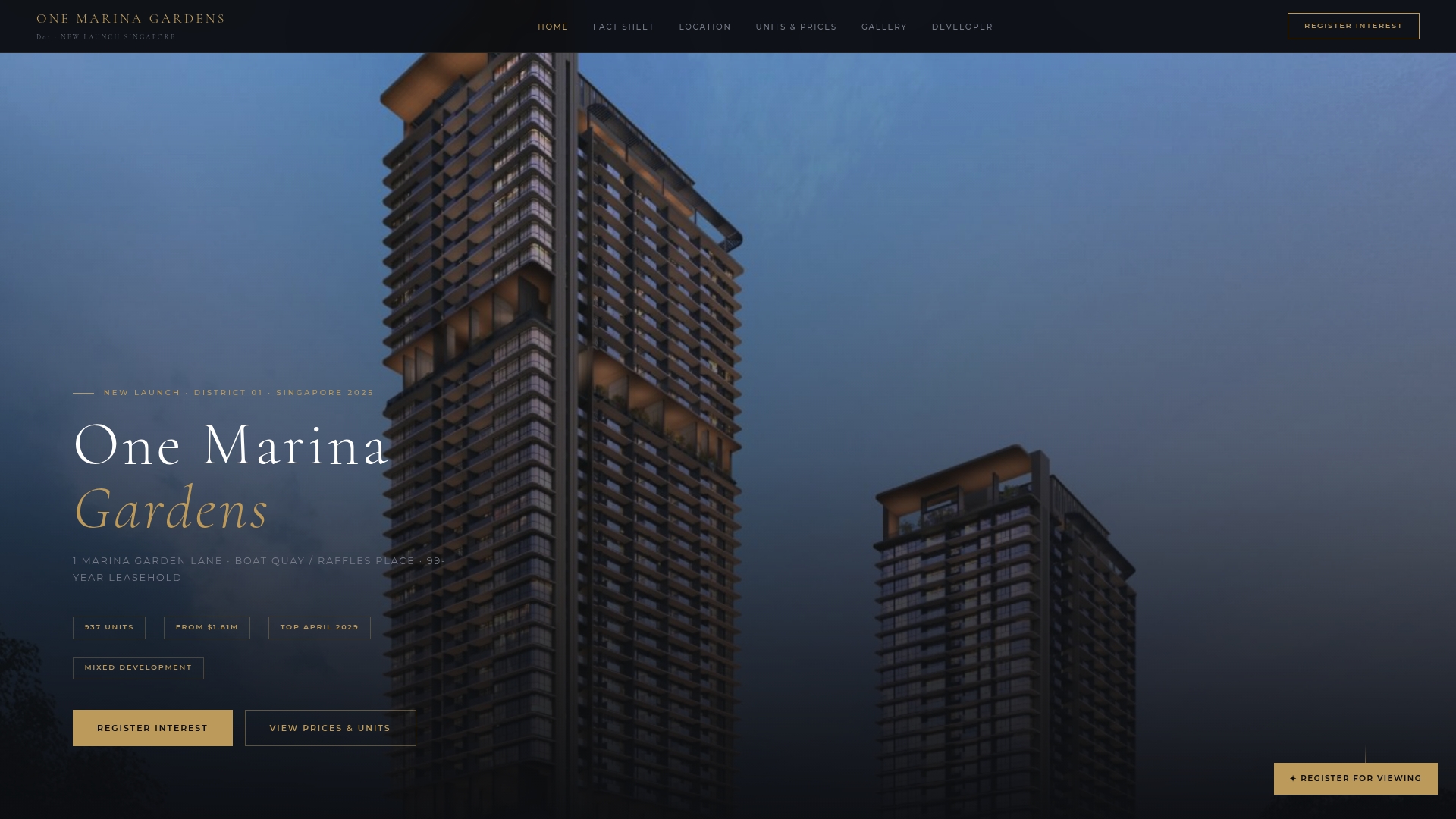
The development sits 160 meters from Marina South MRT, with direct access to the CBD, a 50-metre lap pool, multiple sky terraces, and a dedicated childcare centre. For families upgrading from an HDB, the childcare facility alone removes a significant logistical headache. Rental yields in D01 remain competitive for investors who want the option to lease before owner-occupying.
Before you book, confirm the exact ABSD remission timeline and TOP estimate with your conveyancing lawyer. The One Marina Gardens fact sheet has the unit mix, staged payment schedule, and TOP projection. When you are ready to see the development in person, book a showflat appointment or request the project overview directly from the developer's sales team.
Official and recommended sources to confirm rules and for deeper reading
-
IRAS: Additional Buyer's Stamp Duty (ABSD))) — The primary source for current ABSD rates by buyer profile. Always check this page before signing; rates have changed before and can change again.
-
IRAS: Remission of ABSD for a Married Couple — The definitive guide to eligibility, the 6-month disposal deadline, and the application process. Your conveyancing lawyer will use this page to structure the remission filing.
-
HDB: Selling a Flat — Eligibility — Confirms MOP rules, eligibility conditions, and restrictions on private property ownership during MOP. Check your specific flat type here.
-
MAS: Loan Tenure and Loan-to-Value Limits — The Monetary Authority of Singapore's explainer on LTV limits and TDSR rules. Use this to understand your borrowing ceiling before approaching a bank.
Confirm the date-stamp on every official page before relying on a figure. Rules change, and a rate that was accurate 12 months ago may not be current. For your specific transaction, a licensed conveyancing lawyer and a MAS-regulated mortgage adviser are the only professionals who can give you advice that accounts for your exact ownership structure and financial position.