Marina Bay still commands premium rents, but yield compression means it rewards capital preservation over income. The Core Central Region (CCR) rental index rose modestly quarter-on-quarter in Q2 2026, while the CCR vacancy rate remained elevated according to available data.
TL;DR:
- Marina Bay's rental growth remains slow at 1.2% quarter-on-quarter, with vacancy rates at 8.3%, indicating a balanced but competitive market.
- Gross yields for units range from 2.5% to 3.5%, with smaller units closer to 3.5% and larger units below 3.0%, though net yields can fall below 2% after costs.
- Tenant demand is primarily from expatriate professionals and corporate clients, with potential long-term growth driven by new amenities and family-friendly infrastructure planned in Marina South.
- Shorter leasing periods and flexible lease terms help landlords reduce vacancy, especially for larger units with smaller tenant pools.
- Buying for long-term capital preservation is more suitable than targeting high yields, given the limited supply, masterplan developments, and demand profile in District 01.
Table of Contents
- What Is Driving Marina Bay Rental Demand Right Now?
- How Much Yield Can You Expect by Unit Type?
- Who Is Actually Renting in Marina Bay?
- What Does 8.3% Vacancy Actually Mean for Landlords?
- Should You Buy for Yield or for Appreciation?
- Where One Marina Gardens Fits the Demand Picture
- How Do You Vet a Marina Bay Rental Listing?
- Our Take: Buy for the Address, Not the Yield
- Ready to See the Numbers for Your Own Unit Choice?
- Where This Data Comes From
- Sources
- FAQ
What Is Driving Marina Bay Rental Demand Right Now?
Rental demand in Marina Bay is holding up better than the vacancy figure suggests on its own. The 99 puts the CCR rental index up 1.2% quarter-on-quarter, a modest but real gain against a vacancy rate of 8.3% for the same period. That combination tells you something specific: fewer units are sitting empty relative to a quarter ago, yet enough supply exists that landlords still compete on price and lease terms.
Leasing activity backs this up. ERA's Q2 2026 rental report recorded a 6.6% quarterly increase in rental contracts, with 45,032 contracts signed across private residential properties in the first half of 2026. That is not a boom, but it is a market where tenants are actively signing, not just browsing.
Rent psf in Marina Bay carries a clear premium over the broader CCR average, and monthly rents for larger units regularly land in the higher bands you would expect from a waterfront, CBD-adjacent address. Several neighborhood rent guides put typical 2 to 3 bedroom rents between S$6,000 and S$12,000 a month, depending on unit size, floor, and finishing.
Supply is the other half of the story. District 01 has seen limited Government Land Sale releases in recent years, which limits how much new stock can enter the market. A wave of Marina Bay and Marina South completions between 2024 and 2026 has added near-term inventory, which explains some of the vacancy reading, but the pipeline behind that wave is thin.
| Metric | Q2 2026 figure | What it signals |
|---|---|---|
| CCR rental index (QoQ) | +1.2% | Rents are still climbing, just slowly |
| CCR vacancy rate | 8.3% | Landlords face real competition for tenants |
| Rental contracts (QoQ) | +6.6% | Leasing activity is picking up, not stalling |
| 1H 2026 rental contracts | 45,032 | Steady transaction volume across private homes |
Read together, these numbers describe a market in a holding pattern rather than a downturn. Rents inch up, vacancy stays elevated, and deals keep closing.
How Much Yield Can You Expect by Unit Type?
Gross yields in Marina Bay generally sit between 2.5% and 3.5%, according to multiple market analyses of the precinct, with smaller units usually landing nearer the top of that band and larger units nearer the bottom.
Typical gross yield bands by unit type:
- 1 bedroom: Closer to 3.5%, since smaller units carry lower absolute purchase prices relative to achievable rent.
- 2 bedroom: Roughly 3.0% to 3.3%, the sweet spot most landlords target for balance between rent and resale liquidity.
- 3 bedroom: Around 2.7% to 3.0%, reflecting higher purchase quantum against a smaller pool of tenants who need that much space.
- 4 bedroom and penthouse: Often below 2.7%, since these units chase a thin slice of tenants (large expat families, C-suite relocations) willing to pay for the extra floor area.
Pro Tip: *Run your yield math on the rent you can realistically get in month one, not the highest comparable listing you find online.
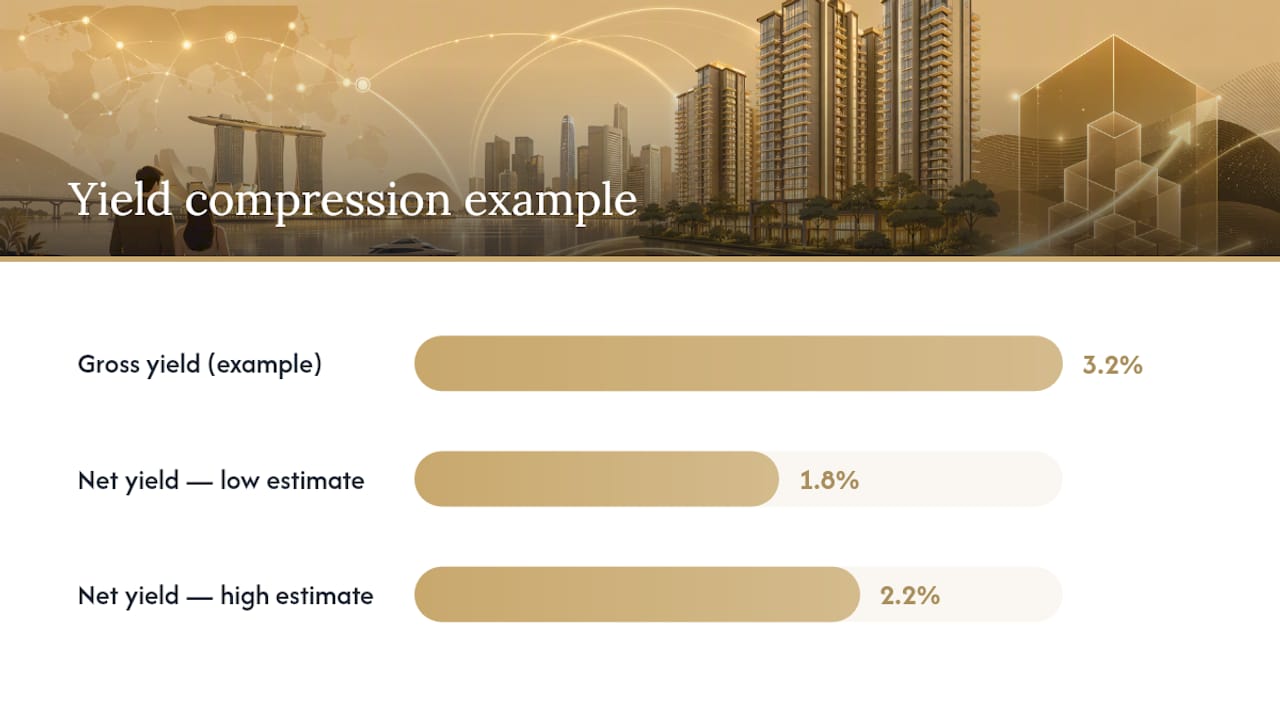
Net yield tells the more honest story. Start from gross rent, then subtract property tax on a non-owner-occupied residential unit, monthly maintenance fees (often S$400 to S$700 for larger units in amenity-heavy developments), agent commission of roughly half a month's rent per year of tenancy, and a vacancy buffer of two to four weeks a year even in a good market. Stack those together and a 3.2% gross yield can easily compress to 1.8% to 2.2% net. That is not a reason to avoid Marina Bay. It is a reason to buy it for the right objective, which is usually capital preservation and long-term appreciation rather than monthly cash flow.
Who Is Actually Renting in Marina Bay?
The tenant base skews heavily toward senior expatriate executives and finance professionals, many with employer-covered housing allowances that remove price sensitivity from the equation. That matters more than it sounds.
Who is shaping demand today:
- Expat senior executives and regional finance-sector staff, frequently on employer-paid packages.
- Corporate assignees on medium-term postings who want move-in-ready units near the CBD.
- Serviced-residence overflow and short-stay corporate demand tied to Marina Bay's convention and financial-district traffic.
- A smaller but growing share of long-term resident families as precinct amenities mature.
That last group is where things get interesting for a 2026 outlook. The URA masterplan guidance for Marina South signals new schools, childcare facilities, and retail coming to the precinct, which historically has been light on family infrastructure compared with mature estates. As those amenities land, expect the tenant mix to broaden beyond single executives and DINK (dual income, no kids) households toward families willing to sign longer leases.
Pro Tip: If you're weighing a 3 or 4 bedroom purchase for rental income, the masterplan timeline matters more than the current tenant profile. Buy ahead of the amenity rollout and you're pricing in demand that doesn't fully exist yet.
What Does 8.3% Vacancy Actually Mean for Landlords?
Well-priced 1 and 2 bedroom apartments in Marina Bay still lease within two to four weeks when priced in line with recent comparables. Three and four bedroom units, along with penthouses, routinely take longer because the pool of tenants who need that much space and can afford it is smaller, even in a prime district.
Landlords can shorten that gap with a few concrete moves:
- Present the unit as tenant-ready. Neutral finishes, quality bedding and bathroom fittings, and a move-in-ready feel matter more to relocating executives than aesthetic flourishes.
- Offer flexibility on lease length instead of cutting rent. Employer-covered tenants often prefer a 12 to 24-month term over a discount, since the company is paying either way.
- Work with a relocation-focused agent, not just a general listing agent. Agents who handle corporate relocations see tenant demand before it hits the open portals.
- Consider a short free-rent period over a permanent rent cut. A one-month incentive preserves your headline rent for future renewal negotiations, while a discount resets the baseline downward.
Larger, luxury-tier units in District 01 typically face longer marketing periods regardless of how well they are staged, simply because the tenant pool is thinner at that price point.
Should You Buy for Yield or for Appreciation?
Marina Bay rewards investors who are honest about what they are buying it for. Marina Bay makes more sense when the goal is capital preservation, prestige positioning, and appreciation tied to a genuinely constrained supply pipeline in District 01.
The URA masterplan timeline for Marina South points to a multi-year rollout of schools, retail, and childcare infrastructure, which suggests investors should be thinking in five to ten year holds rather than flipping on a two or three-year cycle. Scarcity in D01 land supply supports long-term value even when short-term yields stay thin.
A practical checklist before committing capital:
- Set a minimum acceptable gross yield (most investors should hold the line near 3%).
- Model net yield after property tax, maintenance, and a realistic vacancy buffer, not just gross rent.
- Stress-test financing against a mortgage rate 1.5 to 2 percentage points above today's rate.
- Confirm your holding horizon matches the masterplan timeline rather than a shorter exit assumption.
| Investor priority | Best fit in Marina Bay | Key trade-off |
|---|---|---|
| Monthly cash flow | Weak fit | Net yields often under 2% after costs |
| Capital preservation | Strong fit | Limited D01 supply supports long-term value |
| Prestige/owner-occupier resale later | Strong fit | Premium pricing means slower initial appreciation |
| Fast flip (under 3 years) | Weak fit | Masterplan-driven upside needs a longer runway |
Where One Marina Gardens Fits the Demand Picture
One Marina Gardens sits directly inside the district that this data describes: District 01, roughly 160 meters from Marina South MRT, with 937 units spanning 1 to 4 bedroom layouts. That location alone answers a big part of the tenant equation, since Marina Bay's premium rents track directly with proximity to CBD access and MRT connectivity.

The amenity list matters just as much as the address. The development includes a 50-meter lap pool, multiple sky terraces, and an on-site childcare center, alongside retail and dining within the same mixed-use footprint. That combination speaks to two tenant groups at once: the expat executives and finance professionals who currently dominate Marina Bay leasing, and the family segment the URA masterplan is expected to grow as schools and daily-use amenities mature in Marina South.
Why the feature set lines up with demand drivers covered above:
- MRT proximity at 160 meters reduces commute friction for CBD-based tenants, a factor senior executives weigh heavily.
- The childcare center and sky terraces give the development a head start on family-tenant appeal before the wider precinct amenities land.
- A 937-unit scale means more comparable listings to benchmark rent against, which helps both landlords and prospective tenants price fairly.
If you're evaluating unit-level fit against the yield bands discussed earlier, the unit and price list is the place to check layouts against your own cash-flow model, and requesting rental comparables directly from the sales team is worth doing before you commit to a specific stack or floor.
How Do You Vet a Marina Bay Rental Listing?
Screening a listing properly takes more than checking the asking rent against a portal average. Here's a sequence that catches the details generic searches miss:
- Pull recent lease comparables for the same building or block, not just the district average, since Marina Bay rents vary meaningfully by tower and view.
- Confirm the service charge and what it covers. A unit with a lower headline rent but high maintenance fees may cost you more monthly than a pricier alternative.
- Check tenure and any upcoming lease-related restrictions that could affect resale or refinancing during your holding period.
- Inspect unit condition and floor/view honestly. A stack facing the bay commands a real premium; an obstructed lower floor in the same building often does not.
- Ask for the landlord's or agent's tenant history, including average time-to-let and any pattern of early lease breaks, which can signal pricing or condition issues.
Pro Tip: *Always ask the agent directly for the last two closed deals in the same stack, not just active listings.
On negotiation, tenants in this market more often accept flexible lease lengths (12 to 24 months) over deep rent cuts, particularly when their housing is employer-funded. That gives landlords room to hold rent steady while offering the term flexibility tenants actually want.
Our Take: Buy for the Address, Not the Yield
It is where you go for an address that keeps renting to well-funded tenants even in a soft patch, backed by supply scarcity that OCR districts simply don't have.
If you're choosing between unit types, 2 and 3 bedroom layouts tend to offer the best balance of rent believability and resale liquidity. The single tactic that improves net yield fastest is cutting vacancy days through tenant-ready staging and flexible lease terms, not chasing the highest asking rent.
— Velisa
Ready to See the Numbers for Your Own Unit Choice?
One Marina Gardens gives you a direct way to test everything covered above against real unit-level numbers instead of district averages. Its District 01 address, 160-meter walk to Marina South MRT, and amenity set built around a 50 meter lap pool, sky terraces, and an on-site childcare center map closely to the tenant profile driving Marina Bay demand today, and to the family segment the URA masterplan is expected to grow over the next several years.
The current price list and available units covers layouts from 1 to 4 bedrooms, so you can weigh a specific stack and floor against the yield bands discussed earlier rather than guessing off a district-wide average. Reach out to the sales team to request rental comparables for the exact unit type you're considering, and run your own due diligence alongside the figures here before committing. Book a viewing through the units page to see layouts in person and ask about current availability.
Where This Data Comes From
The figures in this article draw from a handful of primary and industry sources worth bookmarking if you're tracking Marina Bay on an ongoing basis:
- 99 for CCR rental index and vacancy data.
- URA's Marina South masterplan and urban design guidance for precinct planning details.
- Stackedhomes' analysis of Marina Bay property values for yield benchmarking.
This article is general information, not a substitute for advice from a qualified financial advisor. Consult a qualified financial professional about your own circumstances before acting on anything here.
Sources
- 99
- Marina South master plan and urban-design guidance — URA
- URA master plan, Marina Bay property values — Stackedhomes
FAQ
How much are units at Marina Bay residences like One Marina Gardens?
One Marina Gardens offers 1 to 4 bedroom units, including 3BR Premium and 4BR Premium layouts, with current pricing available on the official price list rather than a fixed published figure.
Is One Marina Gardens a good buy for rental investors?
For investors prioritizing capital preservation and long-term appreciation over immediate cash flow, One Marina Gardens' District 01 location, MRT proximity, and amenity set align closely with the tenant demand drivers covered above, though every purchase should be checked against your own yield targets and holding horizon.