
Seller's Stamp Duty (SSD) applies to most residential property sales in Singapore when the property is sold within the holding period. For properties purchased on or after 4 July 2025, that window is now several years, with rates running as high as a substantial percentage in the initial year. If you bought a private residential property recently and are considering selling, SSD is almost certainly on the table.
Here is the quick picture for post-4 July 2025 residential purchases:
- Year 1 (up to 12 months): 16% of the higher of sale price or market value
- Year 2 (>1–2 years): 12%
- Year 3 (>2–3 years): 8%
- Year 4 (>3–4 years): 4%
- Beyond 4 years: no Seller's Stamp Duty payable
Your first move is to confirm your acquisition date. That is the date you accepted the Option to Purchase (OTP) or signed the Sale & Purchase Agreement, not the date you collected keys. Once you have that date, use the IRAS SSD calculator or speak to your conveyancing lawyer before you commit to any sale timeline.
Key Takeaways
For properties purchased on or after 4 July 2025, Seller's Stamp Duty applies for up to four years at rates from 4% to 16%, computed on the higher of sale price or market value.
| Point | Details |
|---|---|
| Check your acquisition date first | SSD holding period starts from OTP acceptance or Sale & Purchase Agreement date, not key collection. |
| Post-4 July 2025 rates run to 16% | Year 1 costs 16%; year 2 is 12%; year 3 is 8%; year 4 is 4%; after four years, SSD is zero. |
| Tax base is the higher figure | IRAS uses the higher of sale price or market value; selling below market value can trigger an independent IRAS valuation. |
| File within 14 days (Singapore) | Your law firm files and pays via myTax Portal; late payment attracts a penalty of up to four times the unpaid duty. |
| Onemarinagardens for re-buyers | Sellers planning to re-purchase can explore unit availability and pricing at One Marina Gardens, a new-launch District 01 development with direct MRT access. |
Table of Contents
- What is Seller's Stamp Duty and why does it exist?
- What are the current SSD rates after the July 2025 changes?
- How do you calculate Seller's Stamp Duty?
- Are there exemptions or remissions from Seller's Stamp Duty?
- How do you file and pay Seller's Stamp Duty?
- How does SSD interact with HDB's Minimum Occupation Period?
- What changed on 3 July 2025 and why does it matter?
- The part most sellers underestimate
- Considering a re-purchase after your sale?
- Authoritative sources for further reading
What is Seller's Stamp Duty and why does it exist?
Seller's Stamp Duty is a tax charged on sellers who dispose of residential or qualifying non-residential property within a specified holding period. The Inland Revenue Authority of Singapore (IRAS) administers it, and the rates and holding periods are set by the government through subsidiary legislation.
The policy purpose is straightforward: SSD is designed to discourage short-term speculative flipping and to keep property prices stable. It is not a revenue-raising measure in the conventional sense. The 2025 changes made that intent explicit.
"The Government has decided to extend the holding period for [Seller's Stamp Duty] from 3 years to 4 years, and to increase the SSD rates by 4 percentage points for each tier, for residential properties purchased on or after 4 July 2025. This is to address the rise in sub-sale activity of private residential properties and to promote a stable and sustainable property market." — MAS/MOF/MND joint press release, 3 July 2025
The official IRAS guidance on residential SSD-for-residential-property) is the authoritative source for rates, computation rules, exemptions, and filing procedures. When in doubt, that page and your conveyancing lawyer are your two primary references.
What are the current SSD rates after the July 2025 changes?
The 3 July 2025 announcement extended the residential SSD holding period and raised each tier by a fixed percentage increase for properties purchased on or after 4 July 2025. Properties bought before that date follow the older schedule.
Residential SSD rates by acquisition window
| Holding period | Purchased on/after 4 Jul 2025 | Purchased 11 Mar 2017 – 3 Jul 2025 | Purchased 14 Jan 2011 – 10 Mar 2017 |
|---|---|---|---|
| Up to 1 year | 16% | 12% | 16% |
| >1–2 years | 12% | 8% | 12% |
| >2–3 years | 8% | 4% | 8% |
| >3–4 years | 4% | — | 4% |
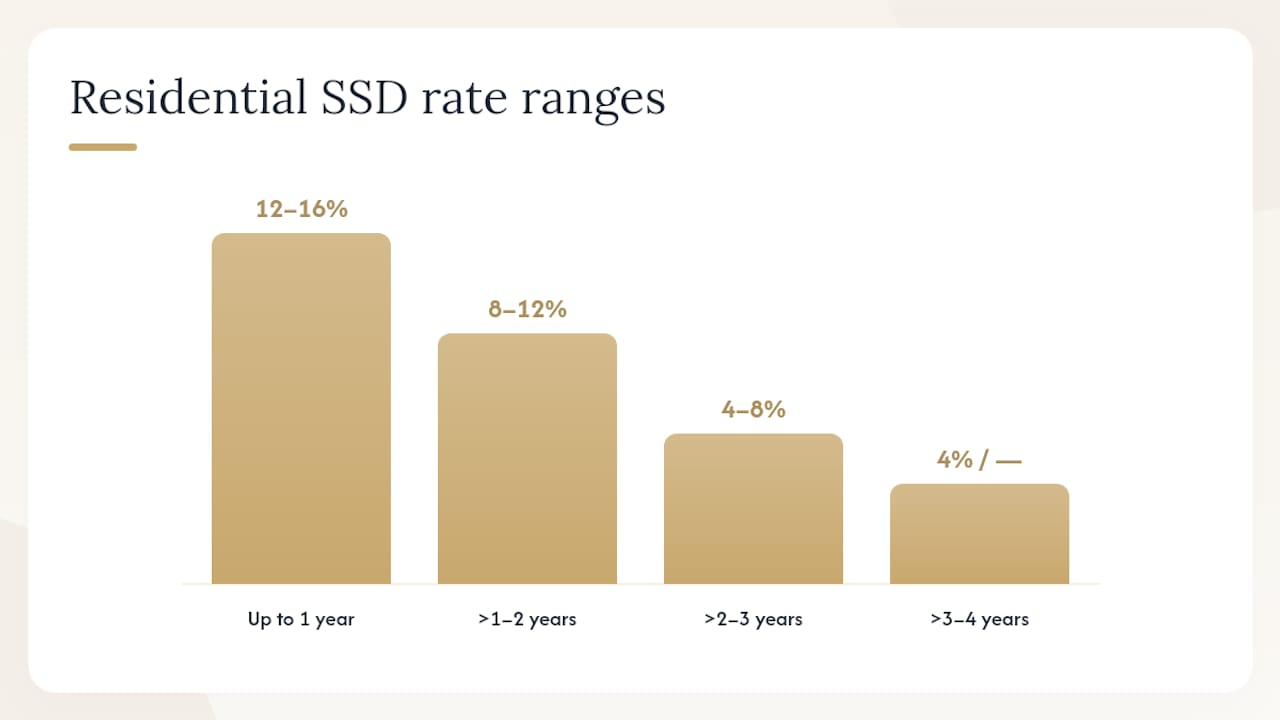
SSD is computed on the higher of sale price or market value. Source: IRAS residential SSD-for-residential-property)
For properties purchased between 20 February 2010 and 13 January 2011, a different (earlier) rate table applies. Check the IRAS page directly if your acquisition falls in that window.
Industrial SSD rates (acquired on/after 12 January 2013)
| Holding period | SSD rate |
|---|---|
| Up to 1 year | 15% |
| >1–2 years | 10% |
Source: IRAS industrial SSD-for-industrial-property)
The tax base rule is the same for both categories. SSD is applied to the higher of the sale price or the market value at the time of disposal. If you sell below market value, whether in a distress sale or a related-party transfer, IRAS can assess market value independently and compute SSD on that figure instead. That is not a theoretical risk; it is a documented IRAS practice.
The IRAS stamp duty rates quick-links page gives you a consolidated view of all current stamp duty rates, including both buyer-side and seller-side charges.
How do you calculate Seller's Stamp Duty?
The calculation itself is not complicated. The steps are:
- Confirm your holding period tier. Count from your acquisition date to the date the conveyance is executed (not the completion date).
- Identify the tax base. Use the higher of the agreed sale price or the market value at disposal.
- Apply the applicable rate from the correct acquisition-window column.
- Round to the nearest dollar.
Worked example 1: Residential property, sold in year 1
A seller purchased a private condominium on 15 August 2025 (post-4 July 2025 rules apply). She sells it 10 months later. The agreed sale price is S$2,000,000 and IRAS assesses market value at S$1,980,000.
- Tax base: S$2,000,000 (higher of the two figures)
- Applicable rate: the highest rate applicable to sales within 1 year under post-4 July 2025 rules
- SSD payable: calculated as the applicable rate applied to the higher of sale price or market value
Worked example 2: Residential property, sold in year 2
Same acquisition date. The seller waits 18 months before selling. Sale price is S$2,100,000; market value is S$2,050,000.
- Tax base: S$2,100,000
- Applicable rate: the applicable rate for sales in the second year
- SSD payable: computed accordingly on the higher of sale price or market value
Waiting eight additional months saves S$68,000 in this example. That is the kind of calculation every seller should run before setting a sale date.
Worked example 3: Industrial property, sold in year 2
A seller acquired an industrial unit on 1 March 2023 and sells it 20 months later. Sale price is S$1,500,000; market value is S$1,480,000.
- Tax base: S$1,500,000
- Applicable rate: the mid-level industrial SSD rate for sales in the second year
- SSD payable: calculated based on the applicable rate and the higher of sale price or market value
Pro Tip: Use the IRAS myTax Portal SSD calculator to verify your estimate before instructing your lawyer. It handles the acquisition-date logic and rate-table selection automatically, which reduces the risk of picking the wrong column.
Yuen Law's SSD guide notes that IRAS market-value reviews most commonly arise in related-party transactions and distress sales where the agreed price is noticeably below comparable transactions. If your sale falls into either category, get an independent valuation before signing.
Are there exemptions or remissions from Seller's Stamp Duty?
Several categories of sellers are automatically exempt or may qualify for remission. Knowing which bucket you fall into can save significant money and paperwork.
Automatic exemptions (no application required):
- Licensed housing developers disposing of residential units they developed
- Disposals arising from compulsory acquisition by a public authority
- Disposals by public authorities themselves
- Certain transfers arising from bankruptcy or judicial proceedings
Conditional remissions (application required):
- Disposals due to financial hardship or other exceptional circumstances may qualify for remission at IRAS's discretion; the seller or their lawyer must apply formally
- Specific corporate restructuring scenarios may also qualify, subject to IRAS review
Partial-interest disposals follow a proportional rule. If you sell a partial interest in a property (for example, a 50% share), SSD is calculated on the higher of the sale price or market value attributable to that portion. Each portion's holding period may be computed separately if the interests were acquired at different times.
Practical checklist before assuming you are exempt:
- Confirm your developer license status if you are a developer
- Retain all sale documentation, including the OTP, Sale & Purchase Agreement, and any valuation reports
- Law firms handling the transaction are required to retain the original SSD declaration forms for at least five years from the date of disposal, as IRAS may request them for audit
- If you believe you qualify for remission, instruct your conveyancing lawyer to prepare the application before the payment deadline
How do you file and pay Seller's Stamp Duty?
In practice, your conveyancing law firm handles the SSD declaration and filing on your behalf. You should still understand the timeline so you can coordinate effectively and avoid penalties.
"Stamp duty, including SSD, must be paid within 14 days after the date of execution of the dutiable document if the document is signed in Singapore, or within 30 days if signed overseas. Late payment attracts a penalty of up to four times the unpaid duty." — IRAS stamp duty rates and filing guidance
Filing and payment steps:
- Your law firm logs into the IRAS myTax Portal (Stamp Duty Login) and submits the SSD declaration.
- Payment is made through the portal via GIRO, eNETS, or other accepted channels.
- The stamped document is returned electronically; this is required before the conveyance can be registered.
Penalties for non-compliance are steep. Late payment attracts a penalty of up to four times the unpaid duty. Understating the tax base (for example, by using a sale price that IRAS later determines is below market value) can trigger additional assessments plus interest. The practical impact on your sale timeline is also real: an unstamped document cannot be used in court and cannot be registered with the Singapore Land Authority, which effectively blocks completion.
The single most useful thing you can do is brief your conveyancing lawyer on your acquisition date and intended sale price as early as possible. SSD liability confirmed well before the completion date means no last-minute surprises and no risk of a delayed handover.
How does SSD interact with HDB's Minimum Occupation Period?
For most HDB flat owners, the 2025 SSD changes are not directly relevant. Here is why.
The HDB Minimum Occupation Period (MOP) for standard Build-To-Order flats is five years. Since the SSD holding period for post-4 July 2025 residential purchases is four years, an HDB owner who completes the MOP before selling will already be outside the SSD window. The two regimes are separate: MOP is an HDB rule governing eligibility to sell, while SSD is an IRAS tax on the disposal. Satisfying one does not automatically satisfy the other, but in practice the MOP timeline usually exceeds the SSD holding period.
When SSD can still affect HDB-related assets:
- HDB shophouses or mixed-use properties with a residential component may have the residential portion subject to SSD if acquired within the relevant window
- Partial disposals of HDB-related assets with a residential component are assessed proportionally
- If an HDB flat was acquired with a shorter MOP (certain executive condominiums or special schemes), verify the SSD holding period independently
Developer exemptions apply narrowly. A licensed housing developer is exempt from SSD on units it developed and sells in the ordinary course of its business. This does not extend to units the developer purchased on the secondary market, and it does not apply to individual investors who hold units in a development company structure.
Checklist for HDB sellers:
- Confirm your MOP completion date with HDB
- Check whether any part of your property has a non-residential component that could attract SSD
- If your flat was acquired under an unusual scheme or involves a partial interest, consult IRAS guidance or your lawyer before assuming full exemption
What changed on 3 July 2025 and why does it matter?
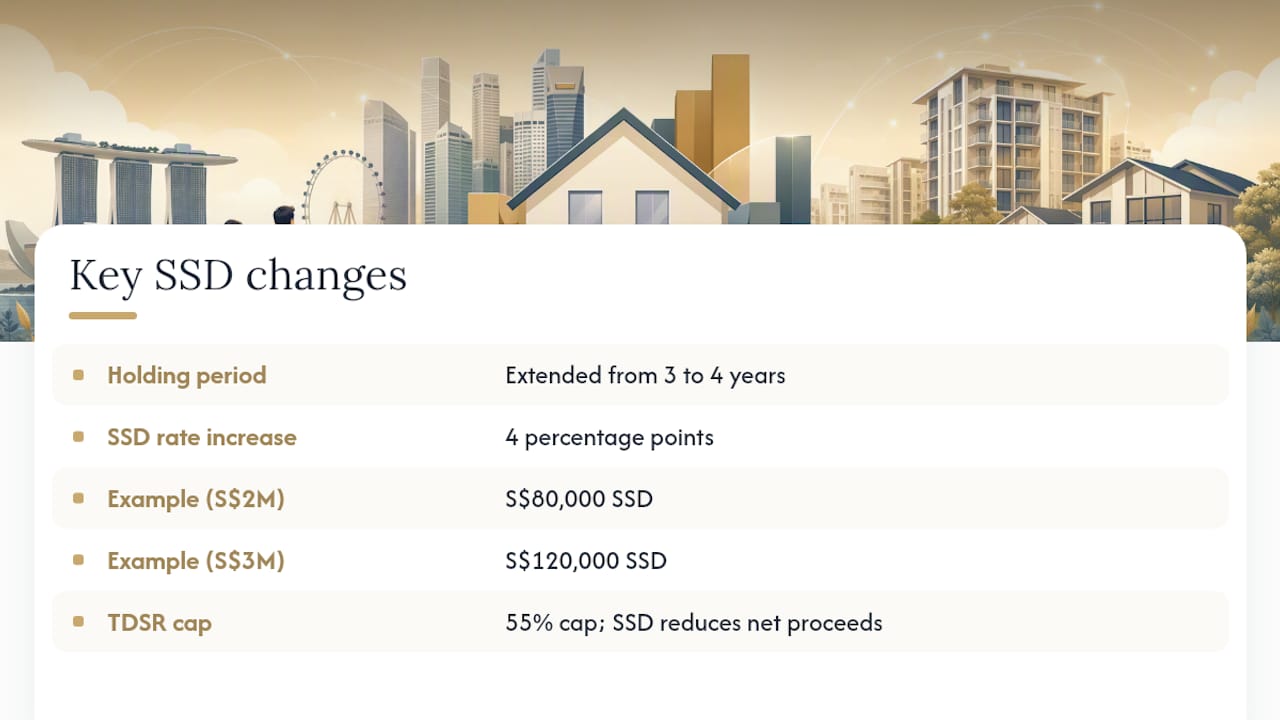
The joint announcement by MAS, MOF, and MND on 3 July 2025 was the most significant SSD revision since 2017. Two things changed simultaneously for properties purchased on or after 4 July 2025: the residential holding period extended from three years to four, and each tier's rate increased by four percentage points.
"The Government has observed a rise in sub-sale activity of private residential properties. Sub-sales, which involve the sale of uncompleted private residential units before the project receives its Temporary Occupation Permit, have increased significantly. The Government is therefore taking steps to address this activity." — MAS/MOF/MND press release, 3 July 2025
The target was specifically the sub-sale market: buyers who purchase uncompleted private residential units and flip them before the project receives its Temporary Occupation Permit. That activity had been rising, and the government's response was to make early exits materially more expensive.
For sellers and investors, the practical implications are significant. A four-year SSD window means that anyone who bought a new launch in 2024 or 2025 is now locked into a longer hold before a tax-free exit becomes possible. Exit planning needs to account for SSD as a real cashflow item, not a theoretical one.
If you plan to sell and re-buy, the TDSR framework adds another layer of planning. The Total Debt Servicing Ratio cap of 55% for property loans (applicable where the OTP was granted from 16 December 2021) means your monthly debt obligations, including any bridging loan or outstanding mortgage, must stay within that threshold. Higher SSD on the sale side reduces your net proceeds, which directly affects how much you can put toward a new purchase. Running both calculations together before you commit to a sale timeline is not optional; it is basic financial planning.
The legislative supplement implementing the 2025 SSD changes is publicly available for sellers who want to read the statutory text behind the policy announcement.
For context on how the Singapore property market is absorbing these regulatory changes, the Singapore property market trends analysis at Onemarinagardens covers the broader investor outlook.
The part most sellers underestimate
Most of the conversation around the July 2025 SSD changes focuses on the rate increase. The holding-period extension from three to four years is actually the more consequential change for the majority of sellers.
A four-percentage-point rate increase hurts. But a one-year extension of the holding period changes the entire calculus for anyone who bought a new launch in 2023 or 2024 expecting to exit cleanly in year three. Those sellers now face a binary: hold for another year or absorb a 4% SSD charge on the full sale price or market value, whichever is higher. On a S$2 million property, that is S$80,000. On a S$3 million property, it is S$120,000.
What makes this particularly sharp is the interaction with TDSR. Sellers who need to re-buy quickly are not just managing SSD on the way out; they are managing reduced net proceeds going into a new loan application. The 55% TDSR cap does not flex for SSD costs. If your sale nets less than expected because of SSD, your borrowing capacity for the next purchase is constrained by that same reduced figure.
The sellers who will navigate this best are the ones who model both numbers together before they sign anything. Run the SSD estimate on your current property. Run the TDSR calculation on your intended next purchase. If the two numbers leave you with a workable gap, the timing works. If they do not, holding longer is usually cheaper than forcing a sale.
This article is general information only and does not constitute tax or legal advice. Confirm your specific SSD liability and filing obligations with your conveyancing lawyer or directly with IRAS.
Considering a re-purchase after your sale?
Sellers who clear their SSD window and are ready to re-enter the market often find that new-launch condominiums in prime districts offer the clearest path to long-term capital appreciation, without the uncertainty of secondary-market pricing. Onemarinagardens at District 01 is one of the few new launches in Singapore with direct access to Marina South MRT, a 50-metre lap pool, multiple sky terraces, and a dedicated childcare centre, all within 160 meters of the CBD corridor.
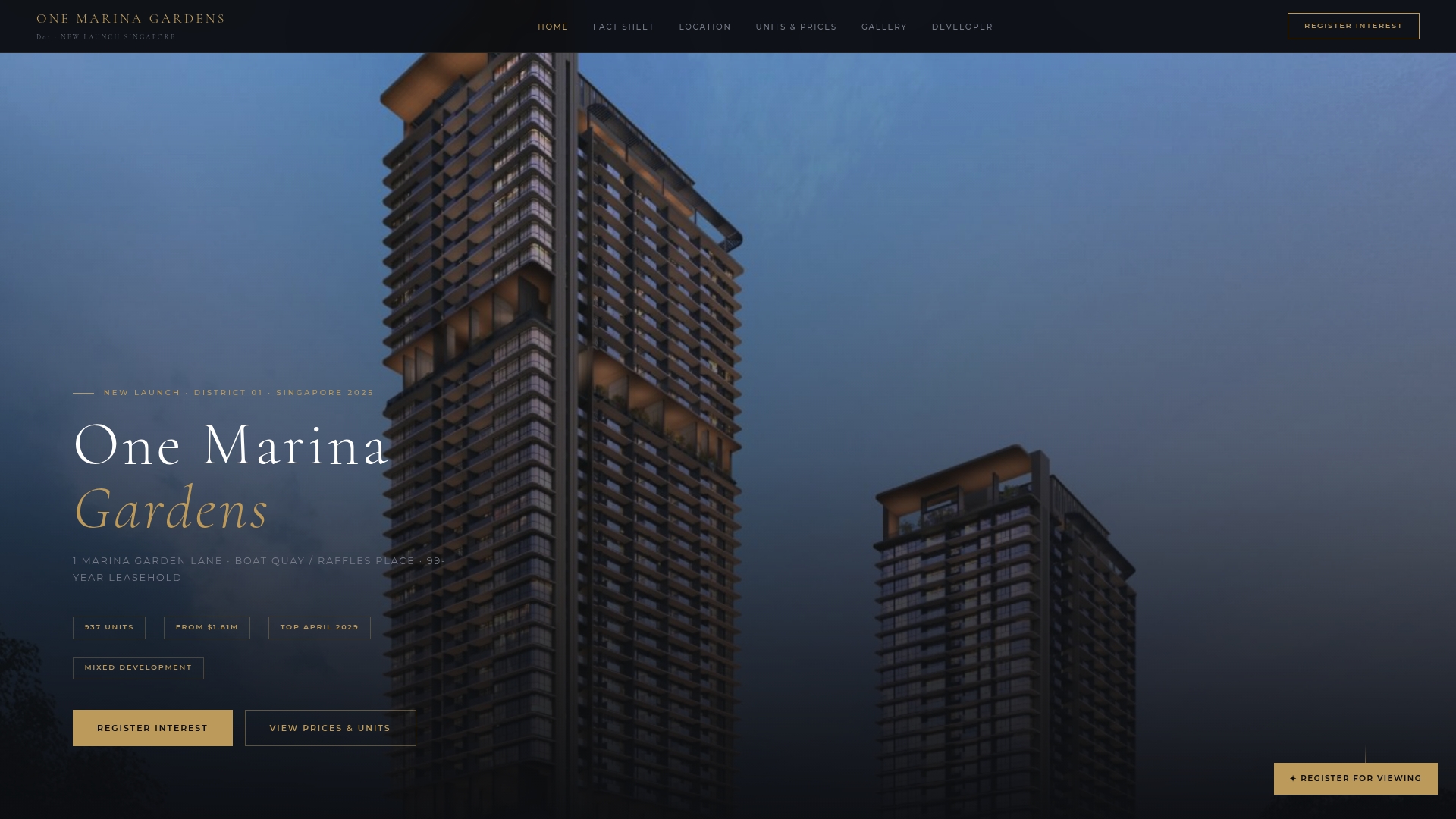
Whether you are timing a sale around your SSD holding period or planning a trade-up from an HDB flat after MOP, the Onemarinagardens sales team can walk you through unit availability, pricing from S$1.81M, and how ABSD and SSD interact for your specific buyer profile. You can also review the ABSD guide for foreign buyers on the site for a full picture of stamp duty obligations on the purchase side.
This is not tax advice. For binding rulings on your SSD liability, contact your conveyancing lawyer or IRAS directly. To register interest or book a showflat appointment, visit the One Marina Gardens listing page.
Authoritative sources for further reading
The sources below are the primary references used in this article. Each one serves a specific purpose depending on what you need to verify.
- Extension of the Holding Period of Seller's Stamp Duty (SSD) and Higher SSD Rates for Residential Properties
- mytax.iras.gov.sg
- Total Debt Servicing Ratio for Property Loans — calculating thresholds
For binding advice on your specific situation, consult your conveyancing lawyer. IRAS also accepts written enquiries for complex cases where the standard guidance does not clearly resolve your position.