
Bring a tape measure, the floor plan, and a list of unit-specific questions to every showflat visit, then confirm each claim in writing before you sign anything. Walk out with recorded measurements, orientation notes, and a clear picture of what's standard versus staged, cross-checked against URA maps and the actual floor plan. That's the difference between an impression and a decision you can defend later.
TL;DR:
- Confirm unit measurements, layouts, and standard finishes in writing before signing, cross-checking against URA maps and the floor plan.
- Evaluate each room's layout efficiency, finishes, ventilation, and balcony practicality on a consistent scale during multiple showflat visits.
- Request detailed documentation such as the specifications booklet, price list, and lot allocation information early, rather than relying on verbal assurances.
- Use a tape measure, level app, and photos to verify key dimensions and test cross-ventilation to avoid staging inaccuracies or unmet expectations.
- Investigate future development plans and zoning on URA maps to avoid units prone to obstructed views or construction disruptions later.
Table of Contents
- Room-by-Room Showflat Viewing Checklist
- What to Ask the Sales Team and What to Get in Writing
- Measuring Tools and the Routine That Saves You Time
- Red Flags That Should Slow You Down
- Pre-Visit Research and Finance Checks
- What Showflats Don't Show You
- Checking the Neighborhood While You're There
- Parking and Accessibility Worth Checking in Person
- Noise and Environmental Factors to Check on Site
- Safety and Security Features to Look For
- Future Development Plans That Could Affect Your Unit
- A Seasoned Buyer's Quick Routine to Run Through at a Showflat
- Why One Marina Gardens Fits Buyers Who Follow This Checklist
- Sources
- FAQ
Room-by-Room Showflat Viewing Checklist
A showflat rewards a system, not a vibe check. Walk through in the same order every time and score each room before your memory blurs one unit into the next.
Start with the two rooms that make or break daily life:
- Living room: measure width and length against the floor plan, then check door swings and how much floor space they eat into circulation.
- Master bedroom: confirm you can fit a queen or king bed with 60 to 70 centimeters of clearance on at least one side for walking.
- Common bedrooms: measure for a study desk or single bed setup, since these rooms often look bigger in a showflat than the floor plan supports.
- Kitchen: check the layout against provided appliances, note whether it's open or enclosed, and inspect fixed cabinetry and the household shelter door.
- Balcony: test whether it fits a small table and two chairs, and confirm if the balcony counts toward strata area or is excluded.
Ceiling height matters more than most buyers realize. A drop from 2.8 meters to 2.6 meters changes how a room breathes, and it's not always obvious without a level app or a quick visual line against a doorframe. Open windows on opposite ends of the unit, if the showflat allows it, and judge whether air actually moves through or just sits.
Score each room on a simple scale as you go:
- Layout efficiency: does the floor plan waste space on corridors or odd corners?
- Finishes: are surfaces consistent, or do you spot mismatched grout, unfinished edges, or filler patches?
- Ventilation: cross breeze, window placement, and whether the unit faces a corridor or open air.
- Balcony practicality: usable furniture space versus decorative square footage.
- Overall condition: for resale units, this covers wear; for new launches, it covers workmanship in the show unit itself.
Keep these scores on your phone. When you've seen three or four units in a weekend, the notes are what save you from confusing one showflat's kitchen with another's.
What to Ask the Sales Team and What to Get in Writing
Verbal answers at a showflat are marketing. Written answers are commitments. Ask these questions and request the paperwork before you leave.
- What is the strata area versus internal liveable area, and which actual floor does this show unit represent?
- What are the estimated maintenance fees, sinking fund contribution, and carpark charges, and what's the basis for those estimates?
- What is the confirmed TOP date, the defect liability period, and is there a liquidated damages clause tied to delays?
- Can I get the specifications booklet, the official price list, and the stack availability chart by email?
A sales team that hesitates on the fourth question is worth noting. The specifications booklet governs what's actually delivered, not the show unit's finishes, so get it in writing rather than relying on a verbal walkthrough. For resale viewings, the equivalent ask is the maintenance fee history and any upcoming lift or facade works the management committee has flagged.
Measuring Tools and the Routine That Saves You Time
Bring four things: a tape measure, your phone loaded with the floor plan PDF and camera ready, a notes app or checklist, and a level app for quick ceiling checks.
Focus your tape measure on the details that actually affect daily living:
- Bed clearance in the master and common rooms
- Wardrobe depth (most built-ins run 60 centimeters. Anything shallower limits storage)
- Dining table circulation space
- Door swing clearances near tight corners
- Corridor width, especially in older resale layouts
Photograph each room with a labeled note, then message the agent to confirm anything ambiguous. That message becomes your paper trail.
Pro Tip: Test cross-ventilation by opening windows on opposite walls and holding a tissue near one opening. If it barely moves, the "cross ventilation" claim in the brochure is optimistic at best.
Red Flags That Should Slow You Down
Some warning signs are subtle. Others are right in front of you if you know where to look.
- Vague or shifting answers about maintenance fees, TOP dates, or unit specs between visits or staff members.
- Visible water stains, uneven flooring, or misaligned tiles, even inside a polished showflat.
- Gaps between the brochure specifications and what the sales staff verbally claims.
- No official price list available on request, or a price list that changes without explanation.
- High estimated maintenance fees with no facility inventory to justify them.
Common defects worth checking include water stains, uneven tiles, and gaps in finishes, all of which show up even in developer show units meant to impress. For resale units specifically, check the lift ratio against the total number of units on the block. A single lift serving more than 40 units per floor plate often means peak-hour waits, something no showflat will demonstrate for you.
Pre-Visit Research and Finance Checks
Do the homework before you step into a showflat, not after you've fallen for one.
- Get an In-Principle Approval (IPA) from a bank and know your TDSR and LTV headroom. Pre-qualifying finance protects you from being upsold on a unit above your real budget.
- Check the developer's track record: past TOP timelines, defect history, and CONQUAS scores where published.
- Use URA maps to verify zoning nearby and check URA REALIS transaction data for recent prices on comparable units in the area.
- Set your target floor range and a budget ceiling that includes Buyer's Stamp Duty and Additional Buyer's Stamp Duty where applicable.
Skipping the IPA step is the single most common mistake among first-time viewers. Without it, every conversation with a sales team happens from a position of guessing rather than knowing.
What Showflats Don't Show You
Showflats are built to sell a feeling, and that means certain choices are deliberate. Furniture is frequently undersized to make rooms look larger than they are, and walls marked "future extension" or left as blank space rarely correspond to anything in the actual unit. Measure against the floor plan, not against your impression of the room.
The documents that actually govern what you receive are the specifications booklet, the approved floor plan, and the site plan. BCA's guidance on condo living outlines what owners should reasonably expect at handover, which is a useful benchmark when a showflat's premium fittings turn out to be paid upgrades rather than standard inclusions.
Treat the showflat as an impression. The floor plan, the specifications booklet, and the site plan are the only sources that tell you what you're actually buying.
Cross-check the site plan against URA's zoning maps to confirm the promised view and stack position hold up against anything planned nearby.
Checking the Neighborhood While You're There
The showflat visit is also your best chance to scout the surrounding area, since most buyers drive straight there and straight back without walking the block.
Before or after your appointment, spend fifteen minutes on foot. Note the walking distance to the nearest MRT station, not the driving distance the sales brochure quotes. Check what's actually open along the route: grocery stores, clinics, food options, and whether the path is sheltered or exposed to weather. A development that markets "steps from the MRT" sometimes means an underground link, and sometimes means a ten-minute walk along an unsheltered main road.
Look at the retail and lifestyle mix inside the development itself if it's mixed-use. A childcare center, a supermarket, or a food court on-site changes daily convenience far more than a rooftop pool photo does. For families, proximity to schools within the 1 or 2 kilometer priority admission bands is worth checking against the Ministry of Education's registration zones, since that affects both convenience and resale appeal to future buyers with children.
Don't skip the unglamorous checks either: rubbish collection points, the location of the nearest bus stop, and whether nearby construction sites suggest years of noise ahead. Sales staff rarely volunteer this. You have to walk it yourself.
Parking and Accessibility Worth Checking in Person
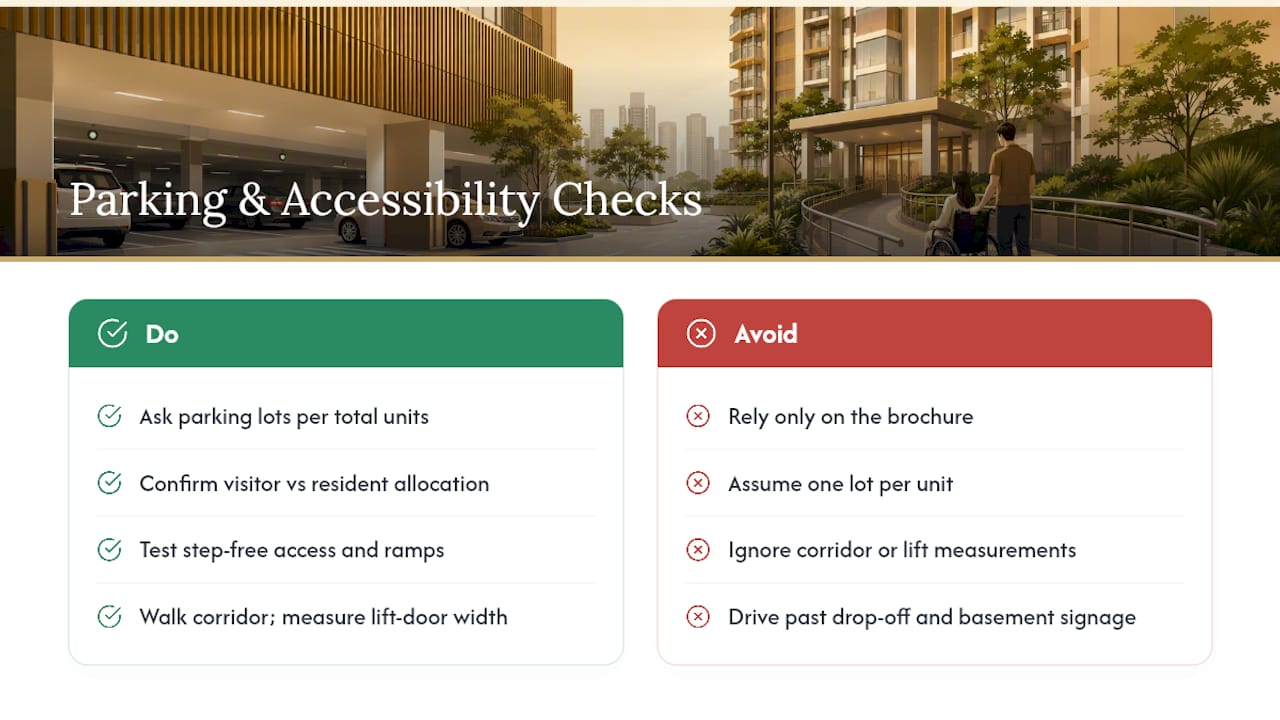
Parking ratios vary a lot between developments, and the showflat brochure won't always spell out the actual lots-per-unit figure.
Ask directly how many parking lots the development has relative to total units. A ratio below one lot per unit is increasingly common in newer District 1 projects given high land costs and strong MRT connectivity, but it matters more if you own two cars or expect visitors often. Ask whether visitor parking is separate from resident allocation, since shared pools get tight during weekends and events.
Accessibility inside the development matters just as much as the car park count. Check step-free access from the lobby to lift lobbies, whether ramps exist at building entrances, and how wide the lift doors are if you're planning for aging parents or a stroller down the line. For resale units especially, walk the actual corridor from the lift to the unit door. Older developments sometimes have narrower corridors that make furniture delivery a headache years later.
If you drive to the viewing, use that trip as your accessibility test. Note how the drop-off zone works, whether the basement carpark has clear signage, and how far the nearest lift core sits from your intended parking level. These details rarely show up in a brochure, but they shape years of daily friction if they're wrong.
Noise and Environmental Factors to Check on Site
A showflat is climate-controlled and soundproofed in ways your actual unit might not be. Test for noise on your own terms, not the sales team's schedule.
If the unit faces a road, an expressway, or a rail line, ask specifically about acoustic glazing and whether it's standard across all units or only in show units. Traffic noise that seems faint during a Tuesday afternoon viewing can be very different at 7 AM on a weekday. If possible, revisit the general area at a different time of day, even if the actual unit isn't accessible outside the appointment.
Check for nearby sources of ongoing disruption: construction sites, industrial activity, or aircraft flight paths if you're near Changi's approach corridors. Ask the sales team directly whether any construction is planned on adjacent plots, and cross-reference that against the URA masterplan rather than taking their word alone.
Environmental concerns extend to things like drainage and flood history. Ask whether the site or surrounding area has any history of ponding during heavy rain, particularly relevant for lower-lying parts of Singapore. This information isn't always volunteered, but it's a fair question and any credible sales team should have an answer ready.
Safety and Security Features to Look For
Security infrastructure is easy to overlook when you're distracted by finishes and views, but it shapes daily comfort and long-term value.
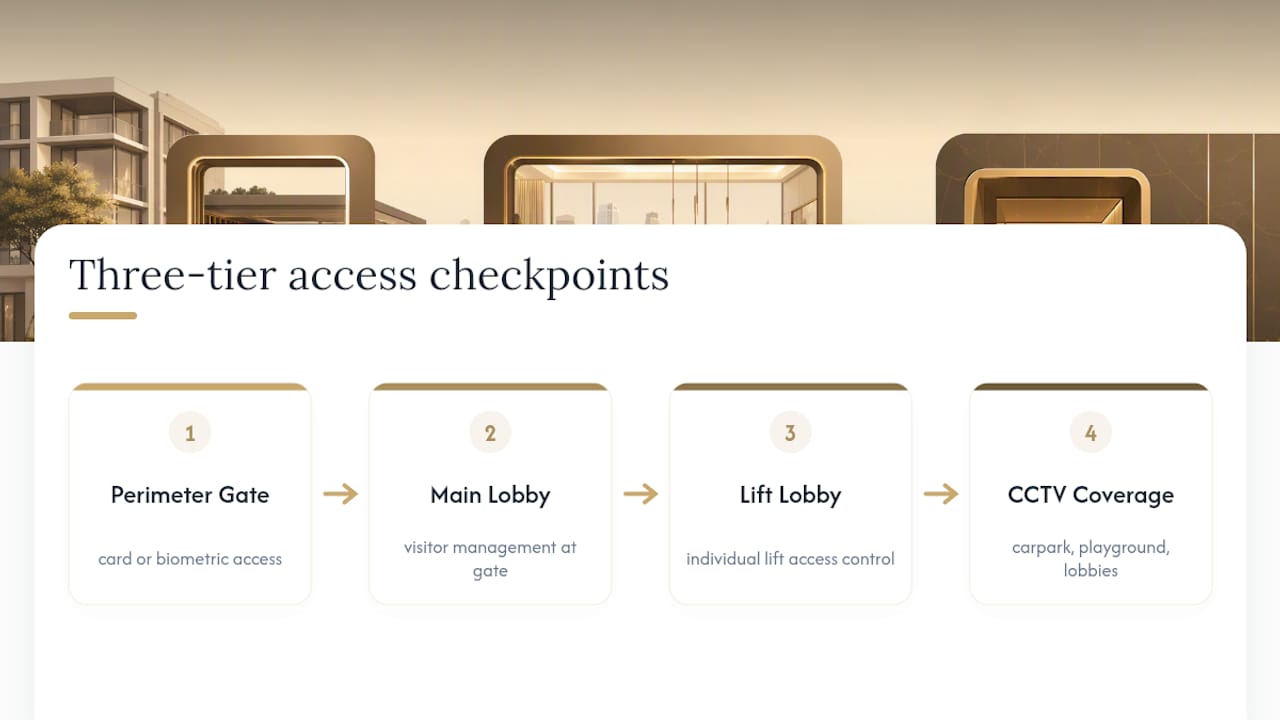
Walk through the access control system during your visit. Check whether entry uses card access, biometric systems, or a combination, and ask how visitor access is managed at the main gate and individual lift lobbies. Multi-tier security, meaning separate access points at the perimeter, the lobby, and the lift, is increasingly standard in newer District 1 developments and worth comparing against older resale buildings that may only have a single gate.
Inside the showflat, check basic safety details often missed in the excitement of viewing finishes: smoke detector placement, fire extinguisher access points in common areas, and whether the household shelter door and frame look properly sealed. For high-floor units, ask about window restrictors, especially important if you have young children.
CCTV coverage in common areas, particularly around carparks, playgrounds, and lift lobbies, is worth confirming directly rather than assuming. Ask whether footage retention and monitoring are managed by an on-site security team or outsourced, since that affects response times if something happens.
Future Development Plans That Could Affect Your Unit
The view and quiet you see during a showflat visit isn't guaranteed to last if a neighboring plot is zoned for future construction.
Check URA's master plan maps for the specific plot your unit faces, not just the general district. Zoning categories reveal whether a currently empty lot or low-rise building nearby is slated for a future high-rise, which could block your view or introduce years of construction noise. This single check has saved buyers from units that looked perfect on viewing day but faced a confirmed 40-story tower two years later.
Also look at transport infrastructure plans. New MRT lines, bus interchange upgrades, or road widening projects can boost long-term accessibility and value, but they can also mean years of construction disruption before the benefit arrives. Cross-reference any sales team claims about "upcoming connectivity" against actual URA or LTA announcements rather than trusting the brochure's optimistic timeline.
For resale buyers, this check matters just as much. An established neighborhood can still see zoning changes, redevelopment of nearby older blocks, or new commercial projects that shift the character of the area. Five minutes on the URA map before you commit is worth more than any amount of showflat charm.
A Seasoned Buyer's Quick Routine to Run Through at a Showflat
Pressed for time? Run this five-step sequence: confirm documents first, measure the master bedroom and living room, check the balcony and test ventilation, ask about TOP date and fees directly, then record everything and step back before deciding.
If a sales team can't produce the specifications booklet or price list on the spot, pause the visit and ask for it by email instead of pushing forward on verbal assurances alone.
— Velisa
Why One Marina Gardens Fits Buyers Who Follow This Checklist
The development is designed for buyers who run this kind of checklist rather than trusting a glossy brochure. It features a range of unit layouts and amenities that you can verify against the specifications booklet rather than take on faith.

Developed by Kingsford Marina Development, the project gives you a real stack to measure against instead of a showflat impression alone. If you want to apply this checklist properly, request the official fact sheet for exact unit dimensions and facility layouts, or visit the project landing page to check current availability and book a site visit where you can bring your own tape measure and ask every question on this list directly.
Sources
FAQ
What Should I Bring to a Showflat Viewing?
Bring a tape measure, your phone with the floor plan PDF and camera ready, a notes app for your checklist, and a level app for quick ceiling checks.
How Do I Know if Showflat Furniture Is Undersized?
Compare furniture dimensions against the floor plan's stated room measurements rather than trusting visual scale, since undersized pieces are a common staging tactic in showflats.
What Documents Should I Request Before Committing to a Unit?
Ask for the specifications booklet, the official price list, the stack availability chart, and written confirmation of maintenance fee estimates and the TOP date.
Should I Check URA Maps Before or After the Showflat Visit?
Check them before your visit so you can verify zoning and planned nearby developments, then confirm the sales team's claims against what URA actually shows.
Does One Marina Gardens Provide a Specifications Booklet for Buyers?
Yes, the One Marina Gardens fact sheet outlines project specifications and unit distribution so buyers can verify details against the actual floor plan.