
SORA is now the primary SGD floating-rate benchmark for retail home loans in Singapore. SIBOR was officially discontinued as a key benchmark on December 31, 2024, following a coordinated transition led by the Monetary Authority of Singapore and the Association of Banks in Singapore (ABS). If your loan was SIBOR-linked, it has either been converted already or was automatically moved to a SORA-based structure by your bank.
The practical takeaway: check whether your loan was converted to a SORA Conversion Package (SCP), confirm the adjustment spread applied to your loan and whether it is floored at zero, and verify that your existing margin was retained through the switch.
"SORA is computed from actual transactions in the unsecured overnight interbank SGD cash market, making it a more robust and transparent benchmark than the quote-based SIBOR it replaced." — MAS SORA page
Key facts to know upfront:
- SIBOR discontinued: December 31, 2024 (ABS and MAS official timeline)
- Transition completed: February 2025, per ABS industry announcements
- Your loan: If SIBOR-linked, check your bank notice for the conversion date, the adjustment spread value, and whether you accepted an SCP or a prevailing package
Table of Contents
- What is SORA and how does it differ from SIBOR?
- How do SORA and SIBOR actually compare for your mortgage?
- How SORA-linked and SIBOR-linked home loans work in practice
- What happened to SIBOR and what were your options?
- Worked examples: how monthly payments change under each scenario
- Where to track current SORA and how rates have behaved historically
- What to ask your bank before accepting any SORA loan offer
- Key Takeaways
- A practical perspective on navigating SORA for different borrower types
- Authoritative sources and where to read more
What is SORA and how does it differ from SIBOR?
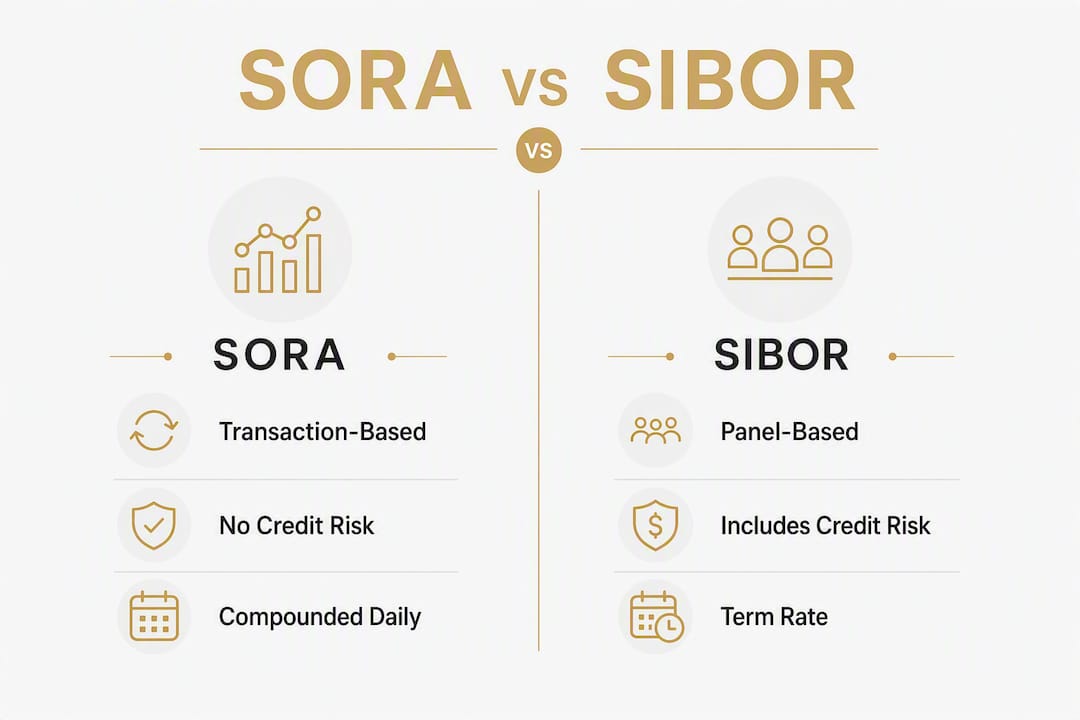
SORA stands for Singapore Overnight Rate Average. MAS defines it as the volume-weighted average rate of borrowing transactions in the unsecured overnight interbank SGD cash market, covering transactions between 8:00 AM and 6:15 PM. MAS computes and publishes the daily SORA figure by 9 AM the following business day. From that daily rate, MAS also calculates and publishes compounded SORA series at 1-month, 3-month, and 6-month tenors, all available on the MAS statistics directory.
SIBOR (Singapore Interbank Offered Rate) worked differently. It was a forward-looking, term-based rate set by a panel of banks submitting their estimated borrowing costs for specific tenors (1-month and 3-month were the most common for home loans). Because it was quote-based rather than transaction-based, SIBOR embedded both term premiums and credit-risk perceptions of the contributing banks. That made it inherently less transparent and more susceptible to the kind of manipulation concerns that prompted global benchmark reforms after 2012.
"ABS recommended SORA as the replacement benchmark because it is underpinned by a deep, liquid overnight market and is computed from actual transactions — producing a more robust and transparent benchmark than the quote-based SIBOR." — ABS microsite
The practical consequence of this difference: SORA carries no term or credit-risk premium by design. Historically, 3-month compounded SORA has tended to run below 1-month and 3-month SIBOR for exactly this reason. That gap is what the adjustment spread was designed to bridge during conversion.
One more thing borrowers should know: if transaction data is insufficient on a given day, MAS uses a contingency production process to compute a Contingency SORA and flags this clearly on the calculation page. Loan documents sometimes reference this contingency language, so it is worth knowing it exists and what triggers it.
How do SORA and SIBOR actually compare for your mortgage?
The differences between these two benchmarks are not just technical. They change how your monthly payment is calculated, how much notice you get before a rate reset, and how exposed you are to sudden rate spikes.

| Dimension | SORA (current standard) | SIBOR (discontinued) |
|---|---|---|
| Calculation method | Transaction-based, volume-weighted average of actual overnight deals | Quote-based, panel bank submissions for term tenors |
| Lookback vs. forward | Backward-looking: effective rate known only after compounding window ends | Forward-looking: rate set at start of period, visible immediately |
| Transparency | High: grounded in real market transactions | Lower: based on estimates, manipulation risk higher |
| Volatility profile | Compounding smooths daily moves over the observation window | Single reset on a specific date; abrupt moves possible |
| Term/credit premium | None (overnight rate only) | Embedded in the quoted rate |
| Typical loan reset | Monthly or quarterly, using 1M or 3M compounded SORA | Monthly or quarterly, using 1M or 3M SIBOR |
| Rate visibility | Rate for a period confirmed after the window closes | Rate known at the start of the interest period |
The lookback feature is the one that surprises most borrowers. With SIBOR, you knew your rate on day one of the interest period. With compounded SORA, the effective rate for a given month is only fully confirmed once the compounding window ends. Banks handle this with an observation shift or a lookback period (typically two to five business days), so your payment can still be calculated in time. But it means you cannot call your bank on the first of the month and get a clean number for the full period ahead.
Pro Tip: Ask your bank specifically what lookback window or observation shift they use. A five-business-day lookback is common, but the exact number affects when your effective rate is locked for each payment cycle. Get this in writing.
The volatility difference is real but often overstated. Because compounded SORA averages daily overnight rates across the entire observation window, a single day's rate spike does not translate directly into a higher payment. SIBOR, by contrast, could jump sharply on a reset date and stay elevated for the full interest period. For borrowers who found SIBOR payments unpredictable, compounded SORA tends to feel smoother in practice.
How SORA-linked and SIBOR-linked home loans work in practice
Both loan types follow the same basic formula: benchmark rate + bank margin = your interest rate. The difference is what sits in the benchmark slot and how it is computed.

For a SIBOR loan, the formula was straightforward:
Monthly interest = (1M or 3M SIBOR + bank margin) × outstanding loan balance / 12
For a SORA loan post-conversion, the formula adds one more component if the loan was converted from SIBOR:
Monthly interest = (3M compounded SORA + bank margin + adjustment spread) × outstanding loan balance / 12
The adjustment spread exists because SORA is structurally lower than SIBOR (no term or credit premium). Without it, borrowers would get an automatic rate reduction at conversion that was not commercially intended. The ABS consumer FAQ explains that the adjustment spread is floored at zero, meaning it cannot make your converted rate higher than the equivalent SIBOR rate at the moment of conversion.
For new SORA loans (not converted from SIBOR), there is no adjustment spread. The formula is simply:
Monthly interest = (3M compounded SORA + bank margin) × outstanding loan balance / 12
For new-launch or BUC (Building Under Construction) loans, the SORA component floats while the bank spread is typically fixed at signing. Market commentary indicates spreads for BUC loans commonly vary depending on loan tier and drawdown profile. Because the outstanding drawn balance during construction is a fraction of the final loan quantum, the early-stage interest cost is lower in absolute dollar terms, but the rate itself still moves with SORA.
Key practical items for borrowers:
- Contingency SORA: — Some loan documents include a fallback clause referencing Contingency SORA. This is the rate MAS publishes when transaction sufficiency conditions are not met. It is rare but worth understanding if you see it in your paperwork.
Pro Tip: Check whether your adjustment spread is fixed for the remaining loan tenure or only applied at the point of transition. A fixed spread gives you certainty; a variable one can shift your all-in rate unexpectedly.
What happened to SIBOR and what were your options?
The transition from SIBOR to SORA was not a sudden change. It followed a multi-year industry process coordinated by MAS and ABS, with clear milestones and borrower protections built in.
The key dates:
- 2021–2022: Industry steering committee established; banks began offering SORA-linked products alongside SIBOR products
- 2023: Banks began proactively offering SORA Conversion Packages to SIBOR borrowers; spot-spread published monthly by ABS Benchmarks Administration Co
- End of 2024: SIBOR officially discontinued as a key benchmark (December 31, 2024)
- February 2025: ABS announced the full completion of the interest-rate benchmark transition
"The SORA Conversion Package was designed to preserve economic equivalence for borrowers: the existing loan margin is retained, and an adjustment spread is added to account for the structural difference between SIBOR and SORA." — ABS consumer FAQ
Borrowers who did not actively choose a package before the deadline were automatically converted. Automatic conversions used a historical-median adjustment spread computed over a multi-year reference period, rather than the spot-spread used during the active transition window. The spot-spread was the average difference between the applicable SIBOR and 3-month compounded SORA over the preceding three months, floored at zero and published monthly by ABS Benchmarks Administration Co.
What borrowers could choose:
- Accept the SCP: Retain existing margin, add adjustment spread, move to 3M compounded SORA. No administrative fee, generally no new lock-in.
- Switch to a prevailing package: Accept a new bank-offered rate (could be SORA-linked with a different margin, or a fixed rate). May carry a new lock-in period.
- Negotiate: Borrowers with strong credit profiles or large loan balances sometimes negotiated margin reductions when switching packages. Lock-in expiry is the best leverage point.
MoneySense notes that the SCP was generally offered with no additional fees and that banks also offered prevailing packages, which may carry lock-ins. The right choice depended on whether the SCP all-in rate (SORA + margin + adjustment spread) was competitive with what the bank's prevailing packages offered at the time.
Worked examples: how monthly payments change under each scenario
These three scenarios use illustrative assumptions. Swap in your own loan balance and current SORA rate to get a rough personal estimate.
Assumptions:
- Outstanding loan balance: S$800,000
- Remaining loan tenor: 20 years
- Bank margin: 0.80% per annum
- 3-month compounded SORA (illustrative): 3.00% per annum
- 1-month SIBOR (illustrative, pre-discontinuation): 3.50% per annum
- Adjustment spread (SCP, floored at zero): 0.30% per annum
- Monthly payment calculated on a simple annualized interest basis for illustration
| Scenario | Benchmark | Margin | Adj. Spread | All-in Rate | Est. Monthly Payment |
|---|---|---|---|---|---|
| A: SIBOR loan (pre-conversion) | 3.50% SIBOR | 0.80% | — | 4.30% | — |
| B: SCP conversion | 3.00% SORA | 0.80% | 0.30% | 4.10% | — |
| C: Prevailing SORA package | 3.00% SORA | 0.80% | — | 3.65% | — |
- Scenario A shows the pre-conversion SIBOR loan. The all-in rate of 4.30% reflects SIBOR's embedded term premium.
- Scenario B is the SCP. The adjustment spread partially offsets the SORA-SIBOR gap, landing at 4.10%. Monthly savings versus Scenario A are modest but real.
- Scenario C is a prevailing SORA package with a lower margin negotiated at conversion. The all-in rate drops to 3.65%, saving roughly S$290 per month versus the old SIBOR loan. The tradeoff: a new lock-in period and a margin that reflects current market conditions rather than your original loan terms.
These figures are illustrative. Actual SORA rates and bank margins change frequently. Always request a formal loan illustration from your bank before making any decision.
Where to track current SORA and how rates have behaved historically
Compounded SORA has historically tended to run below 1-month and 3-month SIBOR. The structural reason is straightforward: SIBOR embedded term and credit-risk premiums that SORA, as a pure overnight rate, does not carry. The adjustment spread in SCP conversions was designed specifically to bridge this gap and preserve economic equivalence for borrowers.
"Historically, 3-month compounded SORA has been lower than 1- and 3-month SIBOR, reflecting the absence of term and credit-risk premia in the overnight rate." — ABS consumer FAQ
On volatility: SIBOR could move sharply on a reset date and stay at that level for the full interest period. Compounded SORA smooths this because it averages daily overnight rates across the entire compounding window. A single-day spike in the overnight market shows up as a fraction of the compounded rate, not the full rate. For borrowers who experienced the 2022–2023 rate-hike cycle on a SIBOR loan, the difference in payment smoothness was noticeable.
Where to find live SORA:
- Daily SORA: MAS SORA page, published by 9 AM each business day
- 1-month, 3-month, and 6-month compounded SORA: MAS statistics directory
Bookmark both. The compounded series on the statistics directory is what your bank uses to calculate your monthly payment, not the daily overnight rate.
What to ask your bank before accepting any SORA loan offer
Most borrowers spend more time choosing a coffee machine than reviewing their loan terms. These are the questions that actually move the needle.
Checklist before signing or accepting any conversion:
- Has my loan already been converted, and if so, on what date and to which package?
- What is the adjustment spread on my converted loan, and is it fixed for the remaining tenure?
- What lookback window or observation shift does the bank use for compounded SORA?
- What is the reset frequency (monthly, quarterly)?
- Are there any floors or caps on the benchmark rate in my loan agreement?
- What are the lock-in period and early-exit fees for this package?
- Does the loan document include contingency SORA language, and what triggers it?
- If I switch to a prevailing package, will my existing margin change?
"Borrowers should compare the all-in rate (compounded SORA + margin + adjustment spread) across packages, not just the headline SORA figure, since margins and spreads vary significantly between offers." — MoneySense
Red flags to watch for:
- An adjustment spread that is described as variable or reviewable after conversion (it should be fixed)
- A new lock-in period attached to an SCP conversion (standard SCP conversions carry no new lock-in)
- Vague language about the compounding method or observation window
- A prevailing package with a significantly higher margin than your original loan, presented as a "better" deal because the headline SORA rate is lower
Understanding LTV limits in Singapore also matters here. If you are refinancing or converting and your property value has changed, the LTV cap (75% for first property, lower for subsequent loans) affects how much you can borrow and whether you need to top up cash. Factor this into any refinancing calculation alongside the rate comparison.
Key Takeaways
SORA replaced SIBOR as Singapore's primary SGD floating-rate benchmark for home loans, with SIBOR discontinued on December 31, 2024, and borrowers converted to SORA-linked packages either by choice or automatically.
| Point | Details |
|---|---|
| SIBOR is gone | SIBOR was discontinued December 31, 2024; all retail home loans are now SORA-linked or fixed-rate. |
| SCP preserves your margin | The SORA Conversion Package retains your existing bank margin and adds an adjustment spread floored at zero. |
| Adjustment spread type matters | Spot-spread (active transition) and historical-median spread (automatic conversion) produce different values; confirm which applies to your loan. |
| Check the all-in rate | Compare compounded SORA + margin + adjustment spread across packages, not just the benchmark rate alone. |
| Immediate next step | Contact your bank with the checklist questions above, or request a formal loan illustration if you received multiple offers. |
A practical perspective on navigating SORA for different borrower types
The mechanics of SORA are clear enough once you understand the compounding logic. What is less obvious is how the right move differs depending on where you are in your property journey.
For owner-occupiers who were converted automatically: The automatic conversion to a historical-median adjustment spread is not necessarily a bad deal, but it deserves a second look. If your all-in rate (SORA + margin + adjustment spread) is materially higher than what prevailing packages offer, the lock-in expiry date is your negotiation window. Banks are generally willing to reprice at lock-in expiry without fees. Do not wait for the bank to call you.
For property investors managing cashflow across multiple loans: The LTV rules for a second property in Singapore are stricter, with the LTV limit dropping to 45% for borrowers with an existing housing loan. That constraint affects how much of your financing is floating-rate SORA exposure versus fixed. If you are carrying two SORA-linked loans simultaneously, consider whether fixing one reduces your aggregate rate risk during periods of SORA volatility. Tracking Singapore property market trends alongside rate movements helps you time refinancing decisions more precisely.
For new-launch buyers at One Marina Gardens or similar BUC projects: The SORA component of your construction-stage loan floats from drawdown, but the bank spread is fixed at signing. The effective interest cost during construction is lower in dollar terms because only the drawn portion accrues interest. The critical decision point is what happens at TOP: your lock-in may expire around the same time, giving you a clean window to refinance to a prevailing package or fix your rate. Plan for this 12–18 months ahead, not at the last minute.
Pro Tip: If your lock-in expiry falls within six months of your project's expected TOP, start comparing packages early. Banks often offer better margins to borrowers who approach them before the lock-in expires, not after.
One practical note on fixed vs. floating: a fixed-rate package removes SORA exposure entirely for the fixed period, but the fixed rate itself is priced off swap rates that already reflect market expectations of future SORA. You are not escaping rate risk; you are paying a premium to know your payment in advance. Whether that premium is worth it depends on your cashflow tolerance, not on a prediction about where SORA goes next.
Authoritative sources and where to read more
The figures and mechanics in this article draw from official MAS and ABS publications. These are the primary sources worth bookmarking:
Official MAS and ABS resources for Singapore borrowers:
- MAS SORA page — daily SORA definition, calculation methodology, and contingency procedures
- MAS statistics directory — live 1-month, 3-month, and 6-month compounded SORA series
- ABS SIBOR-to-SORA consumer FAQ — adjustment spread mechanics, SCP structure, and conversion options
- ABS SOR & SIBOR to SORA microsite — official transition timeline and industry milestones
- MoneySense: Switching to SORA — plain-language consumer guide to conversion options and borrower choices
- MAS LTV limits explainer — current LTV rules for first and subsequent properties
The ABS consumer FAQ is the single most useful document for borrowers who want to verify adjustment-spread calculations or understand exactly what their bank was required to offer. The MoneySense guide is the best starting point for anyone who finds the ABS materials too technical.

If you are evaluating a new-launch purchase and want to understand how SORA-linked financing fits your budget, One Marina Gardens offers 1- to 4-bedroom units in District 01 with direct access to Marina South MRT. Review the project fact sheet for unit mix and financing assumptions, or book a showflat appointment to discuss how current SORA rates affect your monthly commitment across different unit sizes.