
The Progressive Payment Scheme (PPS) is Singapore's legally mandated payment framework for new-launch private residential properties sold while still under construction. Under the Housing Developers Rules (Third Schedule), payments are released in certified tranches tied to specific construction milestones — not in one lump sum at signing.
Here is the full statutory schedule at a glance:
- A booking fee paid on the Option to Purchase (OTP)
- The balance due at Sale & Purchase Agreement (S&P) signing, completing the 15% total downpayment
- A payment stage triggered by foundation completion
- A payment stage triggered by completion of reinforced concrete framework
- A payment stage triggered by completion of partition walls
- A payment stage triggered by completion of ceiling and roofing
- A payment stage triggered by completion of electrical wiring, plumbing, and gas pipes
- A payment stage triggered by completion of carparks, roads, and drains
- A significant tranche payable upon Temporary Occupation Permit (TOP) issuance
- The final payment stage at Certificate of Statutory Completion (CSC) issuance
Total: 100% of the purchase price, paid across ten certified stages. One Marina Gardens, a new-launch development in District 01 by Kingsford Marina Development, follows this same statutory schedule for all its units.
Table of Contents
- What does the progressive payment scheme actually cover?
- The stage-by-stage payment schedule you need to know
- How bank loans disburse during construction and what happens at TOP
- How to fund each stage and what other costs to budget for
- Why PPS protects you — and the risks that still catch buyers out
- Worked example: what a S$1,500,000 unit actually costs at each stage
- Your pre-commitment checklist and questions to ask
- Key Takeaways
- What buyers consistently underestimate about the PPS
- One Marina Gardens and how the sales team can help you plan
- Authoritative sources and tools to verify the rules
What does the progressive payment scheme actually cover?
The PPS applies exclusively to new-launch private residential developments classified as Buildings Under Construction (BUC). The Housing Developers Rules (Cap. 130) make this schedule mandatory for all licensed developers selling uncompleted residential units. You cannot negotiate the milestone percentages, and no licensed developer can legally deviate from them.
What PPS does NOT cover:
- Completed resale condominiums (you pay the full price on completion of the sale)
- HDB flats, which follow a separate HDB payment framework
- Commercial or industrial properties
One important edge case: if you buy a unit after the project has already launched and construction has progressed, you may face multiple simultaneous tranche calls to catch up to the current construction stage. That can mean a significant cash outlay in a short window, so timing your purchase matters.
Key terms you will see in payment notices:
- OTP — Option to Purchase, the booking document you sign and pay 5% to secure the unit
- S&P — Sale & Purchase Agreement, signed within 3–4 weeks of OTP
- TOP — Temporary Occupation Permit, issued by the Building and Construction Authority when the building is substantially complete and safe to occupy
- CSC — Certificate of Statutory Completion, the final sign-off confirming full compliance with building regulations
- Licensed Architect certification — the developer's architect must certify each construction milestone before a payment notice can legally be issued
- Payment notice — the formal written demand from the developer triggering your obligation to pay within the specified window
The stage-by-stage payment schedule you need to know
Each payment is triggered when the developer's Licensed Architect certifies that the relevant construction milestone is complete. Only after that certification can the developer legally issue a payment notice. The table below shows every stage, its trigger, and the typical funding source.

| Stage | % | Trigger event | Typical funding source |
|---|---|---|---|
| OTP (booking) | 5% | Signing of Option to Purchase | Cash only |
| S&P balance | 10% | Signing of Sale & Purchase Agreement | Cash + CPF OA |
| Foundation | 10% | Licensed Architect certifies foundation complete | Bank loan drawdown |
| Reinforced concrete | 10% | Licensed Architect certifies RC framework complete | Bank loan drawdown |
| Partition walls | 5% | Licensed Architect certifies partition walls complete | Bank loan drawdown |
| Ceiling / roofing | 5% | Licensed Architect certifies ceiling/roofing complete | Bank loan drawdown |
| Electrical / plumbing | 5% | Licensed Architect certifies M&E works complete | Bank loan drawdown |
| Carparks / roads / drains | 5% | Licensed Architect certifies external works complete | Bank loan drawdown |
| TOP | 25% | Temporary Occupation Permit issued | Bank loan drawdown |
| CSC | 15% | Certificate of Statutory Completion issued | Bank loan drawdown |
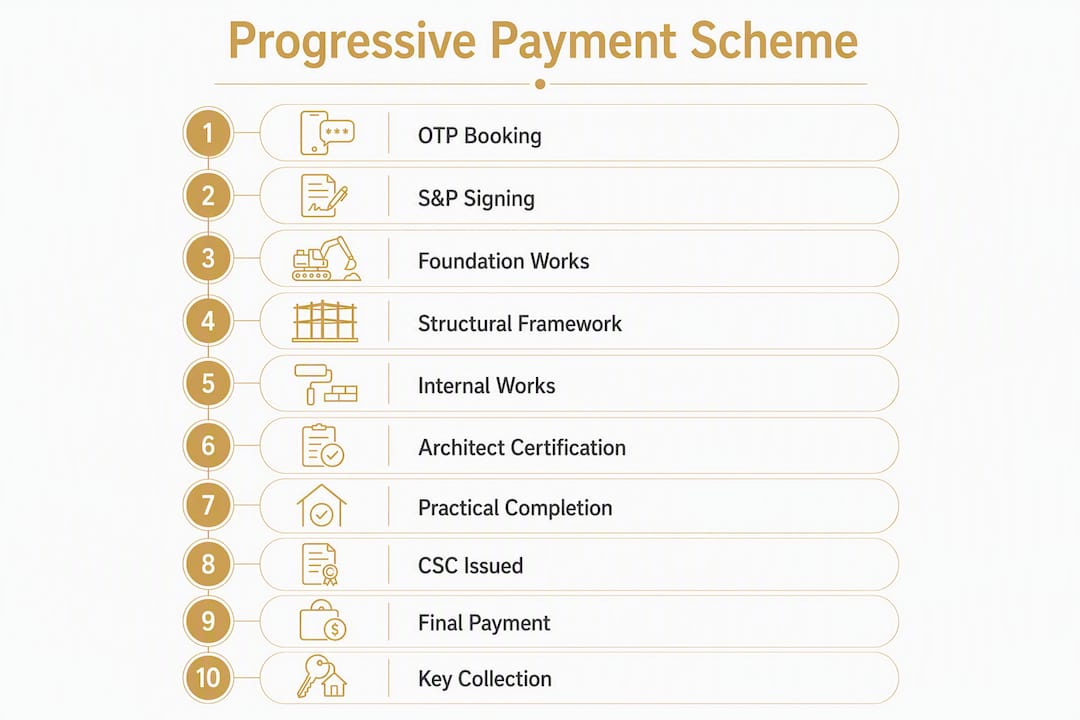
The payment window after each notice is commonly 14 days. Miss it, and the S&P typically imposes late interest charges.
Pro Tip: Share the developer's expected construction timeline with your conveyancing lawyer before you sign the S&P. Your lawyer can flag the approximate dates for each tranche and coordinate with your bank so loan drawdowns are ready before each notice arrives — not after.
How bank loans disburse during construction and what happens at TOP
Banks do not hand over the full approved loan amount when you sign the S&P. Instead, they disburse funds progressively, matching each certified construction milestone. This is the core mechanic of BUC progressive payment from a financing perspective.
During the construction phase, your monthly repayment is calculated only on the portion of the loan already drawn down. That means early repayments are lower than your eventual full mortgage payment. Most banks structure this as interest-only or reduced-instalment payments on the drawn portion, with the remaining loan balance still sitting undrawn.
The repayment jump at TOP catches many buyers off guard. Here is why it happens:
- At TOP, the developer calls the largest single tranche: 25% of the purchase price
- The bank draws down a substantial portion of the remaining loan to fund that payment
- Your outstanding loan balance rises sharply, and your monthly repayment converts to a full amortizing schedule on the total drawn amount
- The CSC tranche (15%) follows, drawing the final loan portion and completing the drawdown
One practical note: you still need to qualify for the full loan amount upfront, even though disbursement is gradual. The bank assesses your Total Debt Servicing Ratio (TDSR) based on the complete loan, not just the early drawn portions. MAS sets the TDSR framework at 55% of gross monthly income for property loans.
Stress-test your affordability before you commit. Run the numbers at the full post-TOP monthly repayment, not the lower interest-only figure during construction. A S$1.5M unit with a 75% loan at a 4% interest rate over 25 years produces a full monthly repayment well above the interest-only amount during the early construction stages. If that full figure strains your TDSR, the lower early repayments are not a safety net — they are a temporary condition.
How to fund each stage and what other costs to budget for
The 5% OTP payment must be in cash. No CPF, no bank loan. That is the non-negotiable starting point for every new-launch purchase.

The S&P balance (the remaining 10% to reach the 15% total downpayment) can be funded from cash, CPF Ordinary Account (OA) savings, or a combination of both. Bank loan drawdowns typically begin from the foundation stage onward, covering the construction tranches and the large TOP and CSC payments.
Stamp duty timing is a separate cash obligation. Buyer's Stamp Duty (BSD) and Additional Buyer's Stamp Duty (ABSD) are both payable within 14 days of signing the S&P. They sit outside the PPS schedule entirely. CPF may reimburse BSD later if approved, but you need the cash available on day one.
Full cost checklist before you sign:
- OTP cash (5%): payable immediately on booking, no exceptions
- S&P balance (10%): due within 3–4 weeks of OTP, cash and/or CPF OA
- BSD: payable within 14 days of S&P; calculated on the purchase price per IRAS tiered rates
- ABSD: payable within 14 days of S&P if applicable (Singapore PRs buying a second property, foreigners, etc.)
- Legal / conveyancing fees: typically S$2,500–S$3,500 for a private residential purchase, payable at S&P stage
- Valuation and loan processing fees: varies by bank; confirm before signing
- Contingency buffer: set aside cash for simultaneous tranche calls if you buy mid-construction, or for CPF reimbursement delays
Why PPS protects you — and the risks that still catch buyers out
The scheme's core protection is the Licensed Architect certification requirement. Developers cannot legally call a payment for a stage that has not been independently certified as complete. That means your money tracks real, verified construction progress rather than a developer's self-reported timeline.
Additional buyer protections include the statutory schedule itself: because the percentages are fixed by law, no licensed developer can front-load payments or demand more than the prescribed tranche at any stage.
The risks that matter in practice:
- The TOP repayment jump: monthly repayments increase sharply when the 25% TOP tranche is drawn. Many buyers budget for the construction-phase repayments and are surprised by the post-TOP figure.
- CPF timing mismatches: CPF OA funds can only be used after the property's valuation is confirmed and CPF Board approves the withdrawal. If your CPF application is delayed, you may need to bridge with cash.
- Late payment penalties: the S&P specifies the interest rate on overdue payments. Missing a 14-day window is expensive.
- Developer delays: construction can run behind schedule, which delays TOP and the CSC. That affects your move-in timeline but does not change your payment obligations once each milestone is certified.
Red flags to watch for:
- Any suggestion from a developer or agent to defer or restructure a statutory tranche — this is non-compliant with the Housing Developers Rules
- Payment notices that lack a Licensed Architect certification reference
- Unusually generous-sounding "deferred payment" or "interest-free" schemes that appear to replace the statutory schedule rather than supplement it
Some developers offer Interest Absorption Schemes (IAS), where the developer absorbs the interest on your drawn loan during construction. IAS is separate from the statutory PPS schedule and may carry an embedded price premium. Always ask for the IAS terms in writing and factor any price uplift into your long-term yield calculation before treating it as a straightforward saving.
Pro Tip: Any deviation from the statutory schedule is a legal red flag, not a buyer benefit. If a sales representative suggests you can skip or delay a tranche, ask for that in writing and run it past your conveyancing lawyer immediately.
Worked example: what a S$1,500,000 unit actually costs at each stage
The table below applies the statutory percentages to a S$1,500,000 purchase price and shows the likely funding source at each stage.
| Stage | % | Amount (S$) | Likely funding source |
|---|---|---|---|
| OTP (booking) | 5% | S$75,000 | Cash |
| S&P balance | 10% | S$150,000 | Cash + CPF OA |
| Foundation | 10% | S$150,000 | Bank loan drawdown |
| Reinforced concrete | 10% | S$150,000 | Bank loan drawdown |
| Partition walls | 5% | S$75,000 | Bank loan drawdown |
| Ceiling / roofing | 5% | S$75,000 | Bank loan drawdown |
| Electrical / plumbing | 5% | S$75,000 | Bank loan drawdown |
| Carparks / roads / drains | 5% | S$75,000 | Bank loan drawdown |
| TOP | 25% | S$375,000 | Bank loan drawdown |
| CSC | 15% | S$225,000 | Bank loan drawdown |
| Total | 100% | S$1,500,000 |
Early cash requirement before loan drawdown begins:
- At OTP: S$75,000 in cash (5%)
- At S&P: S$150,000 in cash and/or CPF OA (remaining 10% to reach the 15% downpayment)
- Total before the bank pays anything: S$225,000
That S$225,000 figure does not include BSD, ABSD (if applicable), or legal fees. For a first-time Singapore citizen buyer, BSD alone on a S$1.5M property runs into tens of thousands of dollars under the IRAS tiered rates — payable within 14 days of S&P.
Scaling to a different price: multiply any percentage by your purchase price. At S$2M, the OTP cash requirement is S$100,000 and the pre-loan total is S$300,000. The proportions stay fixed; only the absolute amounts change.
Estimating your post-TOP monthly repayment: take your total loan amount (typically 75% of purchase price for a first residential property, subject to LTV limits and TDSR), apply your bank's interest rate over the remaining loan tenure, and calculate the full amortizing monthly instalment. That figure — not the interest-only amount during construction — is what you need to be able to service comfortably after TOP.
Your pre-commitment checklist and questions to ask
Work through these steps before you sign the OTP.
- Secure an In-Principle Approval (IPA) from your bank. Confirm the loan quantum, interest rate, and that the bank handles progressive BUC disbursements. Not all bank products are structured identically for BUC loans.
- Check your CPF OA balance and the property's valuation limit. CPF withdrawals for property are capped at the lower of the purchase price or the property's CPF-assessed valuation. Confirm this with CPF Board before relying on a specific CPF amount.
- Set aside cash for BSD and ABSD. Calculate your stamp duty liability using the IRAS rates before signing. This cash must be available within 14 days of S&P.
- Engage a conveyancing lawyer before OTP. Your lawyer reviews the S&P, confirms the payment schedule matches the statutory schedule, and coordinates with your bank on drawdown timing.
- Confirm your bank's progressive drawdown process. Ask specifically: how quickly can the bank disburse after a payment notice is received? Some banks need 5–7 working days; if your payment window is 14 days, that leaves little margin.
- Stress-test your post-TOP repayment. Calculate the full monthly instalment on your total loan at the bank's prevailing rate. If that figure is uncomfortable today, it will not become more comfortable after TOP.
- Build a cash buffer for simultaneous tranche calls. If you are buying a unit mid-construction, multiple stages may be called at once to bring you current with the construction progress.
Questions to ask the developer's sales team:
- Can you confirm the payment schedule follows the statutory Housing Developers Rules Third Schedule exactly?
- How does the Licensed Architect certification process work, and will I receive a copy of each certification with my payment notice?
- What is the expected construction timeline and projected TOP date?
Questions to ask your bank:
- How many working days does your bank need to process a progressive drawdown after receiving a payment notice?
- How are monthly repayments calculated during the drawdown phase, and when does the full amortizing schedule begin?
Questions to ask your conveyancing lawyer:
- Does the S&P match the statutory schedule exactly, with no deviations?
- What is the late payment interest rate specified in the S&P?
- How will you coordinate with my bank to confirm drawdown readiness before each notice window closes?
Key Takeaways
The progressive payment scheme is a statutory, milestone-linked framework — not a negotiable arrangement — and your biggest financial exposure comes at TOP, when the 25% tranche triggers the jump to full mortgage repayments.
| Point | Details |
|---|---|
| Statutory schedule is fixed | Ten prescribed tranches from 5% OTP to 15% CSC; no licensed developer can alter the percentages. |
| Early cash requirement | A S$1,500,000 unit requires S$225,000 in cash and CPF before any bank loan drawdown begins. |
| Stamp duty is separate | BSD and ABSD are payable within 14 days of S&P and sit outside the PPS schedule entirely. |
| Stress-test at full repayment | Always calculate affordability at the full post-TOP mortgage instalment, not the lower construction-phase figure. |
| One Marina Gardens follows statutory PPS | One Marina Gardens units are sold under the standard Housing Developers Rules schedule; the sales team can provide unit-specific payment timelines. |
What buyers consistently underestimate about the PPS
The statutory schedule is genuinely buyer-protective. The Licensed Architect certification requirement means your money cannot be called for work that has not been independently verified as complete. That is a meaningful safeguard in a market where construction projects can span three to five years.
What the scheme does not protect you from is your own cashflow planning. The buyers who run into trouble are rarely surprised by the schedule itself — they are surprised by the cumulative cash demand in the first eight weeks (OTP plus S&P plus stamp duties), and then again at TOP when the monthly repayment steps up. Treating the lower construction-phase repayments as your real mortgage cost is the single most common planning error.
The IAS question deserves more scrutiny than most buyers give it. An Interest Absorption Scheme can look like a free benefit, but developers typically price the absorption into the unit cost. The right question is not "does this scheme save me interest?" but "what is the all-in cost of this unit versus a comparable one without IAS, and does the difference justify the arrangement?" That calculation rarely appears in sales materials.
For buyers considering One Marina Gardens or any new-launch development, the PPS is the framework — the planning work is yours to do. Run the full post-TOP repayment numbers, confirm your CPF position, and have your lawyer review the S&P before the OTP clock starts.
One Marina Gardens and how the sales team can help you plan
One Marina Gardens, developed by Kingsford Marina Development in District 01, follows the statutory progressive payment schedule for all its 937 units. What that means practically: you get a predictable, legally prescribed payment timeline from the moment you sign the OTP through to CSC, with no surprises from non-standard developer arrangements.
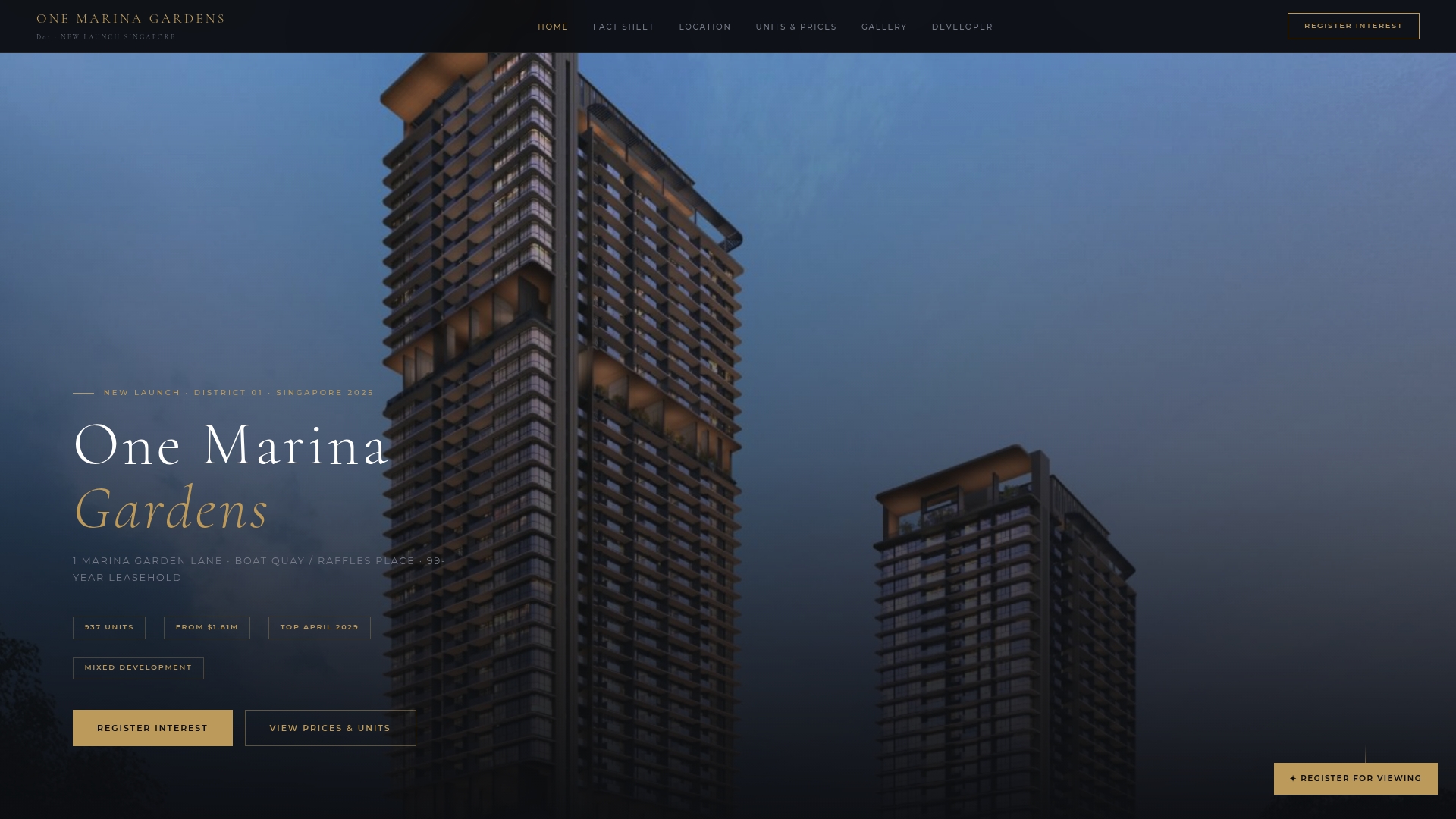
The sales team can provide a unit-specific payment timeline showing projected tranche dates based on the current construction schedule, sample payment notices so you know exactly what to expect in your mailbox, and introductions to financing partners familiar with BUC loan structures. Whether you are buying a 1-bedroom apartment or a 4-bedroom home with Marina Bay views, the team works alongside your conveyancing lawyer and bank to make sure each milestone payment is coordinated well before the 14-day window closes.
View unit layouts and pricing to see which configurations fit your budget, or browse the gallery for artist impressions and development photos. When you are ready to discuss a unit-specific payment schedule, book a showflat appointment directly through the project page at onemarinagardens.info.
This article provides general information about Singapore's Progressive Payment Scheme and is not financial, legal, or tax advice. Confirm current rules, stamp duty rates, and CPF eligibility with IRAS, CPF Board, and a qualified conveyancing lawyer before committing to a purchase.
Authoritative sources and tools to verify the rules
- URA: Housing developers — URA's developer rules page, including guidance on the progressive payment schedule
- IRAS: Buyer's Stamp Duty (BSD) — current BSD rates and calculation guidance
- IRAS: Additional Buyer's Stamp Duty (ABSD) — ABSD rates by buyer profile and residency status
- MAS: TDSR for property loans — how the Total Debt Servicing Ratio is calculated and applied to property loans
- DBS: Buying property under construction — practical guide on BUC loan drawdown, repayment shapes, and cashflow implications
- CPF Board — CPF OA usage rules, withdrawal limits, and property purchase procedures
- IRAS: Stamp duty for property — general stamp duty portal with calculators for BSD and ABSD