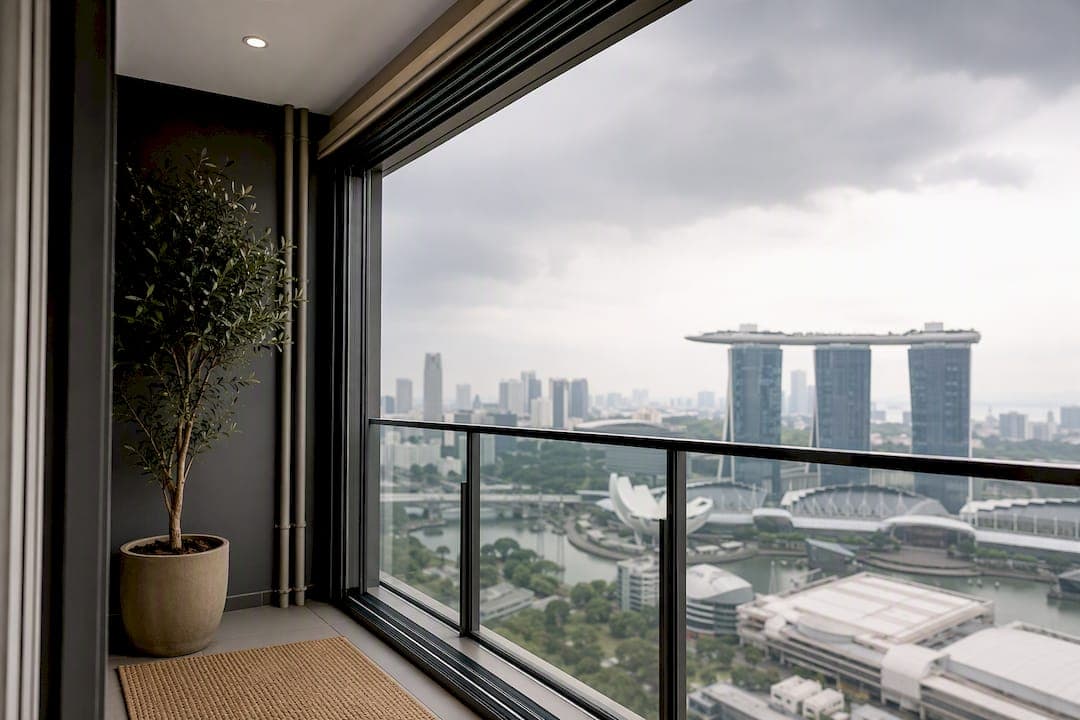
You cannot permanently enclose a condo balcony in Singapore. Retractable screens or blinds are the compliant path, and only if they preserve airflow and carry written approval from your Management Corporation Strata Title (MCST). Three authorities govern what happens on that stretch of tile outside your sliding doors: the Urban Redevelopment Authority (URA) sets the planning and design limits, the Building and Construction Authority (BCA) polices structural safety, and your MCST enforces the by-laws that translate those rules into daily estate life.
Here's the quick version before you touch a drill or call a contractor:
- Allowed: retractable zip blinds or screens that fold away completely and keep the balcony ventilated.
- Prohibited: fixed glazing, glass curtains, or any enclosure that turns the balcony into an air-conditioned room.
- Do first: pull your MCST's current by-laws and submit a written application before ordering materials or booking an installer.
URA requires a continuous perimeter opening of at least 40% on every balcony, and balcony gross floor area is capped at a limited proportion of a unit's internal net size. Miss that opening requirement and even a "temporary" install can be treated as an illegal enclosure.
Key Takeaways
Compliant balcony use in Singapore condos comes down to one formula: retractable, ventilated, and MCST-approved in writing before any work begins.
| Point | Details |
|---|---|
| No permanent enclosures | URA prohibits fixed glazing; retractable screens preserving the 40% perimeter opening are the compliant alternative. |
| MCST approval is mandatory | Written approval under BMSMA is required before modifying a balcony, regardless of what an installer claims is standard. |
| Fabric openness matters | Suppliers commonly use a 1% to 5% openness range to balance airflow with approval odds. |
| Barbecues are almost always banned | Fire safety concerns drive near universal bans on open flames; electric grills and communal pits are the standard workaround. |
| Non-compliance has real consequences | MCSTs can order removal at owner cost, and disputes can escalate to the Strata Titles Board or courts, as seen in the Hawaii Tower case. |
Table of Contents
- Who Actually Regulates Condo Balcony Rules?
- Which Balcony Modifications Are Allowed and Which Are Prohibited?
- What Documents Do You Need for MCST Balcony Approval?
- Why Do Condos Ban Barbecues and Open Flames on Balconies?
- What Happens If You Don't Get Approval for Balcony Work?
- What the Rules Actually Reward, and What Most Guides Get Wrong
- Sources
- FAQ
Who Actually Regulates Condo Balcony Rules?
Three agencies split responsibility for condo balcony rules, and confusing their roles is the most common reason owners submit the wrong paperwork to the wrong party.
URA sets the design envelope at the planning stage. Its Development Control Handbook for residential flats and condominiums spells out exactly how a balcony can be shaped and used before a single unit is sold. Under current guidelines, balcony gross floor area (GFA) can be computed above the Master Plan gross plot ratio, but only up to a 7% cap based on proposed residential GFA, with each unit's balcony capped at 15% of its internal net area. That 40% continuous perimeter opening isn't a suggestion. It's the mechanism URA uses to stop developers, and later owners, from quietly converting semi-outdoor space into enclosed floor area without paying for it through the normal channels.
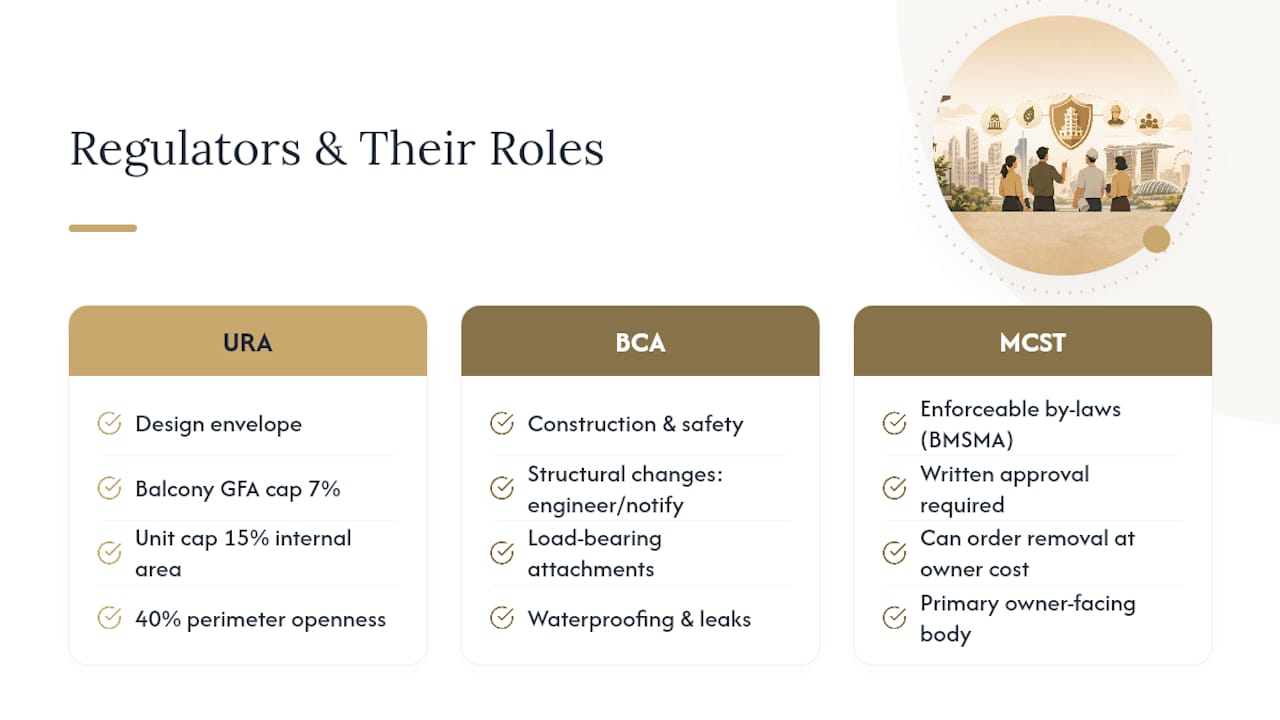
BCA steps in once a balcony becomes a construction question rather than a planning one. If a proposed modification changes structural loading, attaches hardware to load-bearing elements, or affects waterproofing, BCA guidance requires a professional engineer's input or formal notification before work proceeds. Approval from your MCST does not substitute for statutory building-control compliance. A rejected AC condenser bracket, a sagging planter box, or a botched flooring overlay that lets water seep into the unit below are all BCA territory, not just an MCST housekeeping matter.
MCST is where most owners actually experience these rules. Under the Building Maintenance and Strata Management Act (BMSMA), your MCST's by-laws carry legal force. Owners must obtain written approval before modifying a balcony, and an MCST can lawfully order the removal of unauthorized work at the owner's own cost. This is the layer most people underestimate: an installer telling you "this is standard, everyone does it" carries zero legal weight against a by-law that says otherwise.
SCDF's role is narrower but decisive for anything involving heat or flame. Fire safety guidance from the Singapore Civil Defence Force underpins most MCST bans on barbecues, fire pits, and open-flame cooking on private balconies, because unenclosed flames near combustible facade materials and shared corridors create a risk that spreads well beyond one unit.
The mistake most new owners make is treating MCST approval as a formality that rubber stamps whatever a contractor recommends. It isn't. MCST approval is a legal gate that sits on top of URA's design rules and BCA's safety rules, and clearing one does not automatically clear the others.
Understanding which authority governs which question saves you from the classic sequence: buy the blinds, hire the installer, get halfway through the job, then discover the fabric openness percentage or the mounting bracket violates a by-law nobody checked.
Which Balcony Modifications Are Allowed and Which Are Prohibited?
Not every balcony change carries the same risk. Some installations sail through MCST review in a week; others get rejected outright, no matter how nicely they're finished. Here's how the common ones typically shake out.
- Retractable zip-track blinds. These are the most commonly approved balcony modification in Singapore condos, and for good reason: a fully retractable screen preserves the 40% perimeter opening when it's pulled back, satisfies URA's ventilation requirement, and doesn't alter the building's permanent facade. Suppliers generally recommend a fabric openness range of 1% to 5%, tight enough to block wind and rain, open enough to avoid looking like glazing. MCSTs typically control track color and mounting location to keep facades consistent across the estate.
- Fixed glazing and permanent glass enclosures. This is where most disputes originate. A glass curtain wall or a sliding glazed system that seals the balcony year round reads as a permanent enclosure under URA rules and gets rejected by most MCSTs before it reaches the design-review stage.
- Grilles and safety rail modifications. Adding a grille for child safety or pet containment usually needs MCST sign-off, and depending on how it attaches to the parapet, may trigger a structural review.
- AC condensers and heavy fittings. Mounting a condenser unit on a balcony wall or floor almost always needs MCST approval plus a check on whether the load and vibration require a professional engineer letter, particularly on older facades.
- Flooring and finish changes. Overlay tiles, decking, or artificial turf change both appearance and waterproofing performance, so MCSTs commonly regulate finishes even when the work looks cosmetic.
- Barbecues and open flames. Nearly every MCST bans them outright on private balconies, a rule reinforced by fire safety concerns around smoke, heat, and blocked escape routes.
Pro Tip: *Before you commission any drawings, ask your installer for their fabric openness percentage in writing.
What Documents Do You Need for MCST Balcony Approval?
Getting balcony work approved is less about persuasion and more about paperwork. MCSTs reject applications far more often for missing documentation than for the modification itself being unreasonable.
Before you submit anything:
- Request the current version of your MCST's by-laws. These get updated, and an approval process from three years ago may no longer reflect current facade standards.
- Measure and photograph your balcony as it stands, including the parapet height and any existing fixtures.
- Check whether your estate has a published facade standard, common in newer developments, that dictates approved blind colors, track finishes, or screen types.
Assemble your documentation package:
- Elevation drawings showing the modification from the building's exterior view.
- Product specifications and, where possible, a physical fabric or material sample.
- Proof of contractor insurance, which most MCST management offices now require before granting site access.
- A professional engineer's letter if the work touches structural elements or adds meaningful load.
- A proposed installer schedule and, in some estates, a refundable deposit against damage to common property.
During submission and review, expect a response window that varies by estate, often several weeks rather than days. Follow up in writing rather than by phone so there's a paper trail if a dispute arises later. The most common reasons applications stall are incomplete drawings, missing insurance certificates, and fabric or color choices that don't match the estate's facade standard.
Once you have approval, treat the letter as a permanent document. Keep it with your unit's title documents, not just in an email folder. Retain product warranties and installation drawings too. If you sell the unit later, a buyer's lawyer will likely ask for exactly this paperwork, and a missing approval letter can hold up a transaction or trigger a fresh compliance review by the incoming owner's MCST.
Why Do Condos Ban Barbecues and Open Flames on Balconies?
Fire safety, not aesthetics, drives the near-universal ban on balcony barbecues in Singapore condos. Open flames on a private balcony sit close to combustible facade materials, shared corridors, and neighboring units, and a grease fire or tipped-over grill can spread faster than most owners assume in a high-rise setting.
- SCDF guidance around fire risk and emergency access underpins most MCST decisions to prohibit open flames and fire pits on private balconies.
- Smoke and odor complaints from neighboring units are the most frequent trigger for enforcement action, even before any safety incident occurs.
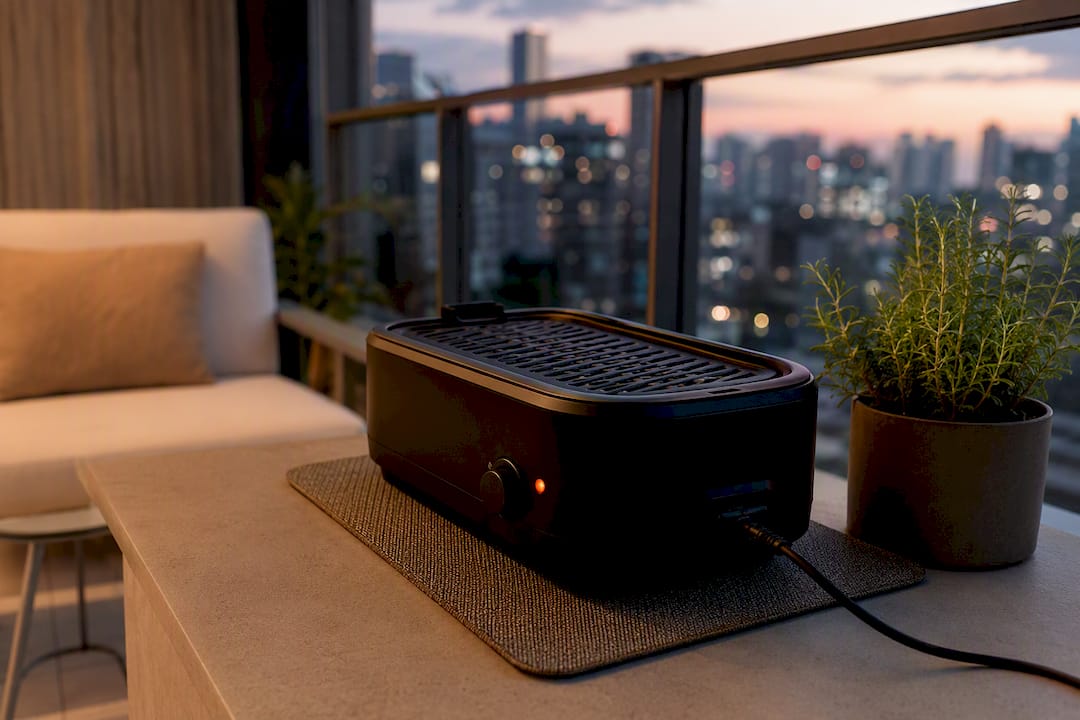
- Electric grills and induction cooktops are the go-to substitute; they deliver the outdoor cooking experience without an open flame or the fuel storage problem that comes with gas canisters.
- Most estates operate a communal barbecue pit precisely so residents have a legitimate outlet, and booking one for a birthday or gathering typically just requires reserving the facility through the management office.
If you're planning a larger event that seems to need more than the communal pit allows, ask your MCST directly rather than assuming the answer is no. Some estates will grant one off exceptions for supervised, contained setups; almost none will tolerate an unauthorized grill discovered after a smoke complaint.
What Happens If You Don't Get Approval for Balcony Work?
Skipping MCST approval doesn't just risk a stern letter. It exposes you to a documented enforcement process and, in disputed cases, court intervention that has already set real precedent in Singapore.
- The typical sequence starts with a warning letter, escalates to a formal notice demanding removal or restoration, and can end with the MCST recovering removal costs directly from the owner.
- Owners who dispute an MCST decision, or who believe an MCST is enforcing unevenly, can escalate to the Strata Titles Board, which handles disputes over by-law interpretation and enforcement.
- Unresolved disputes occasionally reach the courts, where judges weigh both structural integrity and the modification's effect on the building's external appearance.
The clearest illustration is the Hawaii Tower case, where the court applied what amounts to a permanence test: how fixed is the alteration, and how much does it change the unit's appearance relative to the original facade and the estate as a whole. That reasoning now shapes how MCSTs across Singapore evaluate borderline cases, from semi-permanent screens to structural balcony extensions.
Courts have shown they will compare an altered facade against both the original unit design and the surrounding estate. A modification that looks harmless to the owner can still fail that comparison if it stands out against every other unit on the same stack.
If you receive a notice, respond in writing quickly, request the specific by-law being cited, and ask whether a modified version of your installation, rather than full removal, might satisfy the concern. MCSTs often prefer a negotiated fix over a costly enforcement process.
A Quick Compliance Checklist Before You Buy, Hire, or Install
- Before you buy: ask the seller or agent whether the balcony has prior modifications, and request copies of any MCST approval letters on file.
- Before you hire: confirm the installer carries valid contractor insurance, ask for the fabric openness percentage in writing, and request elevation drawings before signing.
- During installation: photograph the work in progress and test that any retractable system actually retracts fully, not just partway.
- After installation: store the approval letter, warranty documents, and drawings together, ideally digitally and on paper, since you'll need them again at resale.
Pro Tip: Ask sellers specifically whether balcony blinds or screens were self-installed or professionally fitted with MCST sign-off. A self-installed system without paperwork becomes your liability the moment you take ownership, even if the previous owner never had a problem.
How a Development Like One Marina Gardens Approaches Balcony Standards
Premium developments increasingly set facade standards at launch, instead of leaving every balcony decision to individual owners years later. At Onemarinagardens, located in District 01 just 160 meters from Marina South MRT, buyers can review balcony dimensions and layout details directly through the development's fact sheet before purchase, alongside imagery of facade treatment and sky terrace design in the project gallery.
- Residents typically direct by-law and renovation questions to the estate's management office once the MCST is formed.
- Prospective buyers evaluating any development, not only this one, should request any published facade standards and past renovation approval records during due diligence.
- A development with clear specs published upfront, like the One Marina Gardens fact sheet, gives buyers a head start on understanding what balcony flexibility looks like before the MCST's own by-laws are even drafted.
What the Rules Actually Reward, and What Most Guides Get Wrong
Most advice on condo balcony rules treats MCST approval as paperwork to get through. The research says otherwise: approval is where URA's design intent and BCA's safety standards actually get tested against your specific unit. Treating it as a formality is how owners end up with removal orders years later.
The conventional advice to "check with your MCST" undersells how much documentation now matters. Fabric openness percentage, elevation drawings, and contractor insurance aren't box ticking. They're the details that separate a one week approval from a three month back and forth.
If you take one thing from this, prioritize getting your MCST's current by-laws in writing before you spend a dollar on materials. Everything else, from choosing a retractable screen over fixed glazing to picking an electric grill over a gas one, follows naturally once you understand that the by-laws, not the supplier's sales pitch, decide what's compliant. A development that publishes clear facade standards from day one, the way One Marina Gardens does through its fact sheet, gives owners a real head start most estates never offer.
This article is general information, not a substitute for advice from a qualified lawyer. Consult a qualified legal professional about your own circumstances before acting on anything here.
Sources
- Balconies, Private Enclosed Spaces, Private Roof Terraces and Indoor Recreation Spaces — URA
- What to know as a condo owner — Building and Construction Authority (BCA)
- 2022_SGHC_280 — Court judgment (Hawaii Tower case) — eLitigation
- MCST Approved Balcony Blinds: Planning a Compliant Condo Installation — SmartZip®
FAQ
Can I Enclose My Balcony in Singapore?
No. URA prohibits permanent enclosures like fixed glazing on condo balconies, and the balcony must retain a continuous perimeter opening of at least 40%. Retractable screens or blinds that fold away completely are the compliant alternative, subject to MCST approval.
Can I Barbecue on a Condo Balcony?
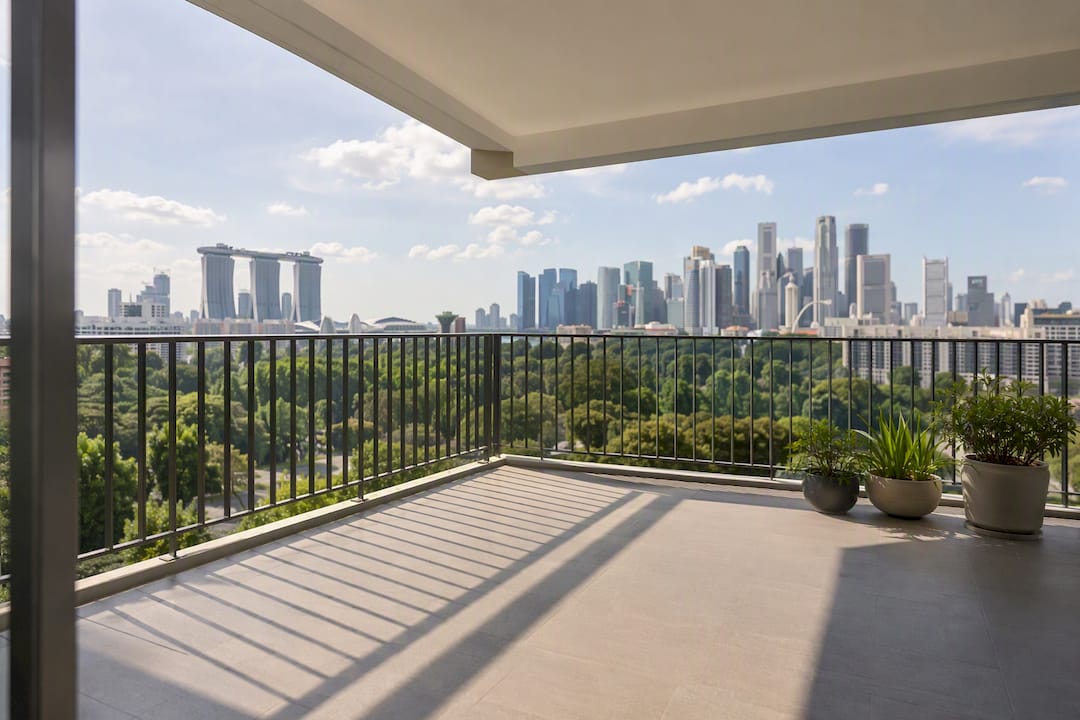
Almost never. Most MCSTs ban open flames and barbecues on private balconies due to fire safety risks tied to smoke, heat, and blocked emergency access, and electric grills or communal BBQ pits are the standard approved alternative.
Do I Need MCST Approval for Blinds or Screens?
Yes, written MCST approval is required even for retractable zip-track blinds, and MCSTs typically request elevation drawings, fabric samples, and proof of contractor insurance before approving an installation.
What Happens if I Install Something Without Approval?
The MCST can issue a warning, then a formal notice demanding removal or restoration, and can recover the cost of removal from you directly. Disputes can escalate to the Strata Titles Board or, in rare cases, the courts.
Who Do I Contact First About Balcony Rules?
Start with your MCST's management office to obtain the current by-laws and any published facade standards, since these govern day-to-day approval decisions even though URA and BCA set the underlying design and safety framework.