
Yes, foreigners can buy private condominiums in Singapore without prior government approval. The catch is a 60% Additional Buyer's Stamp Duty) on top of the standard Buyer's Stamp Duty, which makes Singapore one of the most expensive entry points for foreign residential buyers anywhere in Asia. Landed homes require a separate approval from the Land Dealings Approval Unit (LDAU) before you can even sign a contract.
Three things every foreign buyer must confirm before making an offer:
- ABSD exposure: At 60% of the purchase price (or market value, whichever is higher), ABSD must be paid in cash. On a S$2 million condo, that is S$1.2 million in stamp duty alone.
- Unit classification: Some units inside condominium projects are classified as having a landed component (strata-landed townhouses, for example) and trigger LDAU approval even when the project is marketed as a condo.
- Financing limits: The Monetary Authority of Singapore (MAS) caps loan-to-value ratios and loan tenures, and banks often apply additional overlays for foreign income.
The official bodies you will deal with: the Singapore Land Authority (SLA) for LDAU approvals, the Inland Revenue Authority of Singapore (IRAS) for stamp duties, MAS for financing rules, and the Housing & Development Board (HDB) for public housing eligibility. One Marina Gardens in District 01 is an example of a private condominium that foreigners can purchase without LDAU approval.
Key Takeaways
| Point | Details |
|---|---|
| ABSD rate for foreigners | 60% flat on the higher of purchase price or market value, payable in cash within 14 days of signing. |
| FTA remission eligibility | U.S. and qualifying EFTA nationals may apply for ABSD remission via IRAS myTax Portal on a first residential property. |
| LDAU approval required | Any landed or strata-landed unit needs LDAU approval before purchase; allow approximately 30 working days for assessment. |
| Financing limits | MAS caps LTV at 75% for a first property; banks often apply lower effective LTVs for foreign income; non-PRs cannot use CPF. |
| Onemarinagardens | One Marina Gardens (District 01) offers non-landed strata units from S$1.81M with no LDAU ambiguity, 160m from Marina South MRT. |
Table of Contents
- How Singapore defines a foreign buyer for property rules
- Which property types can foreigners actually buy?
- When do you need LDAU approval, and how does it work?
- What taxes and fees will you pay as a foreign buyer?
- How bank financing works for foreign buyers in Singapore
- Step-by-step: how to buy a condo in Singapore as a foreigner
- Document checklist for foreign buyers
- Risks and red flags to watch for
- What developers tell foreign buyers about new-launch purchases
- Resale conditions and restrictions on foreign ownership changes
- How double taxation agreements affect foreign property buyers
- How to choose a property agent and conveyancing solicitor as a foreign buyer
- An editorial perspective on what foreign buyers consistently underestimate
- One Marina Gardens is built for exactly this buyer profile
- Sources
- FAQ
How Singapore defines a foreign buyer for property rules
Under the Residential Property Act 1976 (RPA), a "foreign person" is anyone who is not a Singapore Citizen, a Singapore company, a Singapore limited liability partnership, or a Singapore society. Permanent Residents (PRs) occupy a middle tier: they are not citizens, so they pay higher ABSD than citizens, but they are not treated as full foreigners either.
The practical categories:
- Singapore Citizens (SC): Lowest ABSD rates; no LDAU approval needed for any residential purchase.
- Permanent Residents (PRs): Higher ABSD than citizens; can buy HDB resale flats under certain conditions; still need LDAU approval for landed property.
- Foreigners (non-PR, non-SC): Highest ABSD (60%); can buy private condos freely; need LDAU approval for landed; cannot buy HDB flats.
- Foreign companies and trusts: Treated as foreign persons for ABSD purposes; additional restrictions may apply depending on structure.
Joint purchases get complicated fast. If one buyer is a foreigner and the other is a Singapore Citizen, the ABSD rate applied is the higher of the two rates, calculated on the full purchase price. Dual nationals holding Singapore citizenship are treated as citizens, but you must declare the Singapore citizenship at the point of purchase.
Certain nationalities qualify for ABSD remission under Singapore's Free Trade Agreements. IRAS confirms that nationals of the United States and qualifying EFTA countries (Iceland, Liechtenstein, Norway, and Switzerland) may be treated as Singapore Citizens for ABSD on a first residential property purchase, subject to conditions. The remission application is submitted through the myTax Portal after stamping.
Which property types can foreigners actually buy?
The rules split cleanly into three buckets: freely purchasable, restricted (approval required), and off-limits.
Freely purchasable by foreigners:
- Private condominiums and apartments (strata-titled, non-landed)
- Privatized Executive Condominiums (ECs) after the 10-year Minimum Occupation Period (MOP)
- Commercial and industrial properties
- Shophouses (commercial component)
Restricted — LDAU approval required:
- Landed residential property on mainland Singapore (detached houses, semi-detached, terraced houses)
- Sentosa Cove landed property (special rules apply; owner-occupation conditions attached)
- Strata-landed units (townhouses, cluster houses) even within a condominium project
Off-limits for foreigners:
- HDB flats (new and resale), with narrow exceptions for PRs buying resale HDB under HDB eligibility rules
- New Executive Condominiums during the 10-year MOP
- Agricultural land and certain gazetted areas
Pro Tip: Before signing anything, ask the developer or your conveyancing solicitor to confirm in writing whether the unit you are buying is classified as non-landed strata or has any landed component. A townhouse inside a condominium project can look identical to a strata apartment on the marketing brochure but trigger a full LDAU application. Get that written confirmation before you pay the option fee.
The SLA confirms this classification risk and recommends verifying directly with the developer or a solicitor. A standard private condominium unit like those at One Marina Gardens carries no such ambiguity, which is one practical reason foreign buyers gravitate toward established new-launch projects with clear strata classifications.
When do you need LDAU approval, and how does it work?
LDAU approval is required any time a foreign person wants to purchase landed residential property in Singapore, including strata-landed units. The legal basis is the Residential Property Act. There is no blanket approval; SLA assesses each application individually.
Typical LDAU assessment criteria:
- Length of PR status (longer tenure generally viewed more favorably)
- Economic contribution to Singapore (employment, business ownership, taxes paid)
- Intended use of the property (owner-occupation is required; investment-only applications are rarely approved)
- Details of the property itself (location, size, value)
Documents typically required for an LDAU application:
- Completed online application via the SLA LDAU portal
- Copy of Singapore PR card and passport
- Evidence of employment or business activity in Singapore (employment letter, ACRA business profile)
- CPF contribution history (demonstrates economic contribution)
- Income tax assessments for recent years
- Property details: address, title, purchase price, and developer or vendor particulars
- Owner-occupation undertaking (written commitment to occupy the property)
Timeline: SLA typically completes its assessment within approximately 30 working days from the date of a complete submission. Complex cases or incomplete applications take longer. Do not sign an Option to Purchase for landed property before receiving LDAU approval or at minimum confirming your eligibility with SLA, because the option period may not be long enough to accommodate the approval timeline.
| Stage | Action | Responsible party |
|---|---|---|
| Pre-offer | Confirm unit classification with developer/solicitor | Buyer |
| Pre-offer | Submit LDAU application via SLA portal | Buyer |
| During assessment | Respond to any SLA queries promptly | Buyer |
| Post-approval | Proceed to Option to Purchase | Buyer + solicitor |
What taxes and fees will you pay as a foreign buyer?
The total acquisition cost for a foreigner is substantially higher than for a local buyer. Here is the full picture.
Buyer's Stamp Duty (BSD) is tiered and applies to every buyer regardless of nationality. IRAS calculates BSD on the higher of the purchase price or the market value. The tiered structure means the effective BSD rate rises with the property value.
This is the single largest cost item in any foreign condo purchase.
Key payment deadlines and rules:
- BSD and ABSD must be stamped within 14 days of signing the Sale & Purchase Agreement (or within 14 days of the Option to Purchase being exercised, whichever applies). Late stamping attracts penalties.
- ABSD must be paid in cash. Non-PR foreigners cannot use CPF funds for ABSD or downpayment.
- FTA remission applications (for qualifying U.S. and EFTA nationals) are submitted via the myTax Portal after stamping.
A valuation gap is a real cash risk. Because both BSD and ABSD are calculated on the higher of price or market value, a property where the bank or IRAS valuation comes in above your agreed purchase price means you pay more stamp duty than the headline price implies. Arrange an independent valuation before committing.
How bank financing works for foreign buyers in Singapore
Foreign buyers can access Singapore bank financing, but the rules are tighter than for citizens, and lenders often apply conservative overlays on top of the MAS regulatory floors.
MAS regulatory limits (apply to all buyers):
- First residential property: LTV up to 75% if loan tenure is 30 years or less and borrower is under 65
- Second residential property: LTV drops to 45%
- Loan tenure: capped at 30 years for private residential property, subject to age-at-maturity limits
- Total Debt Servicing Ratio (TDSR): monthly debt obligations (including the new mortgage) cannot exceed 55% of gross monthly income
That means your cash requirement at completion is higher than the regulatory minimum suggests.
Documents lenders typically request from foreign buyers:
- Passport and valid Singapore pass (Employment Pass, Dependent Pass, etc.)
- Last 3–6 months' bank statements (Singapore and overseas accounts)
- Last 3 months' payslips or employment letter confirming salary
- Last 2 years' income tax returns (home country and Singapore, if applicable)
- Existing loan statements (to calculate TDSR)
- Proof of funds for downpayment and stamp duties
CPF rules: Non-PR foreigners cannot use CPF for any part of the purchase. PRs can use their CPF Ordinary Account for downpayment and monthly installments on private property, subject to CPF withdrawal limits and the Valuation Limit. This distinction significantly affects how much cash a non-PR buyer must have liquid at completion.
Pro Tip: Get an In-Principle Approval (IPA) from at least two banks before you make an offer. Ask each lender directly how they treat overseas income, whether they apply a haircut to foreign-currency earnings, and what their effective LTV is for your pass type. The answers vary more than you would expect.
For a broader view of how Singapore's property market trends affect financing conditions, the market commentary on that topic is worth reading before you lock in a rate.
Step-by-step: how to buy a condo in Singapore as a foreigner
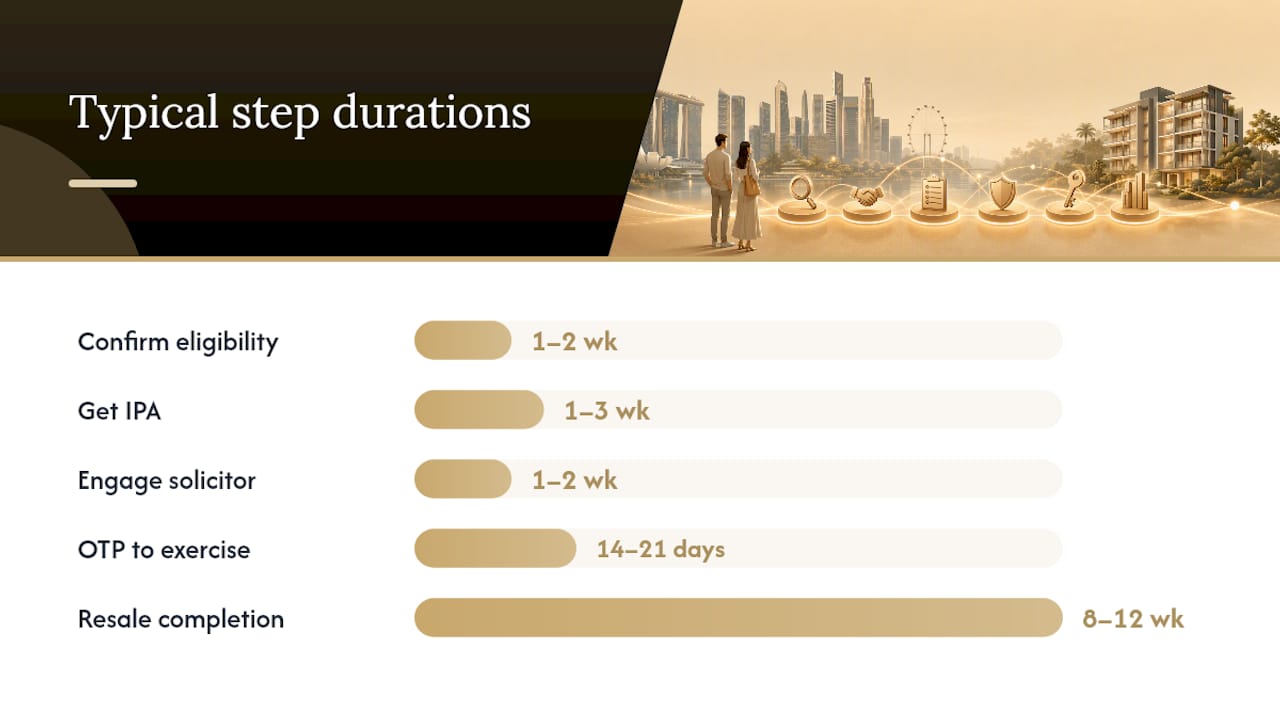
- Confirm eligibility and ABSD exposure (Week 1–2): Verify your buyer category, check FTA remission eligibility on IRAS, and calculate your total acquisition cost including 60% ABSD.
- Get an In-Principle Approval (IPA) (Week 1–3): Approach banks with your income documents. Confirm effective LTV and TDSR headroom before you start viewing.
- Engage a conveyancing solicitor (Week 1–2): Appoint a Singapore-qualified solicitor before making any offer. They will check title, encumbrances, MOP status (for ECs), and unit classification.
- Property search and unit selection (Ongoing): For new launches, attend the showflat or arrange a virtual tour. For resale, conduct physical inspections and request the title search results.
- Receive and sign the Option to Purchase (OTP) (Day 1 of transaction): Pay the option fee (typically 1% for resale; developer sets the amount for new launches). The OTP gives you an exclusive right to buy within the option period (typically 14–21 days for resale).
- Exercise the Option (Within option period): Pay the exercise fee (typically 4% for resale, bringing total deposit to 5%). Your solicitor reviews the Sale & Purchase Agreement.
- Stamp the documents within 14 days: BSD and ABSD must be paid and the instruments stamped within 14 days of the signed instrument. Use the IRAS myTax Portal for e-stamping and any remission applications.
- Mortgage drawdown and completion (8–12 weeks for resale; progressive for new launch): Your solicitor coordinates with the bank and seller's solicitor. For new launches, payments follow the developer's progressive payment schedule tied to construction milestones.
- Handover and key collection: Final payment, title transfer registered with SLA, and keys handed over.
For overseas buyers: A Power of Attorney (POA) notarized in your home country and apostilled (or authenticated at the Singapore consulate) allows an authorized representative to sign documents on your behalf in Singapore. Confirm with your solicitor which documents require original signatures versus POA-authorized execution.
Timeline estimates: Resale transactions typically complete in 8–12 weeks from OTP. New-launch purchases at a project under construction follow the progressive payment schedule, with full completion at Temporary Occupation Permit (TOP).
| Milestone | Resale timeline | New launch timeline |
|---|---|---|
| OTP to exercise | 14–21 days | Set by developer |
| Stamping deadline | 14 days from signed instrument | 14 days from signed instrument |
| Completion | 8–12 weeks from exercise | At TOP (construction-dependent) |
Document checklist for foreign buyers
Identity and status documents:
- Valid passport (all pages)
- Singapore pass (Employment Pass, Dependent Pass, Long-Term Visit Pass, or PR card)
- Proof of overseas residential address (utility bill or bank statement)
- Tax identification number from home country
Financial and banking documents:
- Last 6 months' bank statements (Singapore and overseas)
- Last 3 months' payslips or salary confirmation letter
- Last 2 years' income tax returns
- Existing loan statements (all jurisdictions)
- Proof of funds for downpayment and stamp duties (cash in a Singapore account is cleanest)
Transaction documents:
- Option to Purchase (signed copy)
- Sale & Purchase Agreement
- Title search results (your solicitor obtains this)
- Independent valuation report
- Power of Attorney (if signing remotely), notarized and apostilled
LDAU-specific documents (landed property only):
- Proof of PR duration (PR card, ICA letter)
- CPF contribution history printout
- Income tax assessments (last 2–3 years)
- Employment letter or ACRA business profile
- Owner-occupation undertaking (drafted by your solicitor)
Risks and red flags to watch for
Unit misclassification is the most expensive surprise. A strata-landed townhouse inside a condominium project looks like a condo unit on the floor plan but triggers LDAU approval. If you sign an OTP without knowing this, you may be contractually committed to a purchase you cannot legally complete as a foreigner without approval. Always get written classification confirmation from the developer or solicitor before paying the option fee.

Valuation gaps cut both ways. If the bank values the property below your purchase price, your effective LTV shrinks and you need more cash. If IRAS values it above your purchase price, your BSD and ABSD bill rises. Both scenarios are common in a rising market.
Red flags to raise with your agent or solicitor:
- Developer or vendor cannot provide written unit classification confirmation
- Significant difference between asking price and recent comparable transactions
- Undisclosed encumbrances, caveats, or mortgages on the title
- Unusual or non-standard OTP clauses (especially around completion timelines or forfeiture terms)
- Agent pressure to skip the solicitor review or rush the OTP signing
Questions to ask before signing:
- Is this unit classified as non-landed strata or does it have a landed component?
- What is the current market valuation, and has the seller obtained one recently?
- Are there any existing caveats, charges, or mortgages on the title?
- For ECs: has the 10-year MOP been completed?
Pro Tip: Request a title search from your solicitor before exercising the OTP, not after. The search costs a small fee and can reveal encumbrances or ownership disputes that would otherwise surface only at completion, when unwinding the deal is far more costly.
What developers tell foreign buyers about new-launch purchases
New-launch condominiums use a progressive payment schedule tied to construction milestones, which is structurally different from resale where you pay the full balance at completion.
A typical new-launch progressive payment structure works as follows:
- Booking fee / option fee: 5% of purchase price (paid at signing of OTP)
- Upon signing Sale & Purchase Agreement (within 8 weeks of OTP): 15% (bringing total to 20%)
- Foundation completion: 10%
- Reinforced concrete framework: 10%
- Partition walls: 5%
- Roofing: 5%
- Windows, doors, electrical, plumbing: 5%
- Temporary Occupation Permit (TOP): 25%
- Certificate of Statutory Completion (CSC) / legal completion: 15%
That means you need the full ABSD amount in cash well before the property is built, while progressive payments are still ongoing. This cash-flow timing is the single most common planning error among foreign new-launch buyers.
Resale purchases require the full balance at completion, which is simpler to model but demands a larger lump sum at a single point.
On strata classification in developer contracts: New-launch Sale & Purchase Agreements specify the unit type. Read the description carefully. If the agreement references a "townhouse," "cluster house," or "strata-landed" unit, LDAU approval is required regardless of how the project is marketed.
Pro Tip: If you are buying from overseas, confirm with the developer's sales team which documents require original wet signatures versus electronic or POA-authorized execution. Many Singapore developers now accept e-signatures for preliminary documents, but the Sale & Purchase Agreement and mortgage documents typically require originals or properly executed POA. Clarify this before you travel or courier documents internationally.
Resale conditions and restrictions on foreign ownership changes
Once you own a private condominium as a foreigner, there are relatively few ongoing restrictions on what you can do with it. You can rent it out freely (subject to URA short-term rental rules), sell it to any eligible buyer, or hold it long-term. There is no minimum holding period for private condominiums, though a Seller's Stamp Duty (SSD) applies if you sell within 3 years of purchase.
After 3 years, no SSD applies.
If your PR status lapses or you become a Singapore Citizen after purchase, your ABSD liability on that property does not change retroactively. The ABSD you paid at purchase is fixed. Future purchases, however, would be assessed at your new status rate.
For landed property purchased with LDAU approval, the approval typically includes an owner-occupation condition. Renting out the entire property without occupying it yourself may breach that condition. Check your LDAU approval letter for specific terms.
How double taxation agreements affect foreign property buyers
Singapore has an extensive network of Avoidance of Double Taxation Agreements (DTAs) with over 90 countries. For property buyers, the most relevant DTA provisions cover rental income and capital gains.
Rental income: If you earn rental income from a Singapore property while tax-resident in another country, the DTA between Singapore and your home country determines where that income is taxed and whether a credit or exemption applies. Your home country may also tax that income, but the DTA typically provides a credit mechanism to avoid double taxation.
Capital gains: Singapore does not impose a capital gains tax on property sales. This is a significant advantage for foreign investors. A partner resource on why Singapore has no capital gains tax explains the policy rationale and its implications for long-term investors. Your home country may tax the gain on disposal, so check your domestic rules and the applicable DTA before selling.
ABSD and DTAs: The FTA remission described earlier (for U.S. and qualifying EFTA nationals) is distinct from DTA provisions. DTAs do not generally override ABSD; the remission route is the only mechanism for reducing ABSD based on nationality.
How to choose a property agent and conveyancing solicitor as a foreign buyer
The agent and solicitor you appoint are not interchangeable roles. The agent finds and negotiates the property; the solicitor protects your legal interests. For a foreign buyer, both need specific experience with cross-border transactions.
Selecting a property agent:
- Confirm the agent holds a valid CEA (Council for Estate Agencies) license. You can verify on the CEA public register.
- Ask specifically how many transactions they have handled for foreign buyers in the past 12 months.
- Check whether they understand ABSD implications, FTA remission eligibility, and LDAU triggers. An agent who cannot explain these clearly is not the right agent for a foreign buyer.
- For new-launch purchases, developer-appointed agents represent the developer's interests. Appoint your own agent (at no additional cost to you on new launches) to represent yours.
Selecting a conveyancing solicitor:
- Choose a Singapore-qualified firm with a dedicated conveyancing practice, not a general practice that handles property occasionally.
- Ask whether the firm has handled purchases for buyers from your home country and whether they are familiar with POA execution requirements for your jurisdiction.
- Confirm they will conduct a title search, check for encumbrances, verify unit classification with SLA, and advise on ABSD and BSD deadlines.
- Fee transparency matters: get a written fee estimate covering all disbursements before engaging.
For expats comparing condo options across districts, working with an agent who knows both the regulatory landscape and the specific district dynamics saves time and prevents costly missteps.
An editorial perspective on what foreign buyers consistently underestimate
The ABSD number gets all the attention, and rightly so. For a new-launch purchase, ABSD is due within 14 days of signing the Sale & Purchase Agreement, which can be months or years before TOP. Buyers who plan to fund ABSD from the eventual rental income or a future asset sale are structurally misaligned with the payment timeline.
The second underestimated issue is unit classification. The LDAU risk is not theoretical. Strata-landed townhouses inside condominium projects are marketed alongside standard apartments, and the distinction is not always obvious from the brochure. A buyer who signs an OTP on a townhouse unit without LDAU approval is in a genuinely difficult position: the option period is typically too short for LDAU assessment, and forfeiting the option fee is the least bad outcome if approval is denied.
The third thing buyers underestimate is the value of a solicitor who has done this before with foreign clients. The paperwork for a cross-border purchase, including POA notarization, overseas income documentation for the bank, and FTA remission applications, is manageable, but only if someone is coordinating it systematically. A solicitor who handles one or two foreign purchases a year will not have the workflow that a specialist firm does.
Singapore's private condo market is genuinely open to foreign buyers in a way that most comparable cities are not. The ABSD is the price of that openness, and for buyers with a long enough horizon, the absence of capital gains tax and the stability of the legal framework make the math work. The buyers who struggle are those who treat the ABSD as a rounding error rather than the primary line item it is.
One Marina Gardens is built for exactly this buyer profile
Foreign buyers prioritizing location, connectivity, and a clear strata classification will find One Marina Gardens worth a close look. The 937-unit development by Kingsford Marina Development sits in District 01, 160 meters from Marina South MRT, with direct access to the CBD and Orchard Road. Units run from 1-bedroom to 4-bedroom, and every unit is classified as non-landed strata, so there is no LDAU ambiguity.
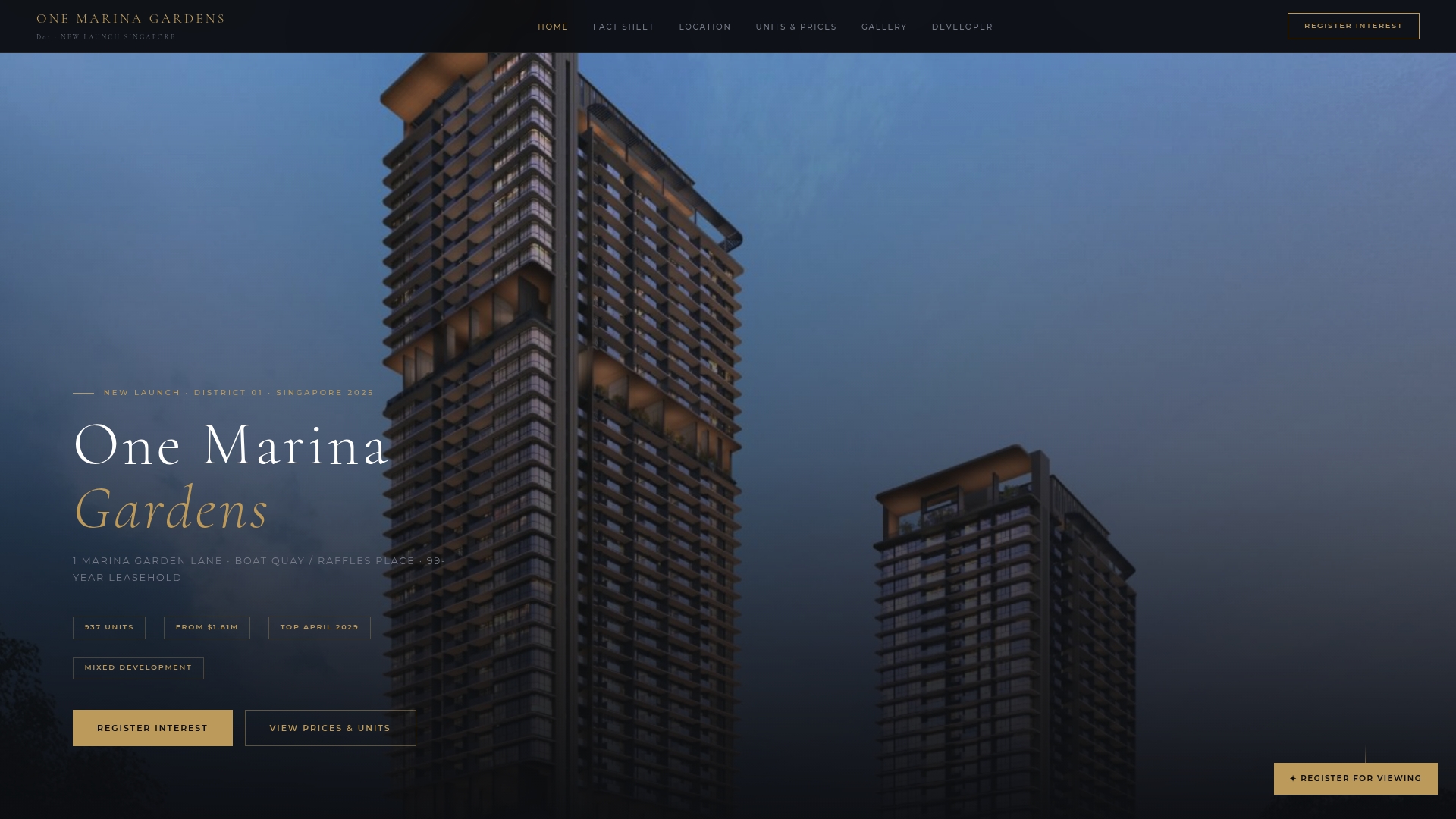
Facilities include a 50-metre lap pool, multiple sky terraces, a dedicated childcare centre, retail shops, and a restaurant within the development. For foreign buyers factoring ABSD into their budget, the project fact sheet includes unit mix, pricing from S$1.81M, and payment schedule details. The sales team can also walk you through a tailored cost estimate that includes BSD, ABSD, and financing scenarios based on your pass type and income structure. Register for a showflat appointment or browse the full development details to start your assessment.
Sources
Direct links to the primary official resources you need:
Verify current ABSD and BSD rates on IRAS directly before signing any instrument, as rates can change by government announcement. Use the SLA LDAU portal for all landed property approval submissions.
This article is general information, not a substitute for advice from a qualified lawyer. Consult a qualified legal professional about your own circumstances before acting on anything here.
FAQ
Can foreigners buy a private condo in Singapore?
Yes. Foreigners can purchase private condominiums and strata-titled apartments in Singapore without prior government approval.
Do foreigners need to pay ABSD in Singapore?
Yes. IRAS sets the ABSD rate for foreigners at 60%, calculated on the higher of the purchase price or market value. Nationals of the U.S. and qualifying EFTA countries may apply for remission on a first residential property under Singapore's Free Trade Agreements.
Can a non-citizen buy a house in Singapore?
Non-citizens can buy private condominiums freely but need LDAU approval from the Singapore Land Authority to purchase landed residential property. HDB flats are off-limits to foreigners; Permanent Residents can buy HDB resale flats under specific eligibility conditions.
What is the minimum salary to buy a condo in Singapore?
Banks also apply their own credit assessments, and foreign income is often subject to a haircut, so the practical income requirement is higher for foreign buyers than the TDSR formula alone suggests.