The minimum downpayment for a private condominium in Singapore is typically 25% of the purchase price when you qualify for a 75% Loan-to-Value ratio, and at least 5% of that must be paid in cash. Your actual cash requirement can climb well past that baseline once you factor in outstanding home loans, loan tenure, CPF Ordinary Account limits, and stamp duties. The worked examples below turn these rules into real dollar figures for purchases at S$800,000, S$1.5 million, and S$2 million.
TL;DR:
- The actual downpayment can be much higher than 25% if you have existing loans, longer tenures, or your loan-to-value ratio drops due to risk factors.
- Valuation differences can reduce your approved loan amount, requiring you to cover the shortfall with extra cash or CPF.
- Buyers need to prepare for stamp duties, legal fees, and other transaction costs within a strict 14-day window, often necessitating cash on hand.
- CPF usage is limited by property lease length, valuation, and loan conditions, with a recommended minimum CPF buffer of S$20,000 to safeguard retirement savings.
- A bank’s in-principle approval and early valuation checks are crucial to avoid surprises and build a realistic finance plan before committing to a unit.
Table of Contents
- What changes the minimum downpayment for your condo
- Cash vs CPF: what S$800,000, S$1.5 million and S$2 million buyers actually pay
- Beyond the downpayment: BSD, ABSD and the fees people forget
- How much CPF you can really use, and why the S$20,000 buffer matters
- Your planning checklist before you commit to a unit
- What buyers consistently get wrong about downpayment timing
- Getting your upfront costs sorted at One Marina Gardens
- Sources
- FAQ
What changes the minimum downpayment for your condo
The 25% figure is not a fixed rule for everyone. It is the outcome of applying the maximum regulatory Loan-to-Value ratio, and that ratio shrinks the moment your borrowing profile gets more complicated.
The MAS loan-to-value framework sets the ceiling banks can lend against, and it depends on how many outstanding housing loans you already carry and how long the loan tenure runs relative to your age:
- With no outstanding housing loans and a standard tenure, LTV can go up to 75%, meaning a 25% downpayment with a minimum 5% cash portion.
- With one outstanding housing loan, LTV typically drops, pushing the downpayment and the required cash share higher.
- With two or more outstanding housing loans, LTV drops further still, requiring a much larger downpayment.
- Longer loan tenures relative to your age or a tenure that extends past typical retirement thresholds can trigger a lower LTV cap even on a first loan.
These bands exist because MAS treats regulatory LTV as a ceiling tied to borrower risk, not a fixed entitlement. Banks then apply their own credit assessment on top, so a buyer who technically qualifies for 75% LTV under MAS rules might still be offered less if income, credit history, or existing liabilities do not support it. The MAS housing loans explainer is direct about this: regulatory limits are the upper bound, and actual bank approvals can be tighter.
A second variable that catches buyers off guard is valuation. If the bank's valuation comes in below the price you agreed to pay, the loan is calculated against the lower valuation figure, not your purchase price. That gap becomes an immediate cash shortfall you have to cover, on top of your planned downpayment.
There is also the separate matter of Total Debt Servicing Ratio and Mortgage Servicing Ratio limits, which cap how much of your income can go toward debt repayments. Even when LTV rules allow a certain loan quantum, TDSR or MSR limits can reduce what a bank is willing to lend, effectively forcing a larger downpayment in cash or CPF regardless of the LTV band you fall into.
Before you pay an option fee on any unit, get an in-principle credit assessment from a bank. It tells you the LTV you actually qualify for, flags any TDSR issue early, and gives you a realistic loan quantum before you are financially committed to a purchase.
Cash vs CPF: what S$800,000, S$1.5 million and S$2 million buyers actually pay
Once you know your LTV band, the math is straightforward. At 75% LTV, the downpayment is 25% of the purchase price, and at least 5% of the full price must be cash. The remaining 20% can generally come from CPF Ordinary Account savings, subject to CPF's own usage caps, which are covered in more detail further down.
A buyer purchasing at 75% LTV needs a minimum of 5% of the purchase price in hard cash, with the rest of the 25% downpayment payable from CPF OA savings where eligible.
Here is how that plays out at three common price points, assuming a first home purchase with no outstanding housing loans and 75% LTV eligibility:
- S$800,000 purchase: minimum cash downpayment is S$40,000 (5%), and up to S$160,000 (20%) can potentially come from CPF OA, for a total 25% downpayment of S$200,000. Buyer's Stamp Duty) on this price works out to S$18,600, calculated using the residential BSD tiers, and is due separately in cash or CPF within 14 days of exercising the option.
- S$1.5 million purchase: minimum cash downpayment is S$75,000 (5%), with up to S$300,000 (20%) potentially from CPF OA, for a total downpayment of S$375,000. BSD on this price comes to S$44,600 under the same tiered structure.
- S$2 million purchase: minimum cash downpayment is S$100,000 (5%), with up to S$400,000 (20%) potentially from CPF OA, for a total downpayment of S$500,000. BSD here is S$69,600, an amount confirmed under IRAS's residential BSD calculation for a S$2,000,000 purchase.
Singapore Permanent Residents and foreign buyers face the same downpayment math for LTV purposes, but their cash needs jump considerably once Additional Buyer's Stamp Duty applies. On the S$2 million example above, a foreign buyer would owe a significant additional amount in ABSD, payable in cash or CPF within the same 14-day window as BSD.
Now consider what happens when LTV drops. On the S$1.5 million purchase, that turns a S$375,000 downpayment into S$825,000, with a correspondingly larger cash component since CPF usage is still capped by the same OA rules regardless of how large the total downpayment gets.
Timing matters as much as the math. Stamp duty on the Option to Purchase or the Sale and Purchase Agreement is due within 14 days of execution, and this is a hard deadline set by IRAS, not a suggestion. Many buyers assume CPF funds will be available instantly to cover this, but CPF withdrawal and disbursement processing takes time, so you typically need cash on hand to meet the 14-day deadline even if you intend to use CPF for part of the payment later.

Beyond the downpayment: BSD, ABSD and the fees people forget
Your downpayment is only one part of the cash you need at the start of a purchase. Stamp duties and transaction fees sit on top of it, and they are due on tight timelines that do not wait for financing to catch up.
Buyer's Stamp Duty follows a tiered structure on the purchase price or market value, whichever is higher, according to IRAS: 1% on the first S$180,000, 2% on the next S$180,000, 3% on the next S$640,000, 4% on the next S$500,000, 5% on the next S$1.5 million, and 6% on any remaining amount. This is why a S$2 million purchase generates S$69,600 in BSD rather than a flat percentage.
ABSD sits on top of BSD for specific buyer profiles: Singapore Citizens buying a second or subsequent property, Permanent Residents, and foreign buyers. Rates differ significantly by category, and IRAS's ABSD page is the definitive source for the rate that applies to your specific profile, since these rates are subject to policy revision.
Other costs to budget for include:
- Legal or conveyancing fees, typically a fixed fee or percentage of the purchase price, payable to the solicitor handling the transaction.
- Valuation fees if your bank requires an independent valuation beyond its own panel assessment.
- Mortgage insurance or fire insurance, often bundled into the loan but sometimes billed separately at completion.
Our internal buyer's stamp duty guide walks through a calculator and worked examples if you want to check your own numbers before committing to a unit.
The sequence matters: you pay the option fee to secure the unit, then stamp duty is due within 14 days of exercising the Option to Purchase, per IRAS. Do not assume CPF funds will be ready in time to cover this window. Our option to purchase guide covers the exact timing and why a cash bridge matters here.
How much CPF you can really use, and why the S$20,000 buffer matters
CPF Ordinary Account savings can cover a meaningful share of your downpayment, but the cap is not simply "20% of the price." According to CPF Board, the amount you can use depends on the purchase price, the bank's valuation, your loan type, and how much lease remains on the property. If the remaining lease covers the youngest buyer up to age 95, your CPF usage is capped at the lower of the purchase price and the valuation. Shorter leases reduce that cap further, which is a common surprise for buyers of older leasehold developments. Our guide on 99 vs 999 leasehold explains how lease length interacts with these CPF limits in more detail.
There is also a longer-term cost to using CPF heavily. Any OA savings withdrawn for a property purchase must generally be refunded with accrued interest when you sell, since CPF Board treats housing withdrawals as a loan against your own retirement savings, not a grant. This is why CPF Board's own guidance from January 2026 recommends keeping at least S$20,000 in your OA rather than draining it entirely for a purchase. That buffer exists for practical reasons: it covers a career break, an unexpected expense, or simply protects your retirement resilience if property values shift.

Pro Tip: Run the CPF housing usage calculator before you commit to a unit, and if you plan to use CPF heavily, consider making voluntary refunds over time to rebuild your OA balance and limit the long-term hit to your retirement savings.
Your planning checklist before you commit to a unit
Turning all of this into action means working through a short sequence of steps well before you sign anything.
- Check your numbers first. Run a home purchase planner alongside the CPF housing usage calculator, and check your OA balance against the recommended S$20,000 buffer.
- Get bank approval in principle. Ask specifically about the LTV you qualify for, how the bank handles valuation, and any tenure limits tied to your age.
- Plan your payment schedule. Budget the option fee, the exercise payment, and BSD or ABSD due within 14 days, and engage a solicitor early so conveyancing does not become a bottleneck.
- Build in a valuation cushion. Keep a cash bridge in case the bank's valuation comes in under your agreed price, and plan any CPF refunds you intend to make after the purchase completes.
Pro Tip: Ask your bank directly whether your rate is pegged to SORA and how that compares to older SIBOR-linked loans still held by some existing owners; our guide on SORA vs SIBOR has the questions worth asking before you sign.
What buyers consistently get wrong about downpayment timing
The most common mistake I see is not the downpayment math itself, which most buyers get right once they see the numbers laid out. It is the timing. The second mistake is skipping an early valuation check and assuming the bank will value the unit at the agreed price. When it does not, that shortfall becomes an unplanned cash call at the worst possible moment. Build your cash bridge and check your CPF caps before you fall in love with a specific unit, not after.
— Velisa
Getting your upfront costs sorted at One Marina Gardens
Knowing your downpayment number is only useful once you know what you are actually buying. One Marina Gardens offers a variety of condominium homes in District 01 near Marina South MRT, allowing your financing plan to be matched against a specific unit rather than a hypothetical price.
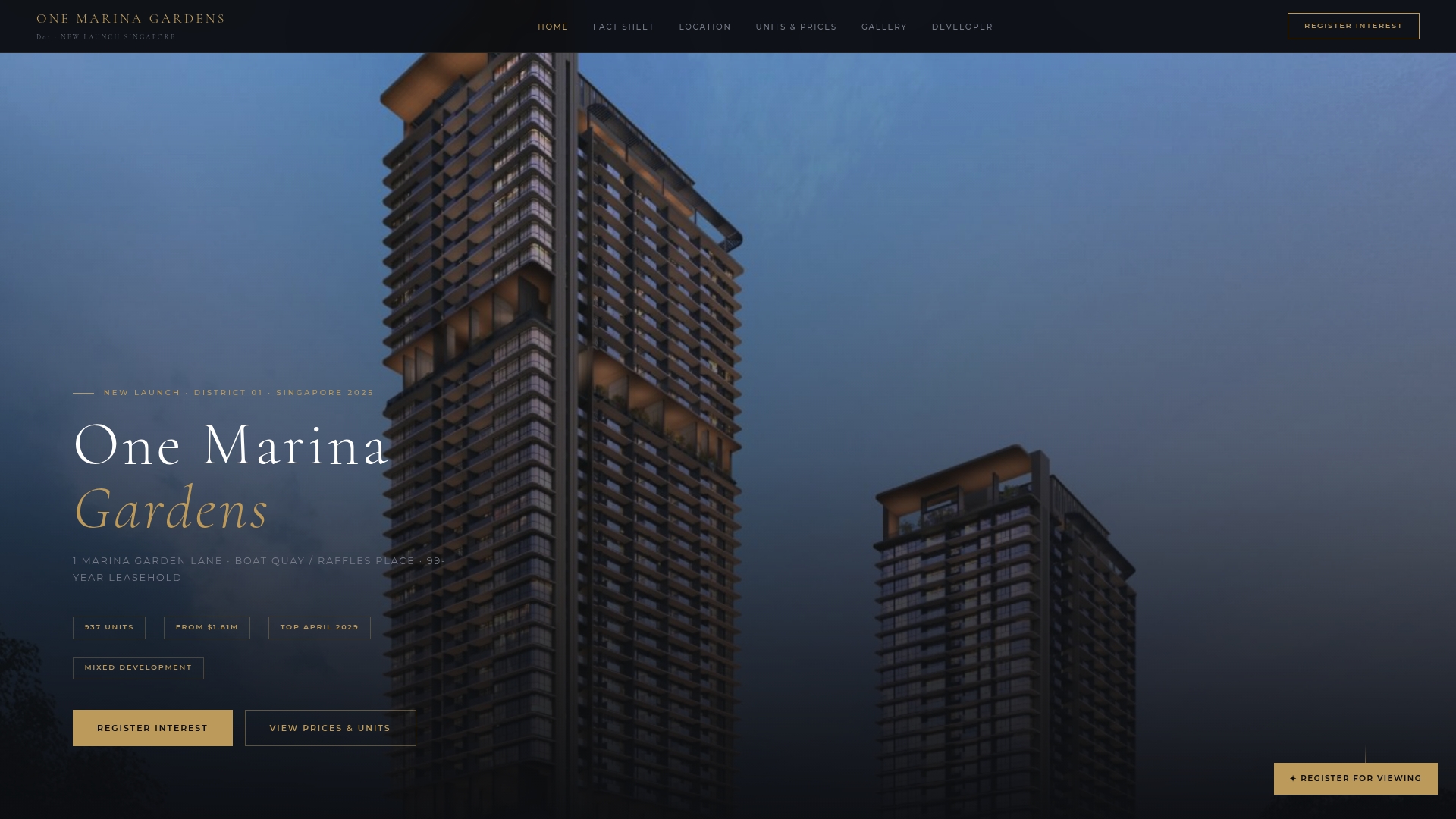
Our sales team can assist you with cash and CPF breakdowns alongside unit pricing details, as prices vary across floor plans and stack positions.
- Browse current unit types and availability across all four layouts.
- Check the latest price list and available units on the official website.
- Request a tailored upfront-cost worksheet and arrange a showflat visit to see the sky terraces and lap pool in person.
If you are ready to see how your downpayment plan applies to a real unit, get in touch through our unit pages and we will walk you through pricing and availability.
This article is general information, not a substitute for advice from a qualified financial advisor. Consult a qualified financial professional about your own circumstances before acting on anything here.
Sources
- CPF | How much CPF savings you can use for your home purchase
- MAS | Loan tenure and loan-to-value limits
FAQ
What is the downpayment needed for a condo?
The typical minimum downpayment for a private condo in Singapore is 25% of the purchase price when you qualify for 75% LTV, with at least 5% of the price paid in cash. If your LTV is lower due to existing housing loans, the downpayment percentage rises accordingly.
Is a BTO downpayment 20% or 25%?
BTO flats fall under separate HDB financing rules with different downpayment structures not covered here.
Can CPF be used for condo downpayment?
Yes, CPF Ordinary Account savings can cover part of your condo downpayment, but the amount is capped by your purchase price, the bank's valuation, and remaining lease coverage, according to CPF Board.
What is the minimum salary required to afford a condo in Singapore?
There is no single published minimum salary figure, since affordability depends on the unit price, your Total Debt Servicing Ratio, existing debts, and the loan tenure a bank offers you. A bank's in-principle approval process is the most reliable way to find out what loan quantum, and by extension what price range, your income actually supports.