For most Singapore buyers, location and holding period matter more than the tenure label on the title deed. A 999-year leasehold behaves like freehold for CPF and bank financing purposes, while a well-located 99-year leasehold can outperform a weaker freehold option over a 10 to 15 year hold. The tenure decision really comes down to three levers: how long you plan to hold, where the unit sits, and how much premium you're paying for the extra years.
TL;DR:
- The remaining lease length is more critical than the tenure label, especially after 60 years, as value and financing options decline sharply.
- CPF and bank guidance treat 999-year leasehold the same as freehold due to the lengthy lease and safety margins, unlike shorter 99-year leases.
- Short to medium holds under 15 years benefit from new 99-year or freehold units in prime locations, as lease decay impact remains minimal within that period.
- Properties with over 80 years left on their lease are nearly indistinguishable in market value, but below 30 years, financing becomes significantly restricted.
- Buyers should evaluate lease expiry dates based on their expected resale year, not the original lease start, to accurately assess lease decay risk.
Table of Contents
- 99 vs 999 Leasehold: What Each Tenure Actually Means
- How CPF, Banks, and MAS Guidance Treat Each Tenure
- The Lease-Decay Curve and What It Means for Resale
- When 99-Year Leasehold Beats Freehold (And When It Doesn't)
- Your Unit-Level Checklist Before You Sign
- What Tenure Trade-Offs Look Like at One Marina Gardens
- Price, Location, and Holding Horizon Beat the Label
- Why One Marina Gardens Fits the Tenure-Aware Buyer
- Where to Verify These Numbers Yourself
- Sources
- FAQ
99 vs 999 Leasehold: What Each Tenure Actually Means
Singapore recognizes three residential land tenures, and confusing them costs buyers real money at resale. Freehold grants perpetual ownership with no expiry date. 999-year leasehold is technically a lease, but at that length the difference from freehold is theoretical. 99-year leasehold is a state lease that reverts to the government when it ends, with no compensation to the last owner.
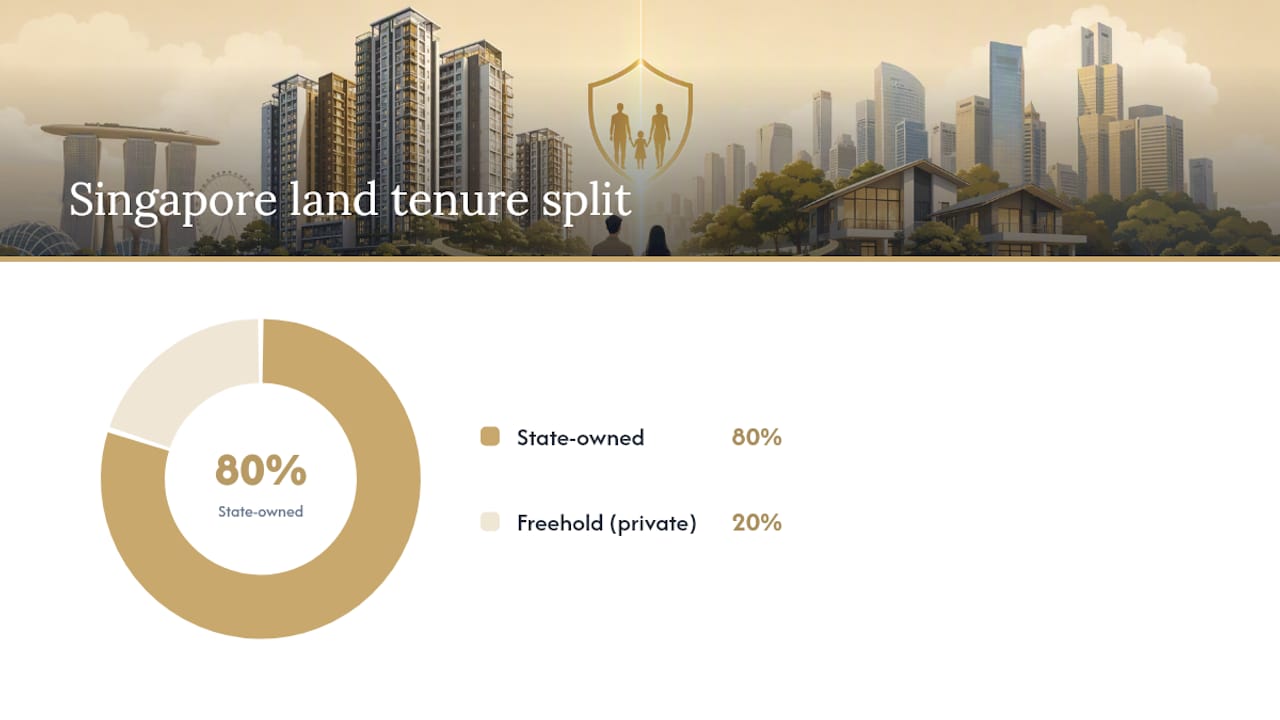
Roughly 80% of Singapore's land is state-owned, and freehold land makes up only about 20% of private residential land. That scarcity is why freehold and 999-year sites tend to cluster in older estates like Katong, Holland Village, and parts of District 10, while almost every Government Land Sales site and every HDB flat comes with a standard 99-year lease.
A few practical distinctions worth keeping straight:
- Freehold: no expiry, land is privately owned indefinitely, subject only to compulsory acquisition by the state under existing law.
- 999-year leasehold: a lease so long it outlasts every buyer, seller, and their grandchildren, treated as freehold-equivalent in nearly every financing and CPF context.
- 99-year leasehold: the lease clock starts on the date the land was granted, not the date you bought your unit, so a "new" 99-year condo could already have a few years shaved off before you even move in.
That last point trips up a lot of first-time buyers. Always check the lease commencement date on the title, not the launch date.
How CPF, Banks, and MAS Guidance Treat Each Tenure
Financing is where the 999-year vs freehold debate mostly disappears, and where the 99-year conversation gets serious. The CPF Board treats 999-year leasehold identically to freehold for savings usage, because the remaining lease duration will always exceed any realistic loan tenure or the CPF age-95 withdrawal limit. For a 99-year leasehold unit, that safety margin shrinks the older the lease gets.
Run these checks before you commit to a 99-year purchase:
- Calculate remaining lease at your age 95. CPF usage gets pro-rated once the lease won't outlast the youngest buyer to that age, cutting how much CPF you can apply toward the purchase.
- Check the loan tenure cap. MAS guidance on loan tenure and loan-to-value limits means banks will not extend a mortgage past the point where the remaining lease runs out, and shorter tenures usually mean higher monthly repayments.
- Confirm the LTV ratio your bank is quoting. Lenders commonly tighten loan-to-value limits as remaining lease shortens, which means a bigger cash outlay for the same purchase price.
The practical upshot: 999-year leasehold clears CPF and bank checks the same way freehold does, with no special scrutiny. A 99-year unit with 90-plus years left behaves almost the same way. The trouble starts decades later, and that's where lease decay comes in.
The Lease-Decay Curve and What It Means for Resale
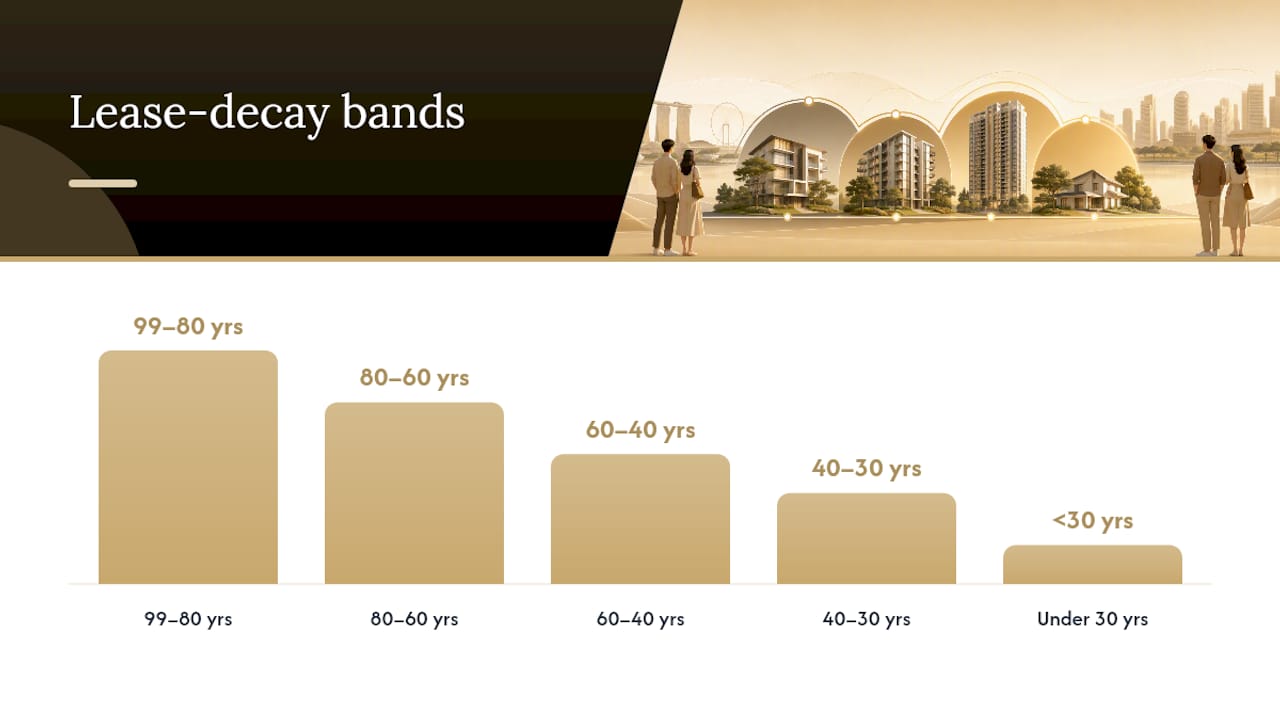
Value doesn't fall off a cliff the day a lease crosses 99 years remaining. It erodes on a curve, and the curve has predictable bends. Industry modeling from ShiokNest's lease-decay analysis maps out the bands most agents and appraisers actually use:
- 99 to 80 years remaining: decay is negligible. Financing is unrestricted and pricing tracks the broader market, not the lease.
- 80 to 60 years remaining: decay becomes noticeable but manageable. Resale pools starts to narrow slightly as some buyers begin factoring in CPF age limits for their own future resale.
- 60 to 40 years remaining: this is the inflection zone. Younger buyers with long CPF horizons start hesitating, and pricing discounts versus fresh 99-year stock widen.
- 40 to 30 years remaining: decay accelerates. Bank loan tenures shorten materially, cash requirements rise, and the buyer pool shrinks to cash-rich buyers or those near retirement age.
- Under 30 years remaining: financing gets genuinely difficult. Many banks restrict LTV sharply or decline the loan outright, and CPF usage is heavily curtailed.
URA's market statistics back up what agents say anecdotally: pricing tracks remaining years far more closely than it tracks the tenure label. A 99-year unit with 88 years left and a freehold unit two streets over can trade at similar PSF, while a 99-year unit with 35 years left in the same postal code sells at a steep discount regardless of what the deed says.
En-bloc redevelopment and lease top-ups are the two escape hatches investors lean on, but neither is guaranteed. En-bloc economics depend on plot ratio, developer appetite, and how much of the lease remains. Older, low-density estates on generous plot ratios are the ones that actually get collective-sale offers, and even then, the process can take years and isn't assured to succeed. Lease top-ups (paying the state a premium to extend the lease) exist but come with their own approval process and cost, and they're not something a buyer can simply assume will happen on schedule.
Pro Tip: Don't model your remaining lease at today's date. Model it at your expected resale year, then check where that number lands on the decay bands above. A unit with 65 years left today might sit at 50 years left when you actually try to sell it.
When 99-Year Leasehold Beats Freehold (And When It Doesn't)
Tenure choice should follow your holding period and goals, not the other way around; understanding how to find the right investment is key, as explained in How To Find The Right Short-Term Rental Investment | OwnInAZ.
- Short-to-medium holds under 15 years. A fresh 99-year launch in a strong location often outperforms an aging freehold unit simply because the entry price is lower and the lease decay barely registers over that window. You capture the appreciation without paying the freehold premium upfront.
- Yield-focused investors. New 99-year projects near MRT lines and business districts frequently command stronger rents than tired freehold stock, because tenants care about condition, amenities, and commute time, not the tenure printed on the deed. A rental yield comparison across Singapore condos makes this pattern clear across multiple districts.
- Freehold wins for multi-generational planning. If you're buying an asset to pass down, or you're over 45 and want to remove CPF pro-rating risk entirely from the equation, freehold or 999-year leasehold takes that variable off the table for good.
- Freehold wins when the price gap is small. If a comparable freehold unit is only modestly pricier, in the same 10–20% band that PropKaki's market analysis typically finds islandwide, the long-term security probably justifies paying it.
Your Unit-Level Checklist Before You Sign
Walk into any viewing with this list and you'll ask sharper questions than most agents expect.
- Remaining lease at completion, not at launch. Ask for the lease commencement date, not just the marketing brochure figure.
- Your age against the CPF age-95 rule. If you're 50 and the lease has 70 years left, you clear it easily. If you're 60 and the lease has 45 years left, you won't.
- Comparable PSF for both freehold and 99-year options nearby, so you can price the actual premium rather than guess at it.
- Projected holding period. Be honest about whether you're staying 5 years or 25.
- En-bloc prospects, weighed as upside only, never as a guaranteed exit.
- Management corporation health. A cash-strapped MCST with deferred maintenance erodes value regardless of tenure.
For quick rule-of-thumb math: if the freehold premium is 15% and your expected holding period is under a decade, that premium usually costs more than it returns unless the freehold unit also wins on location or condition. If you're holding 20-plus years, the math tends to flip. A new launch versus resale comparison is worth reading alongside this checklist, since project age interacts with tenure in ways that pure lease-length math misses.
Pro Tip: If two units are similarly priced per square foot but one is freehold and one is 99-year with 90-plus years remaining, the freehold unit is rarely worth chasing hard. The real premium only shows up once the 99-year lease starts crossing the 60-year mark.
What Tenure Trade-Offs Look Like at One Marina Gardens
One Marina Gardens sits in District 01, 160 meters from Marina South MRT, with direct access to the CBD and Orchard Road. Developed by Kingsford Marina Development, the 937-unit project spans 1-bedroom to 4-bedroom layouts, giving both owner-occupiers and investors room to match unit size to holding strategy.
What makes it a useful case study for the tenure conversation:
- Connectivity compresses the tenure gap. A unit 160 meters from an MRT interchange tends to hold rental demand and resale interest regardless of how many years remain on the lease.
- Amenities matter for the yield side of the equation. Multiple sky terraces, a large lap pool, and a childcare centre are the kind of features that keep tenants renewing rather than shopping around.
- Mixed-use surroundings add resilience. Retail and dining on the doorstep support long-term livability, which is exactly the variable that offsets lease decay concerns for buyers thinking 15 to 20 years out.
Price, Location, and Holding Horizon Beat the Label
Most of the tenure debate online treats freehold as automatically superior, and that framing doesn't hold up once you actually model holding period against entry price. The buyers who get burned aren't the ones who bought 99-year leasehold. They're the ones who bought an aging 99-year unit at freehold-adjacent pricing without checking the remaining lease against their own age and CPF math. Run the numbers before you fall for the label.
— Velisa
Why One Marina Gardens Fits the Tenure-Aware Buyer
If you've read this far, you already know the real question isn't "99 or 999 or freehold," it's "does this specific unit's tenure math work for my holding period and my CPF timeline." One Marina Gardens gives tenure-sensitive buyers a straightforward answer: a District 01 address 160 meters from Marina South MRT, with unit sizes from 1-bedroom to 4-bedroom, so the entry price and layout can be matched to whether you're holding for 10 years or 30.

The connectivity to the CBD and Orchard Road, combined with amenities like the 50-metre lap pool, multiple sky terraces, and the childcare centre, gives the project the kind of rental and resale resilience that typically offsets lease-decay concerns for buyers thinking in decades rather than years. If you're weighing tenure trade-offs on a specific unit, browse the One Marina Gardens gallery to see the actual layouts and facilities, or head to the main project page to check current pricing and book a showflat visit.
Where to Verify These Numbers Yourself
Cross-check any figure in this guide against the primary sources. The Singapore Land Authority governs tenure and land-acquisition rules. The CPF Board sets remaining-lease and CPF usage limits. URA publishes transaction and price statistics, and MAS sets the loan-tenure and LTV framework banks follow.
This article is general information, not a substitute for advice from a qualified financial advisor. Consult a qualified financial professional about your own circumstances before acting on anything here.
Sources
FAQ
Is a 999-Year Leasehold Worth Buying?
Yes, in almost every practical sense it behaves like freehold. CPF usage and bank financing treat 999-year leasehold the same way they treat freehold, since the remaining lease will always outlast any loan tenure or CPF age-95 limit.
What Does 99-Year Leasehold Mean in Singapore?
It means the state grants ownership for 99 years from the lease commencement date, after which the property reverts to the government with no compensation. Most Government Land Sales sites and all HDB flats use this tenure.
Is Freehold Better Than a 99-Year Leasehold Condo?
Not automatically. Freehold typically carries a premium in the 10 to 20% range, and that premium mostly pays off for long holds, multi-generational planning, or buyers over 45 who want to remove CPF pro-rating risk. For holds under 15 years, a well-located new 99-year launch, like One Marina Gardens near Marina South MRT, can outperform an aging freehold alternative on both price and yield.
What Happens to a Leasehold Property After 99 Years?
The lease expires and the property reverts to the state without compensation to the owner. In practice, most 99-year units are sold, redeveloped through en-bloc sale, or occasionally topped up decades before reaching that point, since financing and CPF usage become severely restricted once remaining lease drops below roughly 30 years.