
If you need to move in within a year or generate rental income immediately, resale wins. If you're holding for 10-plus years and want a fresh lease with lower early interest outflow, a new launch typically delivers better long-term economics. The decision almost always comes down to three variables: your move-in timeline, your cashflow position during construction, and your target hold horizon.
The short version:
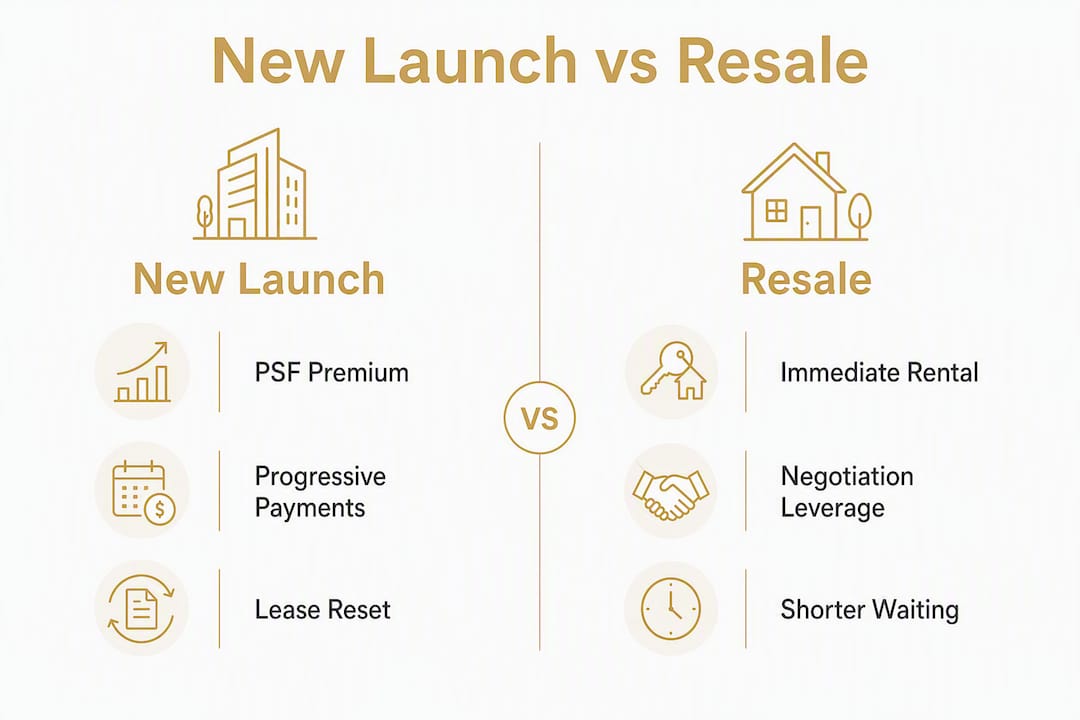
- New launch suits long-horizon buyers (10+ years) who can absorb a 10–30% PSF premium in exchange for a lease reset, modern facilities, and the Progressive Payment Scheme's lower early interest carry that helps with cashflow during construction.
- Resale suits buyers who need immediate possession or rental income, want negotiating room backed by URA caveat data, and prefer known unit condition over showflat promises.
- Your next step: run a cashflow comparison that maps your monthly outflows under both scenarios against your target hold horizon before you commit to either path.
Table of Contents
- How do new launch and resale prices actually compare?
- How payments and lending differ between new launches and resale
- When can you move in or rent out?
- Rental yields and cashflow: resale now vs new launch later
- What does the full cost picture look like?
- How do you use URA data to negotiate on resale?
- What are the main risks, and how do you manage them?
- Which buyer profile should choose which option?
- One Marina Gardens as a new-launch case study
- What's the final verdict?
- Key Takeaways
- The variable most buyers get wrong
- One Marina Gardens: the new-launch case in District 01
- Useful sources and reference links
How do new launch and resale prices actually compare?
New launches generally carry a PSF premium over resale units, though the size of the gap varies across Singapore. In the Core Central Region (CCR), where resale stock already commands premium pricing, the PSF gap tends to be smaller. In Outside Central Region (OCR) growth corridors, developers often price new launches more aggressively relative to resale comparables, resulting in a larger premium.
| Region | Typical Resale PSF | Typical New Launch PSF | Approximate Premium |
|---|---|---|---|
| CCR | $2,400 | $2,600–$3,000 | 10–20% |
| RCR | $2,000–$2,400 | $2,100–$2,400 | 10–20% |
| OCR | $1,500–$1,800 | $1,800–$2,000 | 15–30% |
Ranges are indicative based on 2025–2026 market reporting, with typical new-launch premiums between 10–30% PSF depending on region and project. Always verify against current URA caveat data for your target submarket.
Ranges are indicative based on 2025–2026 market reporting. Always verify against current URA caveat data for your target submarket.
One number that distorts these comparisons: URA's 2024 strata area harmonisation removed non-liveable spaces such as A/C ledges and planter boxes from the stated strata area of new developments. That smaller denominator inflates PSF for new launches relative to older resale units, which were measured under the old rules. Two units with identical usable interiors can show a PSF gap purely from measurement methodology, due to how strata areas are reported. Always ask the developer for the internal floor area and compare that figure, not the headline strata PSF.
Worked example: A 900 sqft (strata) new launch at $2,500 PSF costs $2.25M. A comparable resale unit at $2,100 PSF costs $1.89M. That $360,000 gap is the premium you're paying. If the new launch's actual usable interior is 820 sqft due to harmonisation, the effective PSF is closer to $2,744, widening the real gap further. Factors that justify paying the premium: a fresh 99-year lease, developer-standard fittings, and facilities you'd otherwise renovate into an older unit. Factors that argue against it: resale units in the same block often offer 50–100 sqft more usable space, and URA caveat data gives you a precise anchor for negotiation.
URA estimates showed private home prices rising modestly quarter-on-quarter, with OCR seeing stronger growth. That momentum partly explains why developers in OCR are holding firm on pricing.
How payments and lending differ between new launches and resale
The Progressive Payment Scheme (PPS) is the single biggest structural advantage of buying a new launch, and most buyers underestimate how much it changes early-year cashflow.

How PPS works: Instead of drawing down the full mortgage at purchase, your loan is released in stages tied to construction milestones. A typical schedule looks like this:
The Progressive Payment Scheme involves stages of cash and loan drawdowns tied to construction milestones, starting with an initial booking fee and followed by successive payments as construction progresses, culminating at legal completion.
For a resale purchase, the process is different. You exercise the OTP, and full mortgage servicing typically begins within 8–12 weeks of completion. From day one, you're paying interest on the full loan amount.
Sample cashflow comparison (illustrative, $2M purchase, 75% LTV, 3.5% interest rate):
| Year | Resale: Monthly Mortgage | New Launch (PPS): Monthly Interest | Difference |
|---|---|---|---|
| Year 4+ (post-TOP) | — | — (full drawdown) | Equivalent |
Figures are illustrative. Actual drawdown timing depends on construction progress. Consult your lender for a project-specific schedule.
The PPS interest saving is material over a 3–4 year construction period, but it only holds if you don't need to pay interim rent while waiting for TOP. If you're vacating an HDB flat or renting temporary accommodation, that interim housing cost can erode the PPS advantage quickly.
TDSR rules from MAS apply from the point of loan drawdown. For new launches, each progressive drawdown counts toward your TDSR calculation at that stage, not at booking. For resale, the full loan counts immediately. Buyers with existing mortgages should model both scenarios carefully before committing. CPF usage follows the same staged logic for new launches: you can deploy CPF at each milestone rather than in a lump sum.
When can you move in or rent out?
New launches require patience. From sales launch to TOP typically takes 3–4 years, and that timeline is a hard constraint, not a soft estimate. During construction, the Sale and Purchase Agreement (SPA) gives you statutory protections: developer funds are held in a project account and cannot be withdrawn until construction milestones are certified. That's meaningful protection, but it doesn't change the fact that you cannot occupy or rent the unit until TOP.

| Milestone | New Launch | Resale |
|---|---|---|
| Purchase agreement signed | Day 0 | Day 0 |
| Keys / possession | 3–4 years (TOP) | 8–12 weeks |
| Rental income starts | 3–4 years + defect period | Within weeks of completion |
| Defect liability window | 1 year from TOP | Buyer's inspection pre-OTP |
| Renovation (if needed) | Minimal (developer-fitted) | 2–6 months depending on scope |
Resale buyers get possession in 8–12 weeks and can rent immediately. That immediacy has a compounding effect: a resale unit generating 3% gross yield on a $3M purchase produces meaningful rental income over the same 3–4 years a new-launch buyer spends waiting for TOP.
The defect liability period for new launches runs one year from TOP. During that window, the developer is obligated to rectify structural and finishing defects. For resale, the buyer assumes the unit's condition at handover, which is why a pre-purchase inspection by a qualified surveyor is non-negotiable on older units.
One hidden cost that catches buyers off guard: if you're selling your current home to fund the new launch and need to rent temporary accommodation during construction, that interim rent can represent a substantial monthly outflow depending on unit size and location, accumulating significantly over the multi-year construction period.
Rental yields and cashflow: resale now vs new launch later
Resale wins the short-term yield comparison almost every time. The question is whether new-launch appreciation over a longer hold makes up the difference.
Typical gross yields for resale condos in Singapore vary by district and unit size and tend to be within a moderate range. New launches at TOP tend to yield similarly, but the 3–4 year gap in rental income is the real cost. For investors who need rental income to service their loan, resale is the only viable path.
Scenario table: $2.5M purchase, 75% LTV, 3.5% interest rate
The scenario table illustrates how rental income and capital appreciation vary between resale and new launch over different hold periods, highlighting trade-offs but without specific numerical guarantees. These illustrative scenarios are not forecasts.
New-launch buyers benefit from a lease reset on leasehold projects, which keeps the remaining lease above 60 years at the 10-year mark. That matters because CPF and bank financing become restricted on units with fewer than 60 years remaining, narrowing the buyer pool at resale. A resale unit purchased today with 70 years remaining will have 60 years left in a decade, right at the financing cliff. That lease decay risk is structural, not speculative.
For rental yield benchmarking, compare your target project against recent URA rental caveats in the same submarket before locking in yield assumptions.
What does the full cost picture look like?
The headline price is only the start. Here's what actually moves the needle on total cash needed to close and move in.
Stamp duties (Singapore citizens, first property, $2M purchase):
- Buyer's Stamp Duty (BSD): Calculated on a tiered basis per IRAS BSD rules). On a $2M property: 1% on first $180K + 2% on next $180K + 3% on next $640K + 4% on next $500K + 5% on next $1.5M (where applicable). Approximate BSD: ~$54,600.
- Additional Buyer's Stamp Duty (ABSD): Singapore citizens buying their first property pay 0% ABSD. Second property: 20%. Permanent residents buying first property: 5%. Foreigners: 60%. Full rates at IRAS ABSD).
- Seller's Stamp Duty (SSD): Updated effective July 4, 2025. SSD now applies on a sliding scale based on holding period. Selling within 1 year: 12%. Within 2 years: 8%. Within 3 years: 4%. Beyond 3 years: 0%. This directly affects new-launch sub-sales before TOP and any resale flip within the SSD window.
For a foreign buyer purchasing a unit as a first property, the combined BSD and ABSD can represent a very substantial stamp duty cost that significantly impacts the investment math. That changes the investment math entirely. Detailed ABSD guidance for foreign buyers is worth reviewing before any offer.
Hidden costs that buyers routinely underestimate:
Additional costs buyers routinely face include legal fees, valuation fees, renovation expenses especially for older resale units, maintenance fees, potential GST on mixed-use components, and moving/temporary storage expenses, all varying based on circumstance.
New launches come developer-fitted, which eliminates the renovation line item but doesn't eliminate the maintenance and sinking fund costs. Resale buyers should budget renovation as a certainty on units older than 10 years, not a maybe.
How do you use URA data to negotiate on resale?
Resale buyers have a tool developers never give you: URA caveat transaction data, which shows every lodged transaction by development, unit type, floor, and date. Developer pricing is set by phase and is effectively non-negotiable. Resale pricing is not.
Resale non-landed transaction volumes fell to 2,051 units in Q1 2026, a 41.9% quarter-on-quarter drop as buyers shifted toward new launches. That volume decline creates pockets of motivated sellers, particularly in developments that haven't seen recent transactions. A seller sitting on a unit for 6+ months with no offers is a negotiating opportunity.
How to use URA caveats effectively:
- Pull the last 6–12 months of caveats for your target development and unit type from the URA Realis portal
- Identify the lowest transacted PSF in that window and use it as your opening anchor
- Note any units that transacted below the development's median and research why (high floor vs low floor, facing, renovation condition)
- Bring 3 comparable caveats to your agent meeting and ask the seller to justify any premium above the lowest recent comparable
- Check whether the seller's unit has been listed for more than 60 days, which signals pricing resistance and negotiating room
Questions to ask before making an offer:
- What is the seller's timeline? (Motivated sellers often have a fixed deadline)
- Has the unit been inspected recently? Are there outstanding MCST arrears?
- What is the remaining lease, and does it affect CPF or loan eligibility for the next buyer?
- What renovation work has been done, and are there permits for any structural changes?
Developer price lists don't come with any of this leverage. You pay the phase price, full stop.
What are the main risks, and how do you manage them?
New launch risks:
- Construction delays extending the TOP timeline by 6–18 months, which extends interim housing costs and defers rental income
- Developer quality and finishing standards diverging from showflat presentation (the showflat vs actual unit gap is real)
- Market cycle exposure: you're committing at today's price for a unit you receive in 3–4 years, with no guarantee the market holds
- Sub-sale friction: selling before TOP triggers SSD and requires finding a buyer willing to take over your SPA, which is a thin market
- Illiquidity: you cannot exit cleanly until TOP without SSD exposure
Resale risks:
- Hidden defects in older units, particularly plumbing, electrical, and waterproofing
- Lease decay narrowing your future buyer pool and financing options
- Older facilities that require MCST special levies for major repairs
- Less price transparency on individual unit condition vs caveat data
Mitigation checklist:
- For new launches: verify the developer's track record on past TOP timelines; review the SPA's liquidated damages clause for delays; model your cashflow with a 12-month TOP delay
- For resale: commission a professional building inspection before exercising the OTP; check MCST meeting minutes for pending special levies; verify the remaining lease against your CPF withdrawal limit
- For both: stress-test your TDSR at 4.5% interest rate, not just the current rate
Pro Tip: To neutralize PSF distortions between new launches and resale, ask the developer for the internal floor area (excluding all void spaces, A/C ledges, and planter boxes) and divide the purchase price by that number. Then pull the URA caveat PSF for a comparable resale unit and adjust it upward by roughly 5–8% to account for the older measurement methodology. That gives you a like-for-like PSF comparison that headline figures never show you.
Liquidity is the underrated variable. Resale units in a normal market typically clear within 3–4 months. New launches are effectively illiquid until TOP, and any sub-sale before that date faces SSD exposure plus a thin buyer pool. If there's any chance you'll need to exit within 3 years, resale is the only rational choice.
Which buyer profile should choose which option?
| Buyer Profile | Recommended Option | Minimum Hold Horizon | Top Due-Diligence Question |
|---|---|---|---|
| HDB upgrader needing possession within 12 months | Resale | 3–5 years | Does the remaining lease affect CPF usage? |
| Cashflow-constrained investor, 10+ year horizon | New launch | 10+ years | What is the developer's TOP track record? |
| Investor needing rental income to service loan | Resale | 5–7 years | What is the current gross yield for this development? |
| Owner-occupier, flexible timeline, wants modern facilities | New launch | 7–10 years | What is the usable interior area vs strata area? |
| Upgrader with existing property, strong cashflow | New launch | 8–10 years | What are the ABSD implications of holding two properties? |
| Foreign buyer (60% ABSD) | Resale (if buying) | 10+ years | Does the yield net of ABSD still make sense? |
The HDB upgrader case deserves a specific note. If you're selling your HDB flat and need to move into your new home within 12 months, a new launch is structurally incompatible with that timeline. Resale is the only option that delivers possession on a schedule you can plan around. For buyers considering property at an earlier life stage, the hold horizon math shifts significantly toward new launches given the longer runway for appreciation.
One Marina Gardens as a new-launch case study
Disclosure: Onemarinagardens is the publisher of this article and the developer's appointed marketing channel for One Marina Gardens. The analysis below uses this project as a concrete example of the new-launch case. Run your own numbers independently.
One Marina Gardens sits in District 01, 160 meters from Marina South MRT, with direct connectivity to the CBD and Orchard Road. The project facts:
- Developer: Kingsford Marina Development
- Units: 937 residential units, 1-bedroom to 4-bedroom configurations
- Facilities: Multiple sky terraces, 50-metre lap pool, dedicated childcare centre, retail shops, and restaurant
- Connectivity: 160m from Marina South MRT; walking distance to Marina Bay financial district
- Prices: From $1.81M (see the current price list for available units)
Illustrative comparison against a nearby resale comparable:
A 2-bedroom new launch unit at One Marina Gardens at approximately $2,800 PSF (strata) versus a comparable 2-bedroom resale unit in the Marina Bay area at approximately $2,400 PSF (older measurement methodology). Adjusting for URA harmonisation, the effective usable-area PSF gap narrows to roughly 10–15%. Over a 10-year hold, the fresh 99-year lease on One Marina Gardens preserves financing eligibility for the next buyer, while a resale unit purchased today with 75 years remaining will have 65 years left at exit, still above the financing cliff but narrowing.
The PPS cashflow advantage at a $2.5M price point saves meaningful monthly outflow in years 1–3 compared with full mortgage servicing on a resale equivalent. The developer-backed SPA protections, project account ring-fencing, and one-year defect liability window are structural safeguards that resale purchases don't replicate.
To run One Marina Gardens' specific numbers into the framework above: request the developer's price list, identify your target unit's internal floor area, and model the PPS drawdown schedule against your current housing cost. The project fact sheet has the unit distribution and facility specifications you need to start that calculation.
What's the final verdict?
Resale wins for buyers who need possession now, rental income immediately, or negotiating leverage. New launch wins for buyers with a 10-plus year horizon, flexibility on move-in timing, and the cashflow to absorb interim housing costs during construction.
Six quick diagnostics to test which path fits you:
- Can you wait 3–4 years for possession, or do you need to move within 12 months?
- Do you have cash reserves to cover interim housing costs during construction?
- Does your investment case depend on rental income to service the mortgage?
- Is your target hold horizon 10+ years (new launch) or under 5 years (resale)?
- Are you comfortable with developer pricing rigidity, or do you want negotiating room?
- Does lease decay on a resale unit affect your CPF eligibility or future buyer pool?
Next steps:
- Run a cashflow model comparing PPS drawdowns vs full mortgage servicing for your target price point
- Pull URA caveats for 3 comparable transactions in your target development within the last 12 months
- Book a showflat visit or arrange a resale unit inspection before making any offer
- Confirm your ABSD position and stamp duty exposure with a qualified conveyancing lawyer
- Request a formal price list from the developer or agent and verify the internal floor area
Key Takeaways
Resale delivers immediate yield and negotiating leverage; new launches deliver lease reset and PPS cashflow savings that compound most powerfully over a 10-plus year hold.
| Point | Details |
|---|---|
| PSF premium is real but distorted | New launches carry a 10–30% PSF premium, partly inflated by URA's 2024 strata harmonisation; compare usable interior area, not headline PSF. |
| PPS cuts early interest carry | Progressive Payment Scheme stages loan drawdowns over 3–4 years, materially reducing monthly outflow versus full mortgage servicing on a resale from day one. |
| Resale wins on immediate yield | A resale unit can generate rental income within weeks of completion; a new launch yields nothing until TOP, typically 3–4 years away. |
| SSD shapes your exit window | The July 2025 SSD update sets rates at 12% (year 1), 8% (year 2), and 4% (year 3); sub-sales before TOP and short holds on resale both face this cost. |
| One Marina Gardens fits the long-horizon case | With a fresh 99-year lease, Marina South MRT access, and PPS financing, One Marina Gardens is structured for buyers holding 10+ years who want capital preservation in District 01. |
The variable most buyers get wrong
Most buyers frame the new launch vs resale decision as a price question. It isn't. It's a cashflow sequencing question.
The buyers who regret a new launch almost always made the same mistake: they modeled the PPS interest savings without modeling the interim housing cost. Those two numbers often cancel each other out, which means the real advantage of a new launch isn't the payment schedule. It's the lease reset and the modern product that commands a wider buyer pool at exit.
Conversely, the buyers who regret a resale purchase typically underestimated lease decay. A unit with 72 years remaining feels fine today. At the 10-year mark, it has 62 years left, and financing starts to tighten. At 15 years, some buyers will struggle to get CPF approval. That structural narrowing of your future buyer pool is a risk that doesn't show up in any yield calculation but shows up very clearly in your eventual sale price.
The honest advice: if your hold horizon is under 7 years and you need income, buy resale. If your hold horizon is 10-plus years and you can absorb the wait, a new launch in a well-located development with a credible developer is usually the stronger long-term bet. The data supports that view, and so does the lease math.
One Marina Gardens: the new-launch case in District 01
If the analysis above points you toward a new launch, One Marina Gardens makes a strong case for District 01. The project sits 160 meters from Marina South MRT, giving residents direct access to the CBD without a car. The unit mix runs from 1-bedroom to 4-bedroom, covering both investor and owner-occupier needs. Facilities include a 50-metre lap pool, multiple sky terraces, and a dedicated childcare centre, which is a rare inclusion in a Singapore condo and directly relevant to families weighing long-term livability.

The development is positioned in a mixed-use environment with retail and dining on-site, which supports rental demand from CBD professionals. For investors running the 10-year hold scenario from the cashflow section above, the fresh 99-year lease and Marina Bay address are the two variables that most directly support capital preservation at exit.
Disclosure: Onemarinagardens is the developer's marketing channel for this project. Run your own numbers independently using the URA caveat data and the framework in this article.
To request a price list, book a showflat visit, or download the project fact sheet, visit the One Marina Gardens project page. Available units, pricing from $1.81M, and the full facility specifications are listed there.
Useful sources and reference links
Use these primary sources to verify rules, run your own calculations, and pull comparable transaction data before making any offer.
- MAS TDSR and MSR Rules: — Explains how Total Debt Servicing Ratio and Mortgage Servicing Ratio apply to new and resale purchases, including how PPS drawdowns count toward TDSR.
- CPF Housing Usage: — CPF withdrawal rules for property purchases, including lease-length restrictions that affect both new launch and resale eligibility.
- URA Rental and Transaction Data: — Pull caveat transactions by development, unit type, and date. Use this to identify 3 comparables within a 12-month window before making any resale offer.
- One Marina Gardens Fact Sheet: Unit distribution, facility specifications, and project details for running the worked examples in this article against a specific price list.
- Best condominiums in Singapore: Broader buyer criteria and market positioning context for comparing new launch options across districts.