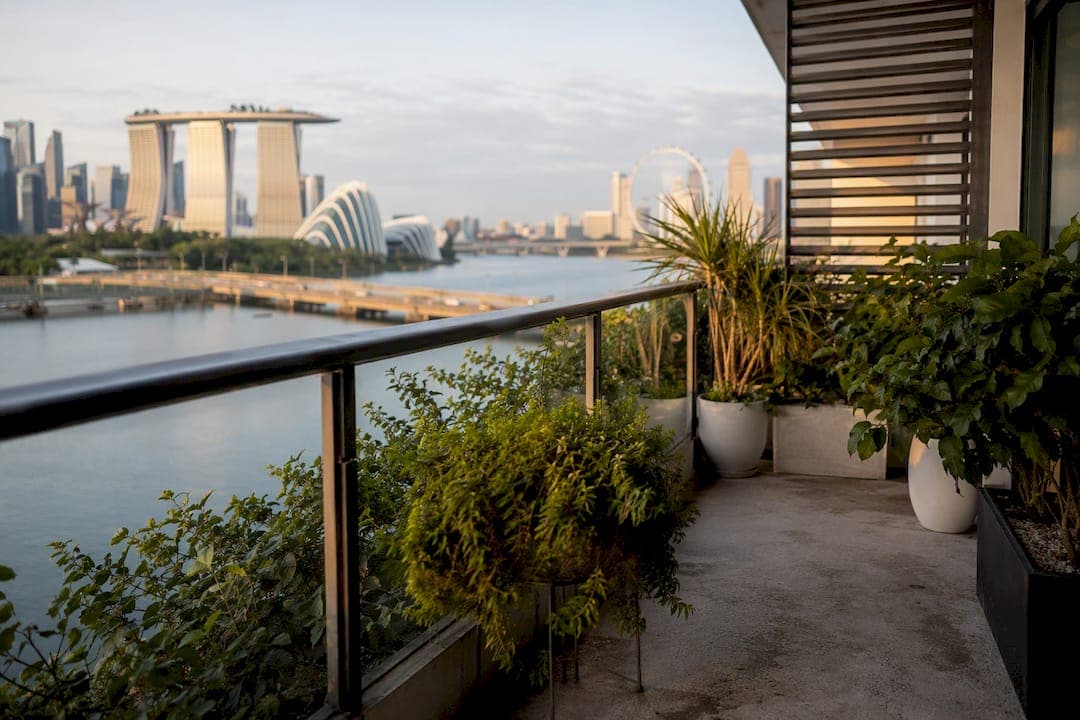
BLUF: renting out a private home for less than three consecutive months, or an HDB flat for less than six months, is illegal in Singapore. There's no gray area here. The Urban Redevelopment Authority (URA) sets the three-month floor for condos and landed property, and the Housing & Development Board (HDB) requires six months per rental application for flats, with written approval mandatory before a single tenant moves in. Both rules trace back to statute: the Planning Act governs private residential property, the Housing & Development Act governs HDB flats.
If you're hoping to rent for a weekend or a fortnight, none of that is available legally through a private residence in Singapore. Your options are:
- A licensed hotel
- A registered serviced apartment or aparthotel
- A longer lease that meets the statutory minimum
If you're an owner currently running short stays through a listing platform, take the listing down now and check whether you need HDB approval before you go any further.
Key Takeaways
Short-term rentals under three months for private property, or six months per HDB application, are illegal in Singapore and enforced with real fines and case-by-case prosecutions.
| Point | Details |
|---|---|
| Minimum stay, private property | Three consecutive months minimum, enforced by URA under the Planning Act. |
| Minimum stay, HDB flats | Six months per rental application, with written HDB approval required beforehand. |
| Occupancy caps | Six unrelated occupants under 90 sqm, up to eight for larger units with S$20 registration through 2028. |
| Owner liability | Owners remain responsible for violations even when a tenant ran the illegal listing. |
| Legal short-stay options | Hotels and licensed serviced apartments or aparthotels, never private listings marketed under other names. |
Table of Contents
- Understanding Short Term Rental Rules Under Singapore Law
- How to Apply for HDB Approval and Stay Compliant
- What Happens If You Break the Rules
- Occupancy Limits and the Temporary Relaxation Rule
- Legal Alternatives for Short Stays in Singapore
- An Owner's Compliance Checklist
- What Minimum-Stay Rules Mean for Condo Investors
- Considering a Compliant, Long-Term Rental Strategy?
- Why the Compliance Conversation Needs to Start Earlier
- Sources
- FAQ
Understanding Short Term Rental Rules Under Singapore Law
Two separate statutes carve up this space, and knowing which one applies to your property changes everything about what you're allowed to do.
Private residential property, including condominium units, falls under the Planning Act. URA's planning permission framework treats any stay under three consecutive months as "short-term accommodation," a use class that residential zoning doesn't permit. It doesn't matter if the guest calls it a vacation rental, a corporate stay, or a home swap. Duration is what the law tracks, not the label on the booking confirmation.
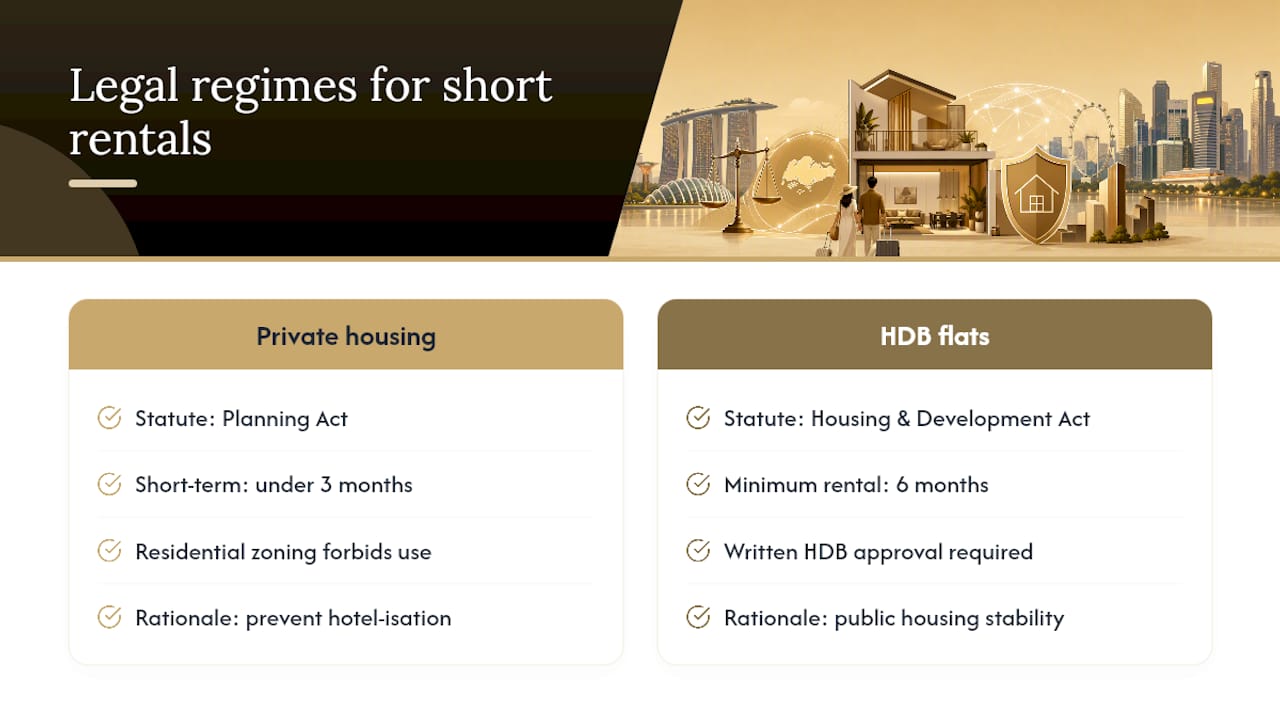
HDB flats sit under a different regime entirely: the Housing & Development Act. Because these flats are subsidized public housing tied to eligibility conditions, HDB imposes its own layer of control on top of the Planning Act baseline. The result is a stricter six-month minimum per rental application, and owners need written HDB approval before renting out a whole flat or even individual bedrooms.
Why the split? Public housing policy in Singapore is built around stability for residents, not turnover. Private housing gets more flexibility, but URA still draws a hard line to stop what planners call the "hotel-isation" of residential blocks, where short-stay guests effectively convert an apartment building into an unlicensed hotel. That's the policy logic behind both statutes, even though the thresholds differ.
How to Apply for HDB Approval and Stay Compliant
If you own an HDB flat and want to rent it out legally, the process has real steps, not just a checkbox.
- Confirm eligibility first. You typically need to have fulfilled your Minimum Occupation Period before HDB will consider a rental application.
- Submit your application through HDB's official portal, declaring the number of tenants, their nationalities, and the intended rental duration.
- Meet the six-month minimum per application, with maximum rental periods capped by tenant nationality: up to three years if every tenant is Singaporean or Malaysian, but capped at two years if any tenant holds another nationality.
- Renew before expiry. Approval doesn't roll over automatically, so mark the expiry date and reapply ahead of time.
Owners of private property face lighter paperwork but real obligations: keep your approved unit layout on file, avoid lease clauses that quietly permit subletting for stays under three months, and vet tenants before handing over keys. If you're planning renovations alongside a new tenancy, HDB permit requirements for structural work follow a separate approval process worth understanding early.
What Happens If You Break the Rules
Enforcement in Singapore isn't theoretical, and the penalties escalate fast once a case reaches prosecution.
URA has pursued operators who advertised stays shorter than three months on booking platforms, and one media release documented six individuals found guilty and fined over one million Singapore dollars combined for running an illegal short-term accommodation operation. Minimum fines under the Planning Act typically start around S$5,000 per offense, but aggregated penalties climb steeply for repeat or multi-unit violations. HDB has separately signaled that compulsory acquisition of a flat is on the table in serious breach cases, a far heavier consequence than a fine.
URA guidance is explicit that owners remain responsible even when a tenant, not the owner, listed the property or ran the short-stay operation. Due diligence isn't optional; it's the legal standard you're held to.
Detection has gotten more sophisticated. URA and HDB monitor listing platforms directly, act on public tip-offs, and coordinate site visits. CNA reporting has tracked a rise in suspected illegal accommodation cases, including overcrowded units and listings openly advertising one-month stays, a duration well below the legal floor.
Occupancy Limits and the Temporary Relaxation Rule
Even for legal, longer-term rentals, Singapore caps how many unrelated people can share a unit, and there's a wrinkle worth knowing if your unit is larger than average.
- Standard cap: six unrelated occupants for private residential units under 90 square meters.
- Temporary relaxation: up to eight unrelated occupants for units 90 square meters or larger, provided the owner registers with URA and pays a S$20 registration fee.
- Validity window: the relaxation runs until December 31, 2028, after which the rule reverts unless extended.
None of this touches the minimum-stay requirement. A larger unit registered for eight occupants still can't be rented out for six weeks. Occupancy caps and minimum-stay rules are two separate compliance tracks, and clearing one does not clear the other.
Legal Alternatives for Short Stays in Singapore
If you need accommodation for less than three months, or you're an owner wondering what's actually permitted, the legal path runs through licensed operators, not private listings.
- Hotels are licensed and built for exactly this purpose.
- Serviced apartments and licensed aparthotels offer flexible stays but operate under a separate license class specifically approved for short-term use.
- Calling a private condo unit a "serviced apartment" or "B&B" on a listing page changes nothing legally. URA has clarified that labeling doesn't exempt a property from the minimum-stay rule; what matters is the actual use and duration.
Before booking anything marketed as a short stay, confirm the operator holds an actual license or registration, and ask for a formal receipt rather than a private transfer.
Pro Tip: If a listing's photos look like a regular condo living room rather than a hotel lobby or serviced-apartment reception, ask directly for the license number before you pay a deposit.
An Owner's Compliance Checklist
Run through this list before your next tenancy, whether you're renewing an existing lease or starting fresh.
- Pull down any active short-stay listing on booking platforms today, not after your next renewal date.
- Reread your lease for subletting language, and add a clause requiring tenants to notify you before subletting any part of the unit.
- Confirm every tenancy meets the minimum, three months for private property, six months per HDB application.
- Keep a paper trail: approval letters, tenant declarations, and lease copies, filed somewhere you can retrieve them fast if HDB or URA asks.
- Declare rental income to IRAS and retain receipts; IRAS guidance on rental income covers what's deductible and what's taxable.
Pro Tip: Schedule a quarterly walk-through of your own unit, even with a long-term tenant in place. It's the easiest way to catch unauthorized subletting before it becomes your legal problem.
What Minimum-Stay Rules Mean for Condo Investors
Minimum-stay rules directly shape how you should think about rental yield. A three-month floor rules out the short-stay arbitrage some investors chase in other markets, so your holding strategy needs to center on stable, longer-term tenancies instead.
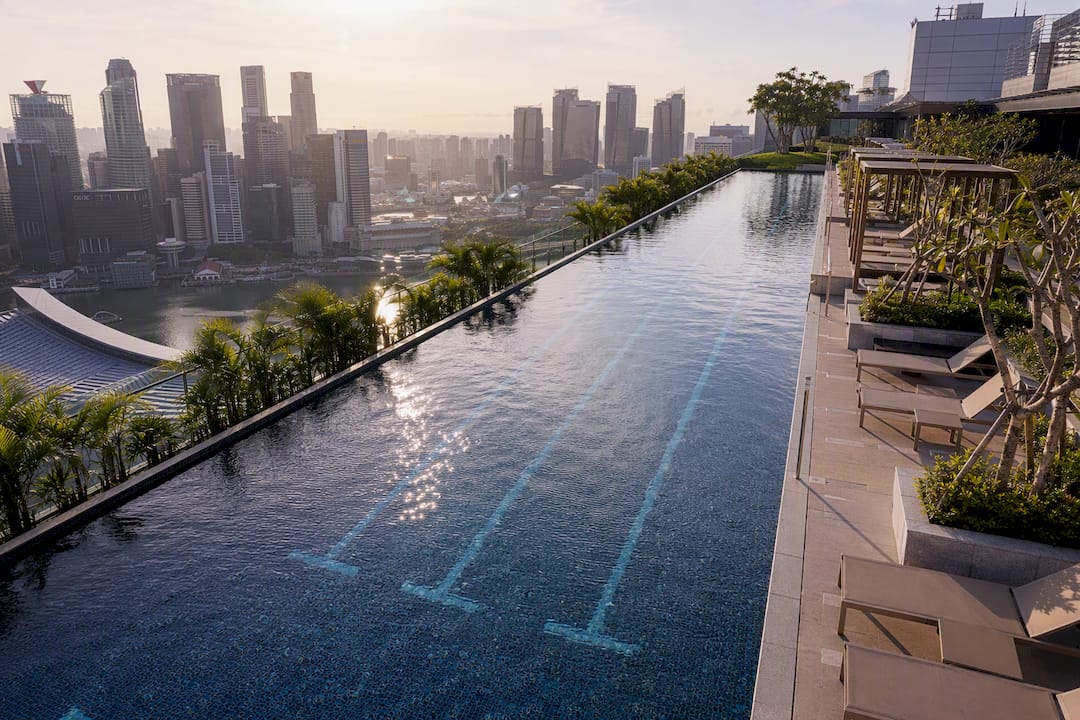
That's exactly the profile a well-located district one development supports. Units at One Marina Gardens, with sky terraces, a 50-meter lap pool, and direct access to Marina South MRT, are built for tenants who stay, not tourists who cycle through weekly. If you're comparing yield potential across projects, rental yield data across Singapore condos is worth reviewing before you commit.
Considering a Compliant, Long-Term Rental Strategy?
Getting the compliance picture right upfront saves you fines, legal exposure, and a scramble later. If you're evaluating a condo purchase with rental income in mind, the unit mix and facilities matter as much as the legal minimums. One Marina Gardens offers 1 to 4-bedroom units suited to tenants signing standard, longer leases, exactly the tenancy structure Singapore's rental rules are built around. Browse the development gallery or check unit specs and facilities to see how the layout fits a compliant leasing strategy from day one.
Why the Compliance Conversation Needs to Start Earlier
Most guidance on this topic treats compliance as a reaction, something you deal with after a tenant gets flagged or a neighbor complains. That's backwards. The real leverage point is before you sign a lease or list a unit, not after URA sends a notice.
The bigger blind spot is owner liability. Plenty of landlords assume that if a tenant runs an illegal sublet without their knowledge, they're in the clear. URA's own guidance says otherwise: due diligence is the owner's job, not a defense you get to raise after the fact. That single point should reshape how every landlord screens tenants and writes lease clauses, yet it's the part most rental guides bury near the bottom or skip entirely.
If you take one thing from this guide, prioritize the lease language over the listing platform. A clean lease with an explicit no-subletting clause and tenant notification requirements protects you more than any amount of platform monitoring after the fact. Rules change, relaxations expire, but a well-drafted lease holds up regardless of what URA updates next.
— Velisa
This article is general information, not a substitute for advice from a qualified lawyer. Consult a qualified legal professional about your own circumstances before acting on anything here.
Sources
- Renting property | Urban Redevelopment Authority (URA)
- Regulations for renting out a flat | Housing & Development Board (HDB)
FAQ
What Is the 80/20 Rule for Airbnb?
There's no official rule based on a fixed percentage in Singapore's short-term rental law. It's not a recognized regulatory standard here, and short-term listings under three months for private property remain illegal regardless of any arrangement.
Can I Rent for Three Months in Singapore?
Yes, three consecutive months is the legal minimum for private residential property under URA rules. Anything shorter is classified as short-term accommodation and is not permitted.
Is Airbnb Still Illegal in Singapore?
Short-term listings through Airbnb or any similar platform remain illegal for private homes rented out for under three months, and HDB flats face an even stricter six-month minimum. The platform's name or marketing label has no bearing on legality.
What Is the Minimum Rental Period for a Property in Singapore?
Private residential property requires a minimum of three consecutive months per tenancy, while HDB flats require six months per rental application with prior HDB approval.