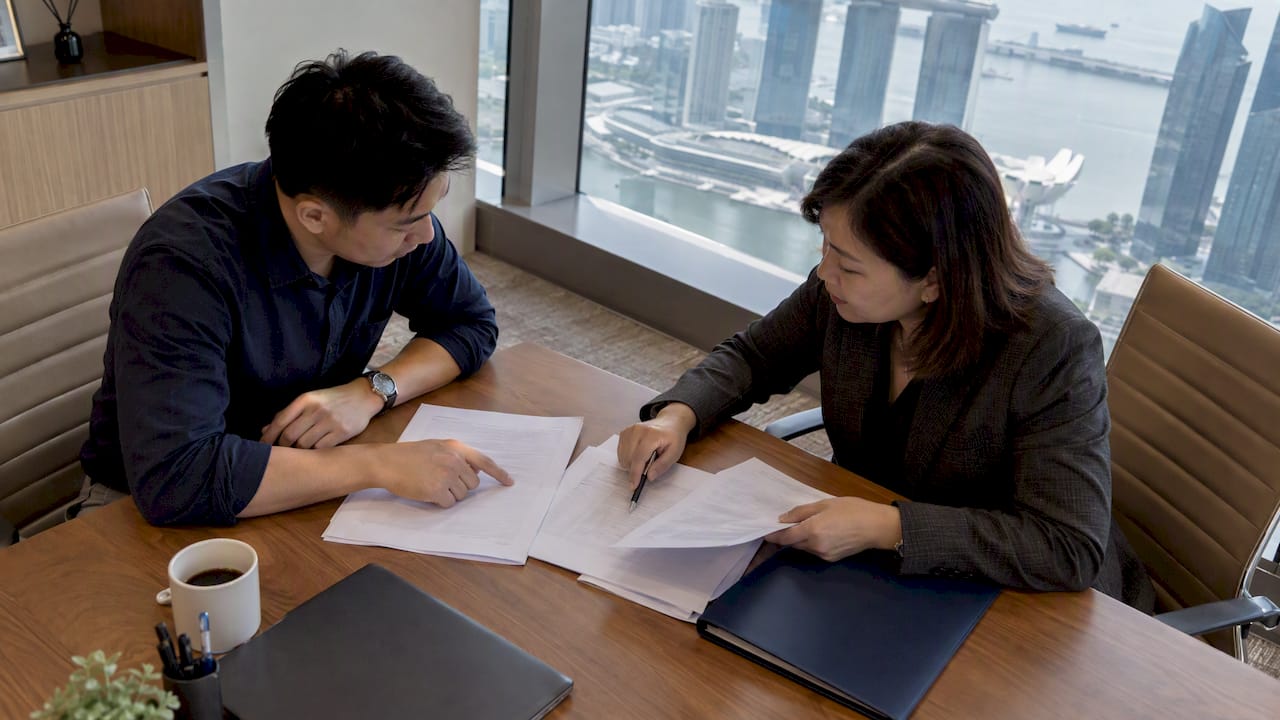
Most buyers in Singapore pay roughly S$2,000 to S$5,000 all-in for private property conveyancing, while HDB resale purchases typically run S$1,500 to S$3,000 with a private lawyer, or under S$1,000 with HDB's in-house option for straightforward cases. The three things that move the price most are CPF and mortgage paperwork, bank panel requirements, and disbursements. Watch for low advertised base fees that quietly exclude these items.
TL;DR:
- Conveyancing costs in Singapore usually range from S$2,000 to S$5,000 for private properties and under S$1,000 for straightforward HDB resale cases using HDB's in-house service.
- Quotes often exclude disbursements like CPF processing, bank fees, and stamp duties, which can significantly increase the final bill.
- Using a bank's panel lawyer can qualify buyers for legal fee subsidies, potentially reducing costs compared to engaging a non-panel firm.
- A clear, itemized quote covering professional fees, disbursements, GST, and scope limitations is essential for accurate budget planning.
- Property complexity, such as multiple owners or CPF ties, greatly influences the conveyancing fees, with more complicated transactions costing more.
Table of Contents
- Typical conveyancing fee ranges you should expect
- What your conveyancing fee actually covers, and what it doesn't
- HDB resale conveyancing: in-house versus private lawyer
- Why a bank mortgage can change your legal bill
- How lawyers actually calculate and quote your fee
- When fees get billed during the conveyancing timeline
- Choosing a lawyer: the questions that actually matter
- Budgeting legal fees into a new condo purchase
- Comparing quotes across different law firms
- Hidden costs that catch buyers off guard
- Negotiating conveyancing fees without cutting corners
- How property type and complexity change your fee
- How and when you'll actually pay
- What matters most when comparing conveyancing quotes
- FAQ
- Sources
Typical conveyancing fee ranges you should expect
Before comparing quotes, it helps to know the bands most buyers fall into. Private property purchases in Singapore tend to run S$2,000 to S$5,000 all-in, covering professional fees plus disbursements. HDB resale deals cost less: a private lawyer typically charges S$1,500 to S$3,000, while HDB's own in-house conveyancing service often comes in under S$1,000 for standard cases with no unusual CPF or ownership issues.
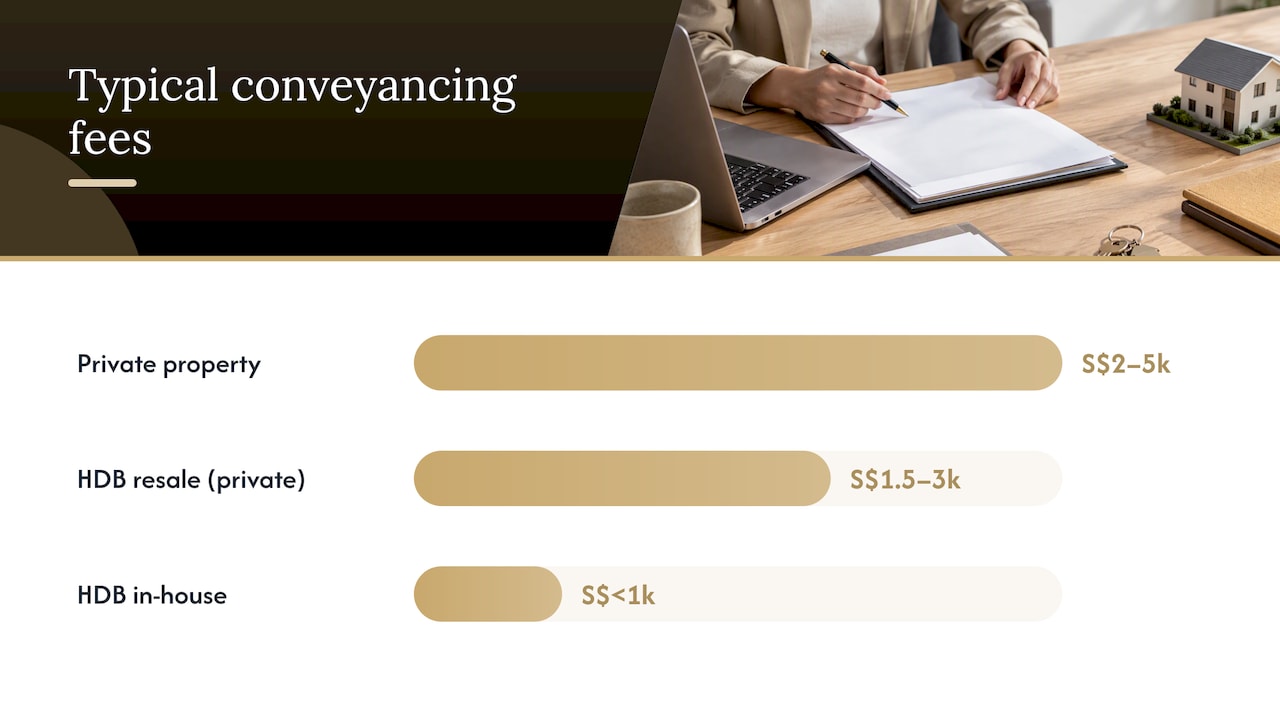
DBS publishes an estimated legal fees table as a general reference for buyers comparing law firm quotes, though the bank notes its figures exclude GST and disbursements, so the real bill lands higher.
Two quick examples illustrate how this plays out:
- A simplified private condo purchase might have professional fees around several thousand Singapore dollars, plus separate disbursements for title search, registration, and stamping, with GST and stamp duty billed separately (which is budgeted separately, as covered in our guide to buyer's stamp duty).
- An HDB resale with a private lawyer might total a few thousand Singapore dollars all-in, whereas buyers qualifying for HDB's in-house service often pay significantly less, sometimes under a thousand dollars.
Variance between quotes usually comes down to a handful of factors: how many owners are on the title, whether CPF funds are involved, whether the transaction crosses borders (a foreign buyer or seller, for instance), and how clean the title search comes back. A single-owner HDB resale with no CPF complications is about as simple as conveyancing gets in Singapore; a private condo purchase with multiple CPF accounts, a bank mortgage, and a tight completion date adds layers of work that justify a higher quote.
What your conveyancing fee actually covers, and what it doesn't
A conveyancing bill in Singapore has two distinct parts, and confusing them is the most common reason buyers feel blindsided.
Professional fees are what the law firm charges for its own work: drafting and reviewing the sale and purchase agreement, conducting due diligence, handling CPF submissions, liaising with the bank, and attending to completion. Disbursements are third-party costs the firm pays on your behalf and passes through, typically without markup.
The Legal Profession (Solicitors' Remuneration) Order sets the principle that solicitor fees must be fair and reasonable rather than fixed by tariff, which is part of why quotes vary across firms.
Common disbursements include:
- Title search fees at the Singapore Land Authority.
- Stamp duty filing and processing charges, separate from the stamp duty itself.
- Land registry and caveat lodgement fees.
- Bankruptcy and litigation search fees for all parties.
- Bank and CPF-related administrative charges when a mortgage or CPF funds are used.
Most firms bill disbursements as itemized pass-through costs rather than a flat lump sum, and GST at the prevailing rate applies to professional fees. A frequent gap buyers miss: a quote that looks competitive on professional fees alone but adds GST and a long list of disbursements only after the engagement letter is signed.
HDB resale conveyancing: in-house versus private lawyer
HDB resale buyers have an option private property buyers don't: using HDB's own in-house conveyancing service instead of hiring a private law firm. For a standard resale, with one or two owners and no unusual CPF history, this is often the cheapest route, sometimes under S$1,000 total.
That said, HDB in-house service isn't available or suitable for every transaction. More complex cases, multiple co-owners with differing CPF positions, estate or divorce-related sales, or buyers who want a dedicated lawyer managing every step, usually need a private firm.
CPF involvement adds its own layer regardless of which route you take. The CPF Conveyancing Panel requires members to nominate a preferred law firm in their application forms, and fees payable to panel firms for CPF disbursement and recovery work are borne by the applicant, varying by the nature of the work involved.
Practical notes for HDB buyers:
- Confirm eligibility for HDB in-house conveyancing before assuming it applies to your case.
- Factor in HFE letter requirements and resale portal steps, since these add administrative time even when legal fees stay low.
- Nominate your preferred firm correctly on CPF forms to avoid delays in fund disbursement.
Why a bank mortgage can change your legal bill
Taking out a home loan brings a second party into the conveyancing picture: your bank. Banks typically maintain a panel of approved law firms for mortgage-related work, and if the firm handling your purchase isn't on that panel, the bank will usually appoint its own panel firm to act for the loan.
This matters because it can mean paying for two sets of legal work instead of one. Many banks offer a legal fee subsidy to offset this, but the subsidy generally applies only when you use a panel firm for both the purchase and the mortgage.
There's also a regulatory wrinkle worth knowing. MAS requires lenders to deduct the value of discounts, rebates or benefits, including developer-paid legal fees, when calculating the adjusted purchase price for loan-to-value purposes. A "free legal fee" offer can therefore affect how much you're able to borrow.
- Ask your bank for its approved panel list before engaging a firm.
- Confirm whether any legal subsidy covers both purchase and mortgage work or only one.
- Clarify in writing who pays if the bank insists on appointing its own lawyer.
Pro Tip: Get your bank's panel confirmation in writing before signing with any law firm, since switching mid-process can mean paying for duplicated work.
How lawyers actually calculate and quote your fee
Singapore has no fixed national tariff for conveyancing. The Legal Profession (Solicitors' Remuneration) Order instead requires fees to be fair and reasonable, judged against the complexity and value of the transaction. This is why two firms can quote meaningfully different amounts for the same deal.
In practice, most firms quote a fixed fee for straightforward purchases and reserve time-based or complexity-adjusted pricing for cases involving multiple owners, estate issues, or cross-border elements. Fixed fees suit buyers who want cost certainty; time-based quotes suit transactions where the scope is genuinely hard to predict upfront.
A complete quote should spell out:
- The scope of work covered, including CPF submissions and mortgage liaison.
- What's explicitly excluded, so nothing surprises you later.
- An itemized list of anticipated disbursements.
- Whether GST is included or added separately.
- Any circumstances that would trigger additional charges.
When fees get billed during the conveyancing timeline
Conveyancing in Singapore follows a predictable sequence, and knowing where fees fall helps you plan cash flow alongside deposit payments.
- Option to Purchase (OTP) issued: your lawyer typically requests an initial retainer around this stage, often within the first one to two weeks of engagement. Our guide to the option to purchase covers this milestone in detail.
- Exercise of the option and contract completion: due diligence, title searches, and CPF or mortgage paperwork proceed over the following several weeks, with disbursements often billed as they're incurred.
- Completion date: final payment, including the balance of professional fees and any outstanding disbursements, is usually settled at or just before completion.
- Mortgage registration: a short administrative tail-end step after completion, sometimes carrying a small separate registration fee.
CPF disbursement and bank loan drawdowns each have their own processing lead times, and delays on either side can push back your completion date, so build in buffer time rather than assuming same-day turnaround.
Choosing a lawyer: the questions that actually matter
Picking a conveyancing lawyer on price alone is how buyers end up with surprise bills. A short, direct comparison process works better.
Look for clarity on scope (does the quote explicitly cover CPF and mortgage work, or just the sale agreement), confirmed bank panel status if you're taking a loan, relevant experience with your transaction type (HDB resale versus private purchase), whether pricing is fixed or variable, and realistic turnaround expectations.
When comparing quotes, ask directly:
- What exactly is itemized in this quote, and what isn't?
- How is CPF handling priced, and is it included or billed separately?
- Is GST included in the headline figure?
- What disbursements should I expect beyond the professional fee?
- If my bank appoints a different lawyer for the mortgage, who covers that cost?
Pro Tip: Ask every firm for the same itemized breakdown format before you compare quotes side by side, since differently structured quotes make real cost differences hard to spot.
Red flags include quotes that list only a headline number with no breakdown, engagement letters silent on bank panel arrangements, and firms unwilling to confirm in writing what happens if the scope expands.
Budgeting legal fees into a new condo purchase
Conveyancing fees are a small line item against the full cost of buying a new-launch condo, but they're easy to overlook when budgeting against deposit installments and progressive payments. For buyers working through a developer's payment schedule, it's worth lining up legal fee timing against each payment milestone rather than treating it as an afterthought.
Our guide to Singapore's progressive payment scheme breaks down how developer payments are staged, which is useful context when your lawyer requests retainers or final settlement amounts at specific points in that schedule. Pairing that schedule with a clear legal fee quote upfront avoids cash flow surprises later in the purchase.
— Velisa
Comparing quotes across different law firms
Fee comparison across Singapore law firms isn't always apples to apples, because headline numbers often hide different scopes. One firm's S$2,500 quote might include CPF handling and bank liaison; another's identical-looking S$2,500 might charge those as extras.
DBS's estimated legal fees page is a useful reference point precisely because it lists ranges rather than a single number, reflecting how much scope and complexity shift the final bill even within the same transaction type. When you request quotes from multiple firms, ask each to use the same structure: professional fee, CPF handling, mortgage liaison, disbursements, and GST, listed separately. That alone often reveals a few hundred dollars of difference that a bare headline figure would have hidden.
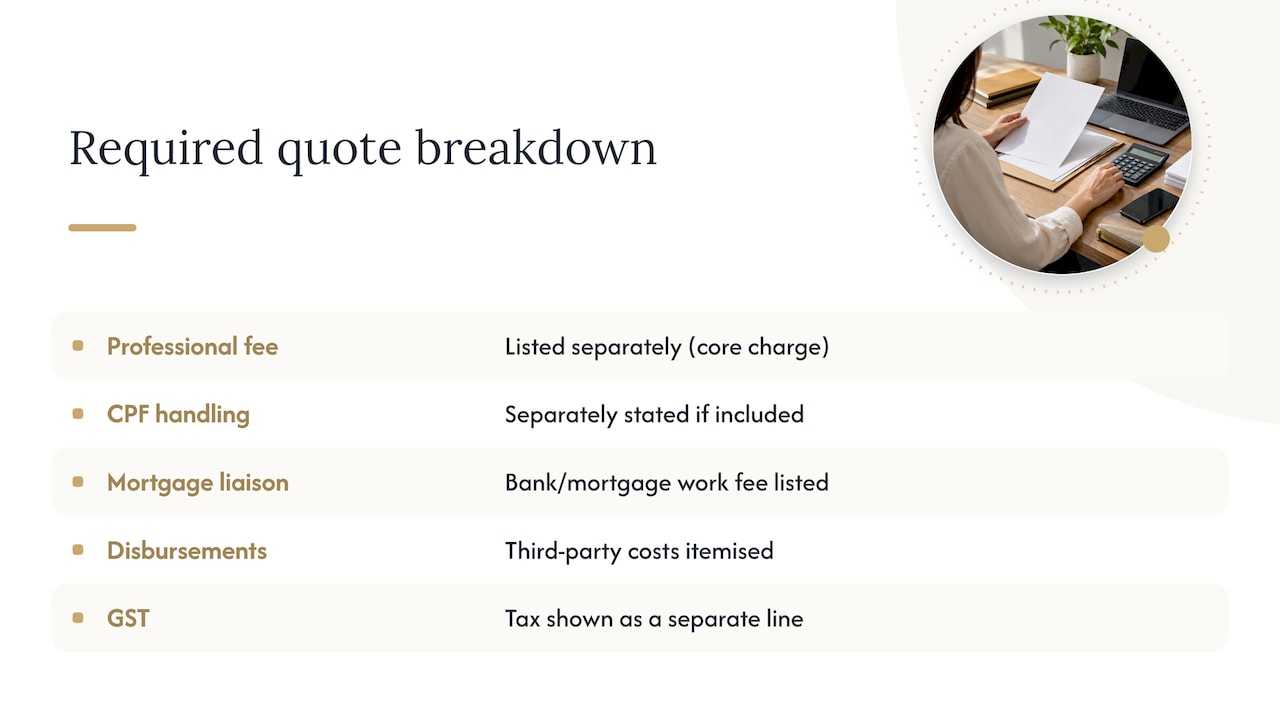
Larger firms with high transaction volumes sometimes offer more predictable fixed fees for standard deals, while smaller firms may be more flexible on price for simple, single-owner cases but less structured in how they itemize. Neither is inherently better, but the comparison only works once every quote is broken down the same way.
Hidden costs that catch buyers off guard
Beyond the quoted professional fee, a handful of costs tend to surface late in the process. Low advertised fees often exclude CPF handling, mortgage documentation, and administrative disbursements, which is why the final invoice can run noticeably higher than the number that first attracted you to a firm.
Other costs that catch buyers by surprise:
- Bankruptcy and litigation search fees for every party on the title, which multiply with co-owners.
- Caveat lodgement or withdrawal fees if an earlier caveat needs clearing.
- Additional administrative charges when CPF submissions require correction or resubmission.
- Courier, printing, and certified copy charges that smaller firms sometimes itemize separately.
The fix is straightforward: insist on a fully itemized quote before engagement, not after. Ask specifically whether CPF submissions, stamping coordination, and registry fees are included in the headline figure or billed on top.
Negotiating conveyancing fees without cutting corners
Conveyancing fees in Singapore aren't fixed by tariff, which means there's genuine room to negotiate, particularly for straightforward transactions.
Bundling helps: if you're also using the same firm for a related matter, or if your transaction is simple enough to quote with confidence, firms are often willing to shave the professional fee. Asking for a fixed fee upfront, rather than accepting a time-based estimate, also protects you from scope creep inflating the bill.
Bank panel status is worth leveraging too. If your financing bank offers a legal subsidy for panel firms, using one of those firms for both the purchase and mortgage legs often beats negotiating a lower fee with a non-panel firm, since the subsidy can outweigh any discount you'd otherwise negotiate.
What doesn't work well: pushing a firm to quote lower without giving them full details of the transaction. An artificially low fee agreed before disclosing co-owners, CPF complications, or cross-border elements usually gets revised upward once the real scope appears, which costs more time than it saves.
How property type and complexity change your fee
The type of property and the shape of the transaction move your fee more than almost anything else. A single-owner HDB resale with no CPF complications sits at the low end of the range, often qualifying for HDB's in-house service entirely. A private condo purchase with a mortgage and standard CPF usage sits in the middle, reflecting the extra bank liaison work.
Complexity climbs from there. Multiple owners with different CPF account structures, estate sales following a death, divorce-related transfers, or a foreign buyer or seller add legal steps that a standard resale never touches. Each of these typically pushes a quote toward the higher end of its range, or beyond it, because the firm genuinely spends more hours on due diligence and documentation.
Property type itself matters less than the paperwork trail behind it. A private condo and an HDB flat with identical ownership structures and no mortgage complications can end up with similarly scoped fees; it's the number of parties, funding sources, and title issues that drive the real difference.
How and when you'll actually pay
Most Singapore law firms request an initial retainer shortly after engagement, often timed close to when the Option to Purchase is exercised, with the balance due around completion. Bank transfer is the standard payment method, and larger firms increasingly accept payment via PayNow or cheque for smaller interim amounts.
CPF-funded portions follow a separate track: CPF Board disburses directly to the relevant party once the application is processed, so you're not personally fronting the CPF-funded share of fees connected to that process, though any panel firm fees charged for CPF disbursement and recovery work are still payable by you.
Interim disbursements, search fees and registry charges in particular, are sometimes billed as incurred rather than bundled into the final invoice, which is why an itemized quote matters: it tells you not just what you'll pay, but roughly when.
What matters most when comparing conveyancing quotes
The conventional advice to "shop around for the cheapest lawyer" misses the real lever: scope clarity beats price every time. A S$1,800 quote that excludes CPF handling and mortgage liaison will cost more in the end than a S$2,500 quote that includes both, once the gaps surface.
Buyers underestimate how much bank panel status affects the final bill, and overestimate how much negotiating the headline professional fee saves them. The bigger savings usually come from matching your lawyer to your bank's panel and confirming whether a legal subsidy applies, not from haggling over a few hundred dollars in professional fees.
If there's one thing to prioritize first, it's getting a fully itemized quote before signing anything, one that names CPF handling, mortgage liaison, disbursements, and GST as separate line items. Everything else, timeline, firm reputation, even price, is easier to judge once that breakdown is on the table.
— Velisa
This article is general information, not a substitute for advice from a qualified financial advisor. Consult a qualified financial professional about your own circumstances before acting on anything here.
FAQ
What is an average conveyancing fee in Singapore?
Private property purchases typically run S$2,000 to S$5,000 all-in, while HDB resale deals with a private lawyer usually cost S$1,500 to S$3,000. HDB's in-house conveyancing service often brings straightforward resale cases under S$1,000.
How much are lawyer fees in Singapore for buying property?
Lawyer fees depend heavily on property type and transaction complexity, with private purchases generally costing more than HDB resale deals due to added mortgage and CPF liaison work. The final bill also includes disbursements and GST on top of the quoted professional fee.
Does using a bank's panel lawyer save money?
Using a panel lawyer often qualifies you for a bank's legal fee subsidy, which can offset part or all of the mortgage-related legal cost. Insisting on a non-panel lawyer can mean the bank appoints its own firm separately, potentially resulting in two legal bills instead of one.
Is there a fixed tariff for conveyancing fees in Singapore?
No, conveyancing fees are not fixed by a national tariff. The Legal Profession (Solicitors' Remuneration) Order requires fees to be fair and reasonable based on the transaction's complexity and value, which is why quotes vary between firms.
Can I use HDB's in-house conveyancing service for any resale purchase?
HDB's in-house service generally suits straightforward resale transactions with one or two owners and no unusual CPF complications. More complex cases, such as estate sales or multiple co-owners with differing CPF positions, typically require a private law firm instead.
Sources
- CPF Conveyancing Panel — CPF Board (PDF)
- Deducting discounts, rebates or benefits — MAS
- Estimated Legal Fees | DBS Singapore
- Legal Profession (Solicitors' Remuneration) Order — Singapore Statutes Online (SSO)