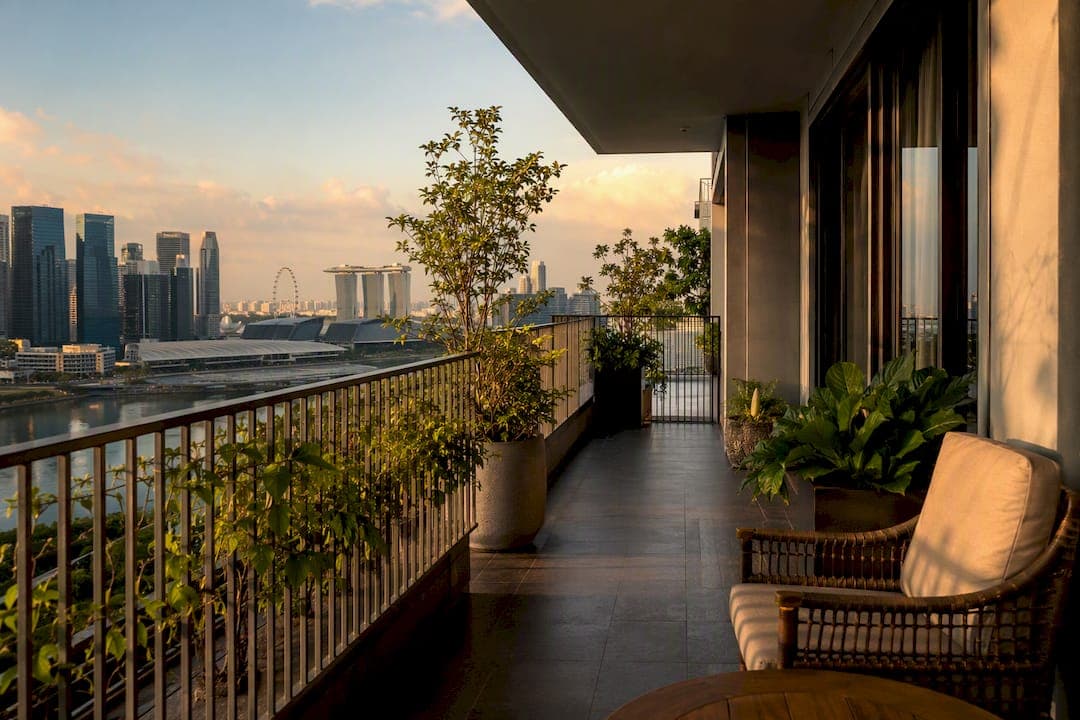
North south facing units are usually the smarter pick in Singapore, and the reasoning comes down to physics, not superstition. A north south orientation typically means your living spaces avoid the harshest afternoon sun and catch more of the year-round cross-breeze that Singapore's monsoon winds provide.
Three things drive this: prevailing winds from the northeast (roughly November to March) and southwest (April to October) tend to align well with north south facades, direct west-facing sun during peak afternoon hours gets dodged, and daylight arrives more evenly across the day instead of blasting one side of the unit for hours. Local property research consistently points to north south stacks as the preferred choice for exactly these reasons.
- Ventilation: Better alignment with seasonal wind patterns
- Heat avoidance: Skips the worst of direct afternoon sun exposure
- Balanced light: More even daylight distribution throughout the day
If you're raising young kids at home, working remote hours, or just tired of running the air-conditioning from 2 PM onward, prioritize a north south stack. If you want dramatic sunset views or don't mind heavier reliance on blinds and cooling, a west or east-facing unit with the right mitigation can still work.
Key Takeaways
North south facing units generally deliver better ventilation and lower afternoon heat gain in Singapore, but stack placement, glazing size, and shading still determine the real-world result.
| Point | Details |
|---|---|
| Orientation beats floor level | A well-positioned north south stack often outperforms a higher unit boxed in by neighboring towers. |
| Verify before buying | Cross-check stack maps, phone compass readings, and Google Maps satellite view during any viewing. |
| Watch corner and side glazing | Even north south units can gain heat through exposed east or west side walls. |
| Combine mitigation measures | Pair reflective film, external shading, and cross-ventilation for the strongest heat reduction. |
Ready to see how stack orientation plays out in an actual floor plan? Browse the One Marina Gardens gallery for façade and balcony references, check exact stack details on the project fact sheet, or book a showflat visit to walk a north south-facing unit in person.
Table of Contents
- What Does North South Facing Actually Mean in Singapore's Climate?
- What "North South Facing" Means and How to Check a Unit's Orientation
- Advantages of North South Facing Homes in Singapore
- The Trade-Offs Nobody Mentions About North South Units
- Sun Path and Prevailing Winds: How They Actually Interact
- Buyer Checklist: Evaluating a North South Stack Before You Commit
- Fixing Unwanted Heat: What Actually Works in Singapore Homes
- Quick On-Site Checks to Confirm a Unit's Real Sun Exposure
- Feng Shui Considerations for Facing Direction in Singapore
- What I'd Prioritize if I Were House-Hunting Right Now
- Sources
- FAQ
What Does North South Facing Actually Mean in Singapore's Climate?
Singapore sits almost exactly on the equator, which changes the whole conversation about house orientation compared to countries in temperate zones. There's no winter sun to chase here. The climate stays hot and humid year-round, with daytime highs regularly in the low 30s Celsius and humidity that rarely dips below 60%, according to Singapore's National Environment Agency.
That equatorial position also does something interesting to the sun's path. Rather than tracking a consistent arc like it would at higher latitudes, the sun's position drifts north and south of directly overhead across the year because of the Earth's axial tilt. Around the equinoxes, the sun sits almost directly overhead at noon. At other points in the year, it shifts slightly toward the north or south, which changes how intensely east and west facades get hit depending on the season.
Wind matters just as much as sun angle here. Singapore's prevailing winds run northeast during the November to March period and shift southwest from April to October, which is why buildings that catch cross-ventilation along a north south axis tend to feel noticeably cooler without mechanical help.
This matters more in a city of concrete high-rises than it would in a landed house with garden shade. Concrete absorbs heat during the day and radiates it back into rooms well into the evening, so orientation choices have outsized effects on:
- How hard your air-conditioner has to work
- Whether afternoons feel livable without cooling
- Long-term utility costs across the life of ownership
What "North South Facing" Means and How to Check a Unit's Orientation
North south facing simply means the main living facades of a unit face roughly along the north and south compass points, rather than east and west. In a typical condo, that means your living room and bedroom windows open toward the north or south skyline instead of catching the rising or setting sun head-on.
Confirming this before you commit to a unit takes four steps:
- Request the stack orientation from the developer's fact sheet or floor plan, which usually marks compass directions clearly on the site plan.
- Cross-check with Google Maps in satellite view, using the map's north arrow to trace which way your intended unit's windows point.
- Use your phone's built-in compass app while standing at the unit or its balcony during a viewing to verify the facing in person.
- Try a sun-path app like SunCalc to see how sunlight will move across that specific facade throughout the day and year.
Pro Tip: Watch out for mirrored stack layouts within the same block. Two units that look identical on a floor plan can face opposite directions if the tower design flips the layout from one wing to another, so always confirm the specific stack number rather than assuming a similar unit shares the same orientation.
Advantages of North South Facing Homes in Singapore
The biggest win is thermal comfort without fighting for it. A north south facade avoids the low, intense afternoon sun that hammers west-facing rooms between roughly 2 PM and 6 PM, when heat gain peaks. That translates directly into lower cooling demand and a home that doesn't feel like an oven by late afternoon.
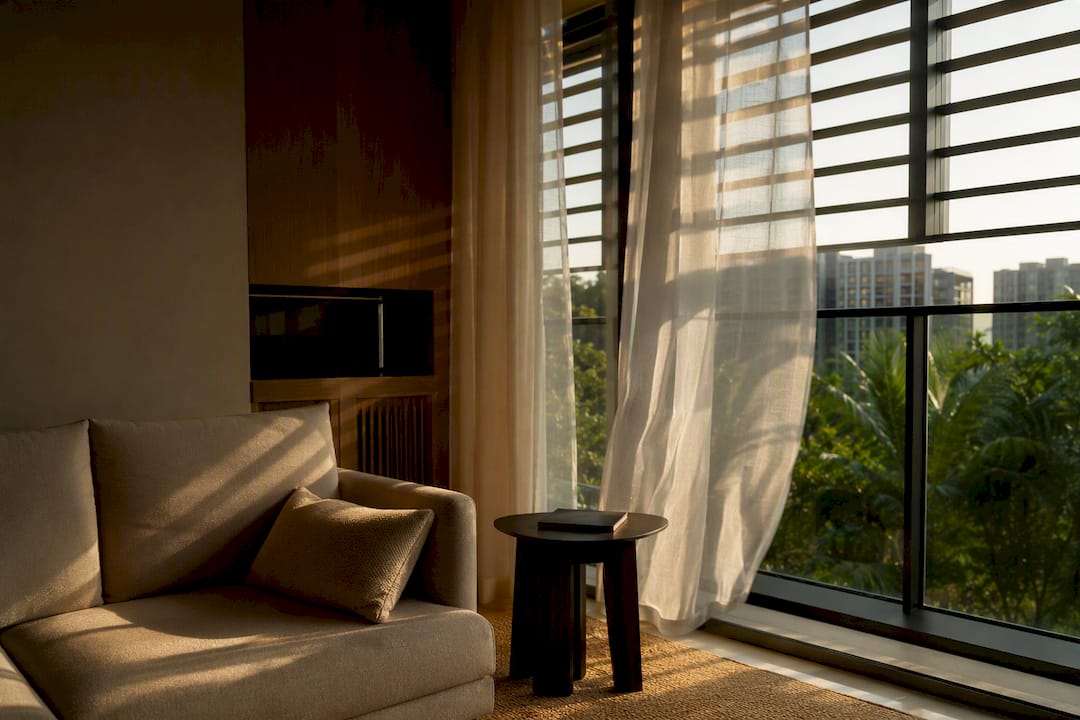
Ventilation is the second major advantage, and it compounds with the first. When your stack lines up with Singapore's seasonal wind shifts, cross-breeze moves through the unit rather than stalling in a single corner. Passive design guidance for hot climates near the equator consistently stresses that shading and airflow matter more than chasing solar warmth, which is the opposite of what orientation advice looks like in colder countries.
The daylight itself is also more usable. Instead of one blinding wall of glass at sunset, north south units tend to get soft, diffused light for longer stretches, which is gentler on furniture, easier on the eyes, and less likely to force you into keeping curtains drawn all day.
Who benefits most from this:
- Families with young children who spend afternoons at home and need rooms that stay livable without constant air-conditioning
- Remote workers running a home office through peak sun hours
- Retirees and older residents who are more sensitive to heat and prefer stable indoor temperatures, a consideration worth pairing with broader retirement living planning
- Long-hour commuters who are only home in the evening but still want the unit to have cooled naturally rather than trapping heat all day
The Trade-Offs Nobody Mentions About North South Units
North south facing isn't a free pass on every front, and pretending otherwise does buyers a disservice. Rooms on the north side, in particular, can feel dimmer during certain months since they miss the more direct light that east or west rooms get at sunrise or sunset. If you keep plants or want strong natural light for reading nooks, that's worth factoring in.
Layout can also work against you. Depending on how the block is designed, a north south stack might come with a narrower or less scenic balcony view compared to a unit angled toward the bay or a park, since orientation and view corridors don't always align.
Heat exposure isn't fully eliminated either. Side walls and staircases on the northwest or southwest corners of a building can still pick up meaningful afternoon warmth, especially in months when the sun's path shifts further toward one hemisphere. A north south label on paper doesn't guarantee zero heat gain if the unit sits at a corner with exposed side glazing.
- Large windows on adjacent east or west walls can undercut the orientation's benefit
- Deep-set balconies help block sun but shrink usable outdoor space
- Corner units often inherit some exposure from both directions
Sun Path and Prevailing Winds: How They Actually Interact
Singapore's afternoon heat problem is largely a west and southwest problem. Because the sun moves from east to west across the sky and Singapore near the equator sees relatively steep sun angles even in the afternoon, west and northwest-facing rooms absorb the most direct, sustained heat from roughly early afternoon through early evening. That's the stretch when concrete facades soak up warmth and keep radiating it long after the sun has moved on, a pattern documented in guidance on why afternoon sun causes problems in HDB units.
Wind timing offers a partial counterbalance. During the northeast monsoon (November to March), breezes generally arrive from that direction; during the southwest monsoon (April to October), they shift accordingly. A north south stack is well positioned to catch these seasonal shifts rather than blocking them, which keeps air moving through the unit instead of pooling stale heat near west-facing glass.
The real advantage of a north south facade in Singapore isn't about avoiding the sun entirely. It's about timing your exposure so the hottest hours of the day hit a wall you're not living behind.
Practically, this means stack selection matters more than floor level in most buildings. A north south unit on a mid-tier floor with a clear wind corridor can outperform a higher unit that's boxed in by neighboring towers, no matter how many stories separate them.
Buyer Checklist: Evaluating a North South Stack Before You Commit
Before signing anything, walk through a short set of checks that separate a genuinely comfortable north south unit from one that only looks good on the floor plan.
- Confirm the exact stack orientation using the developer's official site plan or fact sheet, not just a sales agent's verbal description.
- Check the immediate surroundings for taller neighboring blocks that could either shield the unit from heat or block the wind corridor entirely.
- Match room function to direction: living rooms benefit most from softer north or south light, while bedrooms on the south side often stay cooler at night.
- Ask the agent directly about afternoon sun exposure history and the actual glazing size on the unit's east and west walls, since even a north south stack can have side windows that leak heat.
Watch for these red flags during a viewing:
- Small, shallow balconies that offer no shade buffer against side sun
- Large glass panels facing east or west with no external shading elements
- Units where afternoon visits reveal noticeably warm walls or floors near the balcony door
- Sales material that emphasizes "unblocked views" without specifying which direction those views face
Resale value tracks these same factors closely. Buyers researching stack selection strategy for long-term value consistently point to orientation, unblocked sightlines, and afternoon heat exposure as the three variables that move resale price the most, alongside the layout considerations covered in guides on finding spacious homes in Singapore.
Fixing Unwanted Heat: What Actually Works in Singapore Homes
If you've already bought a unit with some west or afternoon exposure, or you're weighing a non-ideal facing against a better price, mitigation options in Singapore are genuinely effective when combined correctly.
Reflective and low-E window films are the most common fix, and heat-blocking, light-colored curtains and blinds paired with them can meaningfully cut how much solar heat actually enters a room. Suppliers generally market these films around significant reductions in solar heat gain, though actual results depend on the film grade, glass type, and installation quality, so treat marketing figures as a ceiling rather than a guarantee.
Beyond film, a few other categories consistently help:
- External shading like awnings or fixed louvers that block sun before it reaches the glass at all
- Light-colored, thermal-backed curtains for rooms where structural changes aren't an option
- Cross-ventilation adjustments, including trickle vents or strategically opened windows that work with a north south stack's natural airflow
- Specialist window film installers, similar to services like residential window tinting commonly used for solar control, though local Singapore installers who understand HDB and condo glazing specs are worth prioritizing
Pro Tip: Don't rely on a single fix. A unit with external shading, a reflective film, and decent cross-ventilation will run noticeably cooler than one relying on curtains alone, and the combined cost is often still less than a year of extra air-conditioning use.
Quick On-Site Checks to Confirm a Unit's Real Sun Exposure
Before you rely on paperwork alone, spend fifteen minutes actually testing the unit. Four steps get you real answers fast:
- Pull the stack map from the fact sheet and note the marked compass orientation for that exact unit.
- Stand on the balcony with your phone's compass app and cross-reference against Google Earth's satellite view to confirm the facing matches what's on paper.
- Time your viewing for early afternoon if possible, since that's when west and northwest exposure problems show up most clearly.
- Touch the walls and balcony floor near any west-facing glass. Warm surfaces at 3 or 4 PM are a reliable sign of heat retention that will carry into the evening.
Feng Shui Considerations for Facing Direction in Singapore
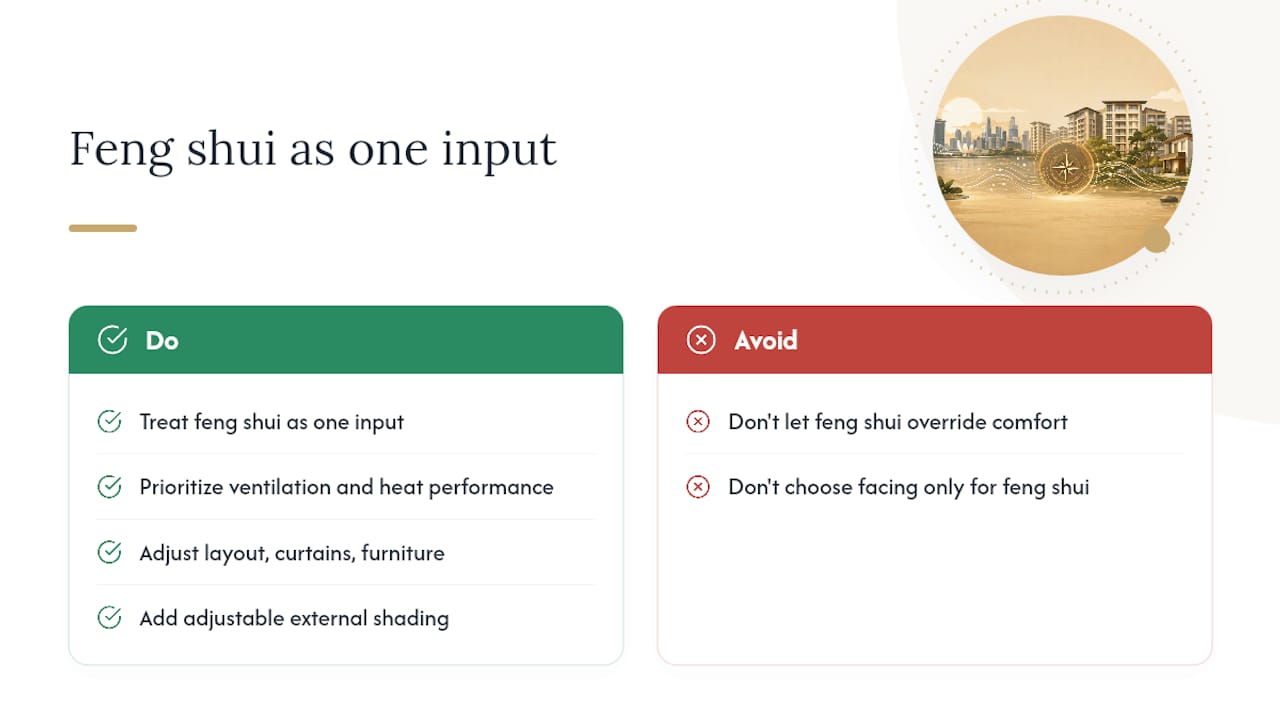
Many Singapore buyers weigh feng shui alongside comfort, and the two don't have to conflict. Feng shui preferences around facing direction are often tied to specific birth elements or a property's surrounding features rather than a single universally "lucky" direction, so what suits one family may not suit another.
The practical move is to treat feng shui as one input, not the deciding factor over ventilation and heat performance. A unit's internal layout, curtain placement, and furniture arrangement can often satisfy feng shui preferences without sacrificing the comfort benefits of a well-oriented stack.
Pro Tip: If feng shui guidance points toward a facing with more sun exposure, adjustable external shading can offset the heat trade-off without changing the unit's core orientation.
What I'd Prioritize if I Were House-Hunting Right Now
If I were touring condos in Singapore today, I'd rule out units before I even looked at finishes. Stack orientation and shading come first, kitchen counters come later. A gorgeous unit with a west-facing living room and undersized balcony overhang is a heat problem wearing nice tiles.
My one actionable habit: bring a compass app to every viewing and check it against the fact sheet before falling for the view. At One Marina Gardens, that kind of stack-level scrutiny is exactly what separates a comfortable long-term home from a unit you'll spend years fighting with curtains and air-conditioning.
Sources
- Sun Direction Singapore: What’s the Best House Facing Direction for Your Home? — PropertyGuru
- Passive Solar Architecture — Best house orientation for sun and comfort
FAQ
What Is the Best House Facing Direction in Singapore?
North south facing is generally considered the best default because it avoids intense afternoon sun and aligns better with seasonal monsoon winds, though corner units and glazing size still affect the actual outcome.
What Is the Sun's Path Like in Singapore?
Singapore's near-equatorial position means the sun sits close to overhead for much of the year, drifting slightly north or south depending on the season due to the Earth's axial tilt, rather than tracking the low arcs seen in temperate climates.
Which Facing Direction Is Considered Lucky in Feng Shui?
There's no single universally lucky direction in feng shui; preferences typically depend on a person's birth elements and the property's surrounding features, so buyers often balance this against practical ventilation and heat concerns.
Is a South-Facing or North-Facing Unit Better in Singapore?
Both perform similarly well in Singapore's equatorial climate since neither faces the harsh west afternoon sun directly, making the choice between them less critical than avoiding east or west-heavy exposure.
Can Window Film Fix a Poorly Oriented Unit?
Reflective window film paired with heat-blocking curtains and external shading can meaningfully reduce solar heat gain, though results depend on film grade and installation quality rather than orientation alone.