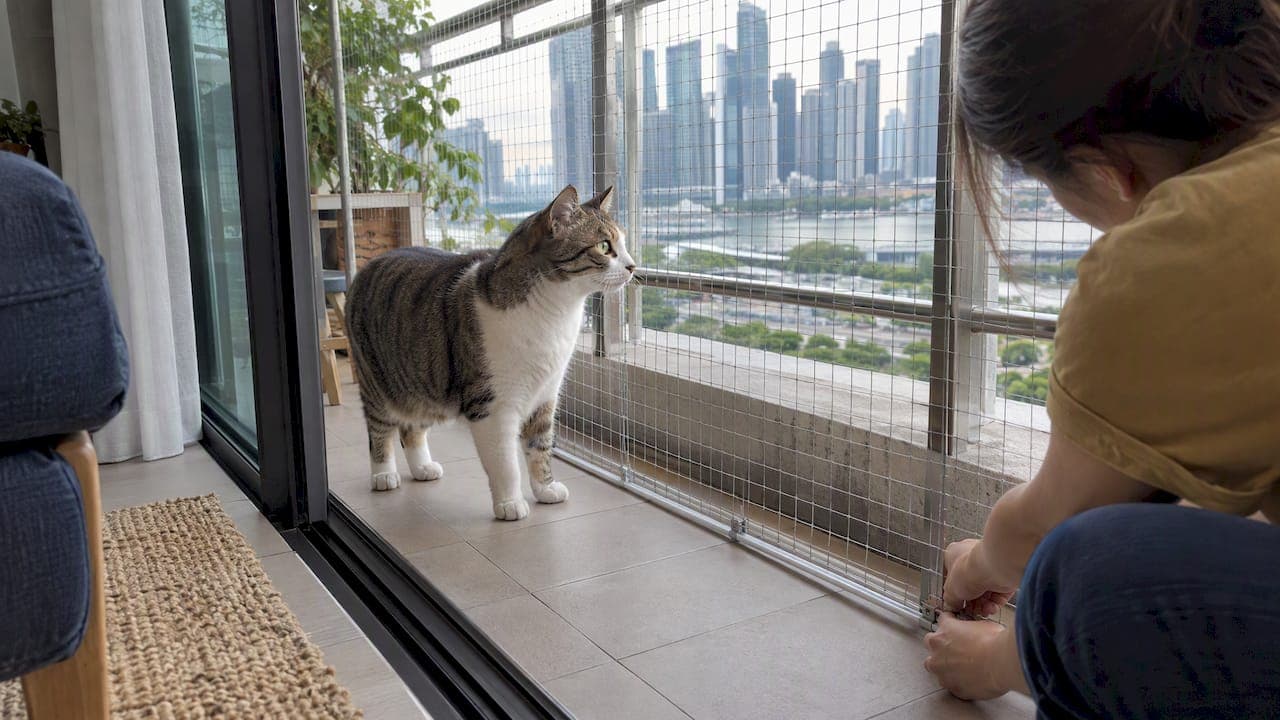
The safest approach to pet balcony safety is a secure, pet-rated barrier such as mesh, a grille, or a fully enclosed catio, combined with active supervision. The Animal and Veterinary Service requires licensed cats to be confined at home with mesh, grilles, or screens that prevent them reaching common corridors or the outside of the building. Before fitting anything permanent, check with your management office or landlord, since stricter rules may apply.
TL;DR:
- Mesh with small openings and weather-resistant materials offers an affordable, flexible barrier that is easy to inspect and maintain regularly.
- Metal grilles provide a durable, semi-permanent solution suitable for larger dogs, but they require permission to install if attaching to external walls.
- Full enclosures or catios guarantee containment but are more costly and require additional space, making them the safest but less practical option.
- Regular inspection after installation is crucial, especially for adhesive or tension-mounted barriers in humid climates, with monthly checks recommended.
- Proper documentation and adherence to building and management rules can prevent disputes and ensure compliance when installing pet balcony barriers.
Table of Contents
- Which barrier type actually keeps your pet contained?
- How do you install a barrier that actually holds?
- What do cat licensing and strata rules require?
- How often should you inspect your pet barrier?
- What habits and training reduce escape attempts?
- Weighing safety against appearance and convenience
- Does your home layout change what you need to retrofit?
- Sources
- FAQ
Which barrier type actually keeps your pet contained?
The right barrier depends on your balcony's layout, your pet's size, and whether you own or rent. Each option trades off visibility, permanence, and cost differently.
Pet-rated mesh or netting is the most common fix. Look for mesh openings smaller than one inch for cats and small dogs, since anything larger can let a determined kitten squeeze through. Choose a mesh rated for outdoor UV exposure and weather, as cheaper netting turns brittle and tears quickly under direct sun.
Metal grilles are a sturdier, more permanent option. They hold up to larger or more persistent dogs and suit balconies where you want a fixed structure rather than a flexible one, though they're harder to remove if you move out.
Clear acrylic or glass panels work well for low parapet walls, closing gaps without blocking the view, but they reduce airflow and can trap heat if the balcony isn't well ventilated.
A full enclosure or catio is the most reliable setup, giving pets outdoor access with no realistic escape route. It costs more and takes up floor space, but it's the closest thing to a guarantee that a cat or small dog can't climb or jump out.
- Mesh and netting: good visibility, moderate permanence, flexible fit, lower cost.
- Metal grilles: lower visibility, high permanence, strong hold, mid to high cost.
- Acrylic panels: high visibility, reduced ventilation, moderate cost.
- Catios and enclosures: full containment, highest cost, most space required.
How do you install a barrier that actually holds?
A barrier is only as good as its fixings. Screwed mounts give the strongest, most durable hold and suit owners planning to stay long term, but they damage walls and usually need permission if they touch an external façade. Tension-fit or no-drill frames suit renters since they leave no marks, though they rely on friction and can loosen over time. Adhesive strips are the easiest to fit but lose grip fastest in heat and humidity, according to UrbanCatOwner's guide to mesh safety, which notes that no-drill and adhesive options should be treated as semi-permanent and checked often.
Before and after fitting, run through this real estate due diligence checklist for Singapore buyers:
- Measure every gap along the parapet, including corners, where mesh often leaves a sliver of space.
- Confirm coverage runs fully from floor to the top rail, not just the open section.
- Check that corner joints are sealed or overlapped, since cats target seams first.
- Pull-test each fixing point by hand to confirm it holds under sudden weight.
- Re-check the installation a week after fitting, since new mounts settle and can loosen.
If you're hiring an installer, ask about their experience with pet-specific jobs, what warranty they offer, whether they carry insurance, and what maintenance schedule they recommend. A installer who can't answer these clearly is a red flag.
Pro Tip: In hot, humid climates, inspect adhesive or tension-mounted barriers monthly, not just seasonally. Heat softens adhesive faster than most labels suggest.

What do cat licensing and strata rules require?
Cat owners face a specific legal requirement here. Under the licensing scheme that started in September 2024, owners must take reasonable steps to protect their cats from hazards, including installing mesh, grilles, or other barriers, and the housing authority may work with AVS on cases of non-compliance.
Beyond that baseline, your management corporation or landlord can set tighter rules. According to a practical by-law guide for condo buyers, no development is automatically "pet friendly," and by-laws commonly limit pet numbers, weight, or require registration, sometimes stricter than the national guideline of three dogs and cats per unit.
Before installing anything permanent:
- Ask management which mounting methods are pre-approved for balconies.
- Confirm whether attaching to an external wall or façade needs formal approval, since internal frame-mounted mesh usually doesn't.
- Register your pet with management if your by-laws require it.
- Keep written permission on file to avoid disputes later. Our guide to condo balcony rules covers what approvals typically involve.
How often should you inspect your pet barrier?
A barrier that was secure on installation day can fail quietly months later. Run a quick visual check weekly, and a full hands-on inspection every quarter or right after a storm.
Watch for loose screws at fixing points, frayed or sagging mesh, adhesive that's gone brittle or peeled at the edges, and gaps opening up at seams or corners. Furniture pushed near the barrier can also become an accidental climbing aid, so keep chairs and planters away from the edge.
Adhesive and tension mounts degrade faster in heat and humidity, according to UrbanCatOwner, which is why these fixes need closer, more frequent attention than screwed installations.
- Replace frayed mesh sections rather than patching them.
- Re-tighten or replace any fixing that moves under a hand pull.
- Call a professional if more than one section shows wear at the same inspection.
What habits and training reduce escape attempts?
A strong barrier matters most, but daily habits lower risk further. Never leave a pet unattended on a balcony in extreme heat, and use a harness and leash for supervised balcony time with dogs, especially around open railings.
Making the space less appealing to patrol also helps. Move perches, scratching posts, and toys away from the edge and toward the interior wall, and keep the balcony stimulating enough that your cat isn't drawn to the railing out of boredom. PetMD's guidance on high-rise risks notes that enrichment and moving furniture away from edges both reduce escape attempts in cats.
- Keep a harness near the balcony door for quick, supervised access.
- Microchip your pet and keep ID tags current as a backup if an escape happens anyway.
- Avoid leaving food or toys near the railing that might draw a pet toward the edge.
Pro Tip: A scratching post placed by the balcony door, not the railing, redirects a cat's attention inward instead of outward.
Weighing safety against appearance and convenience
Balcony barriers are rarely the prettiest addition to a home, and it's tempting to choose the option that blends in best. That instinct should lose every time to the one that actually holds. A barrier that looks seamless but relies on weak adhesive isn't doing its job, no matter how tidy it looks from the living room.

The habit that saves the most trouble later is documentation. Keep the written permission from your management office, the installer's invoice, and any warranty paperwork together, since a dispute over an unauthorized fitting is far easier to resolve with a paper trail than without one.
Choose a fix you can inspect and maintain, not the cheapest stopgap. A barrier you forget about is the one most likely to fail quietly.
— Velisa
Does your home layout change what you need to retrofit?
Some balcony layouts simply need less work to make safe. A covered balcony with a solid parapet wall already blocks sightlines and gaps that an open rail design leaves exposed, which means less mesh, fewer fixing points, and a shorter inspection list. A private enclosed outdoor space goes further still, giving pets room to roam without the same reliance on an add-on barrier at all.

If you're weighing a long-term move rather than another retrofit, it's worth looking at how different unit layouts handle this before you buy. One Marina Gardens offers unit types and floor plans across 2 Bedroom, 3 Bedroom, and 3BR Premium layouts, including configurations with sky terraces that sit differently from a standard open balcony.
- Covered balconies reduce weather exposure for both pets and barrier materials.
- Solid parapet walls need less mesh coverage than open-rail designs.
- Sky terrace layouts offer more usable outdoor space to plan around.
Browse the current floor plans and availability if a different layout is part of your next housing decision.
Sources
- Licensing of cats | Animal and Veterinary Service (AVS)
- Pet Cat Licensing Scheme to Start on 1 September 2024
- Pet Friendly Condo Singapore: The Rules Buyers Miss (2026) - LiveFree
- Cat Proofing an HDB Flat: Mesh Safety Guide | UrbanCatOwner
FAQ
How can I make my balcony safe for my dog?
Install a barrier, such as mesh or a grille, tall and sturdy enough that your dog can't jump or climb over it, and never leave your dog unsupervised near an open railing. A harness and leash during balcony time adds another layer of control while you confirm the barrier holds.
Is it safe to leave a dog on a balcony?
A dog should only be on a balcony with a secure, well-maintained barrier and ideally under supervision, since unsupervised time near an open edge carries real fall risk. Extreme heat is a separate concern and is a reason on its own to avoid leaving any pet outside unattended.
How can I protect my balcony from cats?
Mesh, grilles, or screens that prevent a cat reaching the corridor or the outside of the building are required under AVS's cat licensing conditions for licensed cats. Choose mesh with openings smaller than one inch and check that it covers floor to ceiling with no gaps at the corners.
How do I prevent cats from going on the balcony?
If you'd rather keep a cat off the balcony entirely, close the door or window leading to it and provide enough enrichment indoors, such as window perches, that the balcony isn't the only interesting spot in the home. If you do allow access, a secure barrier and full-coverage mesh make supervised or unsupervised time far safer.
Do I need approval before installing a balcony barrier?
That depends on the mounting method and your building's rules. Internal frame-mounted mesh that doesn't touch the external façade typically doesn't need formal approval, but anything attached to an external wall or parapet may, so check with your management office before fitting anything permanent.