The CBD rental market 2026 outlook splits into two stories. Grade A office rents in the CBD keep climbing on tight vacancy, while residential rents grow more slowly and unevenly across submarkets. Landlords need to underwrite risk at the micro-market level rather than trust islandwide averages, and renters outside the prime core may find real room to negotiate.
TL;DR:
- Vacancy rates in CBD and Marina Bay are at a nine-quarter low, supporting continued rent growth for Grade A office spaces, forecasted near 4% for 2026.
- Submarket performance is uneven, with outside core regions like OCR gaining more than CCR and RCR, driven by affordability and supply dynamics.
- Around 55,800 new private residential units are expected to complete over the next few years, which will likely moderate rent growth in certain districts, especially in older stock areas.
- Rents in suburban and non-prime regions, especially HDBs, remain stable as demand from tenants priced out of private housing persists, keeping vacancy tighter than private condos in most towns.
- Investors should focus on micro-market factors such as vacancy, lease comparables, and supply timing, rather than relying on islandwide averages, to effectively underwrite rental risk in 2026.
Table of Contents
- What Does the 2026 Singapore Rental Market Look Like Right Now?
- Why Are CBD Office Rents Still Climbing While Housing Cools?
- How Do CCR, RCR, and OCR Compare for Rental Demand in 2026?
- How Much New Supply Is Coming, and When?
- How Should Landlords and Investors Underwrite Rental Risk in 2026?
- Should You Renew, Renegotiate, or Move in 2026?
- What Does One Marina Gardens Show About CBD-Connected Demand?
- What Matters Most for 2026: Micro-Markets, Not Macro Numbers
- Exploring a CBD-Connected Option for 2026
- Where These 2026 Numbers Come From
- Sources
- FAQ
What Does the 2026 Singapore Rental Market Look Like Right Now?
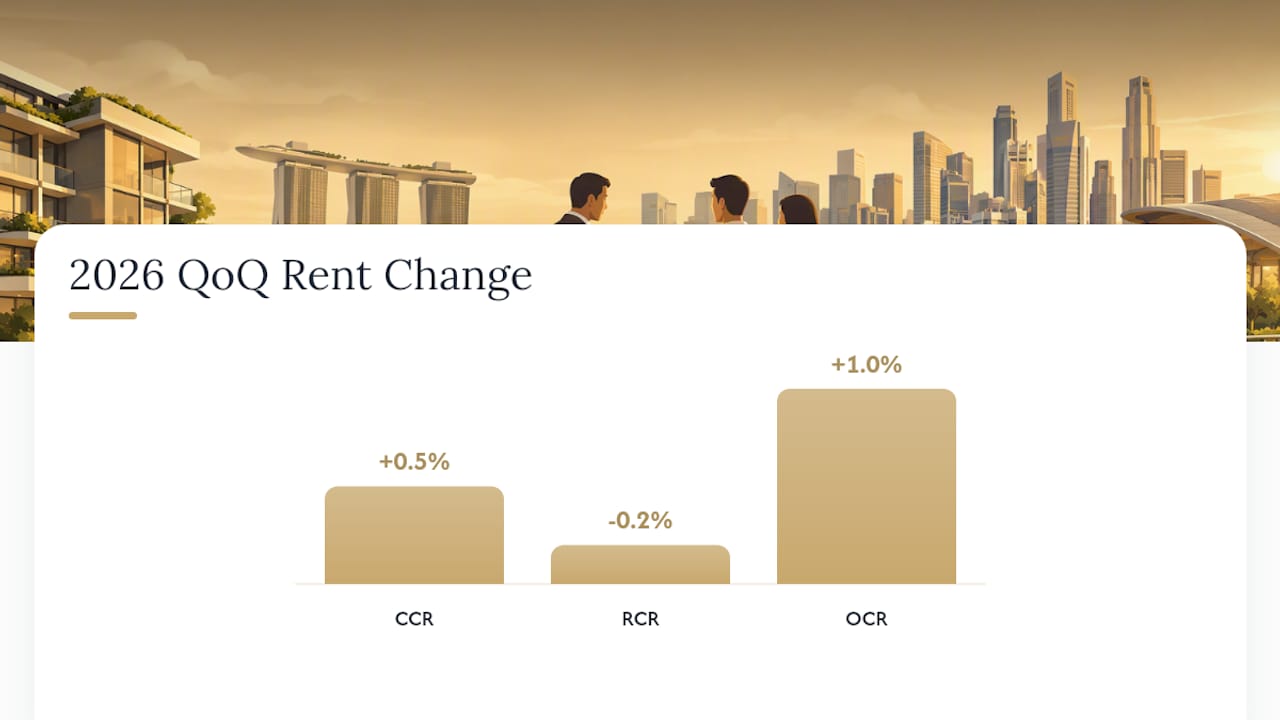
Islandwide private residential rents rose just 0.3% quarter on quarter in the first quarter of 2026, but that headline hides sharp differences underneath. The Urban Redevelopment Authority (URA) reported the Core Central Region (CCR) up 0.5%, the Rest of Central Region (RCR) down 0.2%, and the Outside Central Region (OCR) up 1.0% over the same quarter. That is not a market moving in one direction. It is three markets moving at different speeds, sometimes in opposite ones.
Quarterly rental movement, 1Q 2026 (URA) Islandwide: +0.3% qoq | CCR: +0.5% qoq | RCR: −0.2% qoq | OCR: +1.0% qoq
Vacancy tells a similar story. CBD and Marina Bay precincts run tight, while some suburban clusters carry looser vacancy as new completions land. Economic tailwinds help explain the resilience: growth forecasts in the 2.0% to 4.0% range for 2026, with finance and professional services holding up leasing demand according to Cushman & Wakefield's Q2 2026 marketbeat.
- Islandwide rental growth is positive but modest, not a broad boom.
- CCR and OCR are gaining while RCR softens, an unusual split from prior cycles.
- Vacancy is tightest near CBD and Marina Bay, looser in some outer estates absorbing new stock.
- Employment strength in finance and professional services underpins demand at the top of the market.
For a broader read on where prices and rents are heading this year, see this Singapore property market outlook for 2026.
Why Are CBD Office Rents Still Climbing While Housing Cools?
CBD Grade A office rents are in their sixth straight year of post-pandemic growth. JLL reports gross effective rents for CBD Grade A space rose 1.1% quarter on quarter to $12.19 per square foot per month in Q2 2026, with vacancy excluding new supply falling to a nine-quarter low. JLL is forecasting roughly 4% full-year Grade A rent growth for 2026. CBRE's Q2 2026 figures point the same way: limited new supply through 2026 and 2027 is keeping core CBD space scarce.
This matters for residential landlords because office demand and housing demand near the CBD are linked. Finance, professional services, and technology occupiers are consolidating into fewer, better buildings, a pattern often called flight to quality. Some Grade AAA and Grade AA precincts around Marina Bay posted rents at an eight-year-high in Q2, according to one industry report tracking CBD office rents. Workers who commute to those upgraded offices want to live close to them, and they tend to pay for it.
- Grade A office vacancy excluding new supply is at a nine-quarter low.
- Full-year 2026 Grade A rent growth is tracking near 4%, per JLL.
- Finance and tech tenants concentrating in fewer top-tier buildings support demand for nearby premium housing.
- Well-connected units with strong floor plates and views are seeing longer average lease commitments.
Pro Tip: If you own or are considering a unit within a short walk of an MRT station feeding the CBD, track the office vacancy rate for that specific precinct, not the islandwide number. A tight office micro-market almost always shows up in residential demand within two to three quarters.
How Do CCR, RCR, and OCR Compare for Rental Demand in 2026?
Submarket performance in 2026 breaks the usual assumptions. CCR rents rose 0.5% quarter on quarter even as RCR slipped 0.2%, a reversal of the pattern many investors expect where prime districts move slowest. OCR posted the strongest gain at 1.0%, likely reflecting affordability-driven demand from tenants priced out of the center. Full context on these three zones and how they behave differently sits in this comparison of CCR and RCR.
Unit size matters more than it used to. Singles and young professionals are driving demand for compact one and two-bedroom units near transport nodes and offices, while larger family-sized units in the suburbs face slower absorption as new supply comes online. HDB rentals, meanwhile, continue to see steady demand from tenants priced out of private options entirely, keeping HDB vacancy generally tighter than private stock in most towns.
Yield guidance also diverges by district:
- CCR: lower gross yields (often in the 2.5% to 3.5% range historically) but stronger capital preservation and tenant quality near CBD jobs.
- RCR: moderate yields, currently under mild pressure from softer rental growth and new completions.
- OCR: yields can run higher on a percentage basis, but vacancy risk is more sensitive to new supply timing.
- HDB: consistently tight vacancy, though rental caps and eligibility rules shape who can rent and for how long.
Investors weighing yield against location should look at this ranking of high rental-yield condos for a district-by-district breakdown.
How Much New Supply Is Coming, and When?
Supply is the variable most likely to reshape rents through 2027. URA's flash estimate for the second quarter of 2026 notes the private residential price index rose 0.5% quarter on quarter, but the same release flags that the Government Land Sales Confirmed List will add substantial new stock, with a substantial number of units expected to complete over the coming years.
That volume will not land evenly. Some years and districts absorb new supply faster than others, and older or less well-maintained stock tends to feel the pressure first as tenants trade up to newer completions at similar price points.
- Confirmed List GLS sites are locking in thousands of new units for delivery through the medium term.
- Roughly 55,800 units are projected to complete in the coming years, per URA's flash estimate.
- Increased supply typically moderates islandwide rent averages, but absorption is uneven by district.
- URA's own guidance urges caution against overleveraging, a signal investors should treat as a real underwriting constraint, not boilerplate.
Older CBD-adjacent stock facing this wave of new completions is exactly where the highest-ROI moves tend to show up, a point worth remembering before you plan any renovation budget.
How Should Landlords and Investors Underwrite Rental Risk in 2026?
Treat every acquisition or renewal decision as a micro-market bet, not an islandwide one. Here is the sequence that holds up best in a divergent market like this:
- Build effective-rent comparables, not asking-rent comparables. Normalize for lease start date, floor level, furnishing condition, and any incentives the landlord offered, then calculate the rent actually collected across the full lease term.
- Stress-test vacancy and refinancing before you commit. Model at least one to two months of vacancy per year and check your mortgage against a rate scenario 100 to 150 basis points above today's.
- Account for lease duty on any new tenancy. IRAS calculates lease duty on the higher of contractual or market rent, applying 0.4% to total rent for leases of four years or less, so build this into your net yield math, not just gross.
- Weigh Additional Buyer's Stamp Duty (ABSD) and loan-to-value limits against your holding period before adding a second or third unit to a portfolio.
- Use tactical levers over headline discounts. A minor kitchen or flooring refresh, faster turnaround furnishing, or a flexible lease length often preserves net effective rent better than cutting the asking price outright.
Pro Tip: A $3,000 to $5,000 refurbishment on flooring and kitchen fixtures for an older unit can often close the gap with a newer completion nearby, at a fraction of the price difference tenants would otherwise pay for a brand-new unit.
Decide whether to hold, sell, or reposition based on liquidity needs and where you sit on financing. If your loan is coming up for refinancing in a rising-rate scenario and your unit sits in a softening submarket like parts of RCR, repositioning through refurbishment usually beats holding and hoping. For landlords weighing short-term rental income against long lease strategies, review the short-term rental rules in Singapore before committing capital either way.
Should You Renew, Renegotiate, or Move in 2026?
Renters in RCR and parts of the suburban belt have more leverage this year than the headlines suggest. Run these three checks before your lease renewal conversation:
- Check vacancy in your building or precinct. If units nearby have sat empty for more than a month, your landlord likely has more incentive to negotiate than to re-list.
- Compare effective rent, not asking rent, across three comparable units. Pull listings with similar size, floor, and condition, then factor in any free months or furnishing thrown in, not just the sticker rent.
- Time it against lease expiry. Landlords facing a vacancy gap between tenants often prefer a modest rent freeze over a costly turnover.
Beyond the number itself, ask for concrete value: a repaired air-conditioning unit, included appliances, a lower deposit, or a break clause that lets you exit early without penalty.
What Does One Marina Gardens Show About CBD-Connected Demand?
One Marina Gardens sits in District 01, a 937-unit development roughly 160 meters from Marina South MRT, with facilities including a 50-metre lap pool, multiple sky terraces, and an on-site childcare centre, according to the project's own fact sheet. Given the flight-to-quality pattern already reshaping CBD office demand, a development this close to Marina Bay's job cluster illustrates the kind of asset that tends to hold tenant interest even when islandwide rent growth is modest.
- Direct MRT access at 160 meters removes the commute friction that drives many tenant decisions.
- Resort-style facilities (lap pool, childcare, sky terraces) support demand from both young professionals and families.
- A hypothetical two-bedroom unit here, underwritten at a conservative 3% gross yield with a one-month vacancy assumption, illustrates the kind of math worth running before any purchase. That figure is illustrative only, never a guarantee, and every buyer should verify current asking prices and rental comparables independently.
Related reading on the district's rental dynamics: Marina Bay rental demand and vacancy trends.
What Matters Most for 2026: Micro-Markets, Not Macro Numbers
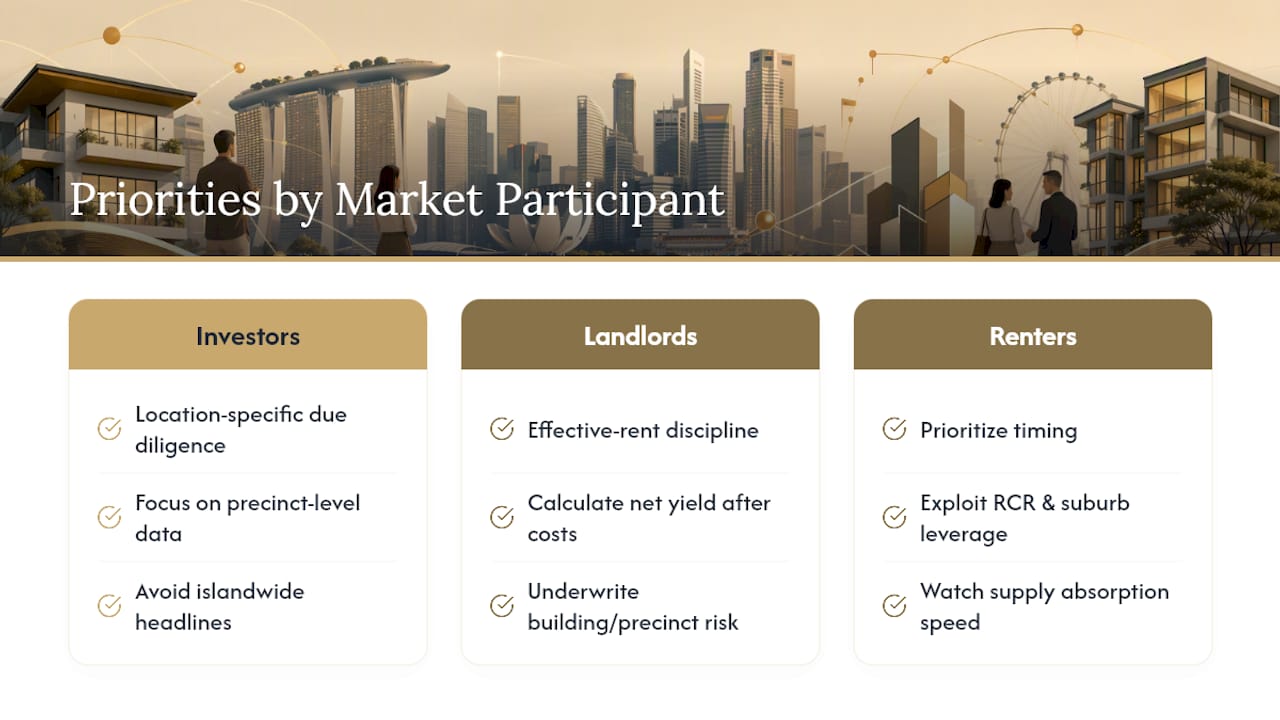
Investors should prioritize location-specific due diligence over islandwide headlines. Landlords should prioritize effective-rent discipline: know your true net yield after lease duty, vacancy, and refinancing risk, not just the asking price on a listing portal. Renters should prioritize timing: the leverage in RCR and parts of the suburbs will not last if supply absorption tightens faster than expected.
The real tail risk sitting under all three groups is interest rates. A refinancing wall hitting at the same time as a supply wave could squeeze margins for anyone who underwrote on optimistic assumptions. Underwrite at the level of the actual building and precinct, not the national index, and you avoid most of the damage.
— Velisa
Exploring a CBD-Connected Option for 2026
If you're weighing whether to buy into the tight CBD tenant demand described above rather than compete for it as a renter, One Marina Gardens gives you a direct entry point. Its District 01 position, 160-meter walk to Marina South MRT, and resort-style facilities like the 50-metre lap pool and sky terraces are built around the exact flight-to-quality demand driving CBD Grade A office rents higher this year.
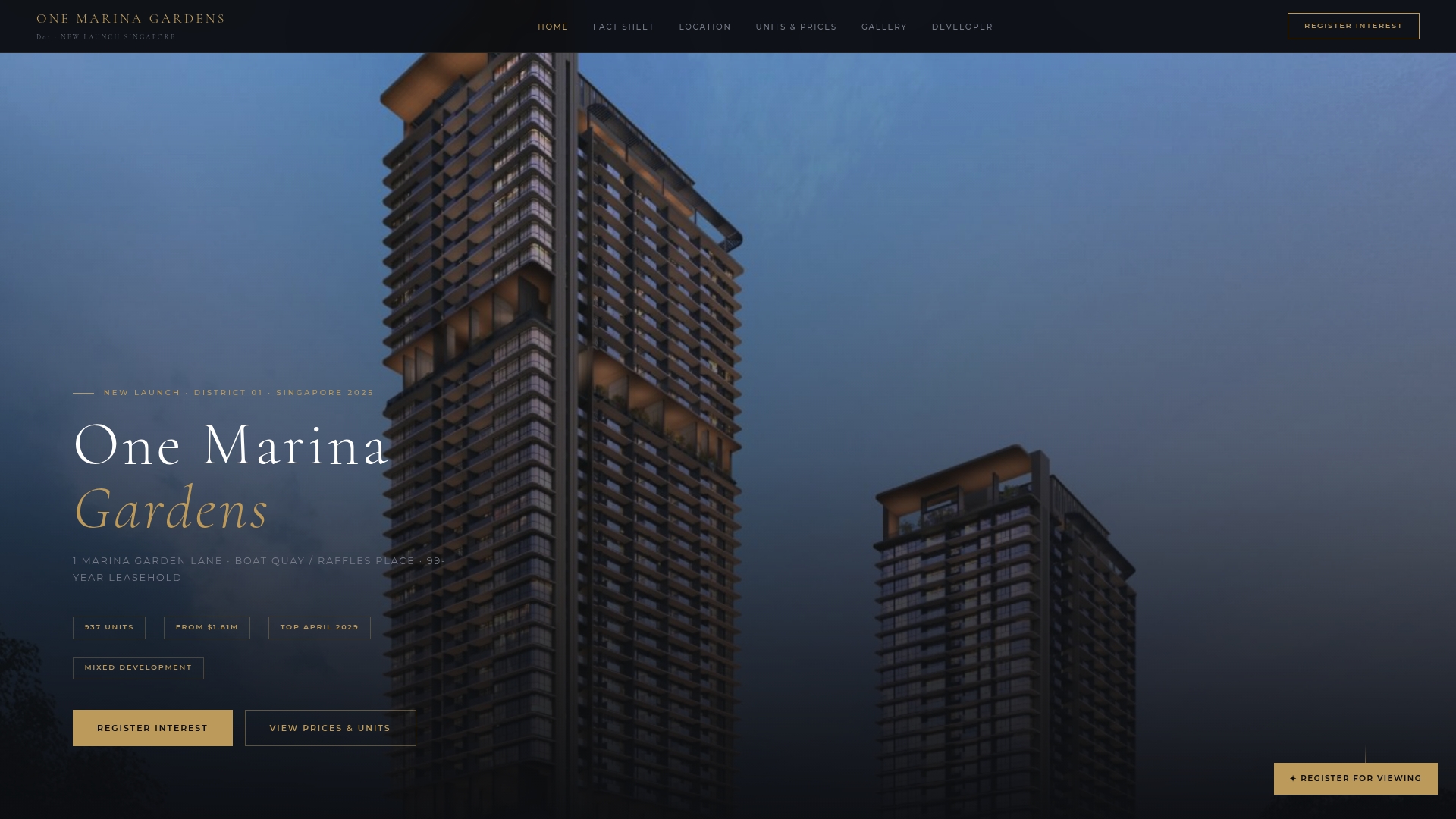
The development offers a variety of apartment layouts, giving both residents and investors multiple options within the precinct. You can review current availability and layouts on the unit catalogue, check pricing on the price list page, or study project specs and facility details on the fact sheet before making a decision. As with any property purchase, run your own underwriting numbers and speak with a financial adviser before committing.
Where These 2026 Numbers Come From
- URA's Q1 2026 real estate statistics release for the quarterly rental index and submarket breakdown.
- URA's Q2 2026 flash estimate for the private price index and GLS Confirmed List supply figures.
- JLL's CBD office rent report for Grade A rent growth and vacancy data.
- CBRE's Q2 2026 Singapore figures for office supply constraints.
- IRAS stamp duty guidance for lease duty calculations.
- URA's property market information portal for readers who want to run their own rental comparable searches.
This article is general information, not a substitute for advice from a qualified financial advisor. Consult a qualified financial professional about your own circumstances before acting on anything here.
Sources
- Release of 1st Quarter 2026 real estate statistics | Urban Redevelopment Authority (URA)
- Singapore CBD office rents enter sixth year of post-pandemic growth as vacancy nears nine-quarter low
- IRAS | Stamp Duty
- Release of flash estimate for 2nd Quarter 2026 private residential property price index | URA
FAQ
Will Rental Prices Go Down in Singapore in 2026?
Rents are unlikely to fall broadly, though growth is slowing and diverging by district. URA data shows islandwide private residential rents rose 0.3% quarter on quarter in 1Q 2026, with RCR actually dipping 0.2% while CCR and OCR both gained.
What Is the Current Trend in the Singapore Rental Market?
The trend is divergence rather than a single direction. CBD Grade A office rents keep climbing on tight vacancy per JLL's tracking, while residential rent growth is modest and uneven across CCR, RCR, and OCR.
What Is the Outlook for the HDB Rental Market in 2026?
HDB rental demand is expected to stay firm, driven by tenants priced out of private housing amid moderate but positive private rent growth. Vacancy in the HDB segment has generally remained tighter than private stock as new private completions get absorbed unevenly.
What Is the Property Market Outlook for Singapore in 2026?
The outlook points to modest overall growth with significant new supply arriving. URA's flash estimate shows prices up 0.5% quarter on quarter in Q2 2026, alongside roughly 55,800 units expected to complete in the coming years, which should moderate future rent and price gains.
How Much Is a Unit at One Marina Gardens?
Current pricing and availability for One Marina Gardens units, including the 2 Bedroom, 3 Bedroom, 3BR Premium, and 4BR Premium layouts, are listed on the official price page. Prices are subject to change, so check the site directly for the latest figures.