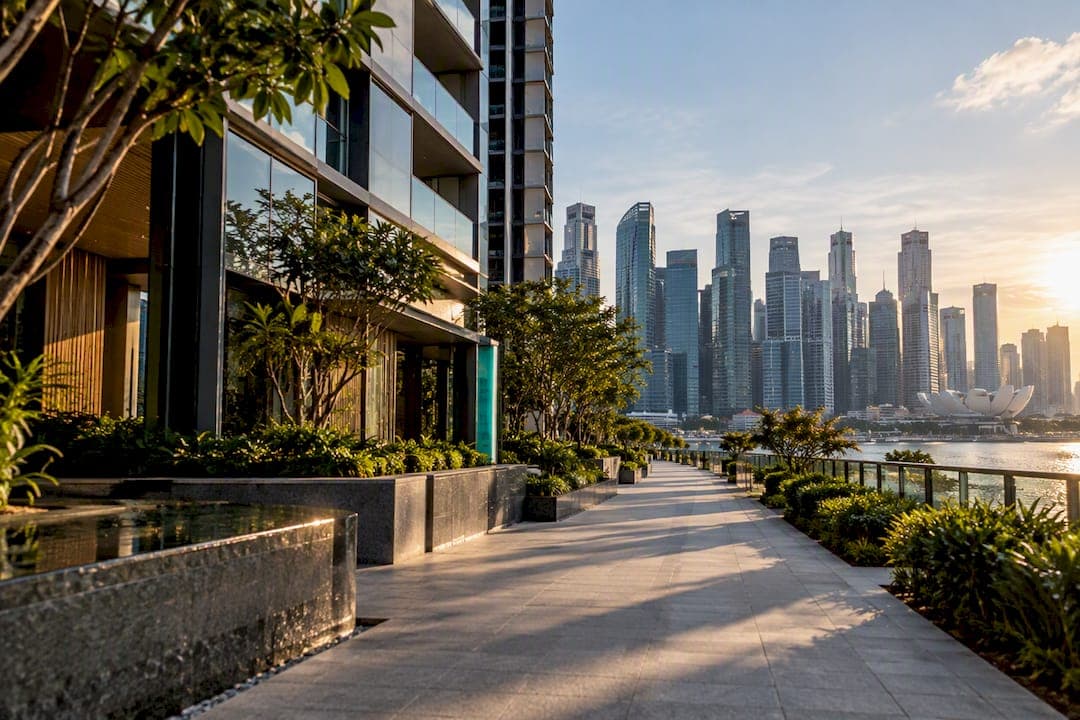
District 1 works for capital preservation, not yield chasing. Recent transaction data shows an average price of $2,650 per square foot against 53 sales in April 2026, roughly 20% above the citywide average, with One Marina Gardens leading transaction counts among active projects. If you need cash flow now, look elsewhere. If you want a scarce, trophy-grade asset that holds value over a five to ten year horizon, District 1 earns its premium.
TL;DR:
- District 1 condos trade at an average of $2,650 per square foot, roughly 25% above the citywide average, reflecting scarcity and premium waterfront location.
- Only 18 to 20 units total in the district create a thin market, with One Marina Gardens accounting for nearly half of the 53 transactions in April 2026.
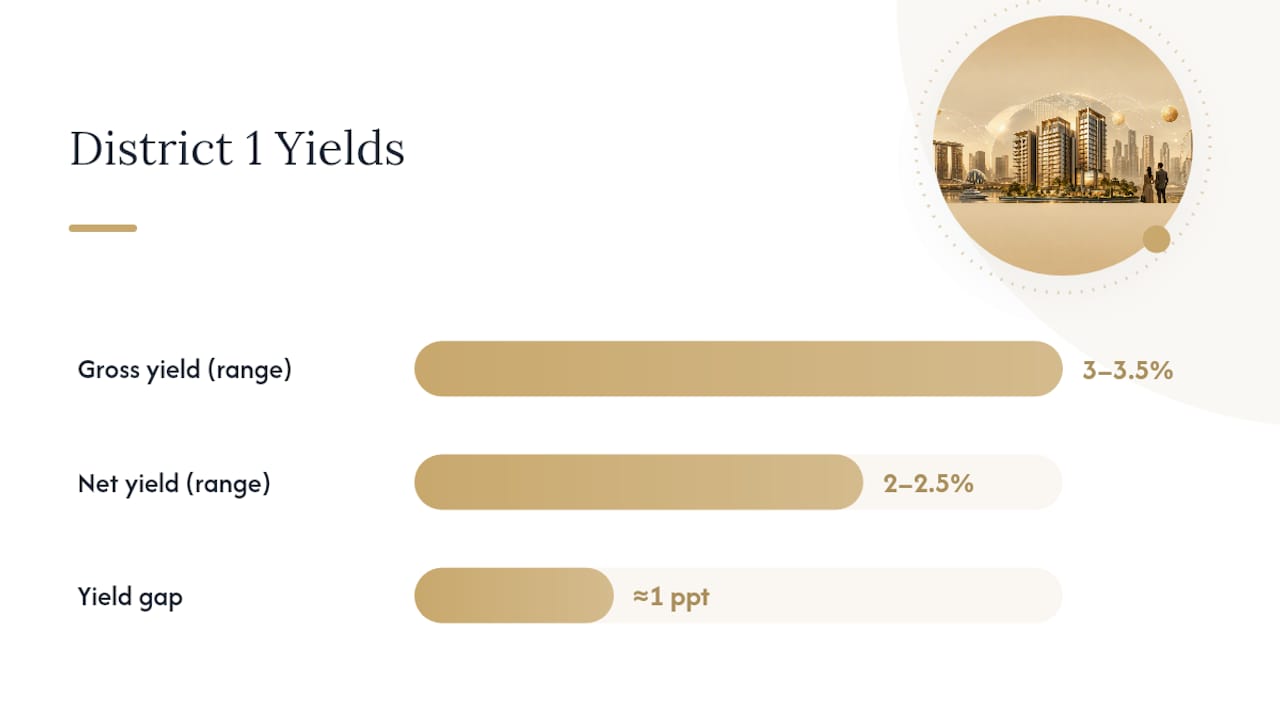
- Rentals and leasing demand outpace sales, providing steady occupancy but resulting in gross rental yields around 3% to 3.5%, which are lower than alternative districts.
- Long-term catalysts like waterfront redevelopment and CBD rejuvenation support noble capital preservation, making District 1 suitable for investors with five-to-ten-year horizons.
- Buyers should prioritize due diligence: review lease terms, recent caveats, maintenance funds, and market conditions, as asking prices often exceed actual transaction prices significantly.
Table of Contents
- What Does the District 1 Condo Market Look Like Right Now?
- Why Do Investors Pay a Premium for District 1?
- What Are the Risks That Cut Into District 1 Returns?
- How Should You Evaluate a District 1 Unit Before Buying?
- What Should You Expect to Pay, and How Do Listings Compare to Reality?
- What Does One Marina Gardens Bring to the District 1 Snapshot?
- Should You Actually Buy in District 1?
- How to View Units and Take the Next Step
- Sources
- FAQ
What Does the District 1 Condo Market Look Like Right Now?
District 1 posted 53 sales transactions in April 2026 against 230 leases, and that four-to-one ratio of renters to buyers tells you almost everything about who actually occupies this market. The average price came in at $2,650 per square foot, a figure that sits meaningfully above the citywide average of $2,124 per square foot recorded in the same digest. That gap isn't noise. It's the scarcity premium investors pay for Marina Bay frontage and CBD walkability.
Statistic Callout: District 1 averaged $2,650 psf in April 2026, roughly 25% above the citywide average of $2,124 psf.
Price dispersion across the district is wide. District 1 holds only 18 to 20 condominiums total, spanning decades-old leasehold stock priced well under the average and new-launch prime developments that push averages above $3,000 per square foot. That spread matters when you're benchmarking any single unit. A $2,400 psf figure could be a bargain in a newer tower or a red flag in an aging one, depending entirely on which project you're comparing against.
Statistic Callout: With only 53 sales transactions recorded district-wide in a single month, District 1 remains one of the thinnest and most concentrated condo markets in Singapore.
One Marina Gardens led the district's transaction activity with 26 recorded sales at an average of roughly $2,974 psf, nearly half of all District 1 transactions that month. That concentration reflects both a large unit count and steady buyer interest, a combination that matters for liquidity later when you're the one trying to sell.
| Project Type | Approx. PSF Range | Notes |
|---|---|---|
| Older leasehold stock | Below $2,400 | Lower entry cost, shorter remaining lease |
| District average (April 2026) | ~$2,650 | Citywide comparison point |
| New-launch prime projects | Above $3,000 | Reflects high-end anchor pricing |
Leasing volume outpaces sales in most months, which signals steady tenant demand even when transaction activity stays thin. For landlords, that's a reassuring signal. For buyers hunting resale comparables, it means you'll often have more leasing data to study than actual sale prices.
Why Do Investors Pay a Premium for District 1?
District 1 sits at the geographic core of Singapore's financial district, anchored by Raffles Place and the Marina Bay MRT interchange, with Marina South MRT extending that reach further into the waterfront precinct. You're paying for proximity, not square footage. A unit here puts you steps from the CBD, Marina Bay Sands, and the civic district, a combination no suburban launch can replicate regardless of how many amenities it bundles in.
Supply is structurally tight. With roughly 18 to 20 condos in the entire district, residential stock competes for land against office towers, hotels, and institutional buildings. New residential launches in District 1 are rare events, not annual occurrences.
Long-term catalysts reinforce the case. The Greater Southern Waterfront redevelopment, ongoing CBD rejuvenation incentives, and continued transport investment around Marina Bay all point toward sustained demand for this footprint over the next decade. None of these move prices quickly. They work slowly, the way trophy assets tend to.
That profile suits specific investors best: those buying for long-term capital preservation, expatriates who want a CBD base with resale flexibility, and buyers who treat the purchase as a store of value rather than an income vehicle. If your mandate calls for immediate cash-on-cash returns, District 1 will frustrate you before it rewards you.
What Are the Risks That Cut Into District 1 Returns?
Gross rental yields in District 1 typically run around 3% to 3.5%, noticeably lower than what you'd find in RCR or OCR projects. High entry prices are the direct cause. When your psf is $2,650 and climbing, monthly rent has to work harder just to keep the yield ratio intact, and it usually can't. Compare that against options in the Core Central Region versus RCR/OCR before assuming District 1 fits an income-first strategy.
Several other factors compress returns further:
- Cooling measures and Additional Buyer's Stamp Duty (ABSD) raise upfront costs meaningfully for foreign buyers and entities, and any purchase decision needs to run those numbers before committing.
- Liquidity risk is real given the small buyer pool. With only 53 sales district-wide in a recent month, an off-cycle or low-volume project can sit on the market far longer than a comparable unit in a higher-turnover district.
- Lease decay matters for aging leasehold stock. A unit with 60 years remaining trades at a discount to a freehold or fresh 99-year equivalent, and that gap widens as the lease shortens.
- Renovation costs and sinking fund shortfalls surprise buyers who skip the paperwork. Older buildings sometimes carry deferred maintenance that only shows up once you're already the owner.
Pro Tip: Never quote gross yield as your expected return. Subtract a realistic vacancy allowance of one month per year, property tax, agent fees, and maintenance, and you'll often find net yield lands a full percentage point below the advertised gross figure.
For a fuller breakdown of how gross figures translate to what actually lands in your account, the math behind converting gross yield to net yield is worth running before you make an offer, not after.
How Should You Evaluate a District 1 Unit Before Buying?
Due diligence in this market follows a fairly consistent sequence, whether you're looking at a resale unit or a fresh launch.
- Check remaining lease term. A leasehold unit with under 60 years remaining faces financing restrictions and a steeper resale discount curve; benchmark it against comparable freehold or longer-lease stock nearby.
- Review the maintenance fund and service charge trend. Ask for the last three years of AGM minutes and accounts, and flag any announced major works package with a large per-unit levy attached.
- Pull recent caveats for the same block, floor, and facing. Consistent monthly caveat activity over the trailing 12 months gives you a far more reliable price benchmark than a single headline sale.
- Estimate realistic rental potential and vacancy. Request recent tenancy history from the seller or agent where possible, since it tells you more than any listing description will.
- Run the full financial picture. Factor in cash required upfront, ABSD exposure, loan capacity, and a stress-tested interest rate scenario before you commit.
Projects with steady transaction volume tend to offer better resale liquidity than one-off headline sales, so weigh that history heavily when comparing two otherwise similar units.
What Should You Expect to Pay, and How Do Listings Compare to Reality?
Pricing across District 1 varies sharply by unit type and building age, but rough psf bands give you a starting anchor. One bedroom units in newer developments often price near or above the district average of $2,650 psf, while larger three and four bedroom layouts in older stock can trade meaningfully below that mark, sometimes under $2,400 psf.
| Unit Type | Typical PSF Anchor | Total Price Sensitivity |
|---|---|---|
| 1 to 2 bedroom, newer stock | Near or above $2,650 | Smaller absolute price, higher psf |
| 3 to 4 bedroom, established stock | Below $2,650 | Larger absolute price, lower psf |
| High-end new launch | Above $3,000 | Reflects prime anchor pricing |
Asking prices and transacted prices diverge more than most buyers expect, even in a trophy market like this one. Sellers list at aspirational figures, then adjust once genuine buyer interest fails to materialize within a normal marketing window. Cross-checking a listing's asking psf against recent caveat records for the same building is one of the fastest ways to identify a motivated seller versus an overpriced holdout.
Practical steps for tracking live opportunities:
- Cross-reference any listing portal price against URA caveat data before making an offer.
- Watch monthly transaction velocity. A district averaging 53 sales a month rewards patience over urgency.
- Treat asking price as a starting point for negotiation, not a ceiling, particularly on units that have sat listed for more than 60 days.
Given the current transaction pace, realistic offers tend to land closer to recent comparable caveats than to the headline asking figure, especially on resale stock.
What Does One Marina Gardens Bring to the District 1 Snapshot?
One Marina Gardens is a 937-unit development in District 1, positioned 160 meters from Marina South MRT with direct connectivity into the CBD and Orchard Road corridor. The project's unit mix spans one-bedroom apartments through four-bedroom homes, giving investors range across entry price points within a single building.
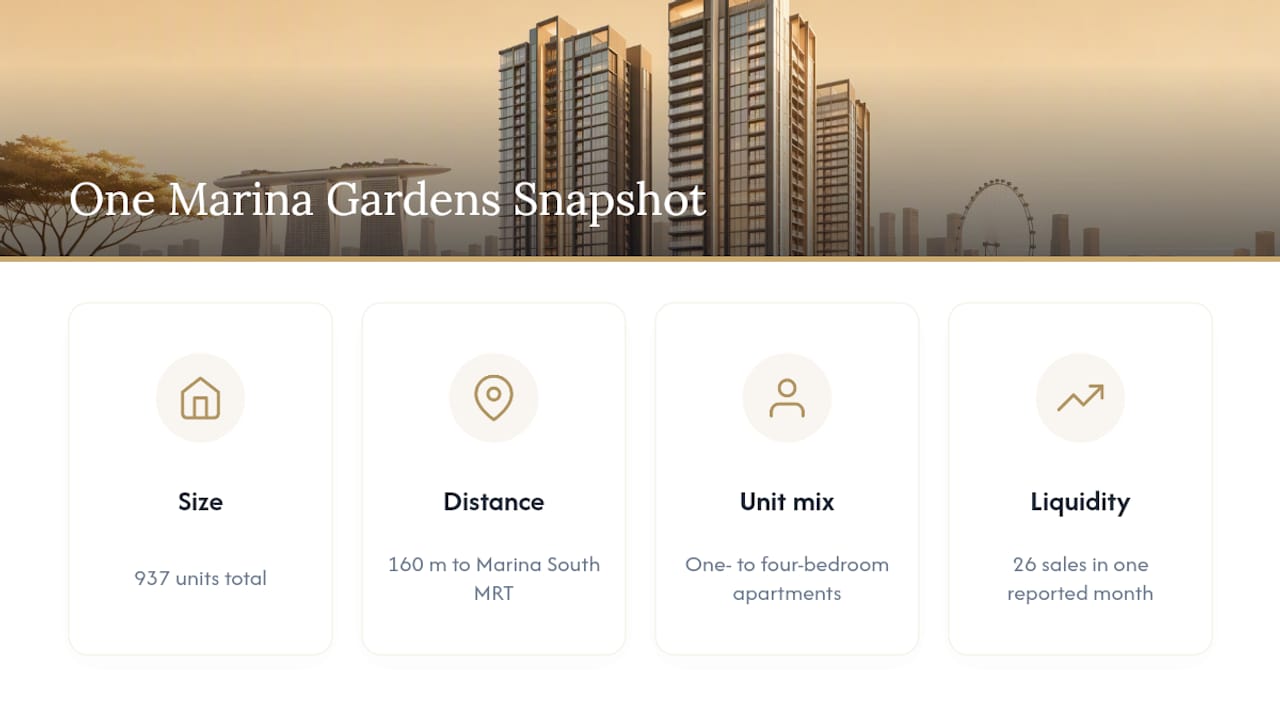
Facilities include sky terraces and a lap pool, a childcare centre, retail shops, and restaurants within a mixed-use base, with close proximity to a nearby MRT station
The project's transaction count of 26 sales in a single reported month places it among the district's most active, a useful liquidity signal if resale flexibility matters to your strategy. That said, apply the same due diligence checklist here as you would to any District 1 project: check the specific unit's floor and facing, review recent comparable caveats, and confirm the financial numbers against your own holding horizon before making an offer.
Should You Actually Buy in District 1?
District 1 fits investors who can hold for five to ten years and who value capital preservation over monthly cash flow. If you're chasing yield above 4%, this district will disappoint you no matter which unit you pick. Run unit-level cash flow scenarios against your own numbers, or book a viewing, before you decide.
— Velisa
How to View Units and Take the Next Step
Reading the data is one thing. Standing in a unit with Marina Bay in view is another. One Marina Gardens gives investors something few District 1 projects can: a single building with 937 units spanning one to four bedrooms, so you can compare layouts, price points, and rental potential side by side instead of chasing scattered listings across a dozen aging towers.
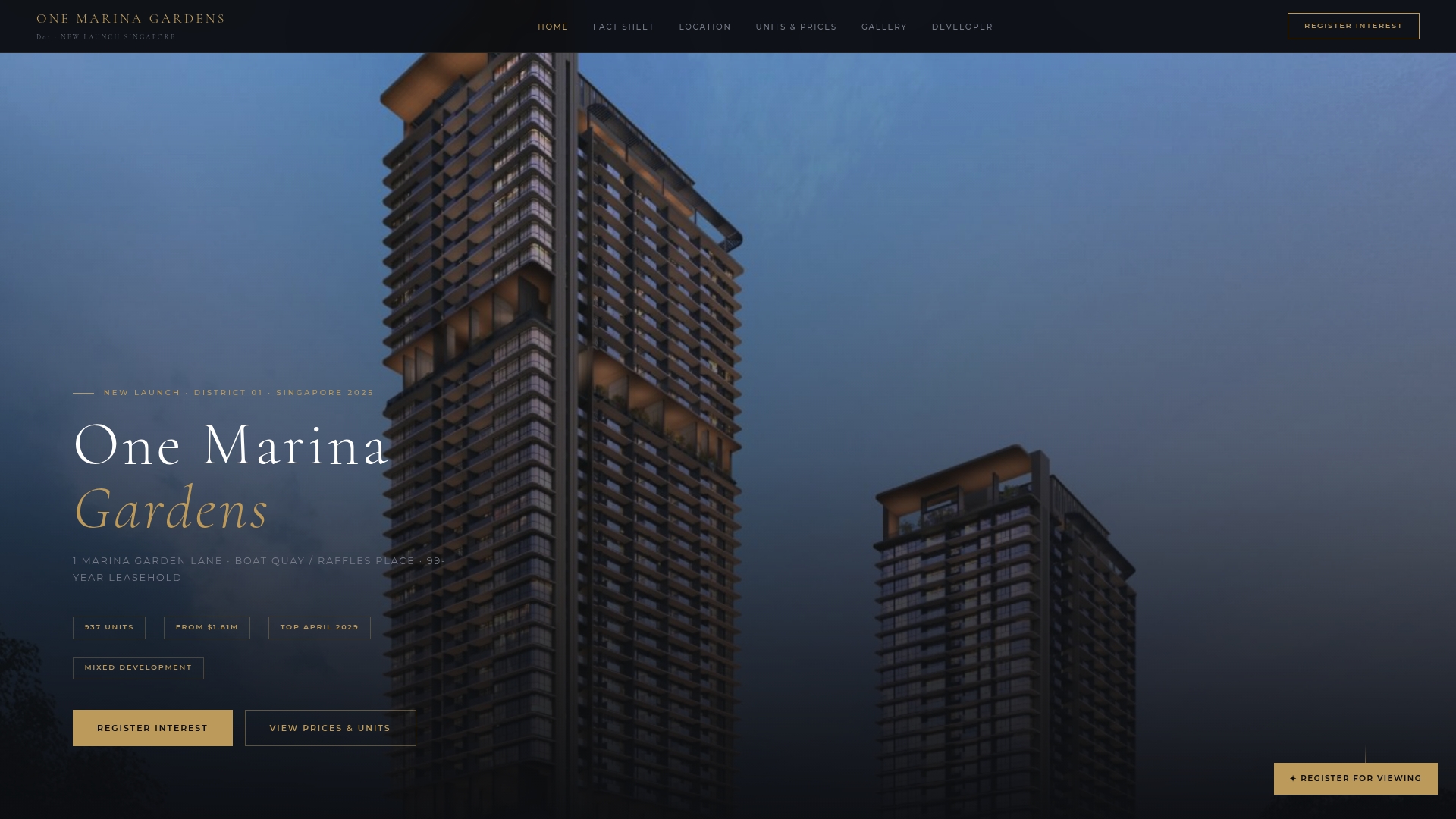
If you're serious about District 1, the practical next step is straightforward. Browse the current unit mix and floorplans to see which layout fits your budget and rental strategy, or check the price list and current availability for up-to-date figures starting from $1.81M. Before making any offer, ask for the unit's caveat history and, where available, recent tenancy records, then arrange a showflat visit to see the sky terraces and pool deck in person.
This article is general information, not a substitute for advice from a qualified financial advisor. Consult a qualified financial professional about your own circumstances before acting on anything here.
Sources
FAQ
Which Condo Is Good for Investment in Singapore?
It depends on your goal: District 1 condos like One Marina Gardens suit capital preservation and long-term holding thanks to CBD scarcity and consistent transaction activity, while RCR or OCR projects typically deliver higher rental yields for income-focused buyers. There's no single best answer, only a better fit for your specific mandate.
Which Condo in Singapore Is the Most Profitable?
Profitability depends on whether you mean rental yield or capital appreciation. District 1 projects trade at a premium of roughly 20% to 25% above citywide average psf, favoring appreciation over yield, while suburban districts generally post stronger gross rental returns.
What Happens After 50 Years Living in a Condominium?
Most private condos in Singapore, including freehold and 99-year leasehold projects, remain fully livable and legally owned well past typical mid-lease terms, though leasehold units see resale value and financing options gradually decline as the remaining lease shortens. Buyers should always check a leasehold unit's remaining tenure and factor lease decay into any long-term holding decision.
Which Condo Will Top in 2026?
No single project can be reliably called the top performer for 2026, since price movement depends on unit-level factors like floor, facing, and remaining lease as much as project reputation. One Marina Gardens led District 1 transaction counts with 26 sales in April 2026, a strong liquidity signal, but investors should still run their own caveat comparisons before assuming any project will outperform.