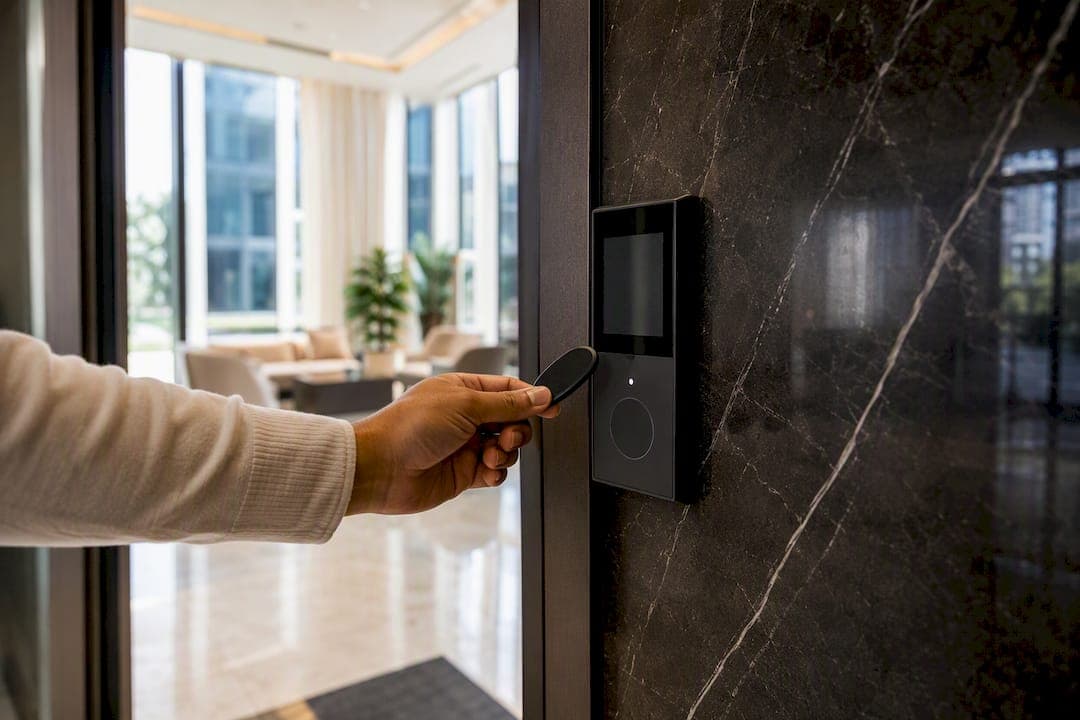
The condo security features that matter most fall into six categories: access control, video surveillance, on-site personnel, visitor and package management, fire and life-safety systems, and unit-level locks. Technology alone doesn't protect anyone. How a building tests, staffs, and governs those systems, and how carefully it handles resident data, decides whether they work when something actually happens. The checklist below breaks down what to look for in each category.
TL;DR:
- Effective access control requires immediate deactivation of lost fobs, detailed logs, and elevator zoning to prevent unauthorized movement within the building.
- CCTV coverage should focus on high-risk blind spots like stairwells and parkades, with clear footage handling and chain-of-custody documentation to support investigations.
- Security personnel should be vigilant, well-trained, and capable of detailed incident reporting, with randomized patrol routes to prevent predictability.
- Package and visitor management systems that issue temporary codes and use automated lockers or monitored rooms significantly reduce theft risks and tailgating.
- Fire safety and security systems must be integrated, regularly tested, and managed with proper documentation to ensure no critical failure during emergencies.
Table of Contents
- What Access Control Systems Should a Secure Condo Have?
- How Should CCTV Coverage and Footage Handling Work?
- What Makes Condo Security Personnel Effective?
- How Do Visitor Registration and Package Systems Reduce Theft?
- What Parking and Perimeter Security Should You Expect?
- How Do Fire and Emergency Systems Connect to Security?
- Which Unit-Level Security Upgrades Are Worth Adding?
- What Privacy Rules Apply to Condo Cameras and Biometrics?
- How Should Boards Test and Govern Security Systems?
- How One Marina Gardens Approaches Integrated Security
- Three Priorities I'd Insist On as a Buyer
- See Security and Amenity Design at One Marina Gardens
- Sources
- FAQ
What Access Control Systems Should a Secure Condo Have?
Access control is the first line of defense, and it's also where most buildings quietly fail. A fob that never gets deactivated after a resident moves out is a security hole with a keychain attached.
Most condos rely on one of three credential types, each with real trade-offs:
- RFID fobs and cards are cheap and familiar, but they're easy to lend, lose, or clone with basic equipment.
- Mobile app credentials let management revoke access instantly and log every entry, though they depend on residents' phones having battery and signal.
- Biometric readers (fingerprint or facial recognition) remove the lost-credential problem entirely, but they raise privacy questions that boards need to handle carefully.
High-rises add another layer: elevator zoning. A building that restricts elevator floor access to only the floors a fob is authorized for stops a stranger from wandering unit-to-unit even if they get past the lobby door. That's a meaningfully different security posture than a building where anyone can ride to any floor once inside.
Ask about redundancy, too. What happens to the doors during a power outage? Do they fail open (a fire-safety requirement in many jurisdictions) or fail locked with battery backup? And how fast does the system deprovision a lost fob or an expired visitor code? A building with same-day deactivation and a visible admin log is managing access; one that can't tell you the last time it audited its fob list probably isn't.
Pro Tip: Ask the property manager to show you the access log interface during a viewing. If they can't produce one in under a minute, the system likely isn't being monitored the way it should be.
How Should CCTV Coverage and Footage Handling Work?
Cameras matter less for what they record than for where they're pointed and how footage gets handled afterward. A building with forty cameras and no coverage of the stairwell has a false sense of security.
Coverage typically combines a few camera types:
- Fixed cameras cover choke points like lobbies, elevator lobbies, and mailrooms.
- PTZ (pan-tilt-zoom) cameras let security staff actively track movement across large areas like parking levels.
- Dome cameras with analytics can flag loitering, tailgating, or unusual movement patterns and alert staff in real time.
Stairwells and parkades are the most commonly missed zones. The Blackbird Security guide to condominium security treats these as high-risk blind spots by design, and recommends pairing camera coverage there with randomized foot patrols rather than relying on cameras alone.
Monitoring models split into two camps: live-watched feeds (rare outside larger developments, since it requires dedicated staff) and event-triggered recording, where motion or access events pull footage for review. Retention windows are typically set for a period sufficient to assist investigations, though the exact duration should be specified in building policy, not left informal.
If you're ever requesting footage after an incident, ask about chain of custody. Good systems timestamp exports, log who accessed the footage, and document why. That documentation is often what makes footage usable for police or insurance claims rather than just something residents assume exists.
What Makes Condo Security Personnel Effective?
Cameras document what happened. Guards prevent it from happening, or at least respond while it's still happening. The two roles work together, and a building strong on one but weak on the other has a gap.
Most developments use one of three staffing models: a stationed concierge who handles the front desk and visitor screening, roving or mobile patrols who walk or drive scheduled (and ideally randomized) routes, and contracted third-party security firms who supply trained guards on rotating shifts. Forward-facing service providers typically bundle guard patrols with remote entry monitoring and parking oversight as a single package, which is worth asking about if a building outsources its security.
What separates a good guard from a mediocre one isn't just presence. It's a specific mix of skills:
- Vigilance during quiet hours, when boredom is the biggest threat to attentiveness.
- Clear, detailed incident reporting that a board or police can actually use later.
- Comfort operating the building's access control software and camera system, not just carrying a radio.
- Calm, professional communication with residents and visitors alike.
The Blackbird Security overview notes that patrol logs and detailed reporting are central to how incidents actually get resolved. Randomized patrol timing matters more than most residents realize. A guard who walks the same loop at the same time every night is, in effect, publishing a schedule that anyone watching the building can learn.
How Do Visitor Registration and Package Systems Reduce Theft?
Package theft and tailgating are the two most common security failures in multifamily buildings, and both are largely solvable with process rather than hardware.
Digital visitor registration lets residents issue a temporary access code tied to a specific date and time window, so a guest doesn't need a permanent fob and the front desk doesn't need to manually buzz every delivery driver in. On the package side, buildings generally choose between automated parcel lockers and staffed concierge rooms. Automated lockers reduce theft risk largely by removing unattended packages from open lobbies and giving residents a trackable, code-based pickup instead. Where lockers aren't practical, a controlled-access package room paired with CCTV and an access log accomplishes something similar.
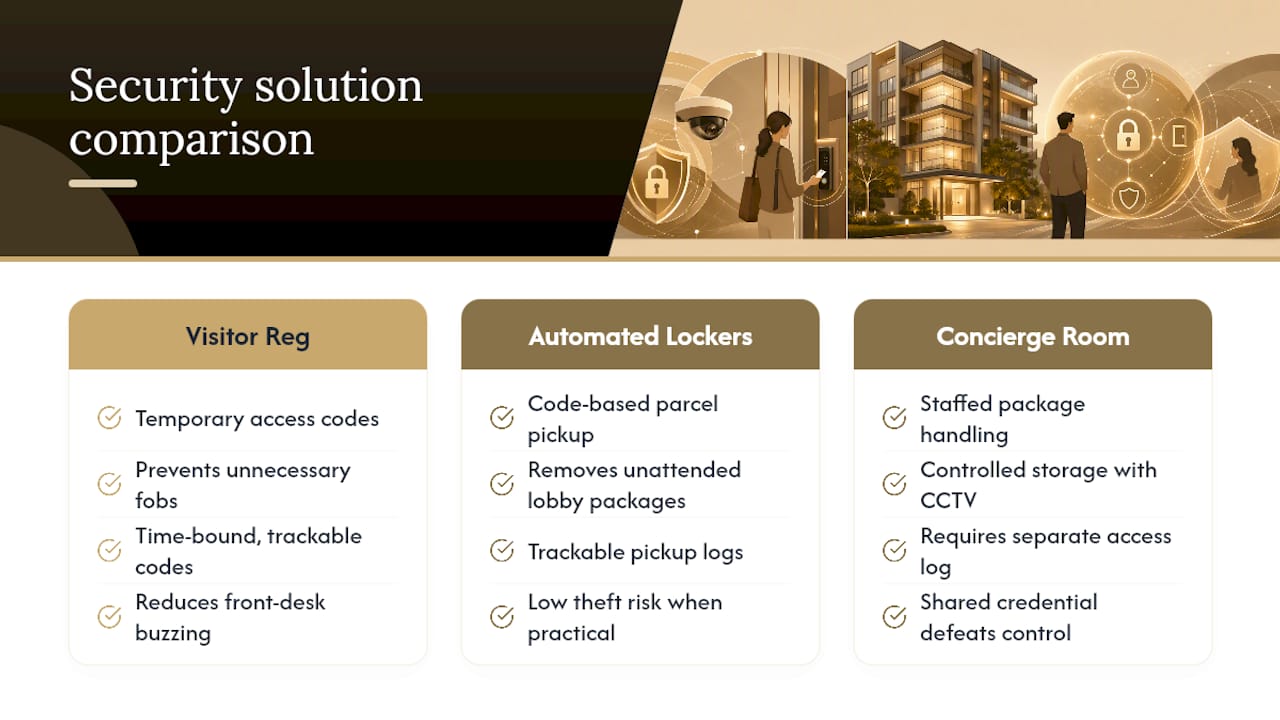
Tailgating, where an unauthorized person slips in behind a resident holding the door, is a design and habit problem as much as a technology one. Vestibule doors that don't allow two people through on a single credential swipe help, but so does simple resident awareness.
Pro Tip: If your building uses a package room instead of lockers, ask whether entry requires a separate fob swipe from the main lobby door. A shared credential defeats the point of a controlled room.
What Parking and Perimeter Security Should You Expect?
Parking levels are where a lot of condo crime actually happens, mostly because they're dim, disconnected from foot traffic, and easy to loiter in without drawing attention.
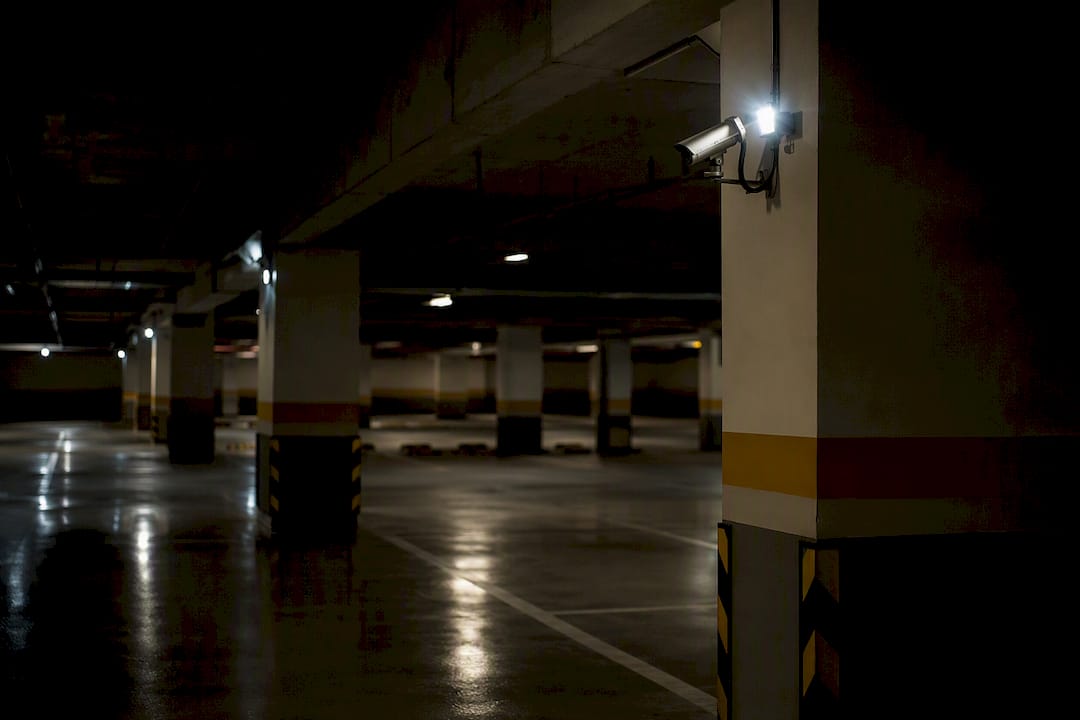
A well-secured parkade typically includes gate barriers with license plate recognition, CCTV coverage at entry points and along drive aisles, and ample lighting to ensure cameras capture usable footage at night rather than grainy silhouettes. Separating resident parking from visitor and service vehicle bays also helps security staff notice when something doesn't belong.
Beyond the parkade, perimeter hardening covers a few practical items:
- Emergency exit doors that alarm when opened outside of a drill or evacuation.
- Regular inspection of perimeter doors for propped-open locks or worn weatherstripping that defeats a latch.
- Landscaping and sightlines that avoid tall shrubs or blind corners near entrances.
Well-lit, sightline-clean common areas and properly maintained parkade entrances consistently reduce opportunistic crime. It's unglamorous work, mostly maintenance and lighting budgets, but it's often the difference between a building that feels safe at 11 p.m. and one that doesn't.
How Do Fire and Emergency Systems Connect to Security?
Fire and life-safety systems overlap with security more than people expect, mainly because both depend on the same access control infrastructure behaving correctly under stress.
A properly designed building interconnects fire alarms, sprinklers, emergency lighting, and evacuation signage so that a single trigger activates the full response rather than one system lagging behind another. Security staff play a real role here too, not just monitoring cameras but helping direct residents during an evacuation and coordinating with first responders when they arrive on scene.
Key items worth confirming as a buyer or board member:
- Routine fire drills and statutory testing schedules for alarms and sprinklers, documented and dated.
- Emergency lighting that activates automatically during a power failure.
- Access control that fails to open egress routes during an evacuation, even though it stays locked against entry.
That last point trips up a surprising number of buildings. A door that's supposed to unlock automatically during a fire alarm but doesn't, because nobody tested the integration between the fire panel and the access control system, is a serious and preventable failure.
Which Unit-Level Security Upgrades Are Worth Adding?
Building-wide systems only go so far. What's on your own door matters just as much, and it's the one layer you have the most direct control over.
Start with the basics: a solid deadbolt, a door viewer, and a reinforced strike plate that resists forced entry better than the stock hardware most units ship with. From there, smart locks and video doorbells add convenience and a personal record of who's at your door, though compatibility and power backup deserve attention. A smart lock that goes dead when its batteries die and has no mechanical override key is a liability, not an upgrade.
A few things to sort out before installing anything:
- Window and balcony locks, especially on lower floors or units near fire escapes.
- Whether you're an owner or a renter, since lease terms often restrict hardware changes.
- Management approval, since many buildings require sign-off before drilling into common-element doors.
- Warranty implications if a smart device damages original hardware.
Check the building's balcony rules before assuming you can add security hardware to an outdoor space, since many developments restrict what's permitted there.
What Privacy Rules Apply to Condo Cameras and Biometrics?
Biometric access control is convenient, but it shifts real liability onto whoever manages the system. A fingerprint or face scan is personal data that can't be reset the way a lost fob can, which is exactly why regulators treat it differently.
The PDPC's guidelines on biometric data in security applications call for informed consent, data minimization, and secure handling before any biometric system goes live. In practice, that means:
- Requiring vendors to prove encryption standards and role-based access to stored footage or biometric templates before signing a contract.
- Posting clear signage wherever cameras or biometric scanners operate, plus a consent process for new residents.
- Setting a defined retention window for footage and biometric data instead of storing it indefinitely by default.
- Naming a data protection contact residents can reach with questions or access requests.
Vendor due diligence for biometrics should include proof of data minimization, role-based access controls, and a tested breach notification plan before a single scanner gets installed.
Boards that skip this step usually don't find out until a resident asks where their fingerprint data actually lives, and nobody has a good answer.
How Should Boards Test and Govern Security Systems?
Technology degrades without testing. A camera that's been pointed at a wall for six months because someone bumped it during maintenance isn't protecting anyone, and nobody finds out until it matters.
Effective governance rests on a few habits:
- Schedule recurring tests for CCTV coverage, alarm panels, access control, and parking gates, not just annual fire inspections.
- Log every incident with enough detail for after-action review, including what worked, what didn't, and whether police were contacted.
- Run resident education sessions on reporting suspicious activity and using visitor codes correctly.
- Maintain a clear reporting channel so residents know exactly who to call, day or night.
| Checklist item | What to ask about |
|---|---|
| Access control | Deprovisioning speed, elevator zoning, backup power behavior |
| CCTV | Stairwell/parkade coverage, retention window, footage request process |
| Personnel | Patrol randomization, incident reporting quality, response times |
| Fire/life safety | Drill frequency, egress behavior during alarms, signage |
| Privacy | Biometric consent process, data protection contact, retention policy |
How One Marina Gardens Approaches Integrated Security
One Marina Gardens layers guarded entry with app-based access control across its residential towers, so the same credential system that opens a resident's floor also logs every entry for management review. Common areas, including the childcare center, sit inside the secured perimeter, giving parents a supervised environment rather than a separate, unsecured drop-off point. CCTV covers shared amenities like the sky terraces and the 50 meter lap pool.
Being 160 meters from Marina South MRT shapes the security design too. High foot traffic near a transit-connected mixed-use development means visitor management and lobby monitoring carry more weight than they would in a quieter, low-traffic building. Families researching childcare-adjacent condo living often weigh exactly this kind of perimeter design alongside amenities.
Three Priorities I'd Insist On as a Buyer
If I were touring showflats, I'd push past the fob demo and ask how access logs get audited, not just whether they exist. Integrated systems and documented governance matter more than any single gadget. For parents, a secure perimeter around childcare space isn't a bonus feature, it's the whole point. Watch for vague answers about footage retention, guards who can't explain their patrol pattern, or biometric collection with no written consent process. Any of those three is a real red flag.
— Velisa
See Security and Amenity Design at One Marina Gardens
One Marina Gardens pairs guarded, app-based access control with a childcare center inside the same secured perimeter, so families evaluating safety don't have to choose between convenience and a locked-down environment for their kids. That combination, transit-connected mixed-use living with resident-level access logging, is hard to find bundled together in District 01.

You can browse layout and amenity photos in the development gallery, or check unit distribution and facility specs on the project fact sheet. If you're ready to see it in person, book a showflat appointment and ask the sales team directly about access control zoning and childcare security during your visit.
Sources
- The Definitive Guide to Condominium Security | Blackbird Security Blog
- Condo Security - Security Guards & System, Condominium ...
FAQ
What Are Five Qualities of a Good Security Guard?
Strong guards combine vigilance during quiet shifts, clear and detailed incident reporting, comfort operating access control and camera systems, calm communication with residents, and consistency in following randomized patrol routes.
What Are Five Core Security Measures for a Condo?
The essentials are access control (fobs, mobile credentials, or biometrics), CCTV covering common areas and blind spots like stairwells, on-site or contracted security personnel, visitor and package management, and tested fire and life-safety systems.
What Are the Features of a Good Security System?
A well-built system integrates access control, video surveillance, and alarms so they trigger together during an incident, backed by clear footage retention policies and documented testing schedules rather than components running independently.
What Are the Four Main Categories of Security in a Condo?
Most frameworks group condo security into physical security (locks, gates, barriers), electronic security (CCTV, alarms, access control), personnel security (guards, concierge staff), and procedural security (visitor policies, governance, and privacy compliance).
Does One Marina Gardens Include Guarded Access and Secured Common Areas?
Yes. One Marina Gardens combines guarded entry with app-based access control, and keeps shared spaces like the childcare center and pool decks within the same secured perimeter.