Gross yield is the headline number: annual rent divided by purchase price, times 100. Net yield subtracts the real costs of owning and renting out the unit, including property tax, MCST fees, vacancy, agent commissions and income tax, before dividing by the same price. For Singapore investors, net yield is the figure that tells you what the property actually earns.
TL;DR:
- Do not subtract mortgage payments from net yield; include them only when calculating cash returns against your down payment and acquisition fees.
- IRAS lets individual landlords claim deemed expenses equal to 15% of gross rent or itemize actual costs each year, while mortgage interest remains separately deductible.
- URA reported Q2 2026 vacancy of 8.3% in the CCR, 6.1% in the RCR, and 5.6% in the OCR; adjust assumptions by district.
- If net yield falls below the effective mortgage rate, expect to add cash monthly; assess leveraged purchases by comparing annual cash flow with invested cash.
- Mass market condos typically net 2% to 3%, while CCR and luxury units often yield 1.5% to 2.5%; weigh both against loan costs.
Table of Contents
- How do you calculate gross and net yield?
- Which landlord costs should you deduct in Singapore?
- How does IRAS's 15% deemed expenses rule work?
- How do you convert gross yield to net yield? A worked example
- What do Q2 2026 vacancy rates mean for your assumptions?
- How should you use net yield to make a decision?
- What is a good net yield in Singapore?
- Why I rank net yield and quantum above everything else
- See what District 01 waterfront living looks like
- FAQ
- Sources
How do you calculate gross and net yield?
Both formulas share one denominator, the purchase price, so the only difference is what you subtract from rent.
- Gross yield = annual rent ÷ purchase price × 100. Use it as a quick shortlisting filter when you compare several units.
- Net yield = (annual rent − landlord costs and tax) ÷ purchase price × 100. This is the number to use for a real decision.
- Costs subtracted are property tax, MCST and sinking-fund fees, agent commission, vacancy loss, insurance, repairs and any income tax on the rental profit.
- Mortgage payments are not subtracted in net yield. They belong in a separate cash-on-cash calculation, which measures the return on the cash you actually put in after financing.
One more distinction matters in Singapore: purchase price (the quantum) versus price per square foot (PSF). PSF is useful for comparing value between projects, but financing rules such as TDSR, loan-to-value limits and stamp duties all work off the total price. PropKaki's guidance on quantum recommends checking total price first for affordability. In yield maths, the quantum is the denominator, so a lower PSF on a bigger unit can still produce a thinner yield than a pricier small unit.
Which landlord costs should you deduct in Singapore?
Skipping any of these can make a gross yield look much better than the real return. Build every one into your model before you trust a net figure.
- Property tax. Investment units pay the non-owner-occupier rate, which is charged on the property's Annual Value, not on the rent you collect. IRAS explains how Annual Value is assessed, and the official NOO rate bands are published on its tax rates page. Our guide to property tax and rental income walks through the calculation.
- MCST and sinking fund. Multiply the monthly maintenance fee by 12. Landlords pay this whether or not the unit is tenanted. See our condo maintenance fee guide for how to estimate it.
- Agent commission. Landlords may pay agent commission when an agent finds a tenant. Divide the total by the tenancy length to include it in your model.
- Vacancy allowance. A common planning assumption is 5% to 10% of the year empty, which is roughly 3 to 6 weeks between tenants.
- Insurance, repairs and refurbishment. Set aside a yearly allowance for fire insurance, zircon servicing and replacing worn fittings between tenancies.
- Income tax. Net rental income is taxable, and you can claim either actual expenses or a flat deemed deduction, covered in the next section.
IRAS pre-fills a 15% deemed rental expense in e-filing as a simplification, and mortgage interest remains claimable in addition to it, per IRAS guidance on income from property rented out. That one rule changes your tax maths more than any other input.
Two habits keep the model honest. Use the same assumptions when comparing units, so differences come from the property and not from your optimism. Then stress-test: rerun the numbers with higher vacancy and higher fees to see how fragile the yield is.
How does IRAS's 15% deemed expenses rule work?
Since YA 2016, individuals may claim deemed rental expenses equal to 15% of gross rental income instead of itemizing actual expenses. The IRAS e-tax guide on simplified claims sets out the mechanics.
- Mortgage interest stays separate. You can claim it in addition to the 15%, so the flat rate does not cost you the interest deduction.
- It is an annual choice. You can opt for the deemed rate in one year and claim actual expenses in another.
- Actual expenses need records. If you itemize, IRAS expects you to keep supporting documents for five years.
The deemed rate may suit landlords whose actual deductible costs are lower than the deemed amount. Compare both methods using your own figures.
| Method | Rent | Expenses claimed (excluding interest) | Net rent before interest |
|---|---|---|---|
| Deemed 15% | Your gross rent | 15% of gross rent | Gross rent less expenses claimed |
| Actual expenses | Your gross rent | Your eligible actual expenses | Gross rent less expenses claimed |
The better option depends on whether the deemed expenses or your eligible actual expenses are greater. Compare both before filing. Run both before you file, and remember that this tax choice changes your take-home return but not the gross yield you started with.
How do you convert gross yield to net yield? A worked example
Take a hypothetical condo in a prime district. These inputs are illustrative only, not quoted market figures.
- Price: $2,000,000. Monthly rent: $6,000, so annual rent is $72,000.
- Gross yield: 72,000 ÷ 2,000,000 × 100 = 3.6%.
- Vacancy at 5%: about $3,600 of lost rent, leaving $68,400.
- MCST at $500 a month: $6,000 a year.
- Agent commission: one month's rent per year, $6,000.
- Property tax: assume it works out to $4,800 a year on the unit's Annual Value. Check the real figure with IRAS.
- Insurance and repairs allowance: $2,000.
- Total costs: 3,600 + 6,000 + 6,000 + 4,800 + 2,000 = $22,400.
- Net income: 72,000 − 22,400 = $49,600, so net yield = 49,600 ÷ 2,000,000 × 100 = 2.48%.
A gap of more than one percentage point between 3.6% gross and 2.48% net is typical of this kind of calculation. Income tax would trim it further.
If you do not know the official Annual Value, use a rental proxy such as the annual rent as a rough placeholder, but know that AV can differ from actual rent, as IRAS notes.
Before you trust any online calculator, check it carefully.
- uses annual rent, not monthly, in the numerator
- applies the NOO property tax rate and not the owner-occupier rate
- lets you enter vacancy and agent commission
- excludes mortgage payments from net yield
- states whether it applies the 15% deemed expense
What do Q2 2026 vacancy rates mean for your assumptions?
Vacancy is where local data should override rules of thumb. URA's Q2 2026 release reported private residential vacancy of 6.4% overall at end-Q2, with 8.3% in the CCR, 6.1% in the RCR and 5.6% in the OCR.

A CCR landlord who models 5% vacancy is already below the market reading, so a 8% to 10% allowance is more defensible there, and 5% to 6% is reasonable in the OCR. Prices and rents are moving slowly: URA's Q1 2026 release showed the private price index up 0.9% and the rental index up 0.3%, with a sizable pipeline of completions that could affect rental supply. Mass-market condos may show higher yields than CCR units when rents are a larger share of the purchase price, while prime units may appeal to buyers focused on location and capital growth. Our look at Marina Bay rental demand covers District 01 specifically.
How should you use net yield to make a decision?
Compare net yield with your mortgage rate. If net yield is above the loan's effective interest rate, the property can plausibly cover its financing before other pressures. If it is below, expect monthly top-ups unless capital appreciation makes up the gap.

For leveraged purchases, go one step further with cash-on-cash return: annual net cash flow after mortgage payments, divided by the cash you invested (down payment, stamp duties and fees). To stress-test rate scenarios, mortgage and macro charts such as those on Fiatmap's Singapore page can help you see how financing assumptions compare.
Run five quick checks before committing:
- Net yield using unit-specific costs and a local vacancy figure
- Loan terms and the effective interest rate, not just the headline rate
- Acquisition costs, since stamp duties raise your true entry cost and sit outside yield maths
- Vacancy profile of the district and project
- Exit and capital growth assumptions, kept conservative
Pro Tip: Model the deal three ways, base, cautious and stressed, and only proceed if the cautious case still lets you sleep at night.
What is a good net yield in Singapore?
Treat these as approximate ranges, not guarantees, and check them against fresh listings:
- Mass-market condos: roughly 2% to 3% net
- CCR and luxury units: roughly 1.5% to 2.5% net
- HDB resale (after the minimum occupation period): often higher, though subletting rules and tax treatment differ
Small units and HDB flats can show a higher gross yield yet lose ground after costs, tenant turnover and tax. A number only means something next to your financing and capital-growth view. For benchmarks, see our guide to what counts as a good rental yield.
Why I rank net yield and quantum above everything else
Most of the mistakes I see start with a gross yield screenshot. A gross-yield headline can feel reassuring until MCST fees, NOO property tax and vacancy reduce the real return. My view is simple: judge affordability by quantum, not PSF, because the bank and the stamp duty office only care about the total. Model cash-on-cash for any leveraged deal, and be harsher on vacancy and maintenance fees than feels comfortable. In District 01 and around Marina Bay, luxury units carry higher MCST fees and potentially higher Annual Values, so the cost side deserves extra scrutiny.
— Velisa
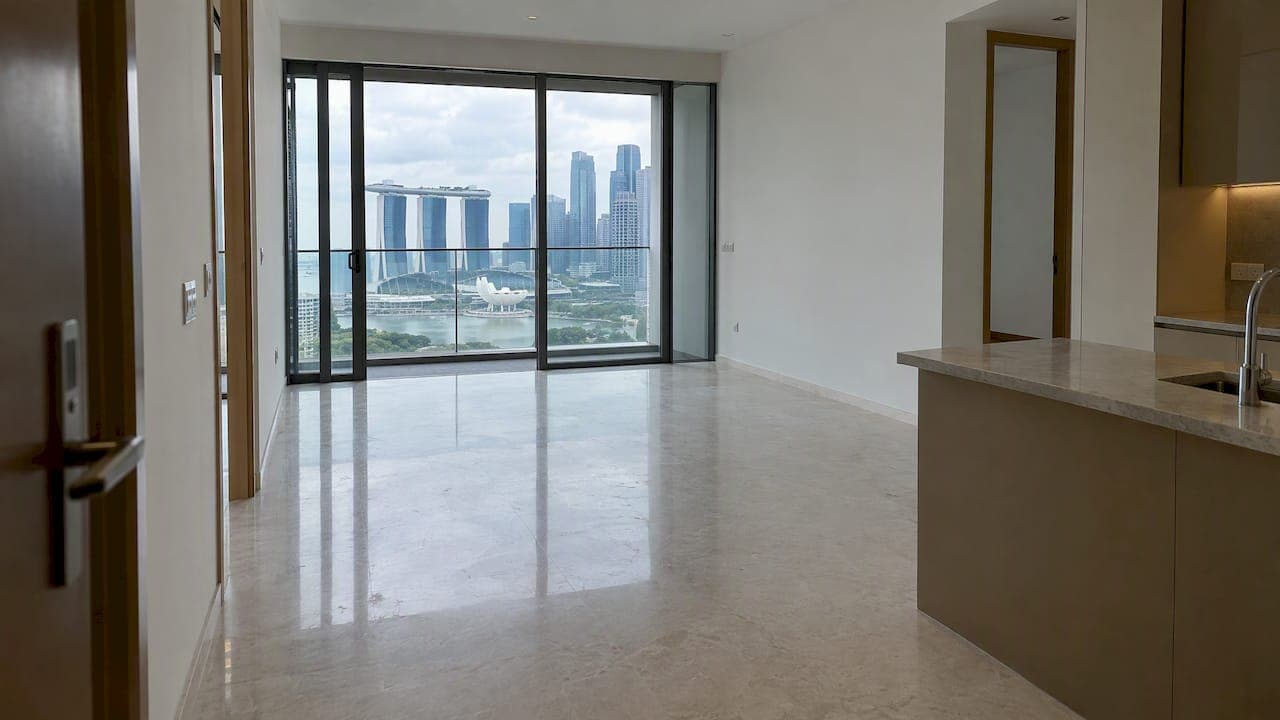
See what District 01 waterfront living looks like
We built One Marina Gardens around a District 01 waterfront address, 160 meters from Marina South MRT, with resort-caliber facilities including sky terraces and a childcare centre. If you want to run your own numbers on a real project, you can:
- Browse the unit types we offer, from 2 Bedroom to 4BR Premium
- Ask for current pricing and available units
- Book a showflat visit
View our unit types and request pricing

This article is general information, not a substitute for advice from a qualified financial advisor. Consult a qualified financial professional about your own circumstances before acting on anything here.
FAQ
What is considered a good rental yield in Singapore?
It depends on property type and whether you mean gross or net. Mass-market condos commonly net around 2% to 3% after costs, and luxury units often net less. Judge any figure against your mortgage rate and growth expectations.
Can I let my friend stay in my HDB for free?
Rules for HDB flats depend on occupancy and subletting conditions that HDB sets, so check HDB's official guidance for your exact case before arranging anything. A free stay generates no rental income, so no rental yield or rental tax calculation applies to that arrangement.
Is 3.5% a good rental yield?
As a gross yield, 3.5% is fairly typical for Singapore condos. As a net yield, it would be strong, since property tax, MCST fees, vacancy and agent commission usually pull the net figure well below gross. Always confirm which number is being quoted.
What is the difference between net yield and cash-on-cash return?
Net yield ignores the mortgage and divides income after costs by the purchase price. Cash-on-cash return includes loan payments and divides the resulting cash flow by the cash you actually invested, so it shows the real return on a leveraged purchase.
Sources
- Release of 2nd Quarter 2026 real estate statistics | Urban Redevelopment Authority (URA)
- Simplification of claim of rental expenses for individuals_2026_01_30
- IRAS | Income from property rented out
- Iras