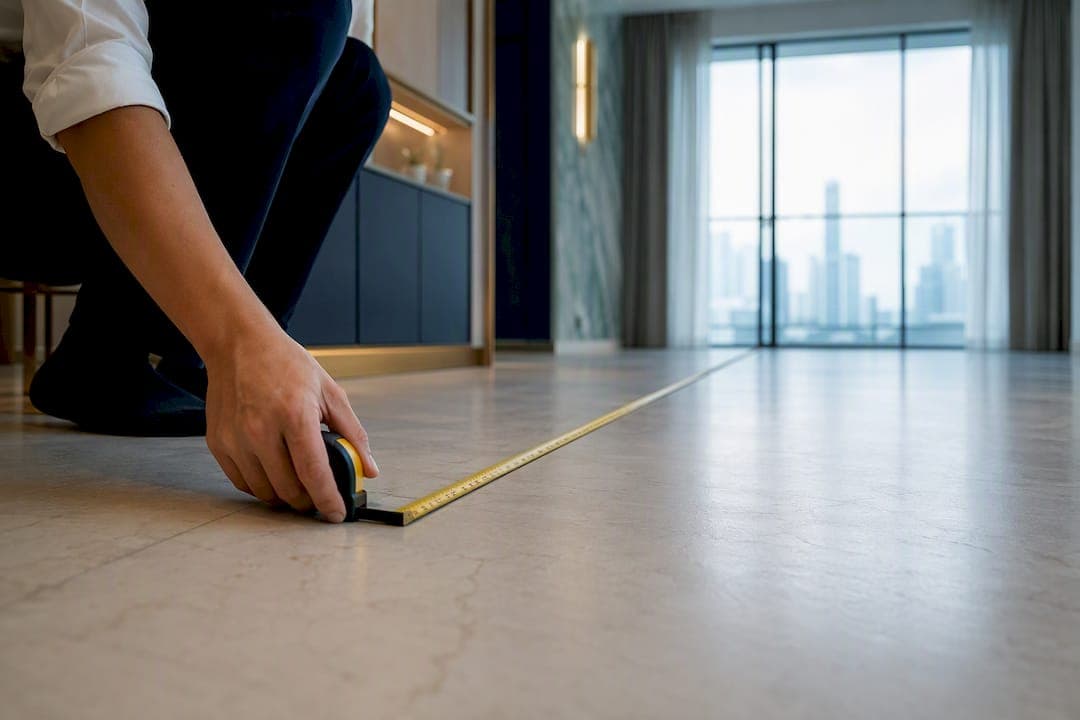
PSF is price per square foot: the sale price divided by the property's floor area in square feet. It's the fastest way to compare two units on a like-for-like basis, but it tells you nothing about whether you can actually afford the place. In Singapore, always check which area measure a listing used before trusting the number, and treat quantum, the total price, as the figure that actually decides your loan and your stamp duty.
TL;DR:
- Comparing PSF figures can be misleading if the area basis, such as strata, GFA, or net internal space, is not clarified and matched when evaluating different listings.
- The PSF calculation varies significantly depending on whether it uses gross floor area, strata area, or net internal area, with differences upwards of 20 percent in some cases.
- Listings often round PSF figures, which can compound confusion; always ask for raw sale prices and area measurements to verify the actual price per square foot.
- PSF is useful for quick comparison in the same project but can be misleading across different unit types or age of developments, where layout efficiency and finishes differ.
- The key for buyers is to focus on quantum for financing and stamp duty decisions, while using PSF only as an initial benchmark after confirming area basis.
Table of Contents
- What PSF means in Singapore property listings
- How to calculate PSF: formula and a worked Singapore example
- Which area figure to use, and why it changes everything
- PSF vs quantum: what each tells you and which one matters for loans
- How to compare PSF across projects using URA transaction data
- Quick checklist buyers should follow when using PSF
- How Onemarinagardens presents PSF for buyers to verify
- The one number buyers fixate on that they shouldn't
- Sources
- FAQ
What PSF means in Singapore property listings
Walk into any showflat or scroll through any resale listing in Singapore and PSF sits right next to the headline price, usually in bold. Agents lean on it hard because it lets a buyer size up a $1.2 million one-bedder against a $2.4 million three-bedder in seconds, at least on paper. New launch brochures often print PSF larger than the actual quantum, because a $2,100 psf figure sounds more digestible than a $2.1 million price tag.
You'll run into PSF in a few recurring contexts:
- Resale listings: portals show PSF calculated off the strata area stated in the caveat lodged with URA.
- New launch brochures: developers calculate PSF off the unit's floor area as declared in the sale and purchase agreement, which may or may not match what a resale agent later uses for comparison.
- Agent marketing decks: PSF gets used to argue a unit is "underpriced" relative to a neighboring project, often without stating whether both figures use the same area basis.
Here's the part that trips up a lot of buyers: not every listing tells you whether the PSF was calculated on gross floor area, strata area, or something narrower. Two listings showing $2,000 psf can represent very different amounts of usable space. If a listing doesn't state the area basis, ask the agent directly before you compare it to anything else.
How to calculate PSF: formula and a worked Singapore example
The formula is simple:
PSF = Sale Price ÷ Floor Area (in square feet)
The area you plug into that denominator changes the answer more than most buyers expect, which is why confirming the area type matters as much as the arithmetic itself.
Here's a worked example using realistic numbers for a District 1 new launch condo:
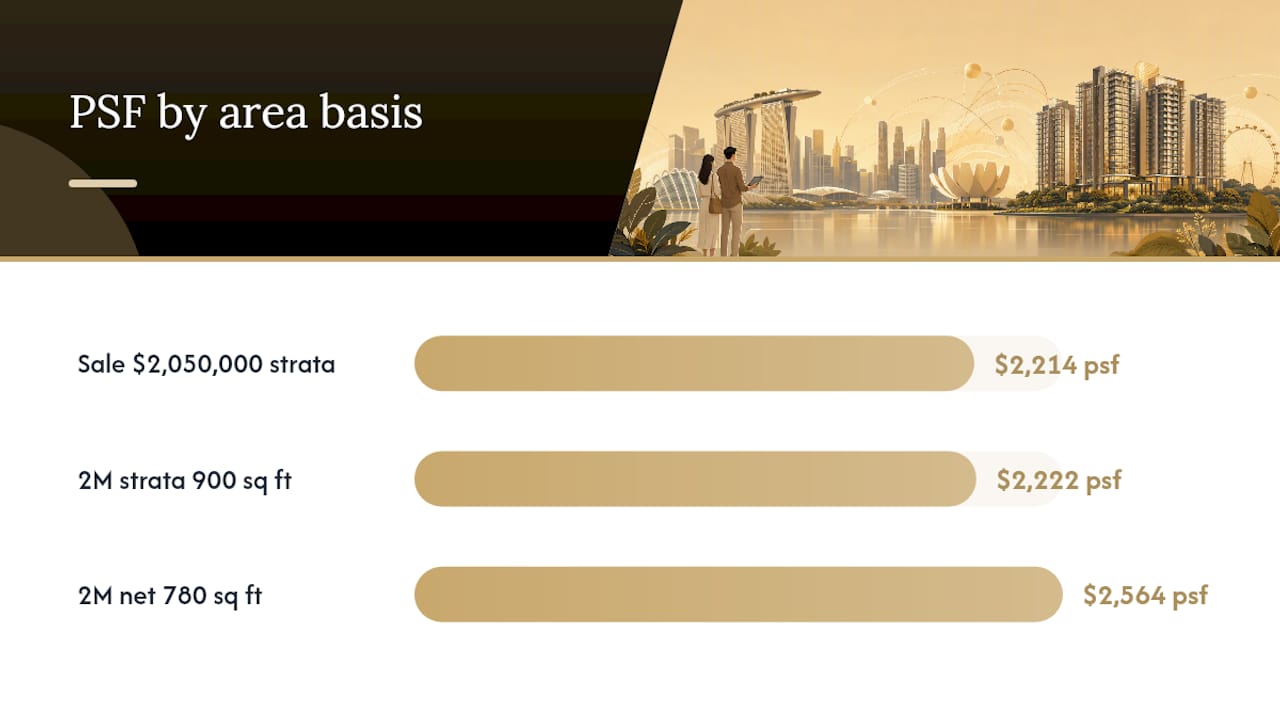
- Sale price: $2,050,000 for a two-bedroom unit
- Strata area: 926 sq ft (as stated in the unit schedule)
- Calculation: $2,050,000 ÷ 926 sq ft = $2,214 psf
- Cross-check: if the same unit is later resold using a net internal area of 810 sq ft (excluding the air-con ledge and balcony), the PSF on that narrower basis jumps to roughly $2,531 psf, even though the price never changed
Nothing about the unit changed. Only the math did.
Quick math check: A $2 million unit at 900 sq ft strata area works out to about $2,222 psf. Drop the area to 780 sq ft net internal area and the same $2 million purchase reads as roughly $2,564 psf. Same price, same unit, a swing of more than $300 psf depending on which area you use.
Listings typically round PSF to the nearest dollar, and some round to the nearest $10 for cleaner marketing. That rounding rarely matters much on its own, but it compounds the confusion when you're already unsure which area basis produced the figure in the first place. When in doubt, ask for the raw sale price and raw area, then run the calculation yourself.
Which area figure to use, and why it changes everything
Singapore property listings draw on several distinct area definitions, and mixing them up is the single most common way PSF comparisons go wrong.
- Gross Floor Area (GFA): the total area a developer is permitted to build under URA planning rules, including common areas in some contexts. This is a planning metric, not a per-unit sales figure, but it shapes how developers price a project overall.
- Strata area: the area registered on the unit's title, and the figure most resale listings and caveats use for PSF. It typically includes the unit's air-con ledge and any private enclosed space (PES).
- Net internal area: the actual livable, walkable interior space, excluding balconies, ledges, and other semi-outdoor elements. This is closer to what you actually experience day to day.
- Private enclosed space (PES) and air-con ledge: semi-outdoor or utility areas often bundled into strata area, sometimes contributing meaningfully to the headline square footage without adding livable room.
The gap between strata area and net internal area isn't trivial. A 1,000 sq ft strata area can translate to roughly 15% to 20% less net internal living space depending on layout, which means the PSF you see quoted might be measuring a unit that feels noticeably smaller inside than the number suggests. URA's own circular DC22-09 clarified how certain elements like air-con ledges and PES are treated for GFA purposes, and that kind of regulatory adjustment can shift how newer projects report area compared to older ones, even when the underlying design is similar.
Pro Tip: Before comparing two PSF figures, ask both agents for the raw area breakdown, not just the headline number. If one quotes strata area and the other quotes net internal area, you're not actually comparing the same thing.
PSF vs quantum: what each tells you and which one matters for loans
PSF standardizes price per square foot. Quantum, the total price you're paying, is what your bank uses to size your loan, what IRAS and Buyer's Stamp Duty calculations are based on, and what determines your actual CPF and cash outlay. PSF vs quantum isn't a matter of one being more "correct." They answer different questions, and conflating them is where affordability planning goes wrong.
PSF works well when:
- You're comparing two units in the same project, similar floor, similar stack, similar size.
- You want a quick gut check on whether a new launch price sits in line with recent transactions nearby.
PSF misleads you when:
- You're comparing a compact one-bedder against a larger three-bedder. Smaller units almost always carry higher PSF because fixed costs (kitchen, bathroom fittings) get spread over less area.
- You're comparing a brand-new launch to a resale unit from a decade-old development, where layout efficiency and finishes differ substantially.
Here's a concrete case: Unit A is 500 sq ft at $2,400 psf, working out to $1.2 million. Unit B is 900 sq ft at $2,100 psf, working out to $1.89 million. Unit A has the "worse" PSF, but Unit B's quantum drives a materially larger loan, a higher Buyer's Stamp Duty bill, and a bigger monthly mortgage. If you're a foreigner factoring in Additional Buyer's Stamp Duty on top, that quantum gap matters even more, and it's worth reviewing how ABSD applies to foreign buyers before you fixate on the PSF headline.
How to compare PSF across projects using URA transaction data
Skip the marketing decks and go to the source by using property submission and search tools to access comprehensive Singapore transaction records. URA's transaction data publishes actual caveats lodged for private property sales across Singapore, and it's the closest thing to an unbiased PSF benchmark you'll find.
Here's how to use it properly:
- Filter by unit type and size band: comparing a 2-bedroom to a 2-bedroom, not lumping all unit types into one average.
- Match floor band and facing where possible: a high-floor unit with a Marina Bay view will always command a premium PSF over a low-floor unit facing a service road, and that's not the project mispricing itself, it's the market working correctly.
- Pull a median, not a single transaction: one outlier sale, often a developer's early-bird promotional unit, can skew your read of a project's true price level.
- Check the transaction date: PSF trends move over quarters, and Singapore's broader market trends shift with interest rates and cooling measure updates.
One caveat URA itself flags: GFA harmonization under circular DC22-09 means newer developments may report area differently than older stock, so a straight PSF comparison between a 2015 launch and a 2026 launch needs an asterisk. Use the median PSF for a district or MRT catchment rather than anchoring on any single listing, and treat any figure that looks unusually low or high relative to that median as a signal to dig into why, not a bargain to jump on.
Quick checklist buyers should follow when using PSF
Bring this list to your next showflat visit or resale viewing:
- Confirm whether the quoted PSF uses strata area, GFA, or net internal area.
- Ask for the unit's net internal area separately if only strata area is shown.
- Calculate your own PSF from the raw sale price and area rather than trusting a rounded headline figure.
- Compare quantum, not just PSF, against your loan eligibility and monthly repayment capacity.
- Factor in condo maintenance fees, which PSF never captures and can vary widely between projects.
- Review the floor plan for layout efficiency: check bedroom widths, circulation space, and how much of the area is balcony or ledge.
- Pull recent comparable transactions from URA and cross-check them against what the agent quotes you.
- Ask about the project's age and any upcoming major repairs, since a lower PSF on an older unit can hide renovation costs down the line.
Pro Tip: Ask your agent for three recent comparable transactions with dates and areas stated, then verify each one on URA's own data before you use them to justify an offer.
How Onemarinagardens presents PSF for buyers to verify
Onemarinagardens sits roughly 160 meters from Marina South MRT, with direct access into the CBD and Orchard Road corridor, and the unit mix runs from 1-bedroom to 4-bedroom layouts across 937 units. Facilities like the multiple sky terraces, the 50-metre lap pool, and the on-site childcare centre are part of what justifies a premium positioning within District 1's PSF range, alongside the connectivity that comes with being steps from a train line.
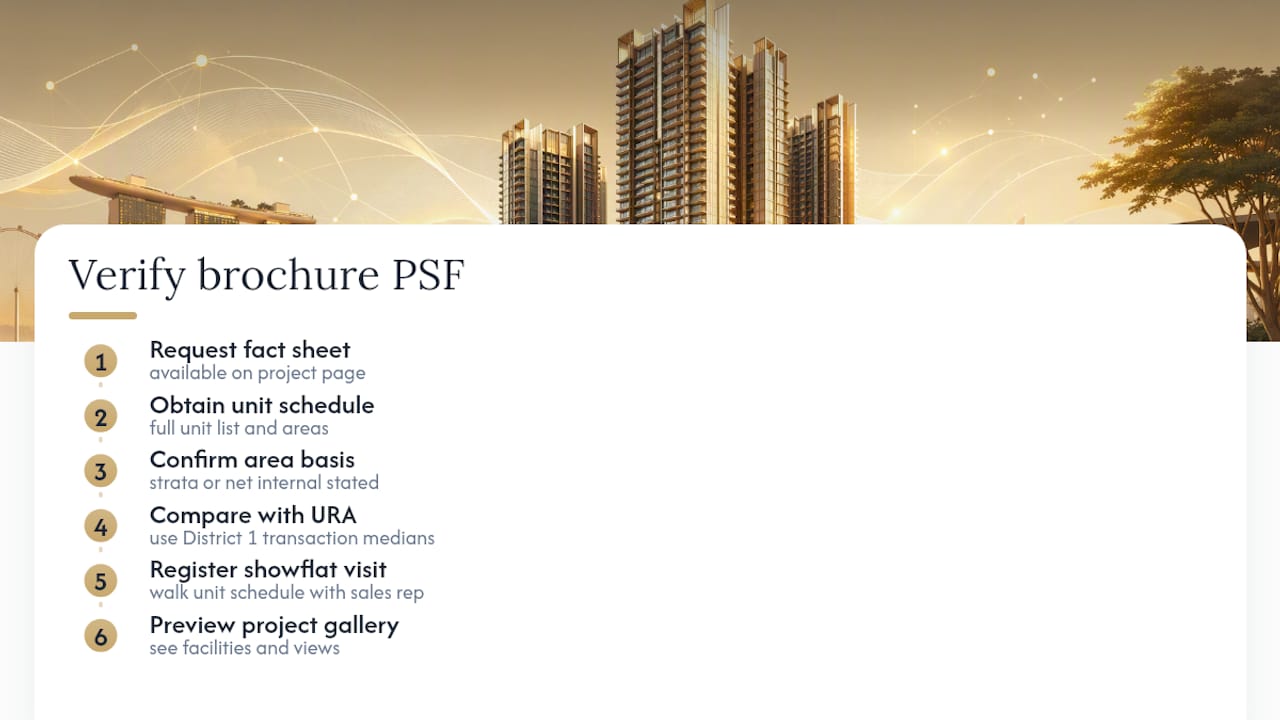
Before treating any brochure PSF as gospel, request the project's fact sheet, the full unit schedule, and a clear note on which area basis, strata or net internal, was used to calculate the published figures. A fact sheet is available on Onemarinagardens' project page for exactly this kind of reconciliation. Then check that headline number against URA's own transaction medians for District 1 rather than relying on the brochure figure alone. If you're ready to see how the layouts and area figures line up in person, registering interest for a showflat visit lets you walk the actual unit schedule with a member of the sales team, and the project gallery gives a preview of the facilities and views before you book.
The one number buyers fixate on that they shouldn't
PSF gets treated like a verdict when it's really just a starting question. The real work starts once you ask which area basis produced it, and whether the unit you're comparing it to even belongs in the same conversation. A one-bedder and a four-bedder in the same building will almost never carry the same PSF, and that's not a red flag, it's just how fixed costs like kitchens and bathrooms get spread across floor area.
What I'd tell any buyer walking into a showflat this year: compute your own PSF from the raw numbers, pull URA's transaction medians for the district before you negotiate, and bring your checklist rather than your gut feeling. Quantum decides what you can borrow and what stamp duty you'll pay. PSF just helps you sort the noise before you get there. Do both, and you'll walk into a negotiation with a number nobody can talk you out of.
— Velisa
This article is general information, not a substitute for advice from a qualified financial advisor. Consult a qualified financial professional about your own circumstances before acting on anything here.
Sources
- PSF (Per Square Foot) - Singapore
- PSF vs Quantum: Are We Looking at the Wrong Number When Buying a Home?
FAQ
What does PSF mean?
PSF stands for price per square foot, calculated by dividing a property's sale price by its floor area in square feet, and it's used across Singapore property listings to standardize comparisons between units.
What does PSF mean in business?
Outside real estate, PSF can also stand for terms like "profit and sales figures" in some business contexts, but in Singapore property, it exclusively refers to price per square foot when discussing listings, transactions, or valuations.
What is a PSF value?
A PSF value is the dollar amount you get when you divide a unit's sale price by its area in square feet, and the exact figure depends heavily on whether that area is measured as strata area, gross floor area, or net internal area.
How do I check the annual value of my property?
Annual value is a separate figure from PSF, set by IRAS for property tax purposes based on estimated market rental, and you can check it through IRAS's own property tax portal rather than through any PSF calculation.