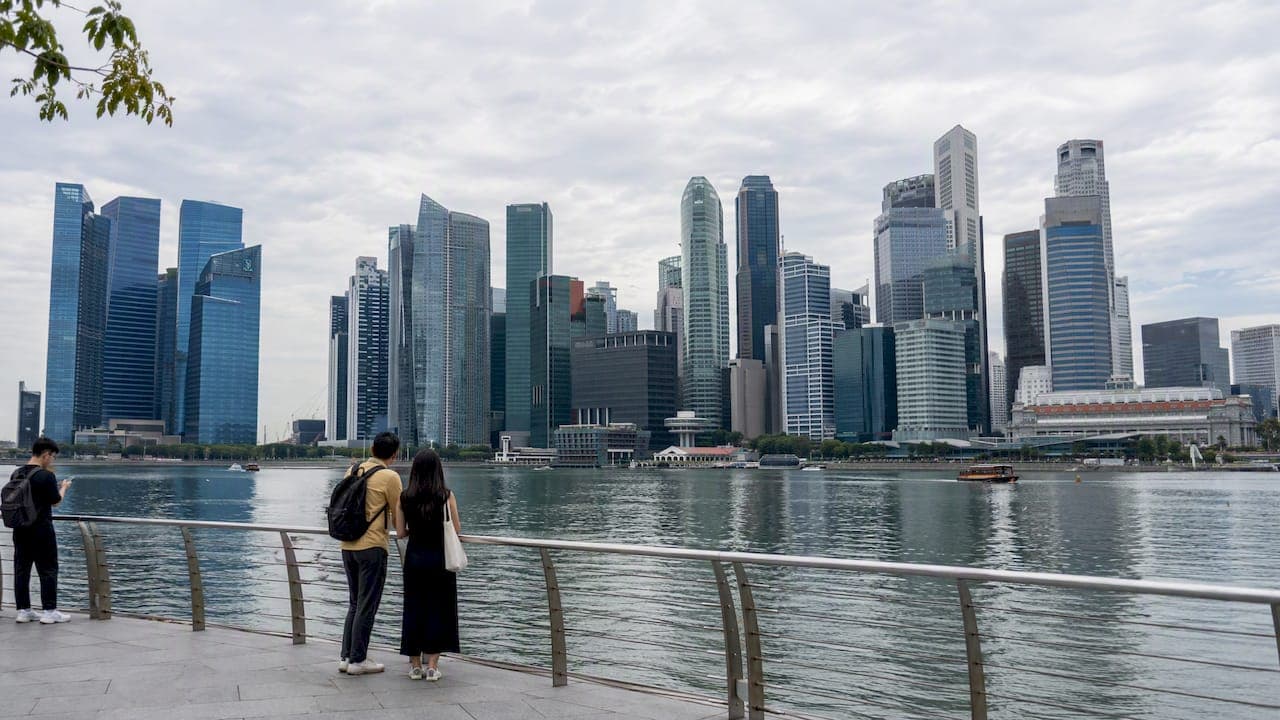
District 1 (D1) covers Raffles Place, Cecil, Marina and People's Park. District 2 (D2) covers Anson and Tanjong Pagar. They sit side by side in the Central Business District, and both are prime addresses. D1 gives you the bayfront, newer master-planned precincts and a more open, waterfront feel. D2 gives you a denser, older, more walkable neighborhood of shophouses, cafes and offices. If you want skyline and water views, large new-build developments and room for family facilities, D1 usually fits better. If you want a lived-in urban texture on your doorstep, D2 is the one to look at.
This guide compares the two districts the way a buyer actually weighs them: geography, price bands, lifestyle, daily commute, supply and investment logic. It is written for owner-occupiers and investors considering a new-build condo in the city core.
TL;DR
- D1 takes in Raffles Place, Cecil, Marina and People's Park. D2 takes in Anson and Tanjong Pagar. Both are in the city core.
- Condo price bands in the two districts overlap, so price alone rarely decides it. One published guide lists roughly $3 million to $5 million for D1 condos and $3 million to $6 million for D2.
- D1 suits buyers who want bay views, new developments with resort-style facilities and a quieter residential feel after office hours. D2 suits buyers who want heritage streets and a dense food scene.
- For investors, the better question is unit type, entry price per square foot and tenant demand, not the district number alone.
- Our own project, One Marina Gardens, is a D01 condo 160 meters from Marina South MRT. Details are in the section on what D1 offers.
Table of Contents
- What D1 and D2 actually mean
- Location and surroundings
- Price: what the numbers do and do not tell you
- Daily life: commute, schools, food and quiet
- Investment: reading D1 and D2 honestly
- Which district for which buyer
- Our perspective: why we think D1 deserves the first look
- A closer look at One Marina Gardens
- A short checklist before you decide
- FAQ
- Sources
What D1 and D2 actually mean
Singapore divides its postal codes into 28 districts. A district is simply a group of postal sectors, the first two digits of a six-digit postal code. Property listings, transaction records and market reports all use these district numbers, which is why buyers searching "D1 vs D2" are usually trying to compare two address zones rather than two formal planning areas.
The two districts are neighbors:
| District 1 | District 2 | |
|---|---|---|
| Areas | Raffles Place, Cecil, Marina, People's Park | Anson, Tanjong Pagar |
| Character | Bayfront, financial core, newer precincts | Shophouses, offices, older city fabric |
| Typical condo price band | $3 million to $5 million | $3 million to $6 million |
The area names and price ranges in the table come from a district-by-district guide published by Home & Decor. Treat the ranges as a rough orientation: the guide is not dated to this month, and new launches in either district can sit well outside them. Always check recent transactions before you set a budget.
One practical point: a postal district is not the same as a planning zone. The Urban Redevelopment Authority (URA) sets land use, height and intensity for each parcel through its Master Plan and Development Guide Plans, and the REALIS data dictionary describes a Development Guide Plan as a detailed plan specifying land use zoning, height and development intensity. Two projects in the same district can face very different rules on what may be built next to them. That is why we always tell buyers to read the zoning around a site, not just its district label. Our guide to five URA Master Plan checks to do before bidding walks through the process.
Location and surroundings
D1: the bay, the towers and the new precincts
D1 is where Singapore's financial skyline and its waterfront meet. The Home & Decor guide lists Raffles Place, Marina Square, Suntec City, Marina Bay Sands and the Marina Bay Link Mall among its landmarks and amenities. For a resident, that means three things.
First, views. Sites near the bay can open onto the water and the skyline, which is rare in a city this compact.
Second, newness. The southern end of D1, around Marina South, is being built out as a mixed-use precinct, so you often buy into a development with retail, dining and childcare designed in from the start. We explain how the precinct is zoned in our piece on the Marina South precinct, URA rules and what they mean for buyers.
Third, a split personality. Raffles Place is a weekday office hub, while Marina and the bay areas feel more open and event-driven. Expect crowds near the big attractions on weekends and a calm residential mood in the new precinct blocks.
D2: Tanjong Pagar and Anson
D2 is smaller and more compact. Tanjong Pagar and Anson combine office towers on Shenton Way and Anson Road with older streets of low-rise shophouses, many converted to restaurants, bars and offices. If you imagine walking down for coffee, then a late dinner, then back up to your apartment, D2 is built for that rhythm.

The trade-off is that you buy into an existing urban grain. Plots are tighter, buildings are closer together and the large landscaped podiums or long lap pools typical of big new projects are harder to fit. Views are often of other buildings, although higher floors can look out to the harbor or skyline depending on the site.
Price: what the numbers do and do not tell you
The single most common mistake in a D1 vs D2 comparison is to treat the district as a price tag. The published ranges above overlap heavily, with D2 listed up to a higher ceiling for condos. The reasons are practical:
- Price follows the individual project: age, tenure, size of the development, facilities, floor level, view and unit size.
- A new launch is priced against current land costs. An older freehold or 99-year resale is priced against its own history and remaining lease.
- Small units and large units behave differently. A compact one-bedroom can look cheap per unit but expensive per square foot.
So compare per square foot (psf) and total price together, and compare like with like: new sale against new sale, resale against resale. Our article on why distance to the CBD shapes land price explains why proximity to the business core is capitalized into land costs, and why both districts carry that premium.
A worked example of the method, using made-up numbers for illustration only: Project A has an 800 sq ft two-bedroom at $2.4 million. Project B has a 700 sq ft two-bedroom at $2.2 million. Project B looks cheaper, but at roughly $3,143 psf against $3,000 psf for Project A, it is the more expensive of the two per square foot. Always divide before you decide.
If you are comparing specific unit types in our development, the units page lists the 2 Bedroom, 3 Bedroom, 3BR Premium and 4BR Premium layouts. For current pricing, our team shares the latest figures on request.
Daily life: commute, schools, food and quiet
Commute
Both districts put you within minutes of the CBD, which is the main reason people pay city-core prices. The question is which MRT line and station you will actually use. Check the walking distance from your door to the station, door to door and sheltered, because a station that is 160 meters away and one that is 900 meters away are very different on a rainy morning.
One Marina Gardens is 160 meters from Marina South MRT, which gives residents a direct link toward the CBD and Orchard Road. For D2 projects, check which of the Tanjong Pagar-area stations is nearest the specific address, as the district is not uniformly close to them.
Families
Families should look at what is inside the project as much as around it. A childcare centre on site means a short walk instead of a school-run drive. One Marina Gardens has a dedicated childcare centre, and our buyer and investor guide to condos with childcare facilities covers what to ask about operator, capacity and fees. Large, newer D1 developments are more likely to include this kind of facility than a small D2 boutique block.
Food and nightlife
D2 wins for sheer density of independent restaurants and bars on the street. D1 has more destination dining, waterfront venues and mall-based options. In the new Marina South precinct, on-site retail and a restaurant in the development itself shorten the trip for everyday needs.
Noise and privacy
Dense shophouse streets can be loud on weekend nights. Bayfront areas can have event noise on specific dates. Visit at night and on a weekend, standing at the unit's orientation if you can, before you commit.
Investment: reading D1 and D2 honestly
Buying property is a major financial decision, and nobody can promise a return. Rents, prices, financing rules and government cooling measures change. Before you buy for investment, review current stamp duty and loan rules on the Inland Revenue Authority of Singapore and Monetary Authority of Singapore websites, and speak with a licensed financial adviser or your bank about your own situation.
With that said, here is the framework we use when weighing the two districts.
- Tenant pool. Both districts draw executives and professionals working in the CBD. A project's walk to the MRT and the office towers matters more than the district number.
- Entry price. Lower psf does not mean higher yield if the rent is also lower. Compare expected rent against purchase price for the specific unit type.
- Supply. A large development with hundreds of units can create competing listings when owners rent out at the same time. A small boutique block has fewer neighbors competing for the same tenant. Check what else is being built nearby.
- Holding period. Prime central assets tend to reward patience rather than quick flips, and transaction costs and holding-period rules punish short-term trading. Our analysis of why a five to ten year hold beats flipping in District 1 sets out that case, and the broader question of whether District 1 is a good investment looks at the risks as well.
- Asset type. Some prime D1 projects are better seen as trophy assets than yield plays. Our article on District 1 condos for investors draws that line clearly.
Which district for which buyer
| If you are... | Lean toward | Why |
|---|---|---|
| A young professional who wants modern city living | D1 or D2 | D1 for new facilities and views, D2 for street life |
| A family needing space and facilities | D1 | Larger developments, on-site childcare and pools are more common |
| An investor seeking a long-term prime hold | D1 | Waterfront, new-build, central location, subject to your own due diligence |
| A buyer who loves heritage and walkable streets | D2 | Shophouse neighborhoods and independent dining |
| A retiree wanting city amenities nearby | Either | Prioritize MRT access, lifts, healthcare access and a quiet block |
If you are a current HDB owner thinking about this move, the step up is a financial plan before it is a district choice. Our 2026 guide to upgrading from HDB to a condo covers the sequence.
Our perspective: why we think D1 deserves the first look
We sell homes in D1, so we will say plainly where we stand, and where we think D2 is the better answer.
What convinces us about the Marina South end of D1 is the combination of things a buyer rarely gets in one address: bay and skyline views, a station 160 meters from the entrance, and a project big enough to carry real facilities. One Marina Gardens has 937 units developed by Kingsford Marina Development, with multiple sky terraces, a 50-meter lap pool and a dedicated childcare centre, inside a mixed-use setting with retail and a restaurant on site. A small block on a shophouse street cannot offer a lap pool of that length, because the land is not there.
What we would tell a buyer is to separate lifestyle from investment. If your weekends are about walking out into old streets and finding a new place to eat, D2 may make you happier than any facility list. If you want space, a family-friendly setup and a long-term prime asset, D1 is where we would send you first.
And whichever district you choose, read the zoning around the site, walk the route to the station, visit at night, and compare psf against recent transactions. A district number does not do those jobs for you.
— Velisa
A closer look at One Marina Gardens
If the D1 profile fits what you want, One Marina Gardens offers 2 Bedroom, 3 Bedroom, 3BR Premium and 4BR Premium homes, with sky terraces, a 50-meter lap pool, a childcare centre, retail shops and a restaurant, all connected to Marina South MRT. See the layouts on our units page, check the 2026 price list, or start from the One Marina Gardens home page to book a showflat visit with the developer's sales team.
If you are also weighing us against another new-build in the same district, our side-by-side comparison of two D01 condos sets out the criteria that matter.
A short checklist before you decide
- Set a total budget and a psf ceiling, then compare only like-for-like projects.
- Measure the real walking route to the nearest MRT station.
- Read the URA zoning for the plots around each shortlisted site. Our three-step unit selection strategy covers how to combine that with unit-level checks.
- Visit each site on a weekday morning, a weekday evening and a weekend.
- Ask about remaining tenure, expected completion and the facilities list in writing.
- Get your financing position confirmed with a bank before you book a unit.
FAQ
What is the difference between D1 and D2 in Singapore?
D1 and D2 are postal districts. D1 covers Raffles Place, Cecil, Marina and People's Park, while D2 covers Anson and Tanjong Pagar. Both are in the central business area, but D1 has the bayfront and newer precincts, and D2 has more shophouse streets and a denser neighborhood feel.
Is D1 more expensive than D2?
Not necessarily. Published district guides show overlapping condo ranges, with D2 listed up to a higher ceiling. The price of a given home depends on the project, tenure, size, view and floor, so compare psf for specific projects rather than relying on the district.
Which district is better for families?
Families often favor D1 developments because large projects can include childcare, long pools and landscaped spaces on site. D2 can work well if you value walkable streets, but check school access, facilities and noise at the specific address.
Is D1 or D2 better for investment?
Neither wins by default. Yield and appreciation depend on your entry price, the unit type, the tenant demand near the MRT, nearby supply and how long you hold. Speak to a licensed financial adviser about your own situation before you buy.
Sources
- Singapore District Map: Your ultimate guide to all 28 districts, Home & Decor
- Data Dictionary, URA REALIS